PART 1
Valeria Montes's divorce was officially signed at 10:17 in the morning, in a family court in Mexico City. As her ex-husband, Rodrigo Alcázar, walked out with two lawyers and without so much as a glance in her direction, she felt something strange: not sadness, but relief.
Five years earlier, Valeria had believed that marrying Rodrigo meant entering an elegant and respected family. Over time, she understood that, for the Alcázars, she wasn't a wife. She was a bank account with good manners.
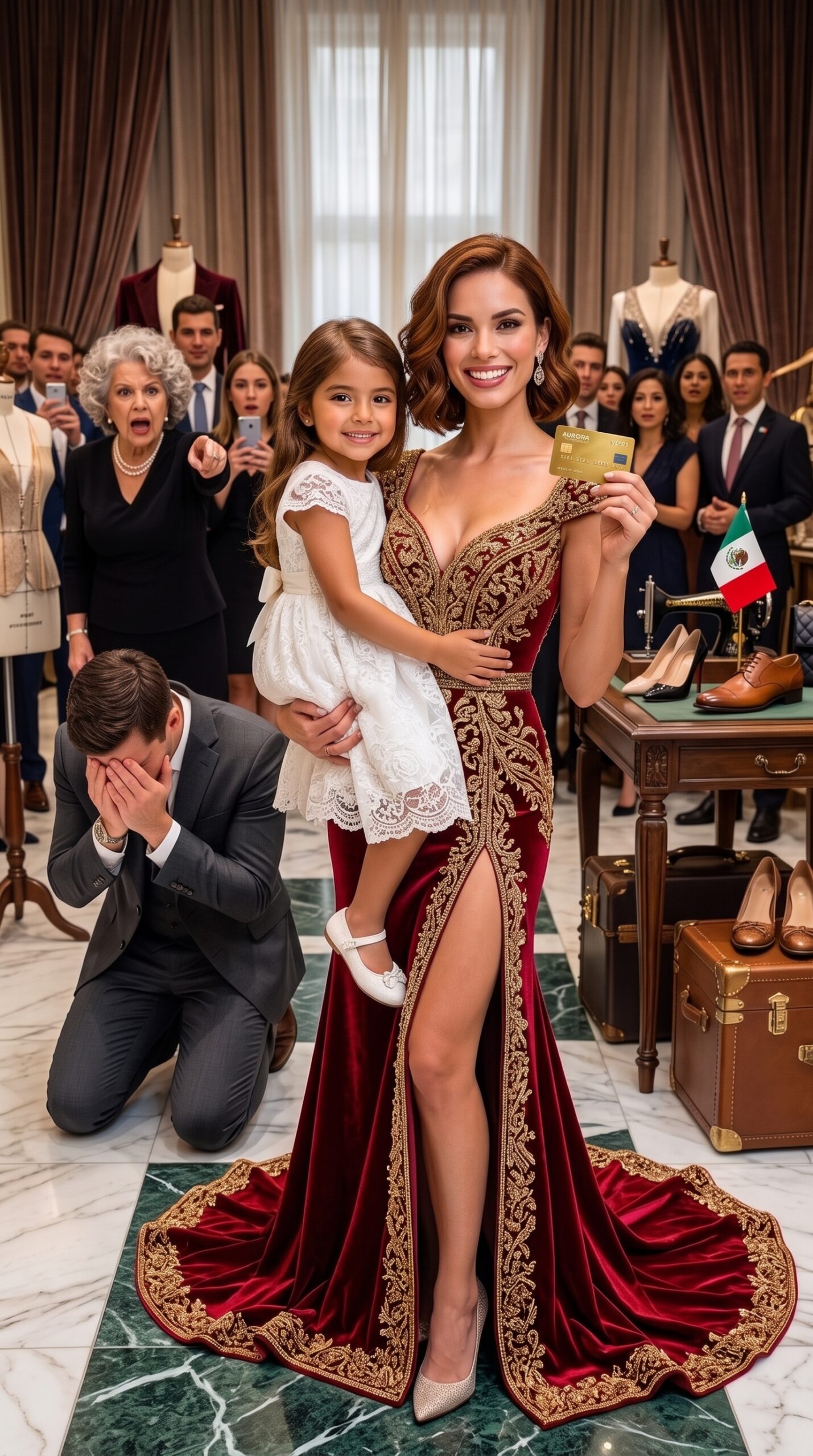
Her ex-mother-in-law, Doña Beatriz, used an additional card linked to Valeria's accounts as if it were a bloodright. Designer bags, spa treatments in Los Cabos, luxury flights, dinners in Polanco, and jewelry she called "family tradition."
Valeria never complained. Every time she tried, Rodrigo told her not to be "common," that in his family, money was not discussed. Curiously, it was always her money that no one could question.
That morning, back at her apartment in Santa Fe, she opened her computer and removed Beatriz from all her accounts. She canceled cards, access, and authorizations. Then she brewed coffee and breathed like someone who had just walked out of a room with no windows.
At 9:40 in the evening, Rodrigo called from another number.
—What did you do, Valeria? —he shouted—. My mom was humiliated in front of the entire board.
Beatriz had bid 900,000 pesos for a necklace at a charity auction. When she tried to pay, the card was declined in front of businesspeople, politicians, and photographers.
—Then she should have used her own card —Valeria replied.
Rodrigo fell silent. Then he spoke in that low voice he used to intimidate her without raising suspicions.
—Don't start a war you can't finish.
Valeria set her cup down on the counter.
—The war ended today. What ended was her access.
She hung up, blocked the number, and slept better than she had in months.
Until 6:39 in the morning.
A metallic noise woke her up. It wasn't the doorbell or the cleaning staff. It was a drill tearing through the lock of her door.
Valeria opened her security app. Rodrigo was outside, impeccable in a blue suit. Beside him, Beatriz wore dark glasses, a white coat, and the furious expression of someone who still believed she owned everything.
A locksmith was working on his knees.
—Open it —Rodrigo ordered—. My ex-wife is unstable. She could hurt herself.
What Rodrigo didn't know was that Valeria was already awake, dressed, and connected to a video call with the eight members of the board of Horizonte Capital, where she was a financial partner.
She turned the camera to the hallway and left the meeting recording.
The lock gave way.
Rodrigo entered with Beatriz behind him, as if the divorce hadn't changed anything. Then he saw the computer, the faces of the board on the screen, and the red recording light.
—Valeria, this is a family matter —Beatriz said.
—No —she replied—. This is my home. And you are no longer my family.
Security arrived first. The police showed up later. Rodrigo was sweating as he invented explanations.
Valeria thought she had won that morning.
Until her lawyer called and said something that froze her blood:
—Rodrigo didn't come for the card, Valeria. He came for your computer.
PART 2
The lawyer, Jimena Robles, arrived at the apartment before 9:00. She didn't take off her blazer or accept coffee. She placed a folder on the table and looked at Valeria with a seriousness that made it impossible to think of a simple family dispute.
During the divorce process, Jimena had requested to review the accounts related to the Alcázar Foundation for Education, an organization that Beatriz bragged about in social magazines and gala dinners.
According to the family, the foundation provided full scholarships to young people from vulnerable communities. At every event, Beatriz spoke of responsibility, privilege, and the future while posing with students in front of cameras.
The reality was different.
—The fund received over 74 million pesos in six years —Jimena explained—. So far, we can only verify that less than 6 million went to educational programs.
Valeria felt the ground tilt beneath her.
The rest had ended up in private flights, renovations, jewelry, rentals of houses in Valle de Bravo, club memberships, and payments to non-existent companies. Several transfers were recorded as "financial consulting from Horizonte Capital."
In other words, they had used Valeria's name and the reputation of the company where she worked to wash the appearance of the expenses.
—Does my signature appear there? —she asked.
Jimena opened the folder.
—It appears many times. The problem is that several are not yours.
Valeria looked toward the broken entrance. Rodrigo hadn't brought a locksmith to recover a canceled card. He had wanted to enter before anyone reviewed the computer and found the files with which they had constructed the lie.
A forensic team copied the hard drive. Soon, the "family" trips coincided with withdrawals, and Rodrigo's praises matched requests for passwords or signatures.
At 7:15 in the evening, the concierge called from reception.
A young woman named Marisol Vega wanted to see her.
Marisol was 24, had a worn backpack, and wet hair. Her face appeared on the foundation's page alongside Beatriz, presented as her greatest success story.
Marisol had received only 35,000 pesos, barely enough for one semester. After that, she was forced to pose at events and repeat that the foundation had funded her entire career.
—Once I corrected Doña Beatriz —she told—. She told me to stop being ungrateful and learn to accept help with elegance.
Then she pulled out a confidentiality agreement.
At the bottom was Valeria's signature.
It was a forgery.
—I thought you knew —Marisol said, almost in a whisper—. That's why I never dared to look for you.
The agreement threatened Marisol with a lawsuit for 3 million pesos if she spoke out.
—Why did you come today? —Valeria asked.
Marisol placed an unmarked envelope on the table. Inside was a yellow note with four words:
"Ask Valeria why."
The postmark was from an office near the foundation's headquarters.
Someone knew Marisol had been used. Someone wanted both women to meet.
Jimena asked if anyone else had contacted her.
Marisol hesitated before answering.
Months earlier, an older man approached her after a talk and said that the initial key to a corrupt foundation was often in the hands of the woman treated like a guest.
—Did he tell you his name? —Valeria asked.
—Yes. He said his name was Ernesto Montes.
Valeria stopped breathing.
Ernesto Montes was her father.
He had died eleven years ago.
The man knew Valeria's full name, Ernesto's old office, and details of the foundation. He could lie about his identity, but he knew too much.
When Marisol left under legal protection, Valeria entered her study and took down a wooden box she hadn't opened since her father's funeral.
Among letters and photographs was an accounting book. When she moved it, an envelope fell out with her name written by Ernesto.
Inside, she found a bank key, a receipt dated six months before her wedding, and a note:
"If the Alcázars ever make you doubt yourself, open box 19 before signing anything."
Valeria felt a knot in her throat.
Her father had suspected before the wedding. Perhaps she, in love, had confused prudence with prejudice.
The phone rang.
It was Jimena.
—The team found a hidden folder on your computer —she said—. It was created years ago and is protected by a system Rodrigo could never erase.
—Who created it?
There was silence.
—Your father.
The next morning, Valeria and Jimena went to the bank. Box 19 hadn't been opened in over five years.
Inside were contracts, emails, suppliers linked to Beatriz, an encrypted memory stick, and a letter.
Ernesto, an expert in financial compliance, had investigated the foundation when a ghost company of Beatriz's appeared in a case. He discovered that she was diverting donations and gathered evidence knowing that Valeria was dating Rodrigo.
But the story had an even more painful twist.
Ernesto hadn't died without finishing his investigation.
Months before he passed away, he delivered a copy of the files to an old colleague named Tomás Arriaga. Tomás was the man who had sought Marisol and used Ernesto's name to protect his identity.
Jimena managed to locate him that same afternoon.
Tomás explained that Ernesto had asked him to watch over Valeria and reveal the documents if the Alcázars attempted to use her as legal liability.
—Why did he wait so long? —Valeria asked, her voice breaking.
—Because your father believed that as long as you were married, any accusation could isolate you further —Tomás replied—. And because I was afraid. That cannot be justified.
Tomás delivered the final piece: an audio recording.
In it, Beatriz spoke with Rodrigo three months before the wedding.
—When she marries you, we'll have access to Horizonte and its clients —she said—. The girl is brilliant, but she needs to feel accepted. Make her believe this family is the best thing that has ever happened to her.
Rodrigo laughed.
—And what if she asks too many questions?
—Then make her doubt herself. Intelligent women also stay silent when they fear appearing conflictual.
Valeria listened to the recording twice. At first, she cried. When it ended, she played it again and stopped crying.
The wedding, the praises, and even the arguments had been a strategy. They hadn't chosen her for love, but for her connections and their need to belong.
Jimena sent the evidence to the prosecutor's office and financial authorities. Several accounts were frozen. Donors received formal notifications. Horizonte Capital opened an internal investigation and confirmed that Valeria had not authorized the operations.
Rodrigo attempted to negotiate.
At first, he apologized, then blamed his mother, and finally threatened to destroy Valeria's reputation. Every message was saved.
Beatriz left an audio filled with indignation:
—Families settle these things privately. You are destroying a legacy out of resentment.
Valeria kept it as evidence.
Three days later, Rodrigo requested a private meeting. Jimena rejected the request. The only conversation took place in the presence of lawyers and was recorded.
Rodrigo showed up without a tie, haggard, and much less elegant than usual.
—We can fix this —he said—. You know I never meant to hurt you.
Valeria watched him with a calm that unsettled him.
—You entered my home saying I was unstable. You forged my signature. You used my name to steal scholarships. What part of that didn’t intend to hurt me?
Rodrigo clenched his jaw.
—My mother pressured me.
—And you enjoyed the money.
He had no response.
The investigation revealed 23 ghost companies, 41 fake contracts, and dozens of young people used as propaganda. Marisol led the declarations, but soon other students appeared.
Some dropped out of college; others were left in debt and were forced to silence to avoid "damaging the cause."
The public downfall was swift.
Beatriz lost her position on three boards. Rodrigo was removed from family management. Photographs of both entering to testify circulated all over Mexico.
Valeria felt no joy.
She felt something deeper: the room inside her head, the one that had spun for years, finally stopped.
One afternoon, she returned to the apartment. The door had been repaired, and the new lock only recognized her fingerprint. On the table lay the canceled card that had started it all.
It seemed like an insignificant piece of plastic.
Yet, that small limit had toppled a lie that had persisted for years.
Marisol resumed her studies with a fund from the recovered donors. Tomás testified, and the diverted assets were secured.
Before putting away her father's letter, Valeria read the last line:
"Don't confuse good manners with good character. Money always ends up telling the truth."
Then she understood that her father hadn’t returned from the past to save her. He had left her tools so she could save herself when she was ready.
Rodrigo had repeated for years that she should be grateful the Alcázars accepted her.
Now she knew the truth.
They never accepted her.
They studied her, used her, and waited for her silence to protect the family image.
But as soon as Valeria closed the access, they all panicked.
Because there are people who call "love" the privileges they obtain from someone. They call "family" the control. They call "resentment" any limit that prevents them from continuing to abuse.
Valeria didn't have to destroy them.
She simply stopped protecting the elegant version they presented to the world.
And that was the hardest justice for them to bear: that the woman they made doubt herself kept every piece of evidence, changed the lock, and finally let the truth speak without asking for permission.





