PART 1
The afternoon Renata returned from the cemetery, she still had dirt stuck to her heels and her black dress smelled of wilted flowers.
She had buried her grandmother Amparo, the only person who had ever asked her to endure humiliation to 'keep the peace.'
But when she arrived home in Coyoacán, there was no silence of mourning.
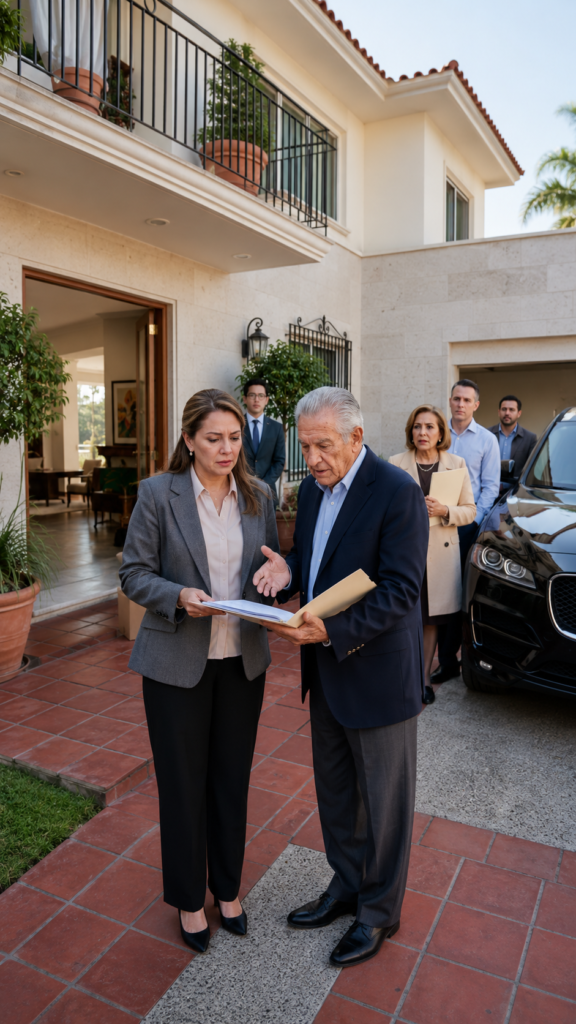
There stood her husband Ernesto at the gate, a folder under his arm, with her mother-in-law Consuelo beside him, dressed as if for Sunday mass.
"The house has been sold," Consuelo said, her calmness terrifying. "Sign the divorce and don’t make a scene."
Renata thought she must have heard wrong.
She looked at the cream-colored facade, the bougainvillea climbing the wall, the wooden bench where her grandmother would sit when she came to visit.
Everything was still there, but something felt dead.
"What did you say?"
Ernesto didn’t lift his gaze.
"Renata, please. It was for the best. There was no point in continuing to pretend."
She had just come from listening to a will she still didn’t fully understand.
Her grandmother had left her a modest fortune, several accounts, a piece of land in Valle de Bravo, and a folder with legal instructions.
Renata had cried in the car, thinking perhaps that money could save her 24-year marriage.
How foolish she felt in that moment.
Consuelo stepped forward.
"Your personal belongings are in a storage unit. The rest belongs to the sale. The buyers are on their way."
A coldness surged in Renata's chest.
It wasn’t just that they had thrown her out.
It was that they had planned it while she held her grandmother’s hand in the hospital.
"When did you sign that, Ernesto?"
He swallowed hard.
"Two days ago."
Two days ago, Renata had been in Santa Fe, watching Amparo’s breath grow fainter.
Ernesto had told her he couldn’t accompany her because he had an urgent meeting.
Now she understood the urgency.
In the entryway were boxes labeled with a black marker.
RENATA.
Not Mrs.
Not wife.
Not 24 years of shared life.
Just a name on cardboard.
Consuelo barely smiled.
"Accept things with dignity. My son has already wasted too much time with you."
Renata stared at her.
For years, Consuelo had treated her like an unwelcome guest in her own life.
"Renatita, how practical you are, you hardly seem to make an effort."
"Ernesto always preferred finer women."
"There are wives who inspire a home, and others who are just company."
And Ernesto always said the same:
"That’s just my mom; don’t take it personally."
But that day, it was personal.
It was her house, her mourning, her clothes in a storage unit, and a divorce set like a trap at the door.
Then a gray truck pulled up in front of the gate.
Two men got out.
One young, in a blue suit with a briefcase.
The other older, with white hair, a firm gaze, and an elegant cane.
Consuelo’s expression changed instantly.
"They’re the buyers. Behave yourself."
Ernesto adjusted his shirt.
"Good afternoon. I’m Ernesto Robles. We can complete the handover."
The older man didn’t respond.
He walked straight toward Renata.
"You must be Renata Salcedo."
She nodded, confused.
"I’m Álvaro Valdés, lawyer for doña Amparo. Your grandmother asked me to come if anyone tried to sell this property without her permission."
Consuelo lost her smile.
Ernesto froze.
Álvaro took out an ivory envelope, sealed with red wax.
On the front was Renata’s name, written in her grandmother’s hand.
"For my girl. Open it when you believe they’ve erased you."
Renata felt her legs weaken.
The young lawyer opened his briefcase and pulled out certified documents.
"Before handing over this house," Álvaro said, "it’s important to clarify that Mr. Ernesto never had full rights to sell it."
Ernesto paled.
"The house is in my name."
"Not exactly," Álvaro replied. "You were a conditional administrator, not a free owner."
Consuelo tightened her grip on her pearl necklace.
"That’s nonsense."
Álvaro stared at her unblinking.
"Ma’am, I suggest you listen. Because your signature is also on here."
Renata broke the seal.
Inside was a letter and an old photograph.
The photo fell to the ground.
Consuelo appeared young, sitting in that very room, signing a paper in front of grandmother Amparo.
Behind the photo, a phrase read:
"When Consuelo says she knew nothing, show her the day it all began."
PART 2
Silence fell over the gate like a bucket of cold water.
Consuelo was the first to react.
"That photo proves nothing."
But her voice no longer sounded like it usually did.
It had no edge.
It was filled with fear.
Renata lifted the photograph and held it in front of Ernesto.
"Did you know this?"
He shook his head, too quickly.
"I didn’t know anything about my mom and your grandmother. I swear."
Álvaro Valdés opened a thick folder on the truck’s hood.
Inside were certified copies, notary seals, acknowledgments of receipt, and a deed dated more than 30 years ago.
"This house was originally purchased by doña Amparo," he explained. "She allowed it to appear under the administration of the Robles family for a specific reason: to protect Renata when she married."
Consuelo let out a dry laugh.
"Protect her from what? We maintained her."
Renata slowly turned toward her.
"I worked 18 years in the accounting firm to pay off debts for your son."
Consuelo had no response.
Álvaro pulled out another sheet.
"Doña Amparo left a reversion clause. If the administrator attempted to sell, evict, mortgage, or use the property to pressure Renata during a separation or divorce, legal control would revert immediately to her."
Ernesto ran a hand over his face.
"But the buyer already paid the deposit."
"Then you have a bigger problem," the young lawyer said, "because you were notified of the restriction before signing the sale."
Renata felt something snap inside her.
Not over the house.
Over the confirmation.
"Did they warn you?"
Ernesto couldn’t meet her gaze.
Álvaro pointed to a document.
"Here’s the acknowledgment. 8:12 in the morning. Two days ago. Signature of Mr. Ernesto Robles."
Renata remembered that very morning.
She had called Ernesto from the hospital.
Her grandmother had just opened her eyes and said in a nearly hushed voice:
"Don’t sign anything when they see you sad."
Renata thought it was delirium.
Now she understood it was a warning.
Consuelo turned against her son.
"You told me that didn’t matter!"
There it was, the blow.
Not only did he know.
She did too.
Ernesto closed his eyes.
"Mom, shut up."
Renata let out a sad laugh.
"Look at that. 24 years asking me to understand your mom, and today you tell her to shut up because she just sunk you in front of everyone."
Consuelo clenched her jaw.
"That house was supposed to be my son’s. Amparo always wanted to control everything."
Álvaro took the old photograph.
"Doña Amparo didn’t control. She foresaw. And from what we're seeing, she was right."
The buyer, a businessman named Julián Arriaga, who had until then remained near the truck, spoke with irritation.
"I was assured that Mrs. Renata was already out of the property and accepting the divorce."
Renata looked at Ernesto.
He lowered his head.
"That’s what I was told," Julián continued. "They even showed me photos of the boxes."
The young lawyer added:
"We also have a record of the move. They entered at 9:47 a.m. without Renata’s authorization. They took furniture, personal documents, and items not included in any sale."
Renata’s eyes burned.
"Did they take my grandmother’s photos?"
Ernesto murmured:
"I don’t know."
"Of course you don’t know," she said. "You never knew where I kept my pain. You only knew where to leave your guilt."
Álvaro handed her Amparo’s letter.
Renata opened it with trembling hands.
"My Renata: if you’re reading this, it means they tried to take you out when you were most vulnerable. Don’t argue. Don’t beg. Don’t explain. The people who want you out will always call a scandal your defense."
Renata cried, but she didn’t lower her face.
She kept reading.
"Consuelo signed a waiver of rights years ago after trying to claim this house with lies. I let her believe I forgot. I didn’t forget. I only waited."
Consuelo took a step back.
Ernesto looked at her as if suddenly seeing a stranger.
"What did you do, Mom?"
She clutched her purse to her chest.
"I just wanted to secure my son’s future."
Álvaro pulled out another document.
"No. You wanted to appropriate a property you knew was conditional. And now there’s possible fraud, marital pressure, and improper disposition of assets."
Consuelo completely lost her composure.
"She doesn’t deserve to keep everything! She didn’t even have children!"
The comment was so cruel that even Ernesto looked up.
Renata stood frozen.
For years, Consuelo had used that wound with gloves.
Never head-on.
Never like this.
Renata had lost two pregnancies.
Ernesto knew that.
The second time, he didn’t enter the hospital room because Consuelo told him those things "were for women."
Renata took a deep breath.
"I didn’t have children, Consuelo. But I had dignity. And you sold that cheaper than the house."
Julián Arriaga closed his folder.
"I’m canceling any deal. And my lawyer will contact you regarding the deposit."
Ernesto paled even more.
"We can work it out."
"Not with me," Julián replied. "You sold me a problem wrapped in a pretty facade."
Álvaro raised his hand.
"From this moment, the property is under provisional fiduciary control of Renata. No one enters, no one takes anything, no one hands over keys."
Consuelo tried to walk toward the door.
"My things are inside."
Renata stopped her with a phrase.
"How curious. Ten minutes ago, my things could be in a storage unit. Now yours matter."
Consuelo stood still.
For the first time since Renata had known her, she found no elegant phrase to disguise her abuse.
The next day, Renata went to the storage unit accompanied by two assistants of Álvaro and a notary.
Every box was photographed.
Every object, noted.
The talavera pot was broken.
The curtains had stains.
Her grandmother’s album was found beneath a box of old dishes, as if Amparo’s memory had been trash.
Renata opened it right there in the storage unit.
On the first page was a photo of her at 8 years old, with braids and scraped knees, sitting in the kitchen of the estate.
On the back, it said:
"This girl observes before speaking. That’s why she will survive where others tire."
Renata cried right there.
But it wasn’t a cry of defeat.
It was the cry of someone who understands they were loved even in secret.
The divorce wasn’t quick.
Ernesto tried to apologize when he saw the sale collapse, that the buyer was suing him, and that his mother could be called to testify.
He sent 43 messages in one week.
"I was wrong."
"I was pressured."
"My mom confused me."
"We can still save what we have."
Renata only responded once:
"What we had wasn’t lost over the house. It was lost when you decided to take me out while I buried the one who truly protected me."
Consuelo tried to play the victim with the family.
She said Renata was ambitious.
That grandmother Amparo had poisoned her against them.
That a decent woman wouldn’t destroy her husband over papers.
But when Álvaro presented the documents, the audios, and the signed notification, even the most meddlesome relatives stopped defending her.
The most significant twist came three weeks later.
In an account review, they discovered that Ernesto had used the advance from the sale to pay off Consuelo’s personal debts.
It wasn’t a divorce planned for self-love.
It was a financial escape.
They wanted to oust Renata, sell the house, cover the disaster, and leave her with a divorce folder as a farewell.
Justice didn’t arrive like in the movies.
It came with appointments, seals, notaries, lawsuits, and awkward silences.
The sale was annulled.
Ernesto was obligated to return the advance and answer for the damages.
Consuelo had to testify about the old signature she had always denied.
And Renata recovered the house, not as a trophy, but as proof that she wasn’t crazy, she wasn’t exaggerating, and she wasn’t "difficult."
Months later, she returned to open the door at sunset.
The bougainvillea had grown back.
The wooden bench was restored.
The washed curtains swayed with the warm air of the city.
On the table, she left the ivory envelope from her grandmother.
No longer as a weapon.
As a reminder.
Sometimes a family doesn’t chase you out with shouts.
They chase you out with smiles, folders, and phrases like "make it easy."
And sometimes, the person who is no longer there is the only one who has everything set for when they try to erase you, so your name appears first on the page that forces them to tell the truth.





