PART 1
Martín dropped the engagement ring on the table as if it burned his fingers.
—Now I get why you never let me pay for anything —he said, holding up Camila's phone—. You've been getting money from an old man for three years, and you still think I’m stupid.
Camila felt the air vanish from the tiny apartment in Iztapalapa.
On the screen was the latest message from Don Rogelio, a 72-year-old man who visited the flower shop where she worked every Friday, near the Jamaica Market.
“I'm running out of things to sell, mija. Hang in there for this month.”
Martín didn’t want to hear explanations.
He had seen the monthly deposits, the words “mija” and “take care of the girl,” along with several conversations where Camila, trying to be funny with her coworkers, referred to Don Rogelio as “my sugar daddy.”
—It was a joke, dude. You don’t know what you’re saying.
—Honestly, I don’t know who you are anymore.
Camila tried to stop him, but at that moment, the doorbell rang.
When she opened it, she found Don Rogelio carrying an old box. He looked thinner than the week before. His hands trembled, and he was breathing as if he had just run up three flights of stairs.
—I brought some things for the girl —he murmured—. I won’t need them anymore.
Martín appeared behind Camila.
He looked at the old man, the box, and then the phone.
—Is this the guy who's been supporting you?
Don Rogelio paled.
—Young man, you are mistaken.
—How much does he pay you? What do you get in return?
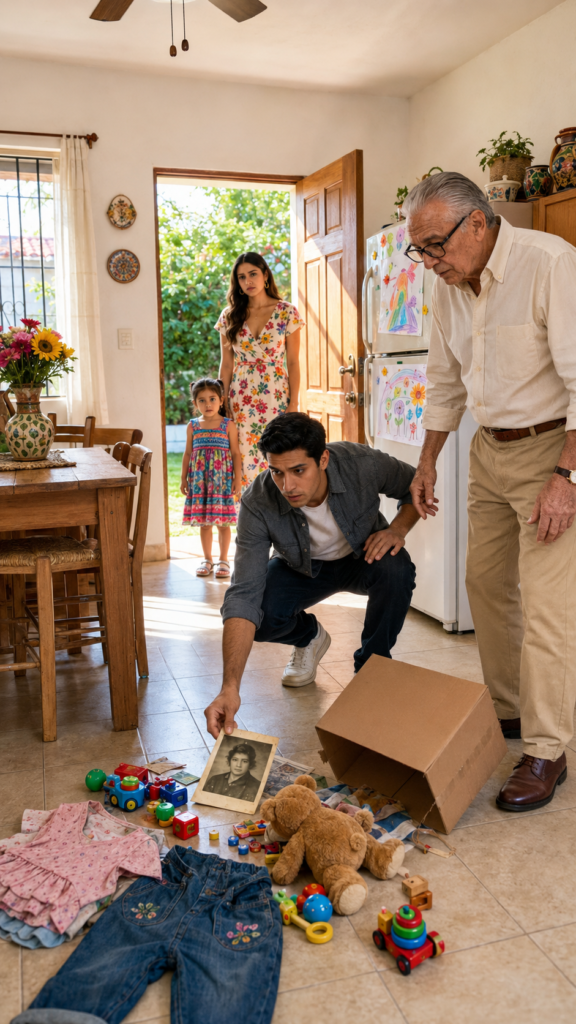
The box slipped from the old man’s hands and fell to the floor. Among a cap, some old records, and a pair of baby shoes was a photograph.
Martín picked it up.
In it was a smiling young man on a motorcycle. He had the same big eyes, the same eyebrows, and the same smile as Renata, Camila’s 4-year-old daughter.
The girl came out of the room, clutching her blanket.
Martín observed the photograph and then Renata's face.
—Who is he?
Camila had been avoiding that question for years.
Don Rogelio lowered his head, defeated.
—His name was Andrés —she replied—. He was Renata’s father. He died before she was born.
Martín looked back at the old man.
Then Don Rogelio gripped the door frame and confessed in a broken voice:
—I am that girl’s grandfather. It’s the last thing I have left of my son.
But before Camila could react, Don Rogelio pulled another envelope from his coat and uttered a phrase that left her frozen:
—I didn’t just come to say goodbye. I came because tomorrow someone will try to take away from Renata everything Andrés wanted to leave her.
PART 2
Camila closed the door and forced Don Rogelio to sit down.
Martín remained by the table, still staring at the ring. Embarrassment began to replace the anger on his face, but Camila had no strength to comfort him.
—Who wants to take something from Renata? —she asked.
Don Rogelio squeezed the envelope in his hands.
—My wife, Teresa. The girl’s grandmother.
The name awakened a pain in Camila that had never fully healed.
Teresa had been the woman who shoved her out of Andrés’ funeral when Camila was six months pregnant. She was also the one who shouted, in front of everyone, that her son was still alive until he met her.
Camila never sought that family again.
Renata was born without Andrés’ last name because her mother preferred to raise her alone rather than allow anyone to humiliate her again.
Don Rogelio began to speak slowly.
Andrés had been Camila’s first boyfriend. They met when he ran a used record stand in front of her aunt’s flower shop.
He was 23, worked some afternoons at his father’s mechanic shop, and dreamed of opening a motorcycle business.
When Camila became pregnant, Andrés came to her house with a pair of yellow baby shoes.
—If it’s a girl, I want her to be named Renata, like my grandmother —he said.
He was happy.
Don Rogelio, however, believed that the pregnancy would ruin his son’s future. Teresa was even crueler. She said that Camila only wanted to take the shop and that a girl “without a last name or money” would never be part of their family.
Andrés defended Camila.
The last argument with his parents happened one night. Don Rogelio, blinded by pride, told him that if he crossed the door, he would no longer be his son.
Andrés replied that he would rather be without family than abandon the mother of his child.
A week later, a truck ran a red light on Calzada Ignacio Zaragoza and hit Andrés’ motorcycle.
He died before reaching the hospital.
—I was the one who kicked him out —Don Rogelio confessed—. He died thinking his father didn’t love him.
Camila said nothing.
She remembered the funeral perfectly. Teresa had seen her arrive with her huge belly and had lunged at her.
“You have no right to be here. You killed him.”
Two relatives dragged her out of the place while she begged to say goodbye.
Don Rogelio didn’t defend her.
—That’s why I never wanted to get close to Renata —he continued—. Not because I didn’t love her. Because I didn’t know how to face it.
A year and a half after Andrés’ death, Don Rogelio accidentally walked into the flower shop where Camila worked.
He bought a bouquet of flowers for 20 pesos.
She didn’t recognize him right away. He had aged suddenly, as if in a few months he had carried 20 years on his back.
He recognized her.
He didn’t dare to say anything.
He returned the following Friday and bought the cheapest flowers again. Then he came back another Friday. And another.
He always counted the coins slowly on the counter.
One day he asked if Camila had a girl.
When she replied that her name was Renata, Don Rogelio had to hold on to the display case to avoid falling.
Since then, he asked the same question every week:
—How is the girl?
He never asked to meet her.
Never demanded photographs.
He never uttered the word “granddaughter.”
Months later, he saw Camila crying while arranging roses. Her mother was hospitalized at IMSS, and Camila was considering dropping out of nursing school to pay for medications and care for Renata.
The following Friday, Don Rogelio left an envelope.
“For you not to drop out of school. Don’t thank me.”
Camila refused three times, but he insisted.
From then on, he deposited money every month. Camila saved it in an account for Renata’s expenses. She never bought clothes, jewelry, or a phone with that money.
However, out of shame and resentment, she hid the old man’s true identity.
With her friends, she joked.
—My sugar daddy is here.
Don Rogelio always frowned.
—Don’t say that, girl. People think badly.
Then he would smile sadly.
Martín covered his face upon hearing that.
—I’m sorry —he said—. I had no right to speak to you that way.
Don Rogelio looked at him without resentment.
—You saw what anyone would have seen. The problem wasn’t your anger. It was all our secrets.
Then he opened the envelope.
Inside were copies of a deed, bank statements, and several letters written by Andrés before the accident.
In one of them, addressed to his father, Andrés said he didn't want to keep the shop. He only asked that when his daughter was born, they accept to meet her.
The letter had never been delivered.
The police found it inside the backpack he carried on the motorcycle, but Teresa hid it.
Don Rogelio discovered it three years later when his wife left some boxes open while preparing to sell the family house.
—Teresa knew that Andrés wanted to reconcile —he said—. For years, she let me believe that my son died hating me.
Camila felt her stomach twist.
—Why would she do something like that?
—Because she never forgave you for Andrés choosing you. And because she feared Renata would have rights over the shop.
Don Rogelio explained that the shop had originally been purchased with money from Andrés' grandmother. In a private document, she had established that if her grandson died, part of the property should go to his descendants.
Teresa found that document after the accident.
She hid it and convinced Don Rogelio to sell the shop.
—I signed without knowing —he admitted—. When I discovered the truth, the buyer had already paid almost everything.
Don Rogelio consulted a free lawyer and managed to recover part of the money. Then he started selling his tools, furniture, and belongings to deposit what he believed belonged to Renata.
Camila opened the bank statements.
The amounts were not huge. Some months there were 2,000 pesos. Others, barely 800.
For her, they represented tuition, consultations, uniforms, and food.
For Don Rogelio, they represented his bed, his father’s watch, the tools of his entire life, and even the refrigerator from his home.
—Why did you never tell me you were selling everything? —Camila asked, crying—. I would have returned the money to you.
—That’s why I didn’t tell you.
—And why did you never ask to see Renata?
The old man looked down the hallway where the girl was sleeping.
—Because I chased away her father. I had no right to show up demanding to be a grandfather. Helping her without intruding was the only way I could sleep.
Camila remembered several occasions when she had seen him sitting on a bench in front of Renata’s kindergarten.
She always thought he was resting after walking.
Now she understood that he had learned the dismissal time.
She saw her cross the gate, run with her backpack, and hug her mother. He watched from afar because he didn’t dare to approach.
—Come and see her —Camila said.
Don Rogelio shook his head.
—It’s too late.
—No. This time, you’re not leaving without meeting her.
Camila opened the door to the room.
Renata was sleeping on her side, hugging a stuffed rabbit. Don Rogelio stayed in the doorway. He didn’t enter or try to touch her.
He watched her for several minutes, as if he wanted to memorize every detail of her face.
—She’s just like Andrés when he was a boy —he whispered.
Then he made the sign of the cross.
Before leaving, he handed the box to Camila. It contained Andrés' cap, several records, photographs, and the yellow baby shoes he had bought when he learned of the pregnancy.
—Tomorrow Teresa will come for this —he warned—. I told her I found the letters. She thinks you have them.
—Let her come —Martín replied—. We won’t let her take anything.
Don Rogelio smiled.
—Take care of both of them. And never judge before asking.
Martín lowered his gaze.
Camila accompanied the old man to the stairs.
—Tomorrow we’ll come for you —she promised—. You’re going to come eat with Renata. We’ll tell her who you are.
Don Rogelio took her hand with his cold fingers.
—Thank you for letting me be her grandfather, even from afar.
He walked away under the yellow streetlight.
It was the last time Camila saw him alive.
The next morning, Teresa appeared in the apartment accompanied by a man who introduced himself as a lawyer.
She demanded the box, the letters, and the documents.
—That old man was sick and confused —she said—. Everything he gave you belongs to my family.
Camila felt the same fear return from the funeral, but this time she wasn’t pregnant, alone, or defenseless.
—Renata is also family to Andrés.
Teresa let out a dry laugh.
—That girl doesn’t even have his last name.
Martín stepped forward, but Camila stopped him.
She didn’t need a man to speak for her.
—She doesn’t have his last name because you dragged me out of the funeral and made me believe that all of you hated her.
—And you should have understood the message.
Teresa tried to grab the box. Camila pushed her away.
The supposed lawyer threatened to report her for breach of trust and exploitation of an elderly person.
Then Martín placed the bank statements, the letters, and the recording he had made since Teresa began to speak on the table.
—Repeat what you said about hiding Andrés’ letter —he said—. I’m sure the prosecutor would love to hear it.
Teresa paled.
Before responding, she received a call. Her expression changed completely.
Don Rogelio had died that morning.
A neighbor found him in his room, lying on a mattress on the floor.
Camila felt her legs give way.
She had promised to go for him.
She had three years to allow him to hug his granddaughter, and she had left him waiting until the very last day.
Teresa left without the box, but claimed she would contest any document.
On Saturday, Camila took Renata to the address written on one of the envelopes.
It was an old tenement in the Morelos neighborhood.
The neighbor who opened the door immediately recognized the girl.
—So you are Renata —she said with tears in her eyes—. Your grandfather spoke of you every day.
Don Rogelio's room was almost empty.
Only the mattress, a candle, two shirts, and a wall covered with photographs remained.
They were images of Renata taken from afar: coming out of kindergarten, walking with Camila, buying ice cream, and playing in a park.
They were not photographs hidden with malice. They were the memories of a man who punished himself by forbidding himself to get close.
In a drawer, they found medical records from IMSS.
Don Rogelio had been suffering from lung cancer for eight months.
He had rejected part of the treatment.
During those same eight months, he continued sending money while repeating that he could still hold on for another month.
Camila sat on the mattress and cried until her voice was gone.
Martín stayed by her side.
—I should have trusted you —he said—. I saw three messages and turned a good man into something dirty. I also turned you into someone you weren’t.
He pulled the ring from his pocket but didn’t try to put it on her.
—I’m not going to ask you to accept it. First, I have to show you that I know how to listen.
Camila didn’t respond.
There were things that an apology couldn’t immediately fix.
Days later, the reading of the will took place.
Teresa attended, convinced she would inherit the small room in the tenement and the remaining money.
The notary read a statement signed by Don Rogelio and backed by medical evaluations that demonstrated he was fully aware.
The room was in Renata’s name.
It wasn’t worth a fortune, but it was all she had left.
There was also a prepared complaint against Teresa for hiding documents related to Andrés’ inheritance and selling assets without informing about the rights of his descendant.
The biggest blow came with a recording.
Don Rogelio had recorded a conversation where Teresa admitted to having hidden Andrés’ letter and the grandmother’s document.
—That girl wasn’t going to keep what was ours —Teresa could be heard saying—. If Rogelio found out that Andrés wanted to forgive him, he would have rushed to find the girl.
Teresa lost the lawsuit.
Part of the money obtained from the sale of the shop had to be returned to Renata through a trust.
But for Camila, justice came too late.
The money couldn’t give her daughter back the three years in which her grandfather watched her grow from a bench.
Nor could it erase the pride that separated Andrés from his father.
Camila arranged for Don Rogelio to be buried alongside his son.
On the day of the funeral, Renata brought yellow flowers.
—They’re happier —she explained.
She left half on Andrés’ grave and the other half on her grandfather’s.
Then she asked why she had never met them.
Camila knelt before her.
—Because adults sometimes get angry, hide things, and think they still have a lot of time to fix them.
—And they no longer had time?
—No, my love.
Renata touched both gravestones.
—Then we shouldn’t get so angry.
Martín and Camila stayed together, but the wedding was postponed.
She needed to regain trust. He understood that loving wasn’t demanding immediate answers or condemning someone for an incomplete story.
Every Friday, Camila closed the flower shop a little earlier.
She bought two simple bouquets, the cheapest ones, and took Renata to the cemetery.
The girl distributed the flowers between her father and her grandfather. Then she ran to the ice cream stand while Camila lingered a few minutes in front of the graves.
There, she understood that Don Rogelio never tried to buy her forgiveness.
Every deposit had been an apology he didn’t know how to pronounce.
Every coin counted on the counter was a piece of the life he was selling to care, from afar, for the daughter of the son he had lost.
Renata inherited a small room, some letters, and a box of memories.
But she also inherited a story that her mother decided to tell her completely, including the parts that made her look bad.
Because Camila understood that Teresa wasn’t the only guilty one.
She also allowed resentment to decide for her daughter.
And although her reasons were understandable, the outcome was the same: a grandfather died after watching his granddaughter sleep just once.
Since then, when someone in the flower shop said there was still time to ask for forgiveness, Camila looked at the chair where Don Rogelio counted his coins.
—Honestly, no one knows how much time they have left —she replied—. Pride always seems important until the Friday when the person doesn’t return.





