PART 1
—Your husband did answer the phone, Mrs. Maribel… but he never crossed that door.
Nurse Lupita said it carefully, as if speaking softly could make the truth less cruel.
Maribel Cárdenas gripped the sheets of the Hospital Civil de Guadalajara, feeling the sting of her surgery wound less than the ache in her chest.
She had spent two weeks hospitalized after an emergency operation. It all began one early morning when terrible pain dropped her to the kitchen floor while she was heating coffee for her husband, Ernesto.
He was the one who called the ambulance.
He was the one who held her hand in the ER.
He was the one who, crying like a child, promised her:
—I’ll be right here, Mari. When you wake up, the first thing you’ll see will be my face.
Maribel believed him because they had been together for twenty years.
They had survived debts, a grocery store that went bankrupt, months of counting coins to pay for their house in Tonalá, and that phrase they always repeated:
—One day, we’ll fix it up nicely.
But when Maribel woke up, Ernesto was not there.
There were only white lights, IV drips, pain, and Nurse Lupita adjusting her pillow.
—Where’s my husband?
Lupita lowered her gaze.
—He’s not here right now.
That “right now” turned into one day.
Then five.
Then ten.
Then fourteen.
Ernesto responded to messages, but they all sounded the same:
“Get better, my love. I’ll explain later.”
Maribel called him one night, crying.
—Ernesto, I almost died.
On the other side, there was silence.
—I know —he whispered.
And hung up.
By the day of her discharge, Maribel had no tears left. She had made a cold decision: she was going to file for divorce.
She took a taxi with her medications in a bag and arrived at the house where she had aged with him.
The façade still looked the same.
The black gate.
The bougainvillea.
The cracked sidewalk.
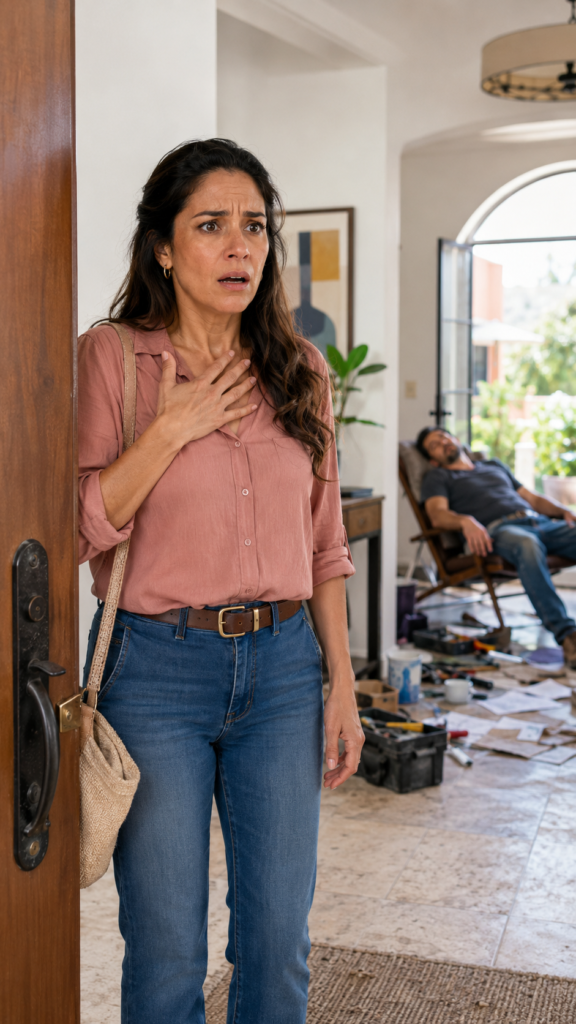
But when she opened the door, her breath caught.
The hallway was no longer dark. The walls were painted a warm cream, just the color she had pointed out years ago in a magazine.
The creaky floorboard was repaired.
The old lamp no longer flickered.
In the living room were shelves with her books, family photos, and a lavender pot.
The kitchen, that kitchen Maribel had hated, was renovated. Light cabinets, a new countertop, a clean window, drawers that opened smoothly.
On the bar was a card with Ernesto’s handwriting:
“You were right. This house could feel like a home.”
Maribel felt rage.
But also confusion.
She climbed to the bedroom. The room smelled of fresh paint. On her nightstand was another note:
“I’m sorry it took me so long to give you the place you deserved.”
Then she saw receipts from the hardware store, carpentry invoices, plumber’s notes.
All dated during the fourteen days she had been hospitalized.
Ernesto hadn’t disappeared.
He had been fixing the house.
But when Maribel entered the laundry room, she found something that froze her blood.
Three sealed bags from the hospital gift shop.
A teddy bear.
A recovery card.
A box of chocolates.
The receipt read: Hospital Civil de Guadalajara, three days after the surgery.
Ernesto had gone.
He had been there.
And yet he hadn’t come to see her.
Then Maribel saw one last note taped to the patio door:
“Come out, please. I can finally tell you what I didn’t have the courage to say.”
And she opened the door, not imagining that the most powerful revelation was yet to come.
PART 2
The patio looked like another place.
The dry earth was turned, the pots arranged, the lemon tree pruned, and the old washbasin covered with new tiles. Where there had once been rusty metal scraps and cans of old paint, now stood a small room of glass and wood.
A reading nook.
The dream Maribel had drawn in a notebook in 2009.
She walked slowly, with the hospital bag in one hand and the teddy bear in the other. Each step pulled at her wound, but more so pulled at her doubt.
Inside the room, Ernesto was asleep in a folding chair.
He had a scruffy beard, scraped hands, dry cement on his shoes, and paint stains on his shirt. Next to him were blueprints, screws, a cup of cold coffee, and a pile of receipts.
He didn’t look like an unfaithful man.
He didn’t look like a calm man.
He looked like a broken man.
Maribel knocked on the glass door.
Ernesto woke up with a start.
—Mari?
For a second, he smiled, relieved. Then he saw her eyes, the teddy bear, the bag of medications, and his face fell.
—Two weeks —she said—. Not two hours. Not two days. Two weeks.
Ernesto stood up.
—Let me explain.
—Don’t come closer.
He stopped instantly.
Maribel lifted the teddy bear.
—You went to the hospital.
Ernesto looked down.
—Yes.
—you bought this.
—Yes.
—And you didn’t go in.
The silence hurt more than an answer.
—Why, Ernesto?
He sat back down as if his legs could no longer hold him.
—Because I was a coward.
Maribel let out a dry laugh.
—What a pretty phrase to cover up an abandonment, huh?
—It wasn’t abandonment.
—Then what was it? Because I woke up asking for you. I spent fourteen nights staring at the door. I humiliated myself making excuses for you in front of the nurses. “He’s probably working.” “He’s probably tired.” “He’ll come tomorrow.” Until I could no longer invent anything.
Ernesto covered his face with his hands.
—On the third day, I went with the bags. I made it to the hallway. I saw you through the little window of the room. You were pale, connected to machines, with tubes, with blood in a bag… and I broke.
—And you decided it was better to leave me alone?
—I decided poorly, Mari. I decided horribly.
—No, Ernesto. You decided for me.
He raised his gaze, his eyes red.
—When I saw you like that, I thought that if I entered and touched you, I would accept that I could lose you. And I didn’t know how to live with that.
Maribel pressed her lips together.
—I didn’t know how to live with the idea that my husband no longer loved me.
The phrase hit Ernesto like a slap.
—I never stopped loving you.
—The love that doesn’t appear feels the same as abandonment.
He didn’t answer.
Because it was true.
Ernesto took a folded sheet from his pocket. It had paint stains and a torn corner.
—I found this the first night I couldn’t sleep.
Maribel didn’t want to take it, but she recognized it before she touched it.
It was her drawing from 2009.
The reading nook.
A small table, two chairs, plants, light coming in the afternoon.
She had made it when she still believed that simple dreams also deserved to come true.
—You kept it —she murmured.
—I kept everything you ever said you wanted.
—Except what I said from the hospital bed.
Ernesto closed his eyes.
—Yes.
That word fell heavy.
Maribel looked around. The house was beautiful. Every painted wall felt like an apology. Every new shelf felt like love. Every receipt felt like guilt.
—Did you really think fixing the house would repair what you did?
—No —he said—. But I thought that if you came back and saw something alive, maybe you’d understand that I wasn’t with another woman, that I wasn’t partying, that I wasn’t running away from you. I was running away from my fear, which is worse, because I left you paying the price.
Maribel took a deep breath.
—Did you go every day?
—Every day.
—And you never went in?
—No.
—What a piece of work, Ernesto.
He nodded, without defending himself.
—Yes.
Then the doorbell rang.
Once.
Then again.
Ernesto and Maribel looked at each other. He walked toward the entrance, and she followed slowly, her heart pounding against her ribs.
When he opened the door, Nurse Lupita was there.
She wasn’t in uniform. She held a folder tightly against her chest, her eyes swollen.
—Mrs. Maribel —she said—. I need to apologize.
Maribel felt her stomach drop.
—Apologize for what?
Lupita looked at Ernesto, then back at her.
—Because your husband didn’t just have fear. There was also something we never told him.
The room went cold.
Lupita entered and placed the folder on the new table.
—After the surgery, there was a complication. You lost a lot of blood and stopped breathing properly for a few minutes. The doctor asked to locate your husband because they needed authorization for another procedure.
Maribel turned toward Ernesto.
He was crying silently.
—I signed —he said—. They told me there was a risk you wouldn’t wake up.
Maribel felt an ancient chill, as if death had brushed past her and no one had told her.
—Why didn’t anyone tell me that?
Lupita lowered her gaze.
—Because when you woke up, you were already stable. The doctor didn’t want to upset you. And your husband… he asked me not to tell you he had been outside.
Maribel’s eyes widened.
—You knew he was going?
Lupita swallowed hard.
—Yes.
—And when I asked about him?
—I told you he wasn’t there at that moment.
—But he had been.
—Yes.
Maribel stood frozen.
Suddenly, it wasn’t just Ernesto who had left her in the dark. The person who had cared for her, who had adjusted her pillow, who had said “cheer up, dear lady,” had chosen to remain silent.
—So there were two people deciding what I could know.
No one spoke.
Lupita began to cry.
—I thought I was protecting you. I really thought that. If I told you your husband was outside but wasn’t coming in, you would break. And you were delicate.
—I was already broken —Maribel replied—. Only you didn’t want to see it.
Ernesto took a step forward.
—Mari…
—No.
He stopped.
It was the first time he did the right thing without her having to explain it.
Lupita pulled receipts from the folder.
—He paid for medications that the hospital wouldn’t cover. He also left money for a nighttime caregiver. He never wanted you to know.
Maribel looked at the papers.
There were the dates.
The signatures.
The purchases.
Ernesto’s name.
He wasn’t innocent.
But he wasn’t the monster she had imagined either.
That was the most painful part.
Because the truth didn’t come clean. It came tangled with fear, love, guilt, and a cowardice that had hurt too much.
—Thank you for coming —Maribel said to Lupita, after a long silence.
The nurse cried more.
—I don’t know if I deserve that.
—I don’t know. But at least today, you stopped lying to me.
Lupita left without asking for anything else.
The house was silent.
Ernesto stood, his shoulders sagging.
—I’m not going to ask you to forgive me today —he said—. Not tomorrow. I just want to tell you the whole truth: I was afraid of watching you die. I was afraid to go in and not know what to say. I was afraid to lose you, and I ended up making you feel lost.
Maribel sat by the window.
Outside, the glass room shone with the afternoon light. It was beautiful. Painfully beautiful.
—When I woke up —she said—, I asked for you before I asked if I was going to live.
Ernesto let out a sob.
—Forgive me.
—Don’t use that word as a band-aid. This can’t be fixed with paint, flowers, or a pretty room.
—I know.
—If we’re going to continue, Ernesto, it won’t be with heroic silences. I don’t want a martyr fixing walls while I break inside. I want a partner who comes into the room even when he’s afraid.
He nodded.
—I’m going to go to therapy.
—Don’t say it to calm me down. Do it because you understand that love is also about staying when everything is ugly.
—I understand.
—And one more thing.
—Whatever you want.
Maribel pointed to the patio.
—Before you build something for me, you ask me where I want it.
Ernesto cried, but smiled faintly.
—Where do you want the pots?
She pointed to the spot where the sun hit best.
—There. So I can see them from my chair.
He went out and moved them without arguing.
There was no magical forgiveness that afternoon.
There was no movie kiss.
Just a wounded woman learning to decide for herself, and a ashamed man learning that love doesn’t work if it comes hidden.
Weeks later, Maribel returned to the hospital for a check-up. Ernesto went in with her. He sat beside her, taking her hand when the doctor talked about scars, care, and risks.
He was afraid.
Of course he was.
But this time, he didn’t run away.
At home, Maribel began to use her reading nook. Sometimes she read. Sometimes she just stared at the garden. Ernesto made coffee, went to therapy on Thursdays at six, and learned to ask before fixing things.
One afternoon, she found another card on the table:
“No more ‘one day.’ What we love must be cared for today.”
Maribel read it several times.
Then she went out to the patio and saw Ernesto arranging some crooked flowers.
—They’re planted wrong —she said.
He stood still.
—Where do you want them, Mari?
She pointed to the exact place.
And he moved them.
Without justifying.
Without fleeing.
Without deciding for her.
Because sometimes what hurts the most isn’t that someone doesn’t love you.
Sometimes what hurts the most is that they love you poorly, in silence, from afar, believing that suffering alone is also a way to protect.
And there remains the question that half of Mexico would discuss in the comments:
Does a cowardly love deserve a second chance, or are there abandonments that not even the prettiest house can repair?





