PART 1
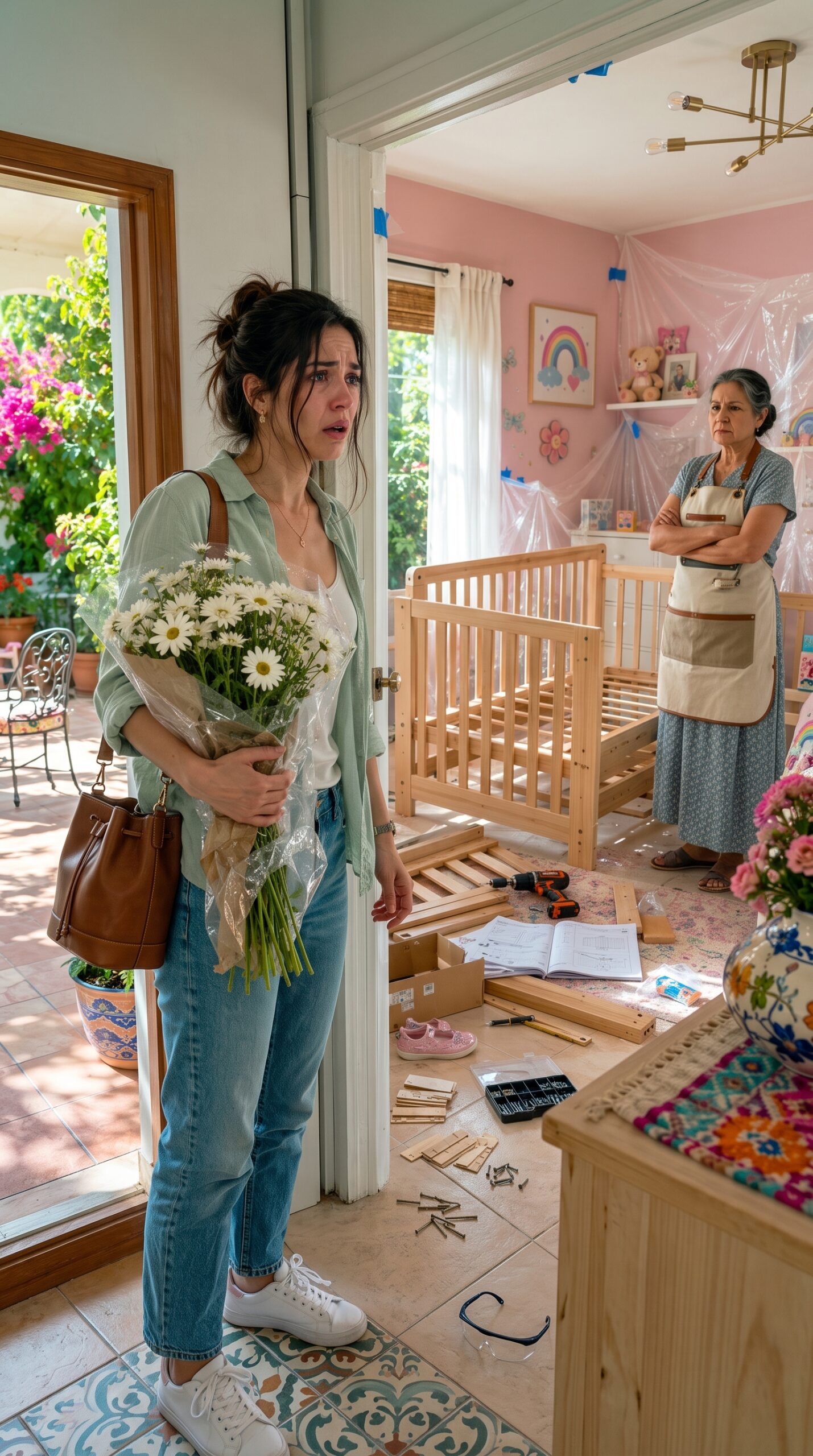
Mariana Salcedo returned from the Dolores cemetery with the white daisies still pressed against her chest.
They were for Lucía, her three-year-old girl, but that Wednesday the rain fell so hard on the grave that several flowers stayed in her hand, bent, muddy.
She entered her home in Coyoacán without turning on the light.
Since Lucía died, the house had been like those long Sundays where no one speaks. The couch still bore a little chocolate stain. In the kitchen, the purple cup with a straw remained uneasily untouched — a reminder of the little girl who once filled it with laughter.
Every Wednesday she went to the cemetery. Every Wednesday she returned with the same broken face.
Her husband, Diego, told her they needed to move on.
"We can't live buried with her, Mari."
But Mariana didn’t want to move on. Not yet. To her, moving on felt like betrayal.
Lucía had been a miracle. Years of treatments, injections, expensive consultations at a clinic near Polanco, tears in parking lots, bills they couldn’t pay. When she was finally born, Diego cried so much that the nurse jokingly told him to calm down.
And then, in less than a year, a rare disease took her away.
Since then, Mariana stopped opening envelopes, emails, messages, and even windows. In the entry drawer, letters from banks piled up alongside receipts, promotions, and several white envelopes from the clinic.
She didn’t touch them.
What for?
If there was no future to plan.
That afternoon, as she climbed the stairs, she noticed something strange. The door to Lucía’s room was open.
Wide open.
Mariana froze.
No one was to touch that room. No one. Not Diego. Not the girl who helped with cleaning. Not Doña Carmen, her mother-in-law, who sighed every visit as if the whole house embarrassed her.
Mariana walked slowly.
And then she saw it.
The peach-colored walls were covered with plastic. The bookshelf of stories was empty. The little kitchen set was no longer in its place.
In the middle of the room, atop a new rolled-up carpet, was a white crib half-assembled.
A crib that Mariana hadn’t bought.
A crib for a baby that couldn’t exist.
Because Diego had sworn to her that they couldn’t have more children. They had gone to the doctor together. They had cried together.
Doña Carmen was there, with a rag in hand and the calmness of someone who believes they own everything.
"What are you doing?" Mariana asked.
The mother-in-law didn’t even flinch.
"This house needs life, daughter. It’s enough of having this room as an altar."
Mariana felt the flowers slipping from her grasp.
"Don’t call my daughter’s room an altar."
"Lucía is with God now," Doña Carmen replied. "The living also need space."
Mariana swallowed hard.
"This house is in my name. I bought it before I got married. You had no permission to come in here."
For the first time, Doña Carmen blinked with fear. But she didn’t back down.
"Diego asked me to come."
Her husband’s name dropped like a stone.
Mariana pulled out her cell phone.
"Then we’re going to listen to him."
She dialed on speaker. It rang once. Twice. Three times.
"Hello?" Diego answered, breathless.
"I’m at the house," Mariana said, staring at the crib. "With your mom. In Lucía’s room. Assembling a crib."
There was silence.
"Mariana, not like this."
"Yes, like this. Answer me something. Can you have children, yes or no?"
Diego breathed like it hurt.
"It’s not that simple."
"Yes or no, Diego."
"Not like you think."
Mariana felt the blood drain from her face.
Doña Carmen looked down.
"Then who is that crib for?" Mariana asked.
Diego didn’t answer. He just said her name with horrible sadness.
"Mariana… you haven’t been here. It’s been a year since you’ve been here."
She hung up before hearing more.
She ran to the entry drawer. She threw envelopes on the floor, receipts, brochures, old letters. She grabbed one from the clinic. It had red letters: URGENT.
She opened it with trembling hands.
The letter was from ten months ago.
Amidst medical jargon and dates she didn’t understand, she read two words that shattered her heart:
"Last embryo."
Behind her, Doña Carmen whispered something that left her breathless.
"That baby is the last piece of Lucía… and you were going to let it die."
PART 2
Mariana crumpled the letter in her hand.
For several seconds, she couldn’t move. The crib, the plastic, the discarded daisies, her mother-in-law’s voice, and those two words mixed in her head like a buzzing.
Last embryo.
The last.
The one that remained from the treatment they gave Lucía.
When Mariana and Diego tried to be parents, the clinic managed to create two viable embryos. One became Lucía. The other was frozen, saved for that future the three of them imagined when laughter still filled the house.
Lucía would touch Mariana’s belly and say:
"Here goes my baby, right, mommy?"
Diego would laugh, fix her curls, and promise that one day she’d have a little brother.
Then came the illness. The hospitals, the sleepless nights, the bills, the prayers, the promises to the Virgin of Guadalupe. And then came the silence.
Everything else faded from Mariana’s mind.
"What did you do?" she asked in a soft voice.
Doña Carmen took a deep breath.
"The clinic sent notices. Many. If no one authorized the procedure before April 15, they would discard it."
Mariana looked at the drawer full of envelopes.
There had been the notice. There, waiting. While she hugged Lucía’s teddy bear as if it were oxygen. While she hated that Diego could bathe, eat, go to work, answer messages.
While she convinced herself that he wasn’t suffering anymore.
"I didn’t know," she said.
"I know."
"Don’t tell me you know."
Doña Carmen put a hand on her chest.
"Mayra came looking for me because Diego couldn’t handle it anymore."
Mariana lifted her gaze.
Mayra.
The new teacher at the school where Diego worked. The one who laughed loudly at parties. The one who sent late-night messages. The one Mariana had imagined a thousand times sitting next to her husband in a car, touching his hand.
"Is Mayra pregnant with him?" Mariana asked.
Doña Carmen shook her head.
"Mayra isn’t pregnant with Diego. Mayra is carrying the baby."
Mariana took time to understand.
"Carrying?"
"She lent her womb. As a surrogate. She didn’t ask for money. She wanted nothing. She said Diego saved her job when she was alone with her sick mom, and now it was her turn to help."
Mariana let out a dry, ugly laugh.
"How lovely. Everyone decided my life while I was burying my daughter."
"It wasn’t like that."
"Wasn’t it? Then how was it? Did you also pick the crib color for me?"
Doña Carmen lowered her head.
"Your signature was needed."
Mariana opened the letter until she found the attached document. On the last page was her full name:
Mariana Salcedo Rivas.
The signature looked like hers.
But it wasn’t.
The “M” had a long hook at the end. She knew it too well. That letter was on Christmas cards, on Tupperware labels, on notes stuck to the fridge when Doña Carmen brought soup.
Mariana lifted the paper.
"You signed for me."
Doña Carmen closed her eyes.
"Yes."
"You forged my signature."
"Yes."
"By what right?"
The mother-in-law didn’t defend herself immediately. That made her seem more guilty.
"By none," she finally said. "But with a lot of fear."
Mariana felt such intense rage that for a moment she wanted to rip the crib out and throw it out the window.
"What were you afraid of? That I would say no? That finally someone in this family would respect a mother?"
Doña Carmen was going to respond, but the door downstairs opened.
Diego’s steps ascended slowly. Too slowly.
When he appeared in the doorway, Mariana almost didn’t recognize him.
He was thin. Thin in a way that isn’t noticeable when one has stopped looking at someone with love. He had dark circles under his eyes, gray skin, and one hand pressed against the wall, as if he needed to hold on.
"Mari," he said.
"Don’t call me Mari."
Diego looked down.
"Let me explain."
"Start with this," Mariana showed him the document. "Your mom forged my signature. Your colleague is carrying a baby made with my embryo. And you told me you couldn’t have kids "not like I thought." What does that mean?"
Diego closed his eyes.
Doña Carmen spoke before he did.
"It means my son is dying."
The room fell silent.
Not even the rain outside. Not even the phone vibrating in Mariana’s bag. Nothing.
"Shut up," she said.
Doña Carmen cried silently.
"It’s not a lie."
Mariana looked at Diego. He didn’t deny it.
"What do you have?" she asked.
Diego swallowed hard.
"A tumor. In my head. They found it two months after Lucía died."
Mariana stepped back.
"No."
"Yes."
"No, Diego."
"The meetings, the trips to Toluca, the calls I didn’t answer… they were tests, chemo, consultations. I didn’t want to tell you like this. Not after Lucía."
Mariana covered her mouth.
She remembered the blood-stained shirts in the hamper. He said it was from a dry nose. She remembered the dizziness. He said he hadn’t eaten breakfast. She recalled finding him once sitting in the shower, without water, shaking. He said he was tired.
She had thought of another woman.
She never thought of death.
"Why did you lie to me?" she whispered.
"Because I could already see you carrying a grave. I didn’t want to put another one on top."
"But you could put a lie on me."
Diego nodded, shattered.
"Yes. And I’m sorry. I didn’t know how to do it right."
Mariana clenched her teeth. The pain no longer knew where to run.
"And the baby?"
Diego looked at the crib.
"I found a letter from the clinic. It said that if we didn’t sign, they would discard the last embryo. The one that was Lucía’s sibling. Our last possible child."
"It was my decision."
"Yes."
"Then you stole it from me."
Diego closed his eyes.
"Yes."
That word didn’t sound like justification. It sounded like a sentence.
"I looked for you," he said. "I called you. I left notes. I asked you to open the mail. I asked you to walk with me. You couldn’t. I don’t blame you. I really don’t blame you. But time was running out."
Mariana felt shame rising in her throat.
Not because she had mourned her daughter. That wasn’t guilt. But because for months she had looked at Diego like an enemy. She had thought he was cold, unfaithful, cowardly.
And he was dying in silence.
"Mayra agreed to help," Diego continued. "My mom did what she did. I allowed it. If someone has to pay, it’s me."
"Everyone has to pay," Mariana said. "Because you all left me alone thinking I was crazy."
Diego broke down.
"I was lonely too."
The phrase fell between them like an uncomfortable truth.
Mariana looked at the wall of the room. Beneath the plastic, there was still the pencil mark: "Luci, 3 years." Her little girl had made it that far. No more.
She approached and touched the mark with her fingers.
The last time they measured Lucía, the girl stood on her tiptoes to cheat. Diego carried her, Mariana laughed, and she shouted that when her little brother was born, they would measure him too.
That memory, buried for a year, returned whole.
Mariana started to cry, but not like at the cemetery. Not with that dry and weary weeping. She cried with rage, with fear, with guilt, with a tenderness that hurt.
"They couldn’t take away my right to decide," she said.
Diego nodded.
"I know."
"Even if it was for love."
"I know."
"Even if you were sick."
"I know."
Doña Carmen knelt as best she could.
"Daughter, forgive me. I saw my granddaughter go. Then I saw my son fade. And when I knew that baby was left, everything clouded over. I thought: if Mariana says no, we lose it. If she doesn’t sign, we lose it. And I committed a crime. I know. But I didn’t know how to let go of the last piece of my family."
Mariana looked at her with tears on her face.
"It wasn’t just your family. It was my daughter. My body. My signature."
"Yes," Doña Carmen said. "And that’s why I deserve for you to hate me."
The argument didn’t resolve that night.
That would have been a lie.
Mariana didn’t hug anyone. She didn’t say "everything is okay." She didn’t smile at the crib like in a cheap movie.
She went down to the dining room, picked up each envelope from the drawer, and sorted them by date. She read each notice. Each missed call from the clinic. Each pending authorization. Each storage notification.
Then she found another envelope.
It wasn’t from the clinic.
It was from Diego.
The letter was dated four months ago.
Mariana recognized his trembling handwriting.
She opened it sitting on the floor, with Diego leaning against the wall and Doña Carmen crying silently.
The letter said that if she was reading it, she might already know the truth. It said he hadn’t wanted to replace Lucía. No one could. He just wanted to rescue the little brother they had all dreamed about before the illness broke their home.
It said he didn’t know how much time he had left.
It said he was scared of dying and leaving her alone with the closed room, the teddy bear on the bed, and the cold coffee in the kitchen.
And at the end, one phrase pierced her heart:
"If he is born, tell him that his sister wanted him first. And tell him that his father loved him before seeing him."
Mariana didn’t speak for a long time.
Then she took a pen.
She didn’t sign to forgive Diego. She didn’t sign to absolve Doña Carmen. She didn’t sign because everything was okay.
She signed because she understood that this baby was also hers. Because he was Lucía’s brother. Because no forgery, no lie, and no tragedy could decide above the truth that she had before her eyes.
She looked for the correct ratification form. The signature came out crooked, wet with tears.
But it was hers.
With her “M,” without a hook.
The next morning she went to the clinic. She demanded to speak with the director. She requested copies of everything. She put in writing that Doña Carmen would not sign anything in her name again. That Diego couldn’t authorize medical decisions without her. That Mayra should be respected, protected, and heard.
She also made something clear that no one expected:
That child was going to be born.
But he wasn’t going to be born into a lie.
Mayra received her weeks later in a café in Del Valle. She had a small belly and eyes filled with fear.
Mariana arrived thinking she would hate her.
She couldn’t.
Mayra wasn’t a mistress. She was a tired woman, in comfortable shoes, carrying a story that didn’t belong to her but that she had accepted to care for.
"I’m sorry," Mayra said. "I should have looked for you."
"Yes," Mariana replied. "You should have."
There was no hug. Just a truth laid out on the table.
Diego died five weeks later.
He managed to know that Mariana had signed. He managed to place his hand on Mayra’s belly once. He managed to hear the heartbeat from a small speaker in the office.
He didn’t get to meet him.
On the day of the funeral, Mariana didn’t cry like she had for Lucía. With her daughter, she cried like someone who loses the world. With Diego, she cried like someone who discovers too late that the world had been looking for her too.
Doña Carmen sat far away, not daring to come closer.
Mariana let her be, but she didn’t call her mom. Not yet.
The baby was born in September, in a hospital in Mexico City, during a dawn of fine rain.
It was a boy.
Mariana named him Diego, after his father, although at home she hardly ever called him that.
She called him "the little brother" like Lucía had named him before he existed.
When she took him home, the room was no longer pink nor a mausoleum. It was light gray, with clean light, a white crib, and on the top shelf, a photo of Lucía smiling with her daisies.
On the wall, Mariana didn’t erase the mark: "Luci, 3 years."
Below, she made a new one, tiny, barely symbolic.
"Diego, newborn."
Doña Carmen placed Lucía’s old teddy bear inside the crib. Mariana wanted to take it out on impulse, but she stopped.
The baby turned his little face toward the stuffed animal, as if he recognized a scent from before life.
Mariana then understood that there are betrayals made with selfishness and others made with fear. But she also understood that love doesn’t make right everything it touches.
Because a mother can forgive over time.
But no one, neither for pain, nor urgency, nor love, has the right to steal her voice.
That night, while the little brother slept, Mariana opened the entry drawer.
There were no longer unread envelopes.
She only kept Diego’s letter, folded in four, next to a dried daisy from the cemetery.
And for the first time in a year, she didn’t close the door to Lucía’s room.
She left it open.
Not to erase her daughter.
But so her brother could grow up knowing that before him, there was a little girl who dreamed of him, a father who left wanting him, and a mother who had to learn, through pain, that being alive doesn’t always mean stopping loving the dead.