PART 1
—So she doesn’t forget where the real blood comes from.
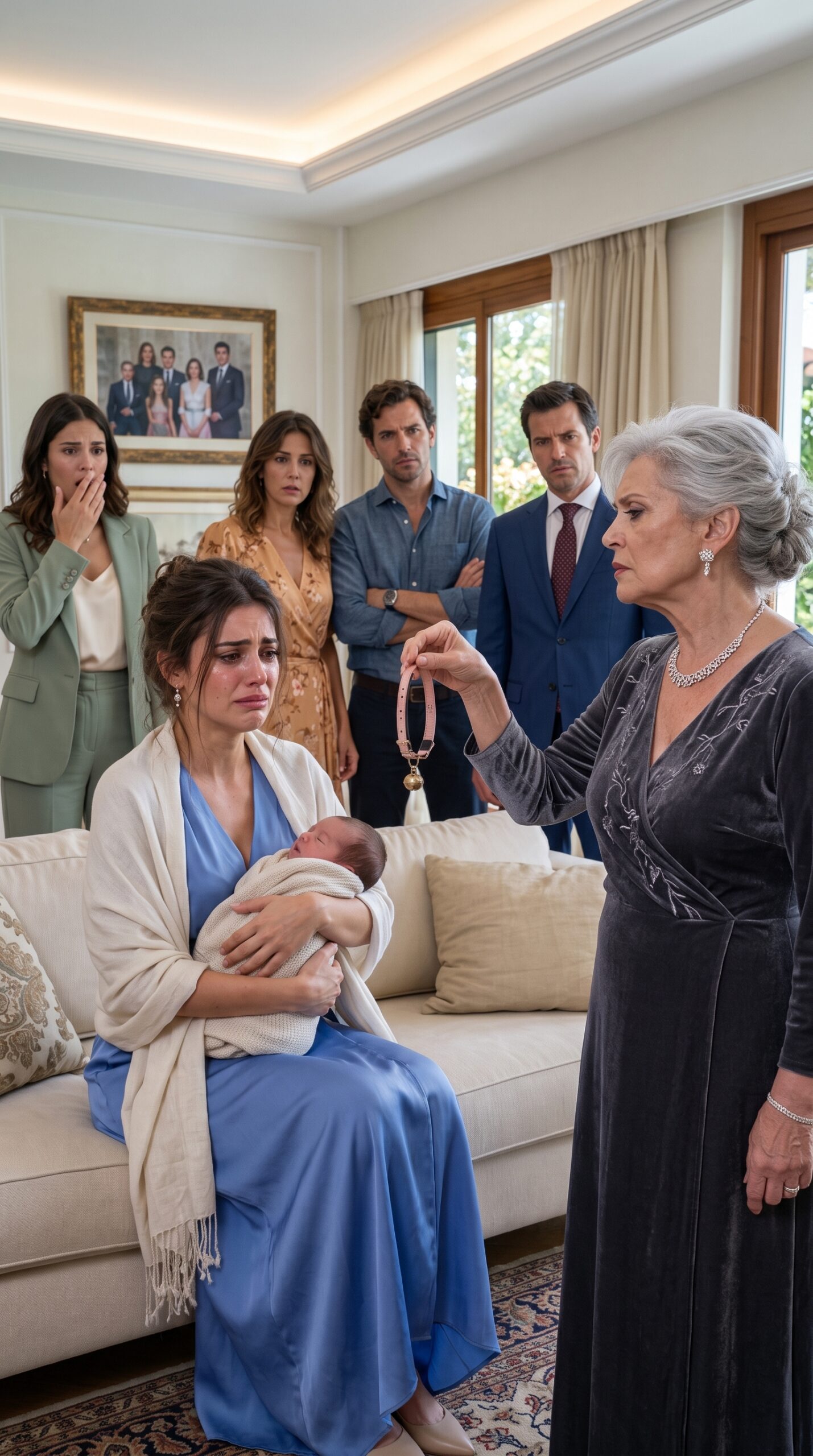
That’s what Doña Rebeca Montes said as she pulled a small red dog collar from a navy blue box, with a golden tag that read "Luna."
The baby was barely 28 days old.
And the whole room laughed.
It wasn’t an awkward chuckle. It was an open, elegant laughter from people holding glasses of expensive wine, as if humiliating a newborn was part of the menu.
Camila Serrano stood next to the gift table, cradling her daughter Valentina against her chest. The little girl slept with her mouth slightly open, wrapped in a white blanket that her maternal grandmother had knitted in Toluca.
The party was at the Montes’ house in Lomas de Chapultepec.
There were uniformed waiters, orchid arrangements, soft music, and a dessert table that looked like it belonged in a magazine. Everything smelled of old money, expensive perfume, and false smiles.
Camila didn’t belong to this world.
They had repeated that to her without saying it since she married Rodrigo Montes, the only son of Rebeca and heir to a chain of private hospitals.
Camila was a pediatric nurse.
Her mom sold tamales outside a high school. Her dad had driven a taxi for 22 years. For her, that was pride.
For Rebeca, it was a stain.
—My son has always been very noble —she would say at meals—. Sometimes too noble with those who aren’t on his level.
Rodrigo would lower his gaze.
—My mom is intense, Cami. Don’t play her game.
Camila believed him many times.
She believed him when they seated her next to the kitchen at Christmas.
She believed him when Rebeca asked if her family knew how to use fish forks.
She believed him when, at the baby shower, an aunt said Valentina would be "very pretty if she inherited more from the Montes."
But that Sunday, something broke.
Rebeca approached in her beige dress, her pearl necklace, and that cold smile she wore when she wanted to hurt without losing her composure.
—I have a special gift for the little girl —she said.
Everyone fell silent.
Camila opened the box out of politeness.
When she saw the collar, she felt her fingers go cold.
—What is this?
Rebeca lifted it for everyone to see.
—A symbolic detail. If the girl is going to carry our last name, the least she should learn from a young age is that not everyone is born to lead.
A cousin let out a laugh.
A sister-in-law began recording.
—Oh, aunt, you’re going too far —someone said, laughing.
Camila tightened Valentina against her chest.
—Don’t put it on her.
Rebeca took one step closer.
—Don’t exaggerate, sweetheart. It’s a joke. Besides, you should be grateful. It’s handmade.
Then she brought the collar closer to the baby’s neck.
Valentina woke up crying.
That cry pierced Camila like a knife.
She didn’t scream.
She didn’t insult.
She didn’t push anyone.
With trembling hands, she pulled out her phone and pretended to check a message. But the camera was already recording.
She recorded the collar.
She recorded the laughter.
She recorded Rebeca’s hand trying to touch her daughter.
And she recorded the phrase that would sink her.
—Putting it on her doesn’t hurt. What hurts is that her mother thinks she’s a lady.
Camila put the phone away, took the diaper bag, and walked toward the door.
Behind her, Rebeca let slip:
—That’s how the ungrateful ones are: dramatic, ungrateful, and dangerous.
Camila didn’t respond.
Because as she left with her crying baby in her arms, she understood they had just given her the exact proof she needed.
And no one imagined what that video was about to provoke.
PART 2
Camila arrived at the apartment with weak legs and her blouse soaked in milk and tears.
Valentina remained restless, as if the poison from that room had stuck to her little body. Camila changed her, breastfed her, and rocked her until the crying turned into a tired sigh.
When the baby finally fell asleep, Camila didn’t allow herself to crumble.
She opened the laptop.
Uploaded the video to the cloud.
Sent it to two emails.
Saved it on a USB drive and in a private folder she had been feeding for months without telling anyone.
There were Rebeca’s messages.
“Are you sure that girl is Rodrigo’s?”
“A nurse doesn’t raise a Montes.”
“Please don’t let your mom bring tamales to the baptism. It’s not a fair.”
There were also audio files.
Photos.
Screenshots of the family chat where they called her "the little girl from the hospital."
Camila hadn’t gathered everything out of revenge.
She had done it because a part of her knew that someday, someone would ask for proof of a humiliation that everyone denied with delicate voices.
Rodrigo arrived almost at 10 PM.
He came from Monterrey, from a meeting with partners. He entered tired, dropped the keys on the table, and smiled upon seeing the crib.
—How was the party?
Camila didn’t answer.
She just turned the laptop around and played the video.
Rodrigo stared at the screen with his brow furrowed. At first, he didn’t understand. Then he saw the collar. He saw his mother smiling. He saw Valentina crying. He saw his cousin recording it like it was gossip.
When he heard the final phrase, he went pale.
—Play it again —he murmured.
Camila played it again.
Rodrigo didn’t blink.
—Did she try to put it on her?
—Yes.
He brought his hands to his face.
—Why didn’t you call me?
Camila let out a dry, broken laugh.
—Because every time I called you about your mom, you asked me to be patient.
The phrase fell between the two like a stone.
Rodrigo lowered his gaze.
Then Camila opened the folder.
She showed him everything.
Every message.
Every audio.
Every mockery.
Every photo where she appeared sidelined, reduced, tolerated as if she were a second-class guest in her own family.
Rodrigo was changing colors.
At the end, he didn’t ask for explanations.
He didn’t defend his mother.
He didn’t say "you must have misunderstood."
He just closed the laptop carefully, as if it contained something that could explode.
—Tomorrow we’re going to see my dad.
His father, Don Hernán Montes, was a serious man, founder of the family’s hospital group. He wasn’t affectionate. He hardly ever spoke at meetings. But he had one rule: never mix last name with impunity.
The next morning, they were received in his office in Santa Fe.
Camila entered with Valentina in her arms. Rodrigo carried the laptop. Hernán listened without interrupting. He watched the entire video twice. Then he reviewed the messages and four audio files.
When he finished, he took off his glasses.
—This is not a misunderstanding —he said—. This is violence.
Rodrigo swallowed hard.
—Dad…
Hernán raised a hand.
—No. Now it’s my turn.
He called his assistant.
—Gather the family today at 6. Main room. Have Rebeca come. Have everyone who was at that party come.
At 6, the conference room was full.
There were uncles, cousins, sisters-in-law, and two close partners who had also been at Valentina’s welcome.
Rebeca entered last.
She looked impeccable, in dark glasses, a designer bag, and an expression of annoyance.
—Hernán, really, what’s the need to make a circus out of Camila’s exaggeration?
No one responded.
Hernán connected the laptop to the screen.
When Rebeca appeared holding the dog collar in front of Valentina, the air shifted.
The laughter that had sounded so comfortable at the party now echoed monstrous.
Camila watched the screen and felt the coldness in her chest again. Not because of the collar. Because of the faces.
Everyone had laughed.
Everyone.
Even those who later said they cared a lot about the baby.
The video ended with the phrase:
—What hurts is that her mother thinks she’s a lady.
The screen froze on Rebeca’s face.
She adjusted her pearls.
—It was a joke.
Hernán stared at her without moving a muscle.
—A joke is trying to put a dog collar on your 28-day-old granddaughter?
—I didn’t put it on her.
—Because her mother had more dignity than all of us combined and left.
The room fell silent.
Rebeca turned to seek support.
No one gave it to her.
—Camila has always been very sensitive —she insisted—. She takes everything personally because she doesn’t understand how our family works.
Rodrigo stood up.
—No, Mom. She understands perfectly. That’s why she got tired.
Rebeca looked at him as if he had betrayed her.
—Rodrigo, watch how you talk to me.
—No. You better watch how you talk about my wife and my daughter.
Camila’s eyes filled with tears.
Not because the pain disappeared.
But because for the first time, Rodrigo wasn’t asking her to endure.
He was standing by her side.
Hernán took a thick folder and opened it on the table.
—This didn’t start with a collar.
His assistant distributed copies.
The pages passed from hand to hand. Messages. Screenshots. Transcribed audios. Photos. Classist comments. Mockeries. Suspicions about Valentina’s paternity.
A cousin who had laughed in the video turned red.
An uncle murmured:
—I didn’t know it was so much.
Camila looked at him without speaking.
There are people who only discover cruelty when someone prints it on letterhead.
Rebeca slammed the table.
—Because that woman should never have entered this family!
The phrase came out clean, unvarnished.
There was no more joke.
There was no more elegance.
There were no more "misunderstood comments."
Just hate.
Rodrigo closed his eyes.
—Thank you —he said.
Rebeca frowned.
—Thank you for what?
—For telling the truth without perfume.
She opened her mouth but couldn’t hold his gaze.
Rodrigo took a deep breath.
—You never hated Camila for anything she did. You hate her because she wasn’t born where you wanted. Because her mom sells food and her dad drove a taxi. Because she didn’t ask your permission to love me. But I’m going to tell you something: those grandparents have more respect, more heart, and more class than all those who laughed at my daughter.
Camila felt something break inside her.
But it wasn’t pain.
It was relief.
Hernán pushed an envelope toward Rebeca.
—And now comes the consequence.
Rebeca looked at him with suspicion.
—What is that?
—The notification from my lawyer. Formal divorce proceedings.
A murmur swept through the room.
Rebeca stood frozen.
—You’re leaving me for her?
Hernán slowly shook his head.
—I’m not leaving you for Camila. I’m leaving you for what you did to a baby. I’m leaving you for all the years I mistook your cruelty for strong character. I’m leaving you because I allowed too much and today I’m ashamed to have kept silent.
Rebeca stood up.
—I built this family with you.
—And you also poisoned it.
She looked around, hoping someone would defend her.
No one did.
Because the video was still there.
The truth was there too.
Hernán continued:
—From today, you are out of the family council. You will not represent the foundation. You will not have access to group events. And until Camila and Rodrigo decide, you will have no contact with Valentina.
Rebeca brought a hand to her chest.
—Are you going to take my granddaughter from me?
Camila stood up.
Her hands trembled, but her voice didn’t.
—You didn’t lose Valentina today. You started to lose her the day you saw her as a way to humiliate me.
Rebeca looked at her with hate.
Also with fear.
Because in front of her was no longer the daughter-in-law who lowered her head at meals.
It was a mother.
And a mother tired of asking for permission to protect her daughter.
—You don’t know what you’re provoking —Rebeca said.
—I do know —Camila replied—. I’m provoking my daughter to grow up far from someone capable of putting a collar on her to remind her that, according to you, she was born beneath.
Rodrigo took Camila’s hand.
He said nothing.
That gesture said everything.
The meeting ended without hugs, without apologies, and without coffee.
Rebeca left with a twisted face. Behind her followed two sisters who didn’t know whether to console her or save themselves from appearing in the next video.
The others remained seated, staring at their copies as if they were sentences.
An aunt approached Camila.
—I didn’t know it hurt you so much.
Camila looked at her.
—I did know. What I didn’t know was that one day there would be proof.
The woman lowered her gaze.
That night, Camila and Rodrigo returned to the apartment in silence.
Valentina slept in her baby seat, with her little fists closed and her face serene.
Rodrigo parked and turned off the engine.
—I’m sorry —he said.
Camila looked out the window.
She had waited for that word many times.
When Rebeca introduced her as “the nurse who married my son.”
When they asked if her family would know how to behave at the wedding.
When they left her alone with the waiters on New Year’s Eve.
But the apology, when it came, didn’t erase anything.
It only opened a small door.
—It’s not enough with an apology —she replied.
Rodrigo nodded.
—I know.
—I need you to never ask me for patience again when someone hurts our daughter.
—Never again.
Camila looked at him.
She wanted to believe him.
Not because it was easy, but because that day, at last, he had chosen a side.
Theirs.
Seven months passed.
The divorce of Hernán and Rebeca became the favorite gossip of wealthy families in Mexico City.
Some said Hernán exaggerated.
Others blamed Camila.
There were also those who claimed that "the daughters-in-law of now" couldn’t endure anything.
But no one could deny the video.
And that changed everything.
Rebeca stopped appearing at meals, foundations, and events. She resigned from two boards. She moved to a house in Cuernavaca and began sending furious messages to Rodrigo.
She said Camila was manipulating him.
That Valentina would grow up without knowing her true level.
That one day he would apologize to her.
Rodrigo didn’t reply.
Later, the messages changed.
They were no longer screams.
They were short phrases.
Then silences.
Then came a letter.
Camila didn’t want to read the first.
Nor the second.
The third arrived one Saturday afternoon, while Valentina crawled in the living room chasing a plastic lid as if it were the most incredible toy in the world.
Rodrigo left the envelope on the table.
—It says it’s for you.
Camila stared at it for hours.
In the end, she opened it.
Rebeca’s handwriting was perfect, slanted, even elegant in its shame.
It said she had been in therapy for months. That she had understood that her fear of losing control disguised itself as education. That her obsession with the last name wasn’t pride, but arrogance. That she had watched the video many times.
And she wrote a phrase that made Camila cry.
“I didn’t want to humiliate Valentina because she was a baby. I wanted to humiliate her because she was yours. And that obligates me to change before I dare to ask to see her.”
She didn’t demand forgiveness.
She didn’t ask to hold the little girl.
She just said:
“Forgive me for treating your origin as a shame when the real shame was mine.”
Camila folded the letter slowly.
Rodrigo watched her from the kitchen.
—Are you okay?
Camila looked at Valentina.
The little girl was sitting on the rug, clapping because she had just managed to hold herself up without falling. She had the clean laughter of someone who still doesn’t know surnames as weapons.
—I don’t know —Camila said—. But I’m at peace.
Not everything healed.
There are wounds that don’t close with a letter or therapy. There are humiliations that stay in memory like a dark room.
But Camila learned something.
Dignity doesn’t always shout.
Sometimes it carries a baby, trembles with fear, walks to the door, and stores a video with cold hands.
Sometimes justice doesn’t come as revenge.
It comes as light.
And when the light enters, everyone has to decide whether to hide or change.
Today Valentina is 8 months old.
Her grandmother from Toluca takes care of her some afternoons and sings to her while making atole. Her grandfather takes her for walks in the park with a happiness that doesn’t fit on his face. Don Hernán visits her on Sundays with sweet bread and sits on the floor even if his knees hurt.
He never speaks ill of Rebeca in front of the little girl.
He only looks at her tenderly, as if trying to silently repair everything he allowed.
Rodrigo and Camila continue rebuilding.
More slowly.
More honestly.
In their house, no one mocks anyone’s origin. No one uses money as permission to tread on others. No one calls "joke" an aggression. No one touches Valentina if her mother says no.
Recently, Camila found the red collar in a bag.
The golden tag clinked against the table.
For one second, she felt the same chill from that party.
Rodrigo wanted to throw it away.
Camila stopped him.
—No. I’m going to keep it.
—For what?
She looked at Valentina sleeping in her crib, with one hand open over her cheek.
—To remember that one day someone tried to put a leash on my daughter… and ended up letting me go.
Because that was the truth.
That collar didn’t mark Valentina.
It marked the end of her mother’s silence.
And if one day the little girl asks why her grandmother took so long to meet her, Camila will tell her the truth in a way she can understand:
That in this life, there are people who need to lose everything to learn to see others as human beings.
And she will also tell her that her mother wasn’t born in a mansion, didn’t have an elegant last name, and didn’t learn to walk on marble.
But the day they tried to humiliate her in front of everyone, she didn’t kneel.
She stood up.
And with a baby in her arms, defended the future of both.





