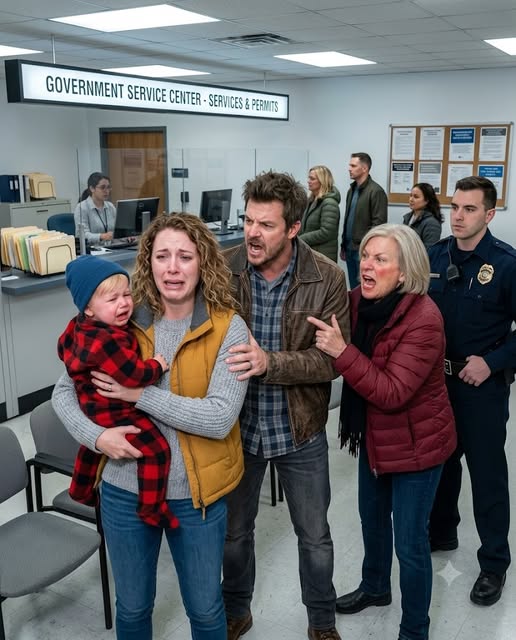
PART 1
The doctor delivered the news at 8:17 on a Monday, at the Ángeles de las Lomas Hospital.
Don Rodrigo Herrera didn't blink when the cardiologist lowered his voice.
—I’m so sorry, Mr. Herrera. Santiago’s heart is failing faster than expected. He’s not responding well, not eating, rejecting therapy. If this continues… we’re talking about 14 days.
14 days.
His son was only 25.
Santiago had been the boy who ran barefoot through the garden of their home in San Ángel, the one who dirtied the sofas crafting castles with cushions, the one who begged his mom to make red cake because he said it tasted like birthdays, hugs, and home.
Now he was a skinny, pale, lifeless young man, sitting in a wheelchair as if he had already said goodbye to the world without telling anyone.
Rodrigo didn’t cry.
He hadn’t cried in 10 years, since Elisa, his wife, dropped dead at the dinner table from an aneurysm.
One minute she was laughing at one of Santiago’s bad jokes.
The next, she wasn’t breathing.
Since then, Rodrigo did the only thing he knew how to do: work.
He bought land.
He built towers.
He closed deals.
He became that businessman everyone talked about in Polanco, the man who turned forgotten neighborhoods into luxury buildings.
But he didn’t know how to sit beside his son and ask him:
—Are you scared, kid?
So he paid.
Private doctors.
Full-time nurses.
Foreign specialists.
Experimental treatments.
Everything that money could buy.
Everything, except his presence.
That afternoon, he took Santiago home.
The boy’s room overlooked the garden where Elisa had planted a jacaranda the year he was born. Santiago stared at the tree as if those purple branches were the only ones that still understood him.
He didn’t touch breakfast.
Nor lunch.
Nor dinner.
The first nurse quit the next day.
—He doesn’t want help —she said, nervously—. He doesn’t want anything.
—Hire another one —Rodrigo replied.
By Friday, two more nurses had left.
Then Camila Méndez arrived.
She was 26, with a canvas bag, a worn brown jacket, and honey-colored eyes that didn’t ask for permission, but neither challenged him.
Doña Lupita, the housekeeper, greeted her.
—You’re not just here to clean, girl.
—I know.
—The young man is very sick.
—I was told.
—He doesn’t eat, hardly speaks, and can’t stand being treated like a baby.
Camila nodded.
—Well, almost nobody can stand being reminded they’re dying.
Doña Lupita fell silent.
It was the most honest thing anyone had said in that house for weeks.
When Camila entered Santiago’s room, she didn’t open the curtains with false cheer nor told him to “hang in there,” like everyone else.
She simply pulled up a chair and stared at the jacaranda with him.
They sat in silence for 6 minutes.
Then she said:
—That tree thinks a lot of itself, doesn’t it?
Santiago glanced at her sideways.
—I’m not saying it ugly —Camila continued—. It looks nice, but it has the face of someone who knows it’s the prettiest in the garden.
There was silence.
Then Santiago murmured:
—My mom planted it.
Camila smiled.
—Then she had good taste.
—Better than my dad.
It wasn’t exactly a joke.
But it came close.
Rodrigo, standing outside, felt something choke in his throat.
He hadn’t heard that tone in his son for months.
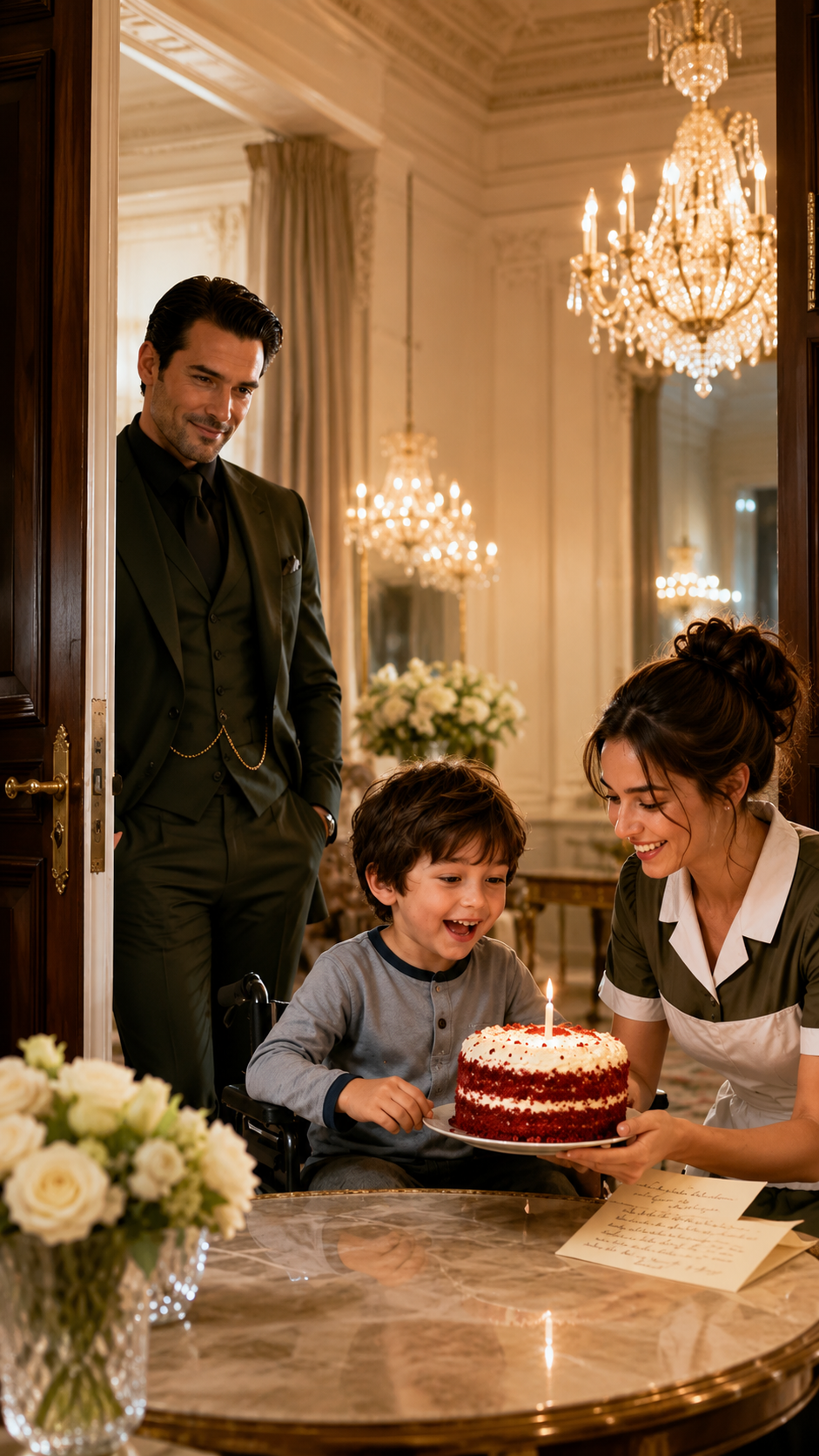
The next day, Camila came in with a small red cake, with crooked frosting and a white candle.
Santiago stared at the plate.
—What’s that?
—A half-ugly red cake, but with heart.
—My mom made one just like it.
—That’s why I made it.
Rodrigo barged in.
—Where did you get that recipe?
Camila wasn’t scared.
—from a box in the kitchen.
Rodrigo felt cold.
No one had touched Elisa’s recipe box in 10 years.
Santiago took the fork with trembling fingers.
He took a bite.
Then another.
And then he cried.
Not loudly.
Not dramatically.
He cried like someone who had been holding their soul for months.
—It tastes the same —he whispered.
For the first time in a long time, he asked for another piece.
Camila reached into her apron pocket and left a folded envelope next to the plate.
—Your mom wrote this for your 25th birthday.
Rodrigo felt the blood drain from him.
Elisa died when Santiago was 15.
Camila looked down.
—She asked me to deliver it when it was needed.
Santiago took the letter.
But before he opened it, Rodrigo saw the writing on the envelope.
It was Elisa’s handwriting.
And beneath Santiago’s name was a phrase that left him breathless:
“When he stops wanting to live, tell him the truth.”
PART 2
The room fell silent.
The candle still flickered atop the cake, small, trembling as if it were scared too.
Santiago looked at the envelope.
Rodrigo looked at Camila.
Camila looked at the floor.
No one was breathing normally.
—What truth? —Santiago asked.
His voice was weak, but not broken.
Rodrigo stepped closer to Camila.
—Who are you?
Doña Lupita appeared at the door, crossing herself quietly.
Camila swallowed hard.
—I’m Camila Méndez. My mom was Teresa Méndez.
Rodrigo frowned.
That name rang a bell.
Not from meetings.
Not from business.
From something older.
Something hidden.
Camila pointed at the letter.
—You’d better read it.
Santiago opened the envelope carefully.
Inside were 3 pages.
Elisa’s writing filled the first page, neat, soft, unmistakable.
Santiago tried to read, but his hands trembled.
Rodrigo took the letter.
For the first time in 10 years, his wife’s voice returned to the house.
“My Santi:
If you’re reading this, it means you’ve reached your 25th birthday, though maybe with a tired heart.
I don’t know what your life will be like when this letter appears. I don’t know if your dad has learned to hug you without feeling awkward. I don’t know if you still hold a grudge because I left without saying goodbye.
But I do know one thing: if Camila is with you, it wasn’t by chance.”
Santiago looked up.
—What do you mean it wasn’t by chance?
Rodrigo kept reading, though each word weighed heavier.
“Camila is Teresa’s daughter, my most loyal friend. When your dad started building his empire, there were people he hurt without looking back. One of those people was Teresa.
Rodrigo wasn’t bad, but he became blind.
He bought the land where Teresa lived with her daughter. Legally he won. Humanly, he lost.”
Rodrigo froze.
The memory hit like a slap.
Iztapalapa.
A complex of tenements.
A halted construction.
A young woman begging for more time because her girl was sick.
Rodrigo didn’t go see her.
He sent lawyers.
Sent security.
Sent papers.
He never looked at the girl.
Camila pressed her lips together.
—My mom lost the house because of your project.
Santiago looked at his father as if he’d just seen him for the first time.
—Is that what you did?
Rodrigo didn’t answer.
Because yes.
He had done it.
And worse: he didn’t even remember it all.
The letter continued.
“I met Teresa when I went to review the complaints about that eviction. I wanted to help her in secret because I was ashamed of what our family was causing.
Over the years, Teresa and I became friends. Camila was a quiet girl, but she had a strange gift: she sat next to whoever was suffering and managed to make them breathe a little better.
When Teresa fell ill, I promised her that her daughter would never be alone.
Rodrigo, if you’re reading this, it’s also for you.
Money doesn’t repair what one breaks if they don’t have the courage to look at the damaged person.”
Rodrigo’s jaw trembled.
Doña Lupita covered her mouth.
Santiago remained pale, but his eyes were no longer empty.
They were filled with rage.
—Did my mom know everything?
—Yes —Camila replied—. She helped us a lot. Paid for my mom’s medications. My school. The rent for a small room. But she never wanted me to feel bought.
Rodrigo whispered:
—Why didn’t she tell me anything?
Santiago let out a bitter laugh.
—Because you were never around, Dad.
The phrase hurt more than any diagnosis.
Rodrigo wanted to defend himself.
To say that he worked for them.
That it was all for Santiago.
That the house, the doctors, the money.
But Santiago raised his hand.
—No. Not now.
And continued reading himself.
“Camila, if one day you return to this house, don’t do it out of debt. Do it only if your heart tells you there is still something to save.
Santi, if you feel you can’t go on, listen to this: your life isn’t measured by how many days the doctors give you, but by how much truth you’re able to face before you leave… or before you stay.”
Santiago left the letter on his lap.
He cried in silence.
Camila did too.
Rodrigo couldn’t.
He still didn’t know how.
The following days changed the house.
Not as a cheap novel miracle.
Not all at once.
But something shifted.
Santiago started eating a little.
Half a bolillo.
A few spoonfuls of chicken broth.
Small pieces of the red cake that Camila baked imperfectly, because she said perfection didn’t always comfort.
He accepted respiratory therapy.
He accepted bathing sitting down without fighting.
He accepted going down to the garden one afternoon, wrapped in a blanket.
Doña Lupita cried hidden by the laundry.
—Honestly, Mrs. Elisa is pulling strings from heaven —she murmured.
But Rodrigo wasn’t at peace.
Guilt, when it wakes up late, doesn’t ask for permission.
One night he entered Elisa’s old office and finally opened the drawers he had kept closed for 10 years.
He found receipts.
Photos.
Letters.
And a yellow folder with the name Teresa Méndez.
Inside were medical documents.
One said that Teresa died waiting for a surgery that the insurance denied.
Another had a note written by Elisa:
“Rodrigo could have prevented this if he had listened.”
He sat on the floor.
For the first time, he cried.
Not beautifully.
Not dignified.
He cried like a man who understood too late that he had built buildings over the lives of others.
At the bottom of the folder was a sealed envelope with red wax.
It said:
“For when Santiago asks about the second truth.”
Rodrigo didn’t want to open it.
He was scared.
But Santiago found it the next day.
—No more secrets —he said.
They were in the living room.
Camila in front of them.
Doña Lupita behind, like a witness to a family breaking and sewing itself back together at the same time.
Santiago opened the envelope.
Inside was an old photo.
Elisa, Teresa, and little Camila, sitting on a bench in Xochimilco, next to the canals.
Behind them stood a man, partially visible.
Rodrigo.
But he was not dressed like a businessman.
He wore a white shirt, a young face, and a smile he had forgotten.
Santiago turned the photo over.
There was a phrase:
“Rodrigo saved Camila once. Then forgot her.”
Rodrigo felt a blow to his chest.
Then he remembered.
An accident in Xochimilco, 19 years ago.
A crashed boat.
A girl who fell into the water.
He jumped in without thinking.
He pulled her out.
He left her coughing in her mother's arms.
Elisa looked at him that day as if she still believed in him.
Camila’s eyes widened.
—You…?
Rodrigo nodded, shattered.
—I pulled you out of the canal.
Camila put a hand to her chest.
—My mom always said a rich man saved my life before taking our house. She never told me it was you.
The living room filled with brutal silence.
That was the cruelest twist.
Rodrigo hadn't been a monster from the start.
He had slowly become one.
And that’s why it hurt more.
Santiago breathed heavily, but didn’t take his eyes off his father.
—So my mom left these letters for you to see who you were before… and who you ended up being.
Rodrigo collapsed to his knees.
Not for show.
Not to be forgiven.
But because he could no longer bear the weight.
—I’m sorry —he said, looking at Camila—. I’m sorry for your mom. For your house. For not asking your name. For believing that paying for things was the same as caring for people.
Camila cried, but didn’t approach.
—My mom died without hating you —she said—. That always made me angry. Now I understand why. She remembered the man who jumped into the water. Not the one who sent lawyers.
Santiago closed his eyes.
—I miss that man too, Dad.
That night, Rodrigo did something nobody expected.
He called his partners.
Canceled a project that was going to evict 38 families in Doctores.
Ordered to create a fund in Teresa Méndez’s name for housing and medical care.
And made Camila the first beneficiary, not as charity, but as restitution.
She didn’t smile.
She only said:
—Don’t buy my forgiveness, Mr. Rodrigo. Earn it.
For the first time, he had no response.
The following days were tough.
Santiago had relapses.
Fever.
Pain.
Fear.
But he no longer rejected everyone.
When the doctor came back to check on him, he didn’t promise miracles.
—His heart is still very delicate —he said—. But there’s an important difference: now he wants to fight.
Santiago looked at Camila.
Then at his father.
—I don’t know if I’m going to live —he said—. But I don’t want to die angry anymore.
Rodrigo approached slowly.
He didn’t know how to hug without awkwardness.
Even so, he tried.
Santiago didn’t push him away.
Camila stepped out to the garden to give them space.
The jacaranda released purple flowers onto the grass, as if Elisa were leaving little signs.
Weeks later, Santiago was added to a special list for a treatment he had previously rejected.
Not because he was sure of being saved.
But because he wanted to try.
The red cake returned to the table every Sunday.
Sometimes it came out crooked.
Sometimes too sweet.
But nobody complained.
Because it was no longer just a recipe.
It was a memory.
An apology.
A second chance.
Rodrigo never returned to being the same.
Some on social media called him a hypocrite when the fund was revealed.
Others said nobody changes.
Others defended Camila, insisting she should never forgive.
And maybe they all had a bit of a point.
Because there are damages that cannot be erased with money.
There are absences that cannot be justified with work.
And there are truths that arrive late, but can still save what is left.
Elisa didn’t leave a letter to revive the dead.
She left a letter to awaken the living.
And that was the part that hurt the most.
Because Santiago had 14 days according to the doctors.
But his father had spent 10 years dead inside, thinking he was still breathing.