PART 1
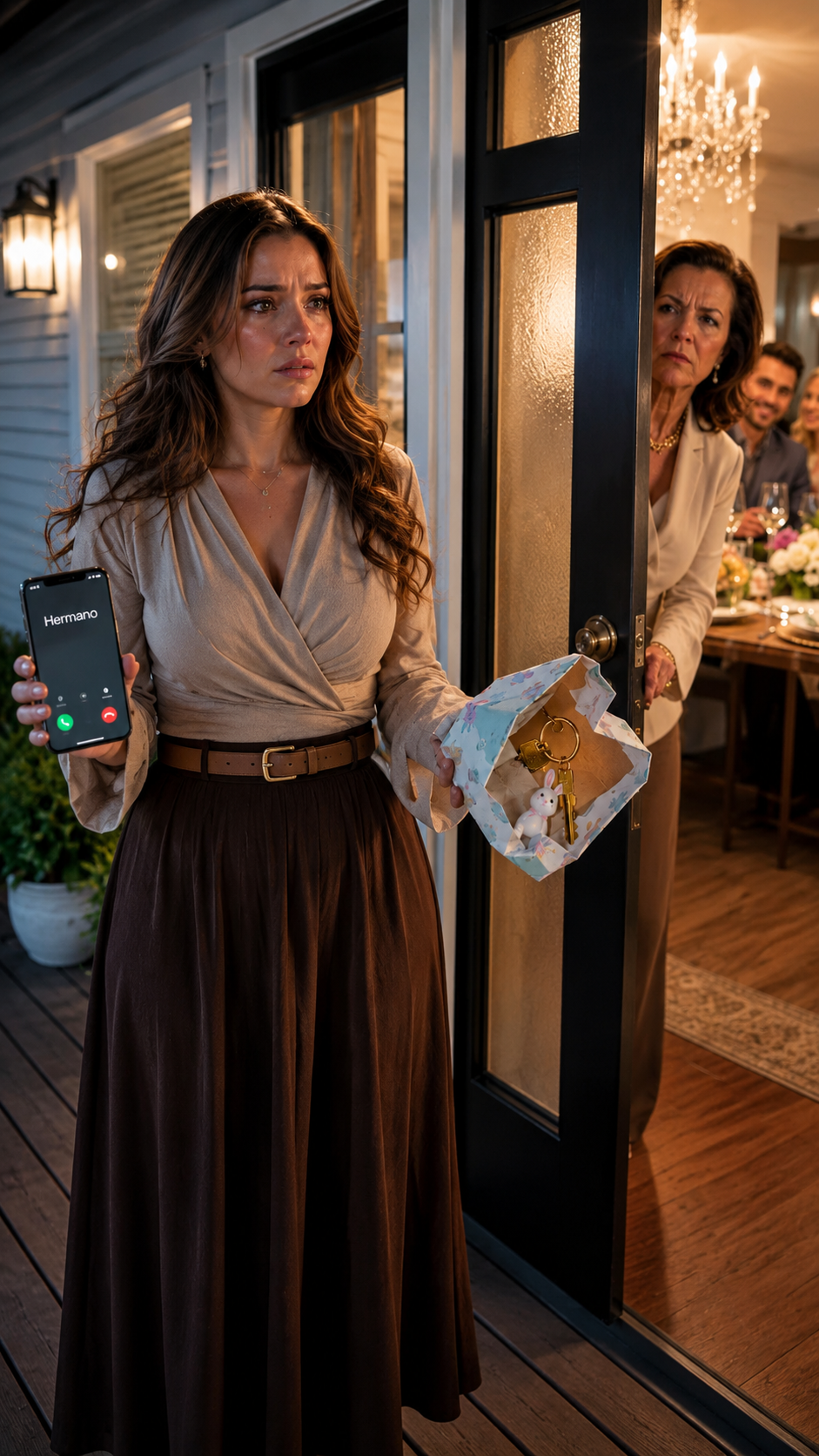
"Sorry, young lady… I think you have the wrong house."
Doña Teresa's voice sounded dry behind the ajar door, as if the woman standing on the porch were not her own daughter.
Sofía froze.
It was Easter Sunday in a rented house in the El Mirador neighborhood of Puebla. From the street, the scent of mole poblano, red rice, sweet bread, and freshly brewed coffee wafted through the air. Laughter, old Juan Gabriel music, and clinking glasses echoed from within.
The whole family was gathered.
Everyone but her.
Sofía wore a simple blue dress, her hair gathered up from the heat, and held a white box tied with a yellow bow. She had cradled it carefully since leaving her apartment, as if carrying something fragile.
Inside were no chocolates.
There was a key.
For six weeks, Sofía had searched for a house for her parents. A single-story home, with no stairs, wide hallways, and a clinic nearby, because her father, Don Ramón, was already walking with a cane and tired after climbing just three steps.
She had also thought of her mother, who always complained about the noise, the humidity, and the neighbors.
Sofía had paid the deposit, the first month’s rent, and maintenance. Everything was in her name, yes, but the idea was to surprise them that afternoon, over coffee and sweet bread.
Only Doña Teresa wouldn’t let her in.
"Mom, it’s me," Sofía said, her throat tight.
Doña Teresa didn’t even look down.
"I already told you. No one named Sofía lives here."
And she shut the door.
The thud wasn’t loud, but it shattered something inside her.
Sofía stood for a few seconds, staring at the wine-colored sheet metal. Behind the door, someone turned up the music. Then she heard her brother Arturo’s voice.
“Enough, Mom, don’t keep it up. If she gets intense, we’ll calm her down later.”
Then came Brenda’s laughter, his fiancée.
“How embarrassing, coming by unannounced.”
Sofía didn’t scream.
She didn’t beg.
She didn’t knock again.
She walked to her car with the box pressed against her chest. The street smelled of wet earth and festive food. When she got into the car, she placed the box in the passenger seat and stared at the house she had been paying for for the past fourteen months.
The rent.
The water.
The electricity.
The gas.
Her father’s medications.
The additional cards her mother used "only for emergencies."
Then her cell phone rang.
It was Arturo.
Sofía answered reflexively.
"Hello?"
No one replied.
She was about to hang up when she heard laughter on the other end. Arturo had accidentally dialed and left the call open.
Brenda’s voice came through clearly.
"Did the offended one leave?"
Arturo burst into laughter.
"Yeah. She can deal with it. Just because she pays the rent doesn’t mean she has the right to sit at the table."
Sofía stopped breathing.
Then Doña Teresa spoke.
"As long as she keeps paying, let her be. Later, we’ll convince her to sign for the new house. If she gets difficult, we can say your dad is unwell."
Sofía looked at the white box.
The key inside no longer felt like a gift.
It felt like a mockery.
Arturo continued, overly confident.
"When my parents move, Brenda and I will stay here. The landlord won’t rent to me because of my issues, but if Sofía remains as a guarantor, everything will be fine."
The call cut off when someone shouted that the mole was getting cold.
Sofía put away her phone.
She didn’t cry.
She started the car and drove away.
At 5:43 the next morning, she logged into her online banking.
She canceled the automatic rent payment.
She blocked the additional cards of Doña Teresa.
She removed her name from the internet, gas, and electricity.
At 6:17, she messaged the landlord:
"Good morning, Mr. Cárdenas. Starting today, I will no longer cover payments or act as a guarantor for renewal."
At 7:02, she called the administrator of the new subdivision.
"I need to modify the contract. My parents will no longer be occupants. The house is just for me."
At 7:48, the first message from her mother arrived.
"Sofía, there’s a problem with the rent. Fix this before you make a mess."
No apology.
No shame.
Not even a "how are you?"
Just money.
Sofía opened the white box. The key shone atop a paper that read: "So you can finally have peace."
And for the first time in years, she understood that peace was no longer for them.
It was for her.
PART 2
By 9 AM, Doña Teresa had turned her guilt into a family tragedy.
First, she called her sisters.
Then her cousins.
Then the group of friends.
Before noon, half the world was messaging Sofía as if she had committed a crime.
"Your mom is crying."
"Your dad doesn’t deserve this."
"A daughter never abandons her parents."
"At Easter, we forgive, sweetie, don’t be bitter."
Sofía sat in her office, in front of a computer she hadn’t touched in two hours. She had an open notebook and a pile of digital receipts on the screen.
She didn’t reply to anyone.
She just started adding up.
14 months of rent.
14 months of electricity.
14 months of water.
14 months of gas.
Supermarket every Friday.
Pharmacy every week.
Private consultations.
Rehabilitation.
A reclining chair her mother requested because "your dad needs it," even though in the photos, it was always Arturo sitting there watching games.
The final sum made her nauseous.
It wasn’t support.
It was a whole life sustained on her back.
Mariana, her coworker and friend, found her pale.
"Is it your family again?"
Sofía told her everything: the door, the call, Arturo’s phrase, Brenda’s plan, the new house, and the key she no longer intended to give.
Mariana didn’t make pity faces. She just pressed her lips together.
"That’s not family, Sofi. That’s a debt with a last name."
The phrase pierced her because it was exact.
At 1:15 PM, Don Ramón called from an unknown number.
Sofía almost didn’t answer.
She did because she still remembered the man who took her for cemitas after school when she was a girl, before the fear of Doña Teresa made him small.
"Daughter," he said, his voice trembling. "Please, don’t hang up."
Sofía remained silent.
"Your mom made a mistake. Arturo did too. It was an awkward moment. Brenda said it wasn’t good to cause a scene with everyone there…"
"And that’s why they pretended I didn’t exist?"
Don Ramón breathed heavily.
"It wasn’t like that."
Sofía opened the white box and took out the key.
"I was going to gift them a safer house. A single story. Near your clinic. I had already paid the deposit and first month."
On the other side, there was a long silence.
"What house?" he asked.
Sofía closed her eyes.
There was the first blow of truth.
Her father didn’t know everything.
Or at least didn’t know the extent.
"The house that Mom and Arturo wanted to use for you to move and he would stay in the current one."
Don Ramón let out a choked sound.
"Sofía…"
"Tell me the truth, Dad. Did you know Arturo was planning to keep the house I pay for?"
He took too long to respond.
"Not in those words."
That answer hurt more than a lie.
Because it meant he knew something.
That he had seen the abuse and preferred not to be disturbed.
That afternoon, Arturo showed up at Sofía’s building. He rang the bell six times and knocked on the door as if he had the right to enter.
"Open up, don’t be dramatic!"
Sofía opened with the chain on.
Arturo looked disheveled, with red eyes and a tense jaw. Behind him was Brenda, wearing dark glasses and a displeased face.
"Do you realize what you did?" Arturo spat. "The landlord gave notice. Mom is unwell. Dad almost fell. What kind of daughter does that?"
Sofía stared at him without blinking.
"The kind of daughter who discovered yesterday that she wasn’t a daughter. She was a credit card."
Brenda scoffed.
"Oh, please. All over one phrase."
Sofía lifted her phone and played the audio.
Arturo’s voice filled the hallway:
"Just because she pays the rent doesn’t mean she has the right to sit at the table."
Brenda removed her glasses.
Arturo went pale.
"That’s taken out of context."
Sofía tilted her head.
"Of course. The context was that you also wanted to keep a house I maintained."
Arturo lowered his voice.
"Look, it’s enough. Give the key to my parents. You make good money. It doesn’t cost you anything."
Sofía let out a dry laugh.
"It doesn’t cost me anything because you never accounted for what it cost me."
He clenched his fists.
"You’re really mean, seriously."
"No. Mean would be to keep paying so they can shut the door in my face."
Brenda stepped forward.
"And what about us? We had plans."
Sofía looked at her for the first time.
"That’s the problem. You made plans with my money without inviting me to the conversation."
Arturo tried to push the door, but the chain held him back.
Sofía wasn’t scared.
She just said:
"If you knock on my door like that again, I’ll call security."
Arturo opened his mouth but couldn’t find a way to reclaim the sister who used to give in to avoid being called conflictive.
That sister was no longer there.
That night, Doña Teresa left a voice message from a neighbor’s phone.
"Daughter, your dad told me about the house. If we had known it was something so important, we wouldn’t have treated you like this."
Sofía listened to the message twice.
On the second time, she understood the cruelest thing.
Her mother didn’t lament having humiliated her.
She lamented not knowing how valuable the daughter she was humiliating was.
The next day, Sofía did something she had never allowed herself.
She prepared an email.
She didn’t write it with insults.
She wrote it with evidence.
She attached receipts for rent, utility payments, deposits for medications, supermarket snapshots, account statements, and the contract where she appeared as a guarantor.
She also added Arturo’s audio.
She sent it to the family that was judging her without listening.
Then she turned off her phone for three hours.
When she turned it back on, the family lie was already burning.
The aunt who had told her about forgiveness wrote:
"Forgive me, sweetie. I didn’t know."
A cousin who never got involved in anything said:
"That was really low of Arturo."
A neighbor deleted her messages from the church group.
Even Brenda’s godmother sent an audio saying that one thing was to help the parents and another was to let them use her "as an ATM in a skirt."
Doña Teresa stopped replying.
Arturo, on the other hand, began defending himself, saying Sofía was "crazy," that she had manipulated the audio, that she was resentful because Brenda was going to start a family.
But Mr. Cárdenas, the landlord, finished tearing down their charade.
He informed Don Ramón that he would not renew the contract without Sofía as a guarantor. He also made it clear that Arturo could not be responsible because he had outstanding debts, two reports for damages in previous apartments, and a past-due promissory note.
There came the twist no one expected.
Brenda didn’t know everything.
Arturo had told her that the house was already "secured," that his sister was going to leave it to them, and that he just needed time to "order his finances."
When Brenda discovered the debts, the reports, and the promissory note, she went to Doña Teresa’s house to confront her in front of everyone.
"They swore to me that Sofía was the selfish one! And it turns out you all were living off her!"
The wedding was suspended that same week.
Arturo blamed Sofía.
Doña Teresa blamed Brenda.
Don Ramón blamed no one.
That silence was his first form of shame.
The following Sunday, Don Ramón asked to meet Sofía at a café near Parque Juárez. She agreed to only thirty minutes.
When she arrived, he was already sitting by the window. His hands trembled over an untouched cup of coffee.
"I need to tell you the truth before your mother twists it," he said.
Sofía sat down.
Don Ramón confessed that Arturo had convinced Teresa for months. He told them that Sofía didn’t need so much money, that she had no children, that she lived alone, that it was "only fair" to help the man who was going to get married.
He also revealed that Teresa had already used one of the credit cards to pay part of Arturo’s wedding venue.
Sofía felt the air leave her.
"It wasn’t for emergencies."
Don Ramón looked down.
"No."
"And you knew?"
He cried silently.
"I knew enough. And I was afraid to fight."
Sofía didn’t scream.
At that point, her pain didn’t need volume.
"These are my conditions," she said. "I won’t pay Arturo’s debts. I won’t finance his wedding, his rent, or his life. If you need therapy, I can pay directly to the clinic. If you all need real support, it will be with receipts, clear contracts, and no secrets."
Don Ramón nodded.
"And your mom?"
Sofía looked out the window.
"My mom shut the door on me. Now she can knock respectfully, not with demands."
On Tuesday, Sofía moved into the new house.
She didn’t give it to her parents.
She took it for herself.
Mariana arrived with boxes, coffee, and two lavender plants. The house was small, bright, with light tile floors and a patio where a bougainvillea was starting to bloom.
Sofía placed her plates in the kitchen.
She hung her keys by the door.
She set the white box on a shelf, but it was empty.
The key was already on her keychain.
That night, she prepared noodle soup, opened the windows, and listened to the silence.
It wasn’t the silence of a table where she was excluded.
It was the silence of a house that didn’t ask her to pay to deserve love.
Three days later, Arturo showed up.
He arrived furious, with a scruffy beard and the same attitude as always: as if the world owed him an explanation.
"So you did keep the house."
Sofía was on the porch, watering the bougainvillea.
"I didn’t keep anything. I rented it. I pay for it. I live here."
Arturo looked inside, as if he could still find a way to enter.
"You left your parents homeless."
"No. I stopped sustaining a lie."
"You’re cruel."
Sofía turned off the hose.
"Cruel was saying I wasn’t part of the family while using my money to plan your future."
Arturo swallowed hard.
"Mom says you’re killing her with sadness."
Sofía held his gaze.
"No. She’s being killed by the habit of confusing me with an obligation."
For the first time, Arturo didn’t know how to respond.
Sofía went inside and closed the door.
This time, the door was on her side.
Two months passed.
Don Ramón signed a contract at a simple, clean assisted living residence near his clinic. Sofía paid directly for the therapies, not the full rent, and left everything in writing.
Doña Teresa took weeks to speak again.
One day she sent a small package.
Inside was a poorly painted ceramic mug, with a crooked blue flower. Sofía had made it in middle school. Her mother wrote a note:
"I found this while packing. I think it was always yours."
Sofía left the mug in the kitchen.
She didn’t reply.
Not every forgiveness needs an immediate response.
Sometimes, the first form of justice is returning what should never have been taken.
When the next Easter arrived, Sofía didn’t go to any family meals.
She prepared green chilaquiles, placed fresh flowers in a vase, and hung a yellow wreath on her door.
At noon, she received a message from Doña Teresa.
"Happy Easter, daughter. I hope that one day you can forgive me."
Sofía read it.
She felt no hatred.
Not even tenderness.
She felt distance.
And that distance, for the first time, didn’t give her guilt.
She stepped onto the porch with her cup of coffee. The bougainvillea swayed in the wind. The street was quiet. No one asked her for money. No one charged her love. No one expelled her from a table she had paid for herself.
Sofía then understood something many families prefer not to discuss:
when a daughter stops holding everything up, the family doesn’t always break.
Sometimes, only the abuse breaks.
And what remains after is not loneliness.
It’s peace.