PART 1
At the Coyoacán Cultural Center, as the rain beat against the windows as if it too wanted to enter, Mateo Ríos arrived, clutching an old shoebox to his chest.
He was 10 years old, his sneakers torn at the toes, his pants soaked up to his knees, and a white shirt that his mom had washed with such care it still smelled of cheap soap.
He wasn’t going to beg for charity.
He was going to sing.
The children's contest promised 1,500,000 pesos to the winner. For many kids, it meant fame, interviews, and applause. For Mateo, it was the only way to pay for his mother’s surgery, Clara Ríos, who was hospitalized by an illness that was slowly extinguishing her body.
At the registration table sat Patricia Moncada, the event director. She wore a red jacket, perfect lips, and a gaze capable of making anyone feel small.
When she saw Mateo, she didn’t ask his name.
First, she looked at his shoes.
Then the box.
Then she smiled with disdain.
—This contest isn’t for kids who come from slums to elicit pity—she said, her voice deliberately loud—. Here we seek real talent, prepared, presentable kids, not brats who dirty the stage.
Mateo tightened his grip on the box.
Some mothers turned their heads. A guard stopped chewing gum. A girl in a sequined dress lowered her gaze, uncomfortable.
—I’m here to sign up—he replied, trying not to let his voice tremble.
Patricia took his form with two fingers, as if it were wet trash.
—Mateo Ríos. 10 years old. No singing school. No representative. Morelos neighborhood. Guardian: Clara Ríos.
She raised an eyebrow.
—And what do you have that the others don’t?
Mateo took a deep breath.
—I have a voice.
Patricia let out a dry laugh.
—Anyone can have a voice, kid. Even those who shout “tamales” on the corner. That doesn’t mean they can sing on a stage.
Mateo felt his face flame.
But he remembered what his mom told him when life got heavy:
“When they try to humiliate you, don’t give them your dignity as well.”
So he didn’t cry.
He just said:
—I also have the money.
Patricia frowned.
—The registration costs 4,800 pesos. We’re not talking about buying a corn on the cob.
Mateo placed the box on the table.
He opened it.
And emptied a year’s worth of sacrifices inside.
Coins of 1, 2, 5, and 10 pesos fell with a metallic clatter. Then crumpled bills, some taped together, others folded so many times they looked like old paper.
The reception fell silent.
Mateo began to count.
—1,000.
Patricia stopped smiling.
—2,000.
A man took out his phone to record.
—3,000.
The coins kept shining on the table.
—4,800.
Mateo raised his gaze.
—There’s nothing missing.
Patricia was about to respond when a door in the hallway opened.
A tall man stepped out, with a well-groomed beard, a black jacket, and tired eyes. It was Leonardo Aranda, a famous singer, producer, and the main judge of the contest.
Mateo recognized him from the huge poster at the entrance.
Leonardo looked at the boy.
And froze.
Something in that rain-soaked face, in that clenched jaw, in that way of holding fear without breaking, hit him in the chest like an old song.
—What’s happening here?—he asked.
Patricia adjusted her jacket.
—Nothing important, Leonardo. A kid without preparation insists on participating.
Mateo swallowed hard.
—She said I came to dirty the stage.
The silence became sharp.
Leonardo looked at Patricia.
—Did you say that?
—I’m just protecting the image of the program.
—I asked if you said it.
Patricia didn’t answer.
Leonardo took a clean form and handed it to Mateo.
—Fill it out again.
—But I’m the director—she protested.
—And I’m a sponsor. If the rules say any child aged 8 to 15 can enter by paying the fee, then let him enter.
Mateo filled out the paper with trembling hands.
Name: Mateo Ríos.
Age: 10.
Talent: singing.
When Patricia stamped the form, she did it with rage.
—Friday. 6 PM. Don’t be late.
Mateo picked up his empty box and walked toward the exit.
Before leaving, Leonardo called him.
—Mateo.
The boy turned around.
—Good luck.
Mateo nodded, not understanding why that man looked at him as if he had just seen a ghost.
That same night, in the damp room where he lived with his mom, Mateo taped the contest flyer next to the hospital budget.
Prize: 1,500,000 pesos.
Surgery and treatment: 1,250,000 pesos.
Clara, pale under a blue blanket, watched him with eyes full of love and fear.
—You don’t have to carry this, my boy.
Mateo sat next to her.
—If you die, then I do have to.
Clara covered her mouth to keep from crying.
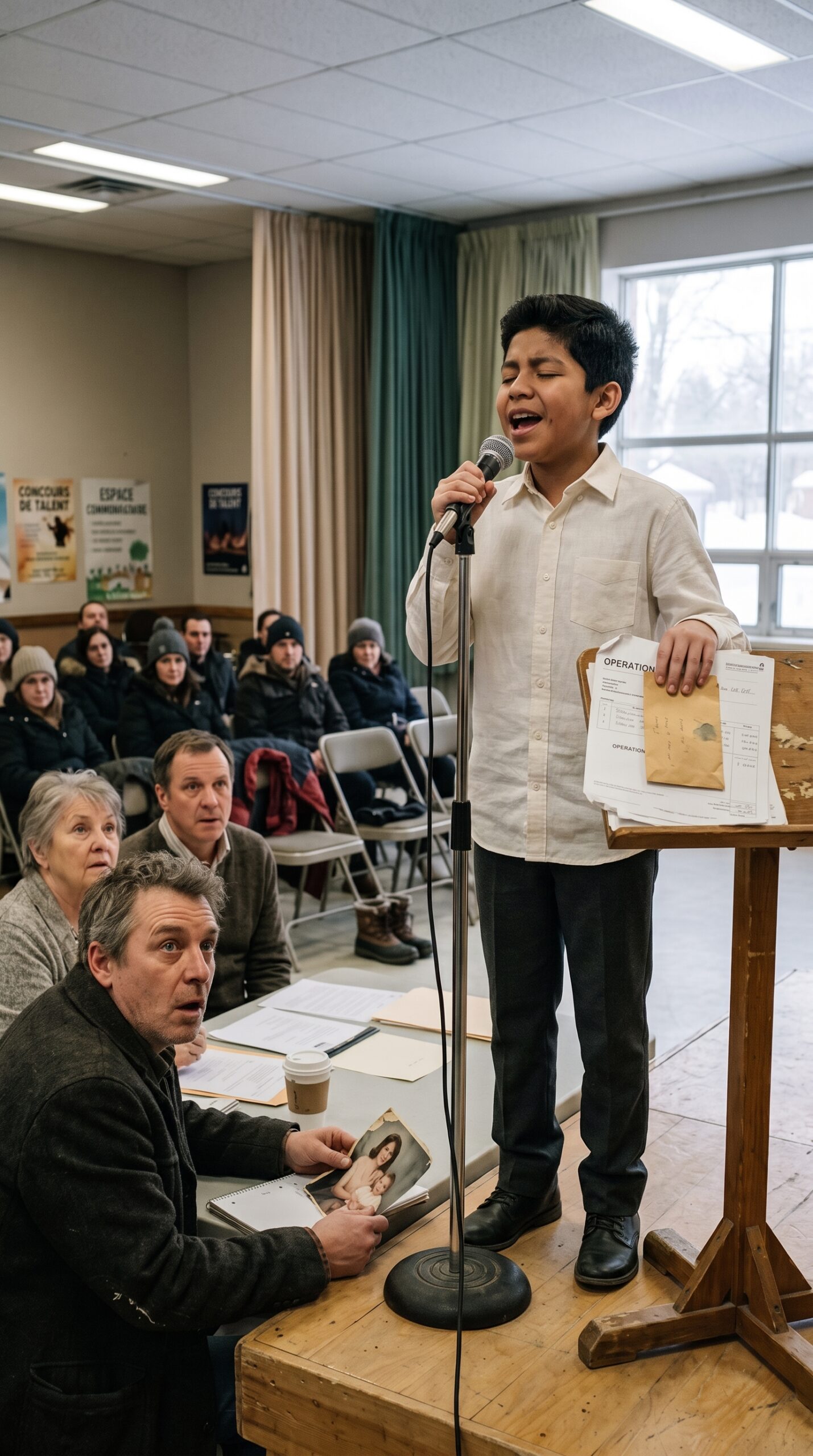
On Friday, Mateo stepped onto the stage alone, without a track, without an elegant suit, without anyone to adjust the microphone for him.
In the front row, his mom wasn’t there. The fever didn’t let her go out.
Mateo pulled out a note written by her:
“Sing as if I were there.”
He closed his eyes.
And sang.
PART 2
Mateo chose a song that Clara used to hum when she washed other people’s clothes in the patio of the tenement. It wasn’t the most modern or the easiest. It was a sad ranchera, one of those that seems to carry a hidden wound in every note.
At first, his voice came out soft.
Then it grew.
He didn’t have perfect technique. He didn’t do fancy embellishments. But he sang with something no teacher could teach: fear, hunger, love, and a clean desperation, from a boy who didn’t seek fame but time for his mother.
The auditorium stopped moving.
A woman clutched her chest.
A rich kid waiting for his turn stopped practicing steps.
Leonardo Aranda, sitting at the judges’ table, was left breathless.
Because in Mateo he saw his own face at 10 years old.
The same tense eyebrow.
The same way of clenching his mouth when a note hurt.
And when Mateo reached the highest verse, Leonardo remembered Clara.
Clara Ríos.
The girl from the Guerrero neighborhood he had loved before becoming famous. The woman who told him, 11 years ago, that she was pregnant. The woman he left with a broken promise and a dead phone.
When Mateo finished, there were 3 seconds of silence.
Then the audience stood up.
Not everyone.
But enough for the boy to open his eyes and not know what to do with so much applause.
The scores were good.
9.5.
9.7.
9.6.
Patricia raised a 7.4.
The crowd protested.
—Emotional, yes—she said into the microphone—, but not sufficiently trained.
Mateo lowered his head.
Leonardo said nothing.
But his eyes were wet.
That night, someone uploaded the video to Facebook:
“Boy with torn shoes sings to pay for his mom’s surgery and makes a famous judge cry.”
In a few hours, it reached 1,000,000 views.
Then 3,000,000.
Then 6,000,000.
A nurse from the General Hospital started a campaign for Clara. In 24 hours, they raised 380,000 pesos.
It was a lot.
But it wasn’t enough.
The final was still the only door.
And Patricia Moncada didn’t intend to leave it open.
On the day of the final, at 11 AM, Mateo received an email.
“Subject: Urgent eligibility problem.”
The committee said they had found old videos of Mateo singing well-known songs on a YouTube channel. According to the regulations, using material without permission could disqualify him. He had until 1 PM to present legal documents.
Mateo read the message once.
Then again.
Then he looked at his mom, who was sitting on the bed with skin almost transparent.
—I’m going to be disqualified.
Clara took the phone with weak hands.
—No, my love…
—We don’t have those documents.
She couldn’t lie.
—No.
The phone buzzed again.
It was a message from Leonardo.
“Come to the center now.”
Mateo ran.
He arrived sweaty, wearing a borrowed jacket that was too big. Leonardo was waiting for him at the entrance and took him straight to Patricia’s office.
He didn’t even knock.
Patricia was behind the desk, calm, as if she hadn’t just pushed a child off a cliff.
—This is legality—she said—. The rules are clear.
Leonardo placed a folder on the table.
—Then you’ll also disqualify your son.
Patricia turned pale.
Mateo’s eyes widened.
—Your son?
—Emiliano Moncada—Leonardo said—. He participates tonight. His application video uses an edited commercial track. Without permission. The same offense.
Patricia pressed her lips together.
—That’s different.
—No. What’s different is that he’s your son and Mateo isn’t.
The woman stood up angrily.
—You’re not going to threaten me in my own office.
Leonardo pulled out other papers.
—I also have 2 complaints from families you humiliated for coming from Tepito, Iztapalapa, and Neza. They were shelved because you had connections. But if you disqualify Mateo today, before 6 PM, all of Mexico will know you used the regulations to protect your son and destroy a poor boy.
Patricia trembled.
Rage colored her neck.
But she knew she was trapped.
She sat down, typed, and sent an email.
—The disqualification is withdrawn.
Mateo could hardly breathe.
In the hallway, he paused.
—Why are you helping me so much?
Leonardo looked at him with enormous sadness.
—Because I should have helped someone many years ago, and I was a coward.
Mateo wanted to ask more, but Leonardo received a call.
He listened.
His face changed.
—Clara Ríos?—he murmured.
Mateo felt cold.
—What’s wrong with my mom?
Leonardo put the phone away.
—Sing tonight, Mateo. We’ll talk about the rest later.
The final was a blaze.
The auditorium was full. Local cameras, raised cell phones, neighbors with handmade signs. Clara arrived in a wheelchair, accompanied by Teresa, the nurse who had started the campaign.
She wore a blue dress and a white scarf.
When Mateo saw her in the front row, his soul nearly broke.
Emiliano sang before him. He did it perfectly. Clean voice, impeccable clothes, the confidence of a boy used to having the world make space for him.
As he came down, he approached Mateo.
—My mom shouldn’t have done that to you—he whispered.
Mateo looked at him, surprised.
—No.
Emiliano lowered his gaze.
—Sing well, dude.
Mateo barely smiled.
—You too.
Then they announced his name.
—Mateo Ríos, with an original song entitled “Get Up.”
There was no track.
No musicians.
Just a microphone.
Mateo looked at Clara.
Looked at Leonardo.
Looked at his shoes.
And sang.
The song spoke of a room with a stained ceiling, of a mother who said “I’m fine” when she couldn’t get up, of a boy who learned to count coins before sleeping soundly.
Then the song grew.
It spoke of stages that also belong to those who arrive soaked, of small voices that don’t ask for permission to exist, of mothers who are home even when the world falls apart.
Clara cried without hiding.
Neighbors shouted.
Leonardo covered his mouth.
Patricia remained rigid.
In the last verse, Mateo sang looking at his mother:
—If I’m scared, I sing.
If they push me, I get up.
If the world lets go of your hand,
I’ll hold you tighter, Mom.
The silence that followed was brutal.
Then the entire auditorium stood up.
The scores came in.
9.8.
9.9.
9.7.
Patricia raised an 8.8, her face hardened.
The audience booed.
Leonardo raised his card.
The sum was enough.
Mateo Ríos won.
1,500,000 pesos.
The boy didn’t run for the check. He ran to Clara, knelt before her wheelchair, and hugged her as if the world had been saved for just 1 second.
—You did it—she cried.
—We did it—he said.
But the night still had a truth hidden.
When the auditorium started to empty, Leonardo approached.
—Clara… I need to talk.
She stiffened.
—No.
Mateo looked at his mother.
—Do you know him?
Clara closed her eyes.
—Yes.
They went to a small room behind the stage. There were cables, folding chairs, and old posters.
Leonardo closed the door.
It took a long time for him to speak.
—What I’m going to say I should have said 11 years ago.
Clara began to cry.
Mateo felt the floor shift.
Leonardo knelt in front of him.
—Mateo… I’m your biological father.
The boy was left speechless.
He looked at Clara.
—Is it true?
She nodded, broken.
Mateo took a step back.
—No.
—Son...
—Don’t call me son.
Leonardo lowered his head.
—You’re right. I have no right.
Mateo looked at him with rage.
—You left us.
—Yes.
—You left my mom alone.
—Yes.
—You let me grow up thinking my dad didn’t love me.
Leonardo closed his eyes.
—Yes.
Every answer was a stone falling.
Mateo clenched his fists.
—Then don’t come now. Don’t come when I’ve already won. Don’t come when there are cameras. Don’t come when everyone knows my name.
Leonardo pulled out an envelope.
—I didn’t come for that.
He handed it to Clara.
She opened it with trembling hands.
Inside was a receipt from the hospital.
The entire surgery was paid for.
Medications.
Post-operative care.
Treatment.
Everything.
—The prize is for your future—Leonardo said—. For studying, for living better, so you don’t have to count coins for a life. Your mom goes into surgery in 3 days.
Mateo felt like he couldn’t breathe.
—Why?
Leonardo cried.
—Because I can’t turn back time. But I can prevent you from losing your mom over something I can pay for.
Mateo looked at the receipt.
Then at the check.
Then at that famous man who had his same gaze.
—Thank you—he finally said.
Leonardo lifted his face with hope.
Mateo cut him off.
—But that doesn’t make you my dad.
The phrase left the room frozen.
Leonardo nodded, shattered.
—I know.
—My dad would have been there when there was no money for the light. When my mom had a fever. When I sang in the bathroom so I wouldn’t cry. You weren’t there.
—I know.
—And I don’t want you to buy me.
—Never.
Mateo took a deep breath.
—If you really want to help, don’t disappear. Don’t promise a picture-perfect family. Don’t lie. Don’t pressure me. And don’t ask me to call you dad.
Leonardo put a hand to his chest.
—I won’t.
Clara took Mateo’s hand.
—You decide, my love.
Mateo looked at Leonardo.
—For now, you’re Leonardo.
The man nodded.
—For now, I’m Leonardo.
Clara’s surgery was 3 days later.
It lasted 6 hours.
Mateo waited in the hallway, hands together and heart knotted. Leonardo was there too, but he didn’t enter without permission. He brought coffee, signed papers, spoke with doctors, and waited in silence.
When the surgeon came out, he said:
—The operation was a success. Recovery is needed, but your mom has a real chance.
Mateo let out a small sound, as if he could finally be a child again.
He didn’t hug Leonardo.
But he looked at him.
And that look was no longer just rage.
Months later, Clara walked again in the tenement's patio. Mateo started singing classes with a strict teacher who told him:
—You have soul, kid. Now let’s take care of that throat.
Leonardo kept his promise.
He didn’t disappear.
Nor did he demand forgiveness.
When a TV station wanted to do a special exploiting Clara’s pain, he refused.
—Her suffering isn’t for sale.
Mateo heard that phrase from the kitchen.
He said nothing.
But something inside him loosened.
With part of the money, Clara and Mateo moved to a simple apartment in Narvarte. Two bedrooms, a window with sun, and a sink that didn’t drip.
The first night, Mateo couldn’t sleep.
He waited for the sound of drops.
It didn’t come.
And he cried in silence.
2 years later, Mateo opened a scholarship program for children from popular neighborhoods. He called it Casa Levántate.
At the entrance, there was a hand-painted sign:
“Here, nobody dirties the stage. Here, everyone has the right to step on it.”
Children from Iztapalapa, Neza, Tepito, Xochimilco, and Morelos arrived. Some brought borrowed guitars. Others just a song learned from grandma.
One day, an 8-year-old boy appeared with a shoebox full of coins.
Mateo stood still.
—What do you have there?
—My registration—said the boy—. I didn’t gather it all in bills.
Mateo knelt in front of him.
—Here, you don’t have to empty your dignity on any table.
The boy blinked.
—So can I sing?
—Of course you can. But you’re going to arrive early, you’re going to work hard, and you’re going to sing with everything you have in here.
He touched his chest.
From the door, Leonardo watched.
Clara, already strong, whispered to him:
—He’s growing well.
Leonardo replied:
—Thanks to you.
She looked at him.
—And to the fact that you, although late, learned to stay.
When Mateo turned 15, there was mole, tres leches cake, and too many people in the apartment. Leonardo arrived early to move chairs.
After eating, he handed Mateo an envelope.
Mateo frowned.
—Is it money?
—No—Leonardo replied quickly.
Everyone laughed.
Inside was the deed to a local in the Morelos neighborhood, in the name of Casa Levántate.
—For your first community music school—Leonardo said—. It’s not mine. It’s not to buy you. It’s for the children that nobody wants to listen to.
Mateo remained silent.
Then he asked:
—What will it be called?
—You decide.
Mateo thought of the rain, of his torn shoes, of the box of coins, of his mom in bed, of that woman who told him he didn’t belong.
—Casa Levántate Morelos—he said.
Everyone applauded.
Mateo approached Leonardo.
And hugged him.
It was brief.
Awkward.
It didn’t heal 11 years.
But it opened a door.
—You’re still Leonardo—Mateo said.
The man smiled through tears.
—I know.
Mateo looked at him.
—but you’re my Leonardo.
Years later, when Mateo sang on big stages, people asked him what the most important day of his life was.
He never said the final.
Never said the prize.
Never said his first famous concert.
He always answered:
—The day my mom walked out of the hospital alive.
And if someone asked him about his father, Mateo would say:
—He arrived late. Very late. But he learned to stay.
One rainy afternoon, at Casa Levántate, they were reviewing scholarship applications. Leonardo passed him a folder.
—This girl sings son jarocho. She’s 11 years old. I think we should accept her.
Mateo read.
Signed.
And almost without thinking, said:
—Thank you, Dad.
There was no music.
No cameras.
Just rain on the roof.
Leonardo stood still, with filled eyes.
Clara, from the door, heard it all and smiled.
Because Mateo understood something no contest teaches:
Sometimes the happy ending isn’t that the past stops hurting.
It’s that the future becomes stronger than the wound.
And his, at last, was singing.





