PART 1
Sebastián Robles was 35 years old, running a growing construction company, a father to a 6-year-old daughter, and living a life so orderly that even his tragedies seemed meticulously categorized.
His mother, Clara, had been dead for 27 years.
That’s what he’d been told since he was a child.
That’s what the gravestone in the Dolores pantheon said.
That’s what his father, Don Ernesto Robles, repeated every time Sebastián asked why his mom hadn’t come back for him that April afternoon.
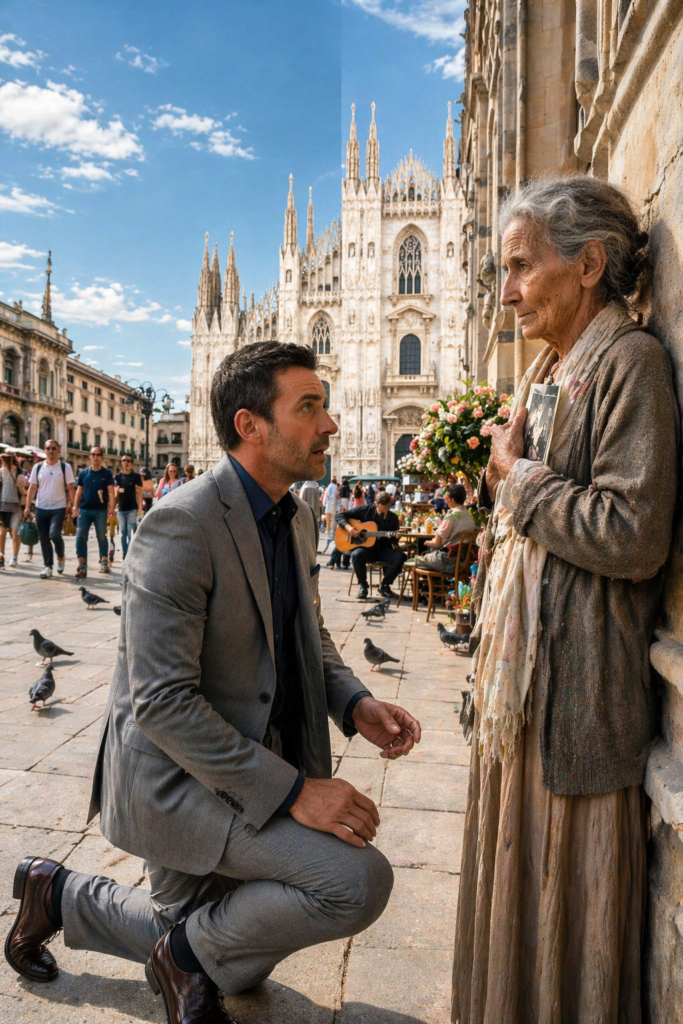
But one Sunday, as he was leaving mass at the Metropolitan Cathedral in Mexico City, Sebastián spotted a woman sitting next to a stone column, draped in a gray shawl, with a rusty can in front of her feet.
Her head was bowed.
In her hands, she clutched an old photograph, corners creased and worn.
It was a photo of an 8-year-old boy in a navy blue school uniform.
Sebastián froze as if someone had nailed his shoes to the ground.
Isadora, his fiancée, stood beside him, confused by the sudden change in his expression.
—Sebastián… —she whispered—. That lady looks so much like your mom.
He didn’t respond.
The woman lifted her gaze for barely a second.
She had the same green eyes Sebastián saw every morning in the mirror.
The same firm jawline.
The same small scar near her left eyebrow that appeared in the only family photograph his father kept in the living room.
Sebastián felt the noise of the Zócalo fade away.
The balloon vendors, the tourists, the organ grinders, the children running among the pigeons… everything became distant.
His mother was dead.
His father had buried her.
He himself brought flowers to her grave every Sunday.
For 27 years, Sebastián had stood before a tomb, believing that his mother was listening to him from heaven.
And now that same woman was there, alive, trembling from the cold, begging for coins outside the Cathedral.
Sebastián walked toward her.
Isadora tried to stop him, but he shook off her arm.
When he reached her, he crouched slowly, as if fearing the woman would vanish with any sudden movement.
—What’s your name? —he asked.
The woman pressed the photo against her chest.
—I’m nobody, sir.
—Tell me your name.
She lowered her gaze.
—Clara Mendoza.
Sebastián’s breath caught in his throat.
That was his mother’s full name.
The name carved on the gravestone.
The name his father uttered with tears every May 10th.
—I’m Sebastián —he said, his voice broken—. I’m your son.
The woman closed her eyes.
But she didn’t smile.
She didn’t cry tears of joy.
She didn’t open her arms.
She only murmured, as if she had been expecting this punishment for years:
—you shouldn’t have found me, son.
Sebastián felt something shatter inside him.
—My dad told me you were dead.
Clara looked at him directly for the first time.
—Your dad did what I asked him to.
—What do you mean?
She swallowed hard.
—I took away a mother to give you a father.
PART 2
Sebastián stood frozen before her, one knee resting on the dirty sidewalk, while Isadora watched from a few steps back, pale and hesitant to speak.
The phrase hit him over and over.
I took away a mother to give you a father.
Throughout his life, Sebastián had revered Don Ernesto Robles.
His father was the embodiment of hard work, sacrifice, and love.
He raised him alone in a modest home in the Roma neighborhood, rising before 5 to go to work, returning at night with calloused hands, still finding the strength to help him with his homework.
He never remarried.
He never brought another woman home.
He said Clara had been the love of his life and that some men only had a heart for one woman.
When Sebastián transformed his father’s small materials shop into a large construction company, everyone said Don Ernesto had lived a fulfilled life.
But the old man died 2 years prior, in a hospital bed, with something lodged in his throat.
He could hardly speak.
He squeezed Sebastián’s wrist and murmured a name.
—Clara…
Then he uttered a single word.
—Forgive me.
Sebastián thought his father felt guilty for not being able to save his wife.
He hugged him, cried on his chest, and told him there was nothing to forgive.
Now he understood that word weighed more than a death.
—Explain it to me —Sebastián pleaded—. Explain it now, because I'm losing my mind.
Clara looked at the photo of the boy.
—You were 8 years old the last time I saw you.
—You took me to school —he said, almost voiceless—. You fixed my collar. You smelled like orange blossoms.
She covered her mouth.
That detail crushed her more than any reproach.
—Yes. That morning I took you to school. But I didn’t come back for you.
—Dad said there was an accident.
—There was an accident, yes. But not mine.
Sebastián furrowed his brow.
—What are you talking about?
Clara looked toward the Cathedral, as if searching for courage in the bells.
—That day, someone died, Sebastián.
He felt a chill.
—Who?
Clara pressed her lips tightly.
—Your sister.
The word crashed between them like a stone.
Sebastián let out a dry, nervous laugh, impossible to fathom.
—I didn’t have a sister.
—You did. Her name was Mariana. She was a year and a half old.
Sebastián shook his head vehemently.
—No. That’s not true. I would have remembered.
—You don’t remember because your dad and I erased everything. Photos, toys, clothes, certificates, neighbors’ comments. We even erased her name from the house.
He felt nauseous.
A sister.
A little girl.
An entire life ripped from his memory.
Clara continued speaking, each word heavier than the last.
That morning, after dropping Sebastián off at primary school, Clara returned home because Mariana had a fever. Don Ernesto needed to go with her to a notary in Coyoacán to sign some papers for the land where they planned to open their first business.
The neighbor upstairs, Doña Lucha, offered to watch the children for a while.
But Doña Lucha went down to the market for tortillas and left Sebastián playing in the yard with his little sister.
—You weren’t to blame —Clara said quickly—. You were a child. An 8-year-old doesn’t look after a baby.
Sebastián could hardly breathe.
—What happened?
—There was an old well in the yard. Your dad had been saying for months that he was going to cover it. He’d put a board over it, but the board was rotten.
Sebastián clutched his chest.
An image flashed through his mind like lightning.
A red ball.
A short scream.
Dark water.
Then nothing.
—No —he murmured.
Clara cried for the first time.
—Mariana climbed up. The board gave way. When we arrived, the neighbors had already pulled her out.
Sebastián stumbled back until he sat on the steps of the Cathedral.
Isadora approached, but he raised a hand to stop her.
—My dad told me you had died.
—Because I begged him to.
—Why?
Clara took a deep breath.
—Because after Mariana’s burial, your dad broke. He didn’t yell at me. He didn’t hit me. He didn’t make a scene. He just looked at me and said that every time he saw my face, he saw his daughter at the bottom of the well.
Sebastián closed his eyes.
—That was cruel.
—It was true.
—No. The blame was his too. The well was his. He didn’t cover it.
Clara nodded slowly.
—That’s why he also died inside. But at that moment, he blamed me. And I…
Her voice cracked.
—I blamed you.
Sebastián opened his eyes.
The square seemed to run out of air.
Clara leaned toward him, desperate.
—Not because you were guilty. Not because a child could understand it. But I was mad with pain. Every time I saw you play, every time I saw you eat, every time you slept peacefully, something horrible was born here.
She struck her chest.
—I thought: “I told him to look after her.”
Sebastián went pale.
—I was 8 years old.
—I know, son. I’ve known for 27 years. That’s why I left.
Clara told him that the same night she talked to Ernesto in the kitchen. She told him she couldn’t stay in that house. That sooner or later, in a moment of rage, in a moment of carelessness, in a night of pain, she could tell Sebastián a phrase that would ruin his life.
She could say: “Your sister died because you got distracted.”
And no child walks away whole after hearing that from their mother.
Ernesto refused.
He begged her to stay.
He told her Sebastián needed her.
He said they were all three broken, but they could learn to live with the wound.
But Clara couldn’t.
She wouldn’t.
Or she didn’t know how.
—I asked him to bury me for you —she confessed—. To invent an accident. To put up a tombstone. To let you believe that I loved you cleanly, from heaven, not from a house where I could watch you with resentment.
Sebastián looked at her with a mix of horror and compassion.
—And did he agree?
—After 3 days. When he understood that if I stayed, I would destroy you. Or I would destroy myself.
Then they crafted the lie.
A closed casket.
A brief mass.
A gravestone without a birth date because there was no body, no certificate, no real permission.
Doña Lucha left the neighborhood.
The neighbors fell silent because Don Ernesto paid off debts, favors, and silences.
Clara first went to Puebla, then to Veracruz, and later returned to Mexico City years later, living in cheap lodgings and cleaning houses where no one asked too many questions.
—But Dad sent you money —Sebastián said.
Clara nodded.
—Every month. It wasn’t charity. It was the price of my death.
Sebastián remembered the transfers he found while going through his father’s papers.
For 27 years, Don Ernesto sent money to an address near the Cathedral.
Sebastián thought it was anonymous help, a kind act from his dad.
He never imagined he was paying rent to his dead wife.
—Why did you beg for alms if he sent you money?
Clara smiled sadly.
—Because two years ago, it stopped coming.
Sebastián understood.
His father was dead.
And with him died the only lifeline keeping Clara from the abyss.
—I watched you grow —she said—. In newspapers, magazines, interviews. I knew when you married the first time. I knew when your girl was born. I knew when your wife left you. I knew when you announced your engagement to her.
She looked at Isadora.
—I could have gone to find you a thousand times. But if I knocked on your door, I would also be knocking on Mariana's door. And I had no right to resurrect her just because I was starving.
Sebastián stood up.
He was trembling.
Isadora stepped closer and whispered in his ear.
—Love, we can handle this. Discreetly. For your daughter, for the company, for the wedding. We can help her without causing a scandal.
Sebastián looked at her as if he didn’t know her.
Discretion.
The perfect word for families that prefer a polished lie over an uncomfortable truth.
The same word his father had likely used for 27 years to hide an empty tomb.
—Do you want me to hide her? —he asked.
Isadora lowered her voice.
—I want to protect you.
—No. You want to protect my presentable version.
She didn’t respond.
A man with a cellphone was already recording from the corner.
A vendor selling esquites murmured something.
People were starting to recognize Sebastián Robles, the businessman who graced business magazine covers, kneeling before a homeless woman who looked like his mother.
Clara noticed and panicked.
—Go, son. You can still leave. Tell them it was a misunderstanding.
Sebastián took off his expensive, custom-made dark blue jacket and draped it over her shoulders.
She tried to refuse it.
—Don’t do this.
—You’re coming with me.
—You don’t know what you’re saying.
—I do.
—If you take me, everyone will ask. They’ll know about Mariana. They’ll judge your dad. They’ll judge me. They’ll judge you.
Sebastián took a deep breath.
—Let them judge.
Clara looked at him in terror.
—Your dad gave you a clean life.
—I don’t want a clean life if it’s built on hidden dead.
She released a sob.
—I wasn’t a good mother.
—I don’t know —he replied—. And that’s the worst part. I don’t know if you were a cowardly mother or a mother who broke trying not to break me.
Clara lowered her head.
—I was both.
Sebastián helped her to her feet.
She felt light, as if over 27 years, she had been wearing away piece by piece.
He held her arm, and for the first time since he was 8 years old, he felt that warm hand that smelled in his memory of orange blossoms.
Isadora didn’t move.
—Sebastián, think about it —she insisted—. Tomorrow this will be everywhere.
He looked at the Cathedral, then at the old photograph of the boy that Clara still held against her chest.
—Let it be.
The next day, social media exploded.
“Mexican businessman finds his mother begging after 27 years.”
Some called him a hero.
Others said it was all a show.
Isadora’s family requested to cancel the wedding “until the matter was cleared up.”
Sebastián’s partners suggested a brief, cold, decent statement.
But no one yet knew about Mariana.
No one knew that in Sebastián’s house, a woman who had faked her death to avoid blaming her own son was now sleeping.
No one knew that Don Ernesto, the perfect father, had cried every Sunday before a box of stones, burdened also by the guilt of not having covered a well.
That night, Sebastián entered the guest room.
Clara slept with the photo of the 8-year-old boy on the bedside table.
Three doors down, his daughter slept curled around a stuffed animal.
Sebastián lingered in the hallway, understanding something terrible.
There weren’t easy monsters in his story.
There were broken adults making impossible decisions.
There was a dead girl.
There was an innocent boy turned into a secret.
There was a father who lied out of love and guilt.
And a mother who abandoned her son to avoid burying him with a phrase.
Sebastián didn’t know if he had rescued Clara out of love, duty, or the shame of leaving her another night on the street.
He also didn’t know if he could ever forgive her.
But that dawn, before closing the door, he whispered the name that had been stolen from him for 27 years:
—Mariana.
And for the first time, the house didn’t sound clean.
It sounded whole.





