PART 1
—If you don’t lend Brenda your card, you’re out of my house —Arturo spat, the coffee cup gripped tightly in his hand.
Mariana looked up from her plate.
She didn’t shout. She didn’t beg.
She simply said:
—No.
Then the boiling coffee flew straight into her face.
It wasn’t an accident. He didn’t drop it. It wasn’t one of those clumsy moves you forgive while cleaning the table.
Arturo’s arm shot out in rage, with that disgusting arrogance of someone who thinks they can punish a woman in her own kitchen and then keep eating breakfast as if nothing happened.
The coffee splashed onto her right cheek, ran down her neck, and burned the skin under her blouse. Mariana let out a dry, short scream, as if the pain had stolen her breath.
She ran to the sink.
With trembling hands, she turned on the faucet.
The cold water hit her face as she struggled to stay upright.
Arturo didn’t even move.
He stood by the table, breathing heavily, eyes filled with fury.
—See what you do —he said—. You act stubborn and then cry.
Mariana leaned against the sink.
The burning was brutal, but what hurt her most was hearing him speak as if she had provoked him to burn her.
They lived in an apartment in the Mixcoac neighborhood, in Mexico City. It wasn’t huge or fancy, but Mariana had bought it on her own before marrying. She had worked nine years as an accountant for a transportation company, putting in extra hours, turning down trips, saving every Christmas bonus and every incentive.
Arturo came later.
Charming salesman, pressed shirt, easy smile, one of those men who greets the neighbor with grocery bags and at family gatherings seems the perfect son-in-law.
But at home, he was different.
And when it came to Brenda, his younger sister, he was worse.
Brenda didn’t ask for favors. She demanded.
First it was 5,000 pesos to “get out of a bind.” Then some expensive sneakers. After that a TV, a cell phone, beauty treatments, designer clothes, and even an advance for a trip to Cancun with her friends.
Every time Mariana said no, Arturo changed.
—Don’t be stingy.
—She’s my sister, not a stranger.
—You have more than we do.
—That’s what family is for, right?
That morning, Brenda had sent a message early on.
“Tell your wife to give me her card. It’s urgent.”
Arturo read it while eating eggs with beans and didn’t even ask.
He ordered.
—Brenda needs your card. You’re going to give it to her today.
—No —Mariana replied—. I’ve lent her money four times, and she never paid me back.
Arturo slammed down his spoon.
—I’m not asking for permission.
—And I’m not supporting your sister.
That’s when the cup went flying.
As the water continued to run over her skin, Mariana looked at her reflection in the dark glass of the window. Her face was red, her eyes teary, and her mouth tight.
For years, she had told herself that Arturo just had a strong character.
That Brenda was abusive but not dangerous.
That in many Mexican families, siblings overstep their bounds.
That marriage was about patience.
But nobody gets married to end up burned for saying no.
Arturo grabbed the car keys.
—I’m going for Brenda. When I get back, you better have the card ready. And if you’re going to make a scene, pack your things and get out.
The door slammed shut.
Mariana stood still.
The coffee dripped from the table, the floor, the chair where just ten minutes ago she had been sitting, thinking about work tasks.
She breathed.
Then she grabbed a towel, wrapped ice in it, stuffed her documents, cards, property deeds into her bag, and left.
In the emergency room, the doctor asked if the burn was accidental.
Mariana wanted to say yes.
Out of shame.
Out of fear.
Out of that horrible habit of protecting the man who had just destroyed her.
But when she opened her mouth, the truth spilled out.
—My husband threw boiling coffee at me.
They treated her, took photos, filed a medical report, and called a social worker.
Mariana signed the complaint with trembling hands.
But she signed.
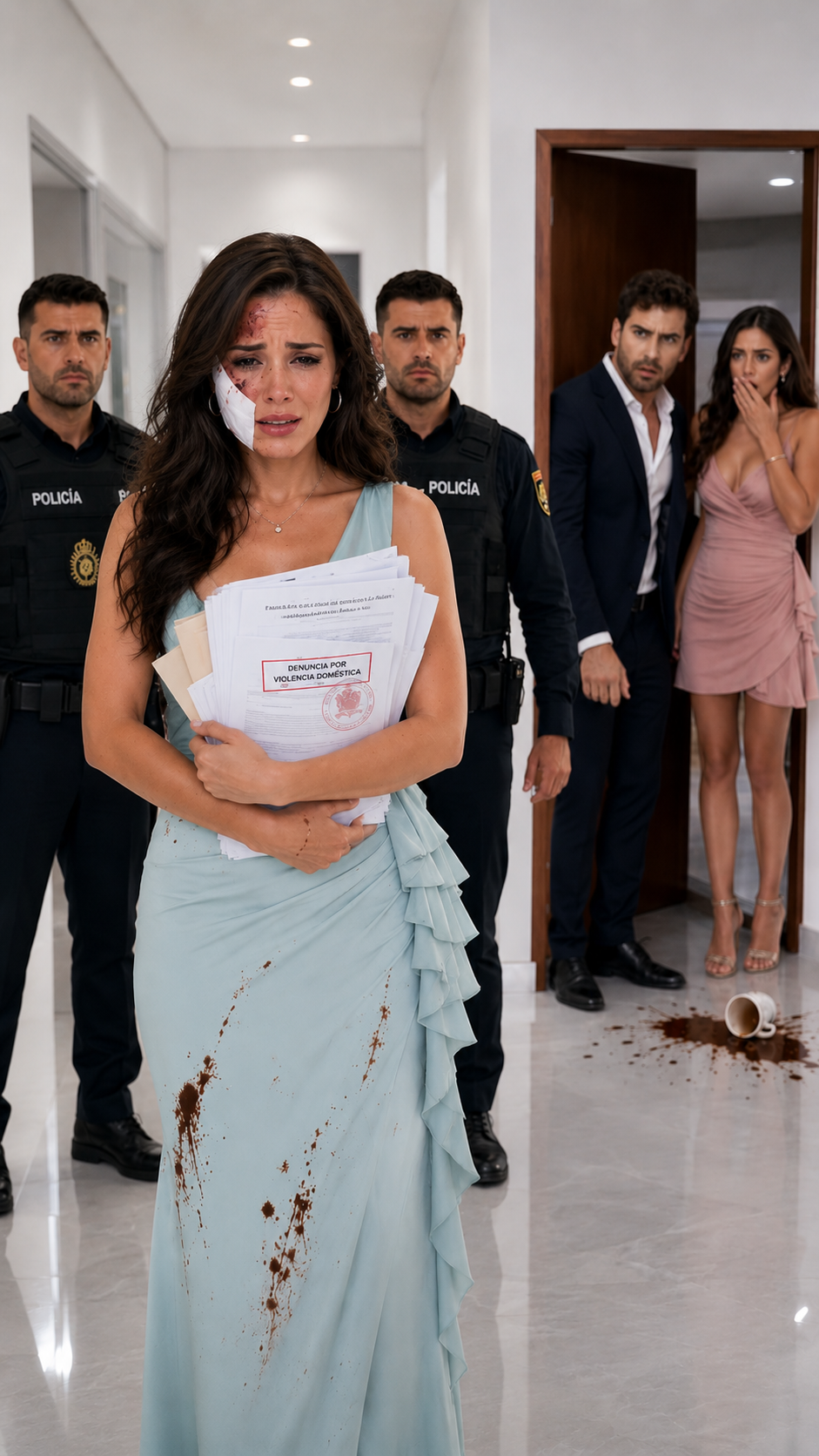
Hours later, she returned to the apartment accompanied by two police officers.
She didn’t enter crying.
She entered with boxes.
She packed her clothes, her computer, her hard drives, the bills, her mother’s jewelry, the deeds, the property tax receipts, and even the coffee maker that Arturo bragged was “ours,” even though she had bought it with her first bonus.
On the table, she left only two things.
A copy of the complaint.
And her wedding ring.
At 7:12 PM, the lock clicked.
Arturo walked in with Brenda behind him, laughing, confident that Mariana would be scared.
But upon seeing the police, the boxes, and the ring on the table, he froze.
Because for the first time, he understood that Mariana wasn’t leaving her home.
She was throwing him out of the life he thought he had conquered.
PART 2
Brenda was the first to speak.
Wearing dark glasses on her head, long nails, and a red bag that Mariana recognized immediately. She had bought it herself a year earlier, after Arturo begged her to “give his sister a treat” for her birthday.
Brenda looked at Mariana’s bandaged cheek and curled her lip.
—Oh, come on. Did you really call the police over a little coffee?
One of the officers stepped forward.
—Miss, watch your tone.
Arturo closed the door slowly. His expression shifted in seconds. From mockery to calculation. He glanced at the boxes, then the ring, then the complaint.
There he understood it wasn’t a tantrum.
Mariana had gathered evidence.
—My love, you’re exaggerating —he said gently, the same tone he used in front of neighbors—. It was an accident. The cup slipped from my hand.
Mariana didn’t respond.
She handed the police officer the medical report.
—Here’s the emergency treatment. There are also photos.
Arturo took a step toward her.
—Are you going to ruin my life over a cup?
Mariana looked up.
—It wasn’t the cup. It was you.
Brenda let out a bitter laugh.
—Well, if you hadn’t jumped up, you wouldn’t have burned yourself so badly.
Silence fell heavily.
Even Arturo turned to look at her, as if he wanted to silence her too late.
Mariana pulled out her cell phone.
She displayed Arturo’s messages from that very morning.
“You give her the card.”
“Don’t make me look bad in front of my sister.”
“You obey or you leave.”
Then she played an audio clip of Brenda.
The voice came through clear, mocking, filled with venom.
—Tell your wife not to be stingy. If she lives well, it’s because you give her a presence. Besides, she doesn’t even have kids. What does she need to hold onto so much for?
Arturo tried to snatch the phone from her.
The officer intervened.
—Don’t touch her.
For the first time in six years, Arturo had to back down because someone else ordered him to.
Brenda pointed at the boxes.
—And why are you taking everything? We all used that TV. The living room too.
—I bought it —Mariana replied—. Just like the refrigerator, the bed, the dining table, and almost everything your brother boasts about when guests come over.
Arturo gritted his teeth.
—This apartment is mine too. I’m your husband.
Mariana opened a blue folder and placed a copy of the deeds on the table.
—No. It’s mine from two years before we married. Your name doesn’t appear on any documents. The mortgage, the property tax, and the maintenance come out of my account.
Brenda took off her glasses.
—You can’t leave my brother on the street.
—He tried to burn me out of my own kitchen —Mariana replied—. I’m not leaving him on the street. I’m stopping him from using my home.
Arturo’s face hardened.
But he could no longer shout.
Not with two police officers in front of him.
As Mariana finished checking the apartment, she found something unexpected.
In the guest room closet was a bag belonging to Brenda filled with receipts from expensive stores. In the study, inside a folder Arturo thought was hidden, there were printed bank statements with charges of 12,800, 18,450, and 27,000 pesos.
Purchases Mariana had never made.
A salon in Satélite.
A jewelry store in Polanco.
A travel agency.
And worst of all: an additional card in her name that she had never requested.
She felt her stomach clench.
It wasn’t just violence.
It was theft.
Arturo saw her putting away the papers and turned pale.
—That’s not yours.
Mariana looked at him unblinking.
—It’s in my account. Of course, it’s mine.
That night, she slept at her friend Renata’s house in Del Valle. Her cheek burned, and her cell phone wouldn’t stop vibrating.
Arturo’s mother sent her nine voice messages.
“Marriages are fixed at home.”
“Don’t mess with my son’s last name.”
“God punishes vengeful women.”
A cousin wrote not to make “a feminist show.”
Brenda, from another number, sent her a threat.
“Drop the complaint or you’ll see what I’m capable of.”
Mariana saved everything.
The next day, a domestic violence attorney, Claudia Arriaga, reviewed the blue folder and frowned.
—This is no longer just about injuries and economic violence —she said—. There could be fraud, misuse of bank data, and threats here.
Mariana felt cold.
Claudia pointed to a charge of 42,000 pesos at a jewelry store.
—This doesn’t look like an impulse purchase. It seems like someone knew how much they could spend without the bank blocking the transaction.
At that moment, a message arrived from an unknown number.
It was a photo taken from the street.
The facade of Mariana’s building.
Underneath it read:
“Open up or we’ll come in for what belongs to Brenda.”
Claudia called the Public Ministry.
But before leaving, another message came in.
A screenshot of a transfer.
96,000 pesos from Mariana’s account to an account in the name of Brenda Salgado.
Date: six months ago.
Concept: “Initial payment family agreement.”
Mariana felt the blood drain from her body.
She had never made that transfer.
And then she understood that the card wasn’t the real problem.
They were preparing to take something much bigger from her.
The protective measures hearing was four days later, in a family court near Niños Héroes.
Mariana arrived with a light scarf covering part of the burn. Renata walked beside her. Claudia carried a folder full of messages, account statements, photographs, and the medical report.
Arturo arrived late, dressed in a black suit, accompanied by Brenda and their mother, Doña Carmen.
They entered as if they were the victims.
Doña Carmen looked at Mariana with disdain.
—What a shame you are. Women like you destroy families.
Mariana didn’t respond.
Claudia had told her to let the documents speak.
And the documents spoke loudly.
Inside the courtroom, Arturo tried to present himself as a desperate husband.
—I love my wife —he said—. She got upset, flailed her arms, and the coffee spilled. My sister has nothing to do with this. It’s all a misunderstanding.
The judge reviewed the photos of the burn.
Then she read the messages.
Afterward, she listened to the audio where Arturo said: “You obey or you leave.”
Silence became uncomfortable.
Claudia stood up.
—Your Honor, we are not dealing with a domestic dispute. We are facing a pattern of control. The victim was physically assaulted after refusing to hand over her credit card. She was also threatened with being expelled from a home that legally belongs to her. Moreover, there are unrecognized charges and transfers linked to the aggressor’s sister.
Brenda shifted nervously.
—That was a loan.
The judge looked up.
—Is there a signed contract?
Brenda opened her mouth.
Nothing came out.
Arturo intervened.
—Mariana knew. She just wants to play the victim now.
For the first time, Mariana asked to speak.
Her voice came out low but firm.
—For years, I was made to feel guilty for taking care of what’s mine. I paid for the house, the utilities, the food, the loans that never returned. I was called cold, selfish, a bad wife. But when I said no, my husband threw boiling coffee in my face. Then he tried to throw me out of my own home. That wasn’t love. That was control.
No one responded.
The judge issued protective measures that same day.
Prohibition of proximity.
Prohibition of communication.
Protection of the domicile.
Permanent removal of Arturo from the apartment while the process lasted.
And a visit to the Public Ministry for the bank movements.
As she left, Arturo waited for her in the hallway, although he could no longer approach.
He didn’t shout.
He did something worse.
He put on a look of regret.
—Marianita, please. Don’t let that lawyer fill your head with ideas. We’re married. We can sort this out at home.
That diminutive disgusted her.
Before, it would have made her doubt.
Not that day.
—You don’t want to settle anything —she replied—. You want me to go back to being quiet.
The court staff noted the breach of compliance.
And that small scene, which would have ended with Mariana crying in a bathroom before, was now recorded in a file.
The following months were tough.
Mariana returned to her apartment with a locksmith. She changed the locks, removed Arturo’s clothes, and handed them over through the lawyer. She took his name off the mailbox. Donated the glasses he used. Threw out the table where the coffee spilled.
The kitchen was the hardest part.
There was the faint stain on the wall.
There was the exact spot where she had felt so small.
Renata hugged her.
—You don’t have to be strong with everything, girl.
Mariana cried.
But she didn’t go back.
The bank later confirmed that several purchases were made with Mariana’s digital data from a device connected in Doña Carmen’s house in Iztapalapa.
There was also a recorded call.
A woman was trying to pass herself off as Mariana to authorize a purchase of 42,000 pesos. The voice was Brenda’s.
When the executive asked for a security word, a man’s voice whispered in the background:
—Say Mixcoac 23.
It was Arturo.
Mariana listened to the recording in Claudia’s office.
She didn’t cry.
She had already cried over love, fear, and shame.
This time she felt clarity.
—They knew exactly what they were doing —she said.
Claudia nodded.
—And that changes everything.
The final blow came with an old message from Brenda to Arturo, recovered during the investigation.
“If you don’t control her now, she won’t let us have anything later. Remember the apartment is in her name. We have to make her sign something.”
Mariana read that sentence five times.
We have to make her sign something.
Then she understood the transfer of 96,000 pesos.
It wasn’t just theft.
They were fabricating a story to later claim that Brenda had rights over her assets. A supposed family agreement. An invented debt. A lie ready to pressure her.
She recalled how many times Arturo had told her they should “formalize” that his family had also contributed to the apartment.
She remembered Doña Carmen insinuating that if Mariana didn’t plan to have children, it was only fair that the property one day be “for the real family.”
It had all been there.
Only Mariana called it discomfort because accepting it was dangerous seemed too painful.
The main hearing was five months later.
The burn no longer needed bandaging, but it left a pink mark near her jawline. Mariana thought of covering it with makeup. Then decided against it.
Not because she wanted to hide her pain.
But because she no longer wanted to live hiding what others had done to her.
The judge listened to the entire sequence: the demand for the card, the refusal, the boiling coffee, the threats, the bank charges, the false transfer, the recorded call, and Brenda’s messages.
The defense tried to turn everything into misunderstandings.
The judge didn’t allow it.
—This wasn’t a common discussion —she said—. It was a pattern of economic, psychological, and physical control within the home, with the involvement of third parties.
Arturo asked to speak.
His lawyer tried to stop him, but he insisted.
—I was wrong —he said with red eyes—. But Mariana knows how to provoke me. My family needed support. I was under pressure. I didn’t think a cup would end my marriage.
Mariana felt tired.
Not even in his apology did he stop blaming her.
The judge looked at him sternly.
—It wasn’t a cup that ended your marriage. It was your decision to use violence to demand obedience.
That phrase closed something inside Mariana.
Arturo received restrictions on proximity, an obligation to repair the damage, and legal consequences for domestic violence and injuries. Brenda faced a separate process for fraud, threats, and misuse of data. Doña Carmen wasn’t convicted that day, but her home was marked in the financial investigation.
In civil court, the divorce was settled with no rights for Arturo over the apartment.
The deeds, payments, and dates made it clear what Mariana had always known.
That house was hers.
As she left the courthouse, Doña Carmen caught up with her on the sidewalk.
—I hope you’re happy. You destroyed a family.
Mariana looked at her without anger.
—No, ma’am. I stopped allowing yours to destroy me.
Doña Carmen wanted to respond, but Brenda pulled her by the arm.
Arturo came out afterward.
Their eyes crossed for one second.
Before, that glance would have made her doubt.
That day, it only made her walk taller.
Months later, Mariana bought a round table at a flea market in Del Valle. It wasn’t expensive, but she liked it because it had no corners.
She invited Renata and two friends from work for breakfast.
They made green chilaquiles, sweet bread, and orange juice. The kitchen filled with laughter. The sun shone right where the old table used to be.
In the middle of breakfast, Renata raised her cup.
—To the houses that return to those who care for them.
They all toasted.
Mariana touched the mark on her cheek.
It no longer hurt the same way.
Sometimes it burned, yes.
But it also reminded her of the exact day she stopped asking for permission to save herself.
That night, when everyone left, she opened a new coffee maker she had kept hidden for weeks.
She brewed a small cup.
Placed it on the round table and sat by the window.
Outside, Mexico City kept buzzing: cars, vendors, dogs, distant music, life.
Mariana sipped slowly.
The coffee was hot.
But it no longer burned.
And for the first time in many years, she understood that a house is not reclaimed just by changing locks.
It is reclaimed when a woman returns to listening to her own voice and discovers that saying “no” does not make her a bad wife, a bad daughter-in-law, or a bad family member.
It makes her free.





