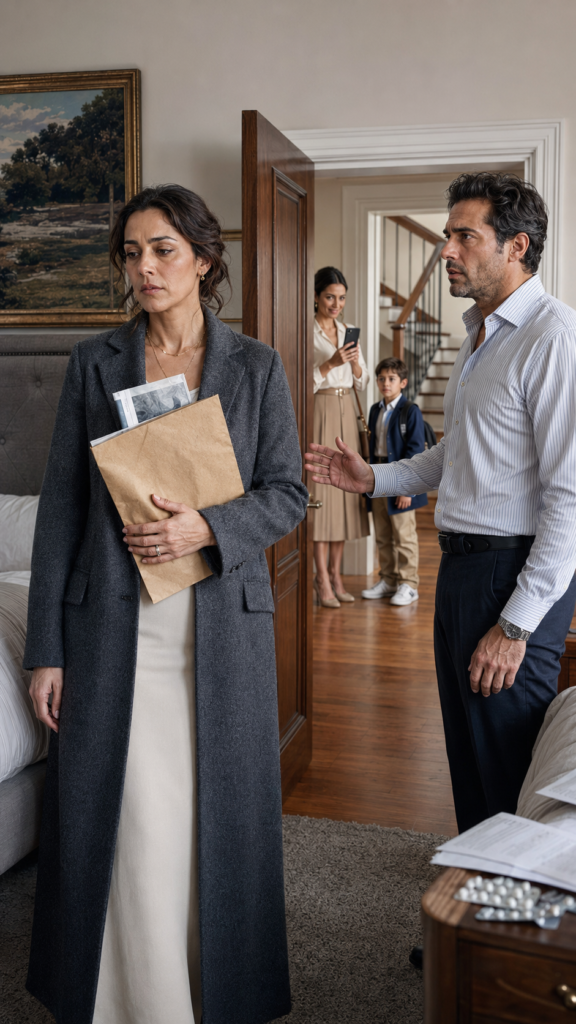
PART 1
The fifth time Alonso Luján locked Clara Rivas in the dark basement of the house, she didn’t knock on the door.
She didn’t cry.
She didn’t scream.
She simply sat on the cold floor, next to the boxes of Christmas decorations, and understood something that shattered her soul: a woman can keep breathing, serve coffee, smile during family meals... and still be dead inside.
From that day on, Clara became the perfect wife in that enormous residence in Lomas de Chapultepec.
Impeccable.
Quiet.
Obedient.
So correct that even Doña Amparo, Alonso’s mother, could find no way to humiliate her in front of guests.
Clara no longer asked why Alonso came home in the early hours with the smell of expensive perfume.
She no longer checked his phone.
She no longer expected explanations.
And above all, she no longer mentioned Irene.
Irene Salvatierra, the widow of Alonso’s older brother.
The “fragile” woman of the family.
Poor Irene, the one everyone cared for as if she were made of glass.
The same Irene for whom Clara had ended up locked away five times “to learn not to make dramas.”
That Saturday morning, Clara woke up before 6.
She prepared soft chilaquiles, chopped fruit, sweet bread, and a container of milanesa for Mateo, her seven-year-old son.
Mateo came down with his backpack slung over one shoulder.
Seeing the food, he grimaced.
—You cooked again?
Clara tried to smile.
—Try it, my love. I made it just how you like it.
The boy pushed the container with his hand.
It fell to the floor.
The lid popped off.
The food spilled onto the white marble.
—Aunt Irene cooks better than you —Mateo said, with a harshness that didn’t seem like him—. I’m not eating garbage.
The housekeeper stood frozen by the sink.
Clara bent down slowly.
She picked up one milanesa.
Then another.
Then the rice.
—It’s okay —she whispered—. I won’t make you food anymore.
At that moment, a sweet voice came from the entrance.
—Mateo, my boy, I brought you molletes from that place you like.
Irene appeared in a beige dress, dark glasses, and that wounded saintly smile that everyone found endearing.
Mateo ran toward her.
—Aunt Irene!
Clara threw the food in the trash.
In the pocket of her robe, she held an envelope from the Ángeles Hospital.
Six weeks.
She was pregnant.
She went upstairs without saying a word.
Downstairs, she could hear the laughter of Mateo, Irene, and Alonso, who had just walked in as if that house had never been a prison for his wife.
Clara folded the medical report into four parts.
She remembered the first time she told Alonso she wanted another child.
He didn’t even smile.
—One’s enough with Mateo —he told her—. Do you want to make Irene feel bad? She only has Alba. Learn to have a little tact.
That night Irene cried, saying Clara had looked at her “like an intruder.”
Alonso didn’t ask anything.
He simply took Clara by the arm and led her to the basement.
He locked her in for three hours.
Then it was four.
Then five.
The last time, six.
Always for Irene.
Always “for the peace of the family.”
Clara entered the bathroom and opened the medicine cabinet.
She didn’t think of revenge.
She thought of silence.
She thought of not bringing another life into a house where love meant enduring invisible blows.
Soon after, pain doubled her over on the bed.
A dark stain appeared on her light dress.
Alonso banged on the door.
—Clara, open up!
When the door burst open, he saw the report, the empty blister packs, and the blood.
He turned pale.
—What did you do?
Clara lifted her gaze.
There was no longer fear in her eyes.
Alonso grabbed a small fruit knife, trembling with rage.
—Look at me when I’m talking to you!
Clara took one step toward the blade.
The edge barely grazed her collarbone.
Alonso dropped the knife, horrified.
—Do you want to die?
Clara smiled without joy.
—You said one was enough with Mateo, Mr. Luján.
Alonso froze.
Mr. Luján.
No longer Alonso.
No longer love.
No longer anything.
Clara pulled out an envelope from the drawer.
—Divorce petition. I’m leaving without asking you for anything.
Alonso tried to grab her.
—You’re not leaving this house.
But when Clara opened the door, Irene was in the hallway with Clara’s phone in hand.
She smiled calmly.
—You’re too late, Clara —she whispered—. I already sent the video to the family group.
And Clara, pale, bleeding, and with the suitcase hidden behind the bed, couldn’t believe what was about to happen…
PART 2
Clara looked at the phone in Irene’s hand.
For one second, the entire hallway fell silent.
The housekeeper stood by the stairs, her eyes filled with fear.
Mateo clutched the bag of molletes to his chest.
Alonso was still behind Clara, his shirt wrinkled and breathless.
Irene raised the phone as if showing a holy proof.
—I only sent what was necessary —she said softly—. You, the blood, the medications, and Alonso trying to save you. Now everyone will understand why you should never have been part of this family.
Alonso frowned.
—What video?
Irene feigned surprise.
—Alonso, please. Clara is unstable. Tomorrow she’ll say you mistreated her. I had to protect you.
Clara let out a dry laugh.
It wasn’t mockery.
It was pure exhaustion.
—How strange, Irene. You just found the perfect angle.
Irene tilted her head.
—People don’t need to see everything to believe something, Clara. A little is enough.
Alonso took a step toward her.
—Give me the phone.
Irene blinked.
—What?
—Give me the phone.
For the first time, his voice didn’t sound like the ever-confident businessman.
It sounded like a man beginning to see that the house he had defended was full of cracks.
Irene pressed the phone to her chest.
—Are you really going to believe her?
Clara didn’t wait for an answer.
She slowly descended the stairs, holding her belly with one hand.
At the entrance, she grabbed a black bag she had prepared three days earlier.
Alonso caught up to her.
—Clara, you can’t leave like this. You’re bleeding.
—I can leave in any way except dead inside —she replied—. I’ve been that way for far too long.
Mateo looked at her with wide eyes.
—Mom?
That word almost broke her.
Clara knelt in front of him and adjusted the collar of his uniform.
—I’m not taking you to school today.
The boy swallowed hard.
—Are you going to come back?
Clara looked up.
Irene was watching her from the stairs, but she no longer seemed fragile.
She looked furious.
—I don’t know, my love —Clara said—. But you’re not to blame for repeating what the adults taught you.
Mateo lowered his head.
Alonso felt a blow to his chest.
It had never occurred to him that his son’s disdain hadn’t been born solely from him.
Someone had planted it in him.
Clara opened the door.
Outside, a taxi was waiting.
Before getting in, she handed a black USB drive to Don Julián, the family driver.
—As agreed. To Attorney Elena Márquez. Right now.
Irene’s eyes widened.
—What is that?
Clara looked at her one last time.
—The whole story.
The taxi took off toward the hospital.
Alonso wanted to follow, but his phone began to vibrate incessantly.
The family group was on fire.
Doña Amparo wrote:
“What did that woman do? She’s crazy!”
A cousin asked if they should call the press.
An aunt sent crying voice messages.
Irene ran down.
—You have to control this, Alonso. Clara is going to manipulate everyone.
He looked at her.
And for the first time, he didn’t see a helpless widow.
He saw urgency.
He saw calculation.
He saw fear.
—Where was the camera? —he asked.
Irene froze.
—What camera?
—The video was recorded from the dresser in my bedroom. Since when have you been filming my room?
Silence fell heavily.
Mateo looked at his aunt.
Irene smiled, but this time it was crooked.
—It was for safety. Clara wasn’t well.
—Since when have you been filming my room, Irene?
She changed her voice.
Her eyes filled with tears.
—I just wanted to protect you. After all I lost, you and Mateo are all I have left.
Before, that phrase would have been enough.
Alonso would have embraced her.
He would have blamed Clara.
He would have closed another door.
But that morning, the image of Clara calling him “Mr. Luján” wouldn’t leave his mind.
Two hours later, Attorney Elena Márquez arrived at the Grupo Luján offices in Santa Fe.
She wasn’t alone.
She brought a folder, the USB, and an urgent request for a protection order.
Alonso received her with a pale face.
—Where’s Clara?
—In a hospital. Stable. Accompanied. And away from you.
The word “stable” let him breathe.
The word “away” sank him again.
Elena connected the USB to a laptop.
—Mrs. Clara Rivas asked me that if anything happened, to show this to you before starting everything.
The first file was an audio.
Irene’s voice was heard crying.
“Clara looked at me funny, Alonso. She makes me feel like I’m intruding in this house.”
Then his voice.
“Go down to the basement. Reflect.”
Then came the blows.
Breathing.
Clara from inside:
“Alonso, open up. I didn’t do anything.”
The audio lasted six hours.
Alonso couldn’t finish it.
—Stop it.
Elena didn’t.
She opened another file.
It was a camera from the hallway that Irene didn’t know existed.
It showed Irene crouched in front of Mateo, days before.
“When your mom cooks, tell her you don’t want it. Tell her that Auntie cooks better. That way your dad will see how she is.”
Mateo, in a tiny voice, asked:
“And if mom cries?”
Irene stroked his hair.
“Then your dad will scold her. Just listen to me, my boy.”
Alonso covered his mouth.
Elena opened a third file.
An audio of Irene sent to a friend.
“As long as Clara is there, I’ll never be Mrs. Luján. Alonso feels guilty for my husband’s death. I just have to remind him, and I’ve got him in my pocket.”
The office grew cold.
Alonso felt everything he had called compassion, family, and duty break apart.
Not because Irene had lied.
But because he had wanted to believe her.
It was easier to think Clara was jealous.
Easier to lock her away than to accept that he had allowed Irene to occupy a place that had never belonged to her.
—I want to see her —Alonso said.
Elena closed the laptop.
—She doesn’t want to see you.
—I’m her husband.
—For now. But that’s already in process.
Alonso clenched his fists.
—I haven’t signed anything.
Elena looked at him without blinking.
—A woman doesn’t need permission to stop belonging to someone.
That phrase left him speechless.
That night, Clara woke up in a white room.
Next to her was Elena, reviewing documents.
There was clean clothes on a chair and a small suitcase by the door.
—Mateo? —Clara asked weakly.
—He’s with the nanny. He’s fine. He asked about you.
Clara closed her eyes.
A tear slipped down to the pillow.
—I don’t want to hate him.
—you don’t have to hate him to protect yourself.
The next day, Irene’s video was already circulating in various family chats.
But then the second video arrived.
The complete one.
It didn’t just show Clara broken.
It showed years of confinement, manipulation, humiliation, and an entire family justifying the unjustifiable because the Luján name weighed more than the truth.
Doña Amparo called Clara.
—Daughter, it was all a misunderstanding. Irene deceived us all.
Clara listened without emotion.
—Irene didn’t lock me up.
The woman fell silent.
—But the family...
—The family looked the other way.
And hung up.
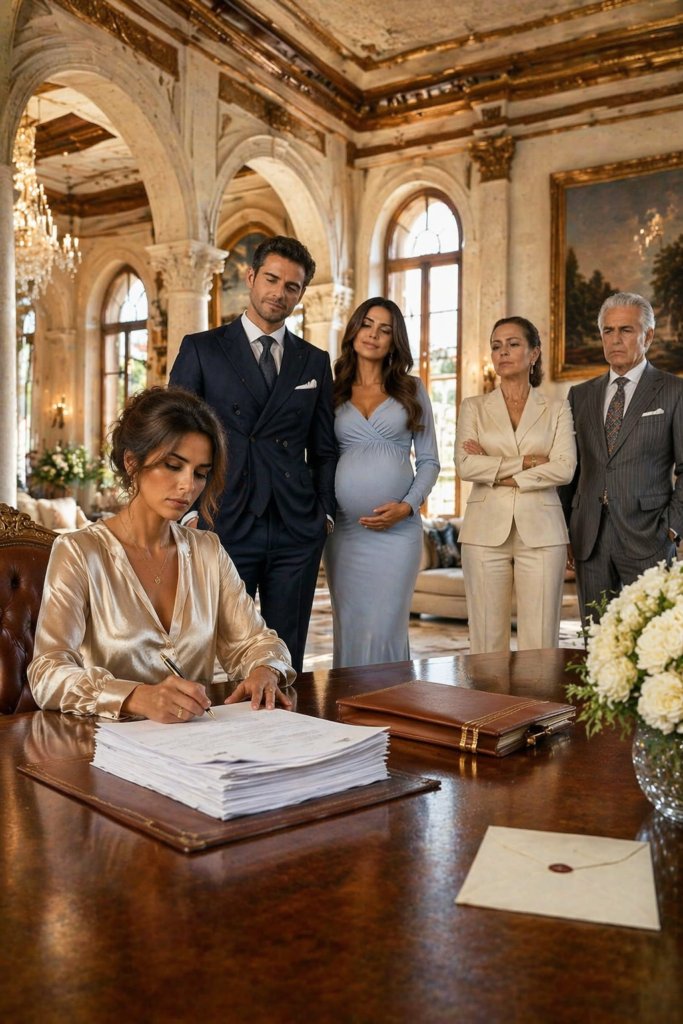
Three days later, Alonso signed the divorce.
Not because he wanted to.
But because Clara arrived at the notary in a dark blue suit, her hair up, and a calmness that no longer asked for permission.
Alonso looked like he had aged ten years.
—I’ll leave you the house —he said—. I’ll give you whatever you want.
Clara took the pen.
—I don’t want anything that comes from your guilt.
—Clara, please.
She signed.
Then looked up.
—There was a time when one word from you could save my day. Later, one word from you could destroy me. Today, your words can do nothing.
Alonso lowered his head.
—And Mateo?
That was the only question that made her take a deep breath.
—Mateo will be able to see me with family psychological support. He needs to learn that loving his mom isn’t betraying anyone.
Alonso nodded.
—I’ll tell him.
—No. I’ll tell him myself.
That afternoon, Clara met Mateo in a park in Condesa.
The boy arrived with swollen eyes.
He didn’t run to her.
He stayed two meters away, embarrassed, as if he suddenly became small again.
—Mom... Aunt Irene said you were leaving because I was bad.
Clara knelt slowly.
—No, my love. I left because the adults in that house caused harm. You repeated things you didn’t understand.
Mateo began to cry.
—I threw your food away.
—I know.
—I said it was garbage.
—I know that too.
The boy broke down.
—I’m sorry, Mom.
Clara hugged him gently.
It wasn’t a perfect hug.
It was trembling, wounded, full of pending things.
But it was real.
And for the first time in a long time, Clara didn’t feel like she was begging for love.
She felt like she was teaching her son how to heal a wound without pretending it didn’t exist.
Irene disappeared from the Luján house before the week was over.
Alonso didn’t look for her.
The family, which for years had called “sensitivity” her manipulations, began to call them by their name when the evidence became impossible to deny.
Clara didn’t return to the residence.
She rented a bright apartment in Coyoacán, resumed her work as a doctor, and began therapy.
Some nights, she woke up feeling like she was still locked in the basement.
So she turned on all the lights.
Opened the window.
Breathed.
And reminded herself that this door no longer had a key.
Months later, Alonso waited for her outside the hospital.
He had a tired face and empty hands.
—I’m not here to ask you to come back —he said—. I just wanted to tell you that I’m sorry.
Clara looked at him without hatred.
That was what hurt him the most.
—I wish you had felt it when I could still hear it as love.
Alonso swallowed hard.
—Will you ever forgive me?
Clara took her time to respond.
—Maybe one day it will stop hurting me. But that doesn’t mean I’ll return to the place where I was broken.
She walked past him and kept going.
She didn’t look back.
On the sidewalk, her phone vibrated.
It was a message from Mateo.
“Mom, today I learned how to make chilaquiles. Can I cook for you on Saturday?”
Clara smiled for the first time without feeling broken.
She replied:
“Of course, my love. But we’ll make them together.”
And she continued walking under the cold sky of Mexico City, with scars on her heart, yes... but with something that no one in that house could ever take from her again.
Her freedom.
Sometimes leaving isn’t surrendering.
It’s stopping the demand for love in a house where only guilt was given.
And the truth is, no one deserves to stay where they have to shrink themselves so others can feel innocent.