PART 1
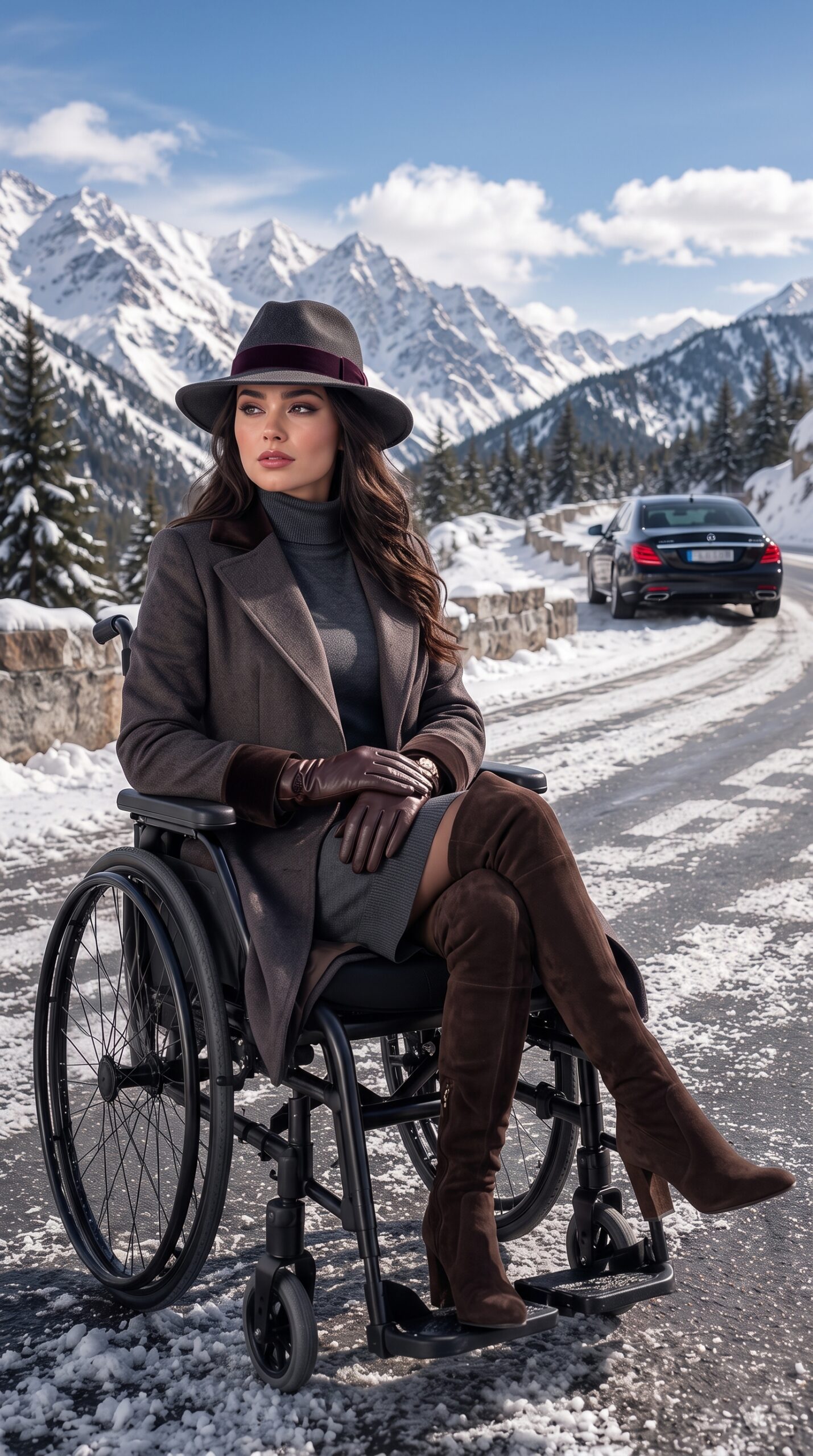
—This is where your burden ends, Mariana —Ricardo said, pushing the wheelchair through the damp pines of Ajusco—. With this cold, not even God will find you in time.
The sky over Mexico City was already dark, though it was barely past six. The air smelled of mud, resin, and abandonment. There were no cars or voices, only branches cracking as if the mountain knew that something terrible was about to happen.
Mariana Solís tightened the old blanket over her legs.
She was 33 years old, her face pale and her lips cracked from the cold. For three years, Ricardo Méndez had posed before everyone as the exemplary husband: the man who took his wife to therapy, who posted loving pictures, and who said, with glistening eyes, that taking care of Mariana was “a blessing.”
But there, without neighbors, family, or cell phones recording for social media, he took off the mask.
—Ricardo, please… I’m your wife —she whispered.
He let out a dry laugh.
—You were my wife. Now you’re a problem on wheels.
Before the accident, Mariana was a dance teacher in Coyoacán. She wore flowered dresses, danced salsa at family parties, and dreamed of opening an academy for neighborhood girls. Ricardo, on the other hand, sold luxury apartments in Santa Fe. He always smelled expensive, spoke beautifully, and knew how to charm whoever suited his needs.
They had been married for five years.
Mariana wanted children.
Ricardo always said later.
Later, after paying for the truck.
Later, after remodeling the apartment.
Later, after selling the land in Cuernavaca that Mariana's parents had left her as an inheritance.
Later, always later.
Everything changed one Friday afternoon, three years ago, when Mariana was driving on Viaducto and saw Ricardo's black truck in the lane beside her. First, she recognized his golden watch. Then his smile. After that, she saw a young blonde woman leaning on his shoulder.
Ricardo kissed her at the traffic light like he hadn’t kissed his wife in years.
Mariana froze. A horn made her move forward without looking. A truck hit her from the side. The world turned to glass, metal, and sirens.
When she woke up in the hospital, Ricardo was crying by her bedside.
—I will never let you go —he promised her.
The diagnosis was cruel: spinal cord damage, years of rehabilitation, the possibility of never walking again.
At first, Ricardo was perfect. He took her to the National Rehabilitation Institute, fixed her hair for photos, and posted on Facebook: “True love is shown when life breaks.”
Everyone admired him.
But Mariana saw what others didn’t see.
Deleted messages. A woman’s perfume. Low phone calls from the bathroom. Looks of annoyance when she asked for help.
Then the worst began.
He would leave her hours without food. He threw clean clothes on the bed. He told her that no one else would put up with an “useless” woman.
Until one morning during therapy, Mariana moved one toe.
The doctor smiled.
—with discipline, you could regain mobility.
Mariana wanted to scream with joy, but in the hallway, she heard Ricardo on the phone.
—Yeah, Paola, she’s still the same. Just sign the papers for Cuernavaca, and I’ll get her out of my life. No one’s going to carry her forever.
That night, Mariana waited for him to leave.
She held onto the wall, trembling.
She took one step.
Then another.
And in Ricardo’s forgotten phone, she saw a message from Paola:
“Do it soon. After you sign, let her disappear.”
Mariana understood they didn’t want a divorce.
They wanted to bury her alive without getting their hands dirty.
PART 2
Since that night, Mariana learned to live with two bodies in the same house.
By day she remained the broken wife. The woman in a wheelchair. The one who looked down when Ricardo humiliated her, the one who asked for water in a soft voice, the one who pretended not to hear when he said on the phone that his life was “paused because of her.”
By night she was someone else.
When Ricardo went out with Paola, Mariana got up.
First, she walked from the bed to the closet. Then from the bedroom to the bathroom. Next, she crossed the entire living room, clutching onto furniture, her legs trembling and her heart pounding in her chest.
For six months, she trained in secret.
She did exercises propped against a chair. She walked in socks to avoid making noise. She climbed one step made of old books. Sometimes she would fall to the floor and bite her sleeve to keep from crying out loud.
But she would get back up.
Ricardo didn’t notice because he no longer saw her as a wife. He saw her as a formality, as a nuisance, as a pending signature.
—You’re looking thinner —he told her one afternoon, leaving a bag of cold tacos on the table—. You should be grateful I still support you.
Mariana lowered her head.
—Thank you.
Inside, she thought that one day he would be grateful he hadn’t known how far she could walk toward justice.
One Tuesday, while Ricardo was showering, Mariana saw his open briefcase.
Inside were copies of her ID, notarial documents, papers for the land in Cuernavaca, and a power of attorney to sell, cede, and manage the property.
She also found a new life insurance policy.
The beneficiary was Ricardo.
The update had a date from eleven days ago.
Mariana felt her stomach tighten.
When Ricardo came out, he was kinder than ever. He wore a salesman’s smile and a loving husband’s voice.
—My love, I need you to sign some papers —he said—. It’s to sort out the land. You can’t go into offices like this, poor thing.
—Whose name would it be in? —she asked.
Ricardo stroked her head as if she were a little girl.
—Mine, temporarily. I’m your husband, Mari. Seriously, don’t be distrustful.
She took the pen.
Her hand shook, but she signed. Not because she trusted him, but because she needed to see him progress to the exact point where he could no longer deny anything.
That night, Ricardo spoke with Paola from the kitchen.
Mariana had a small recorder hidden under the cushion of the chair.
—She signed —he said—. Tomorrow I’ll submit the papers. I’ll take her to Ajusco on Saturday. I’ll tell her she needs fresh air.
Paola responded something.
Ricardo laughed.
—No, dude, she’s not coming back. I’ll take her phone, leave the wheelchair stuck between rocks, and with the cold, it’ll all end. They’ll think she got depressed.
—What if someone finds her?
—Who’s going to suspect me? Everyone thinks I’m the saint who took care of her for three years.
Mariana closed her eyes.
There died the last piece of love that still hurt.
She didn’t confront him. She didn’t scream. She didn’t throw the papers in his face. She did something harder: she prepared.
She contacted a criminal lawyer named Elisa Navarro, from the Del Valle neighborhood. She sent audio recordings, screenshots, documents, and the policy.
Elisa listened without interrupting.
—Mariana, this could become attempted homicide, fraud, and domestic violence. But we need clear evidence of abandonment, location, and you coming out alive.
—I’m going to come out alive —Mariana replied.
—Don’t get overconfident.
—I’m not overconfident. I’m just tired of being afraid.
The lawyer advised her to buy an external battery, a GPS tracker, another recorder, and keep digital copies of everything. She also told her to inform someone close.
Mariana chose Doña Chayo, the neighbor who sometimes brought her soup when Ricardo “forgot” to buy food.
—If I’m not back by eight on Saturday, call this number —she said, handing her a card.
Doña Chayo looked at her with eyes full of suspicion.
—Honey, is that man hurting you?
Mariana couldn’t answer.
She just squeezed her hand.
Saturday dawned cold.
Ricardo made coffee, bought pastries, and even put a scarf around her neck.
—Today we’re going for a walk —he said—. You need to get out. You’re too cooped up.
—Where to?
—to Ajusco. Pines, fresh air, tranquility.
Mariana feigned a tired smile.
—Thank you, Ricardo.
He didn’t see that under the sweater’s sleeve, the recorder was already on.
He loaded her into the truck as if carrying a heavy box. He stored the wheelchair in the trunk and drove south. They passed tamale stands, crowded vans, stray dogs, cyclists in jackets, and women carrying market bags.
Little by little, the city fell behind.
The trees closed in on the path. The phone signal dropped, but it didn’t die. Mariana checked, hidden among the clothes, that the location was still active.
Ricardo drove the truck onto a dirt road.
—It’s very lonely here —she said.
—That’s why it feels peaceful.
He lowered the wheelchair, sat her down with rough movements, and began pushing her through stones, roots, and mud. Mariana pretended to be defenseless, though the fear was real. Not because she couldn’t escape but to confirm that the man she had slept with for five years was capable of watching her die without batting an eye.
Upon reaching the clearing, Ricardo stopped.
He pulled out a cigarette.
—This is perfect.
—Perfect for what?
He leaned toward her.
—So you can finally stop ruining my life.
Mariana let a tear roll down her cheek.
—I’ll give you the divorce. I’ll give you the land. But don’t leave me here.
Ricardo smiled with contempt.
—You’ve already given me the land, dumbass. And the divorce isn’t as useful to me as your insurance.
Mariana felt the air choke her.
That was the secret she hadn’t imagined fully yet. He didn’t just want her inheritance. He also wanted to cash in on her death.
—My insurance?
—I updated it recently. You don’t even read what you sign. So dependent, so broken, so easy.
—Does Paola know?
—Paola knows what’s necessary. She waited three years while I played nurse with you.
Mariana clenched her fingers around the wheelchair.
—I was your wife.
—You were my mistake.
Silence fell heavy.
Ricardo pulled the blanket off her legs and threw it into the mud.
—Let’s see how long you last without playing the victim.
—I’m going to die.
He extinguished the cigarette with his shoe.
—Exactly.
The word hung cold and monstrous.
Ricardo walked away.
—Ricardo! —she shouted—. Don’t leave me!
He didn’t look back.
—When they find you, if they find you, everyone will cry with me. They’ll say I did the impossible for you. I’ll sell Cuernavaca, cash the insurance, and start over.
He got into the truck and drove off.
Mariana waited until the engine disappeared among the trees. Then she waited five more minutes. She took out the recorder, checked the file, and listened to enough fragments to freeze her blood.
“Exactly.”
“Your insurance.”
“You’ve already given me the land.”
“When they find you…”
She took a deep breath.
—Thank you, Ricardo —she murmured—. You buried yourself alone.
She took out her cell phone. There was one bar of signal. Enough.
She sent her location to Elisa, to Doña Chayo, and to 911.
—Emergency, what is your situation?
—My husband abandoned me in Ajusco to freeze to death. I have recordings, location, a tracker of his truck, and documents of fraud.
—Ma’am, can you move?
Mariana looked at her legs.
—Yes. That’s what he doesn’t know.
She stood up.
Everything hurt. Her knees trembled, the cold bit at her ankles, and the ground sank beneath her shoes. But she was standing. The wheelchair was left behind like an empty cage.
—I’m heading toward the main road —she said—. I won’t hang up.
She walked among pines, mud, and stones. Each step was a small victory. Each breath reminded her that Ricardo had calculated her death, but not her strength.
In twenty-four minutes, she saw red and blue lights.
Two state police officers got out with flashlights.
—Is this Mariana Solís?
—I’m here.
One of them looked at her confused.
—We were told you were in a wheelchair.
Mariana turned toward the mountain.
—That’s what my husband believed.
They took her to a nearby police station. Elisa arrived with a folder, her face stern and her voice firm. Mariana handed over the recorder, screenshots, documents, location, and Paola Rangel’s full name.
—With this, we’ll arrest him today —the lawyer said.
They didn’t have to search for long.
Ricardo was in a restaurant in San Ángel with Paola. They were toasting with red wine. On the table was a notebook with numbers: land value, insurance amount, and a house in Valle de Bravo circled.
When the agents approached, Ricardo stood up angrily.
—What does this mean?
—Ricardo Méndez, you are under arrest for attempted homicide, fraud, domestic violence, and forgery.
Paola went pale.
—No, no, he said he was only going to scare her.
An officer received a call and put it on speaker.
Mariana's voice rang out clearly:
—I wasn’t scared, Paola. He left me in the woods. And now I’m walking toward justice.
Ricardo froze.
—It can’t be…
That night, at the Prosecutor’s Office, Mariana asked to see him once.
Not to insult him.
Not to cry to him.
So he could see her standing.
When Ricardo entered handcuffed, he had a wrinkled shirt, swollen eyes, and the face of someone who no longer sees a way out. Paola followed behind, crying without makeup.
Mariana crossed the door walking.
Ricardo opened his mouth.
—You… you can’t walk.
—I’ve been walking for six months.
He recoiled as if he had seen a ghost.
—Did you trick me?
Mariana let out a joyless laugh.
—you planned my death and still have the nerve to feel betrayed.
—I wasn’t going to let it happen for real —he stammered—. I just wanted you to understand.
The prosecutor played the recording.
Ricardo's voice filled the room:
“Exactly.”
“Your insurance.”
“When they find you, everyone will cry with me.”
Paola covered her face.
—Mariana, I’m sorry. I didn't want you to die.
—No, Paola. You didn’t think of my death, but you did wait for my absence. And when a woman waits for another to disappear to take her place, she carries guilt too.
Ricardo fell to his knees.
—Mari, please. Remember when we were happy.
She looked at him with a calmness that hurt more than a scream.
—I do remember. That’s why it hurts so much to know that while I dreamed of a family, you calculated my price.
The case exploded on social media. News outlets talked about “the wife who pretended to remain paralyzed to trap her husband.” Some called her brave. Others said it was impossible to endure six months of pretending.
Mariana didn’t respond.
Those who have never lived trapped with their abuser think escaping is just opening a door. She knew that sometimes the exit is built at night, in silence, step by step.
During the trial, Ricardo tried to play the victim. His lawyer said he was exhausted, depressed, and destroyed from taking care of a disabled wife.
But the prosecutor showed the recording, the documents, the policy, the messages with Paola, and the searches about hypothermia.
Paola claimed she had been manipulated.
Then they read one of her messages:
“When she’s gone, we’ll finally live in peace.”
The room fell silent.
Mariana testified standing, in a simple white suit and her hair tied up.
—For three years I thought my body had betrayed me —she said—. Then I understood that the one who betrayed me was the man who swore to take care of me. I regained my legs in secret because I also needed to regain my voice.
The judge asked what she expected from the sentence.
Mariana took a deep breath.
—that no one should ever call love a prison.
Ricardo received eighteen years in prison. Paola received eight for complicity, concealment, and fraud. The land legally returned to Mariana, and the insurance was canceled.
When she left the courthouse, reporters surrounded her.
—Do you forgive him?
—What would you say to other women?
Mariana looked at the cameras.
—I don’t know if forgiveness is mandatory. Surviving is. If someone is slowly turning off your light, keep evidence, ask for help, and don’t tell your steps to those who want to see you on the ground.
Months later, Mariana reopened her academy in Coyoacán. She no longer just taught dance. She also offered free workshops for women with disabilities, economic dependence, or domestic violence.
At the entrance, she placed a handwritten phrase:
“What is inherited is not always land. Sometimes it’s strength.”
One afternoon, a woman in a wheelchair arrived, her gaze dull.
—I was told you understand —she whispered.
Mariana knelt before her.
—I understand more than you imagine.
—I’m scared.
Mariana took her hand.
—Fear doesn’t mean you’ve lost. Sometimes it means a part of you still wants to be saved.
That night, as she closed the academy, Mariana walked alone through the courtyard. The bougainvilleas swayed with the wind, and the orange sky fell over Coyoacán.
She remembered the forest, the abandoned wheelchair, and Ricardo's voice saying that’s where their problem would end.
He was wrong.
That’s not where Mariana ended.
That’s where the woman everyone thought was broken began, but who was silently preparing for the most important step of her life.