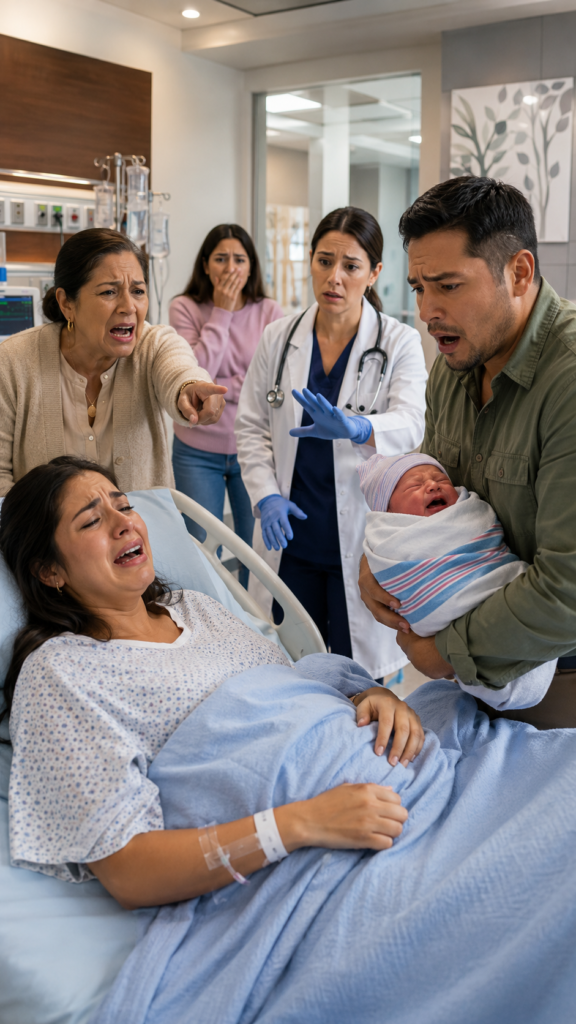
PART 1
Captain Julián Rivas returned to Guadalajara with his uniform still smelling of dust, sweat, and the long road.
He had spent nine months deployed in a troubled area of the Durango mountains, counting the days to meet his newborn son.
In his backpack was a blue teddy bear.
He had bought it at a roadside stand, crooked and overpriced for what it was, but Julián didn’t care.
That teddy bear was for Santiago, the baby he had only seen in blurry ultrasounds and in the videos his wife, Elena, sent him in the middle of the night.
He expected to arrive and find diapers, chaos, the cries of a baby, and Elena laughing at his clumsy first-time dad antics.
But when he opened the door to their home in the Jardines del Bosque neighborhood, he heard no laughter.
No music.
No Elena.
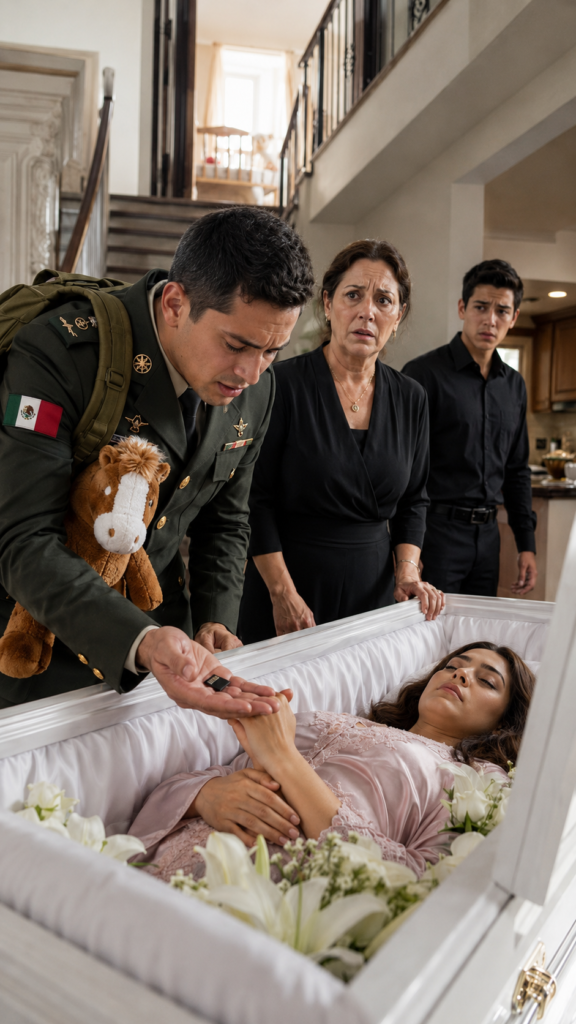
He only saw a white coffin in the middle of the living room.
The backpack slipped off his shoulder and hit the floor with a dull thud.
His mother, Doña Amparo, stood next to the coffin, dressed in black, her hair perfectly styled, golden earrings gleaming too brightly for a wake.
She wasn’t crying.
Her eyes weren’t even red.
“Your wife died in childbirth,” she said coldly. “And if you had been here, maybe she would have been saved.”
Julián didn’t respond.
He felt something shatter inside him, but his legs moved on their own toward the coffin.
There lay Elena.
His Elena.
The woman who sent him voice notes telling him how the baby moved when he heard his voice.
The woman who promised to wait for him in a yellow blouse, claiming that color brought luck.
And there she was.
In that yellow blouse.
Too well-coiffed.
Too still.
Too ready to be buried without him ever having the chance to say goodbye.
In the dining room, his younger brother, Bruno, was sipping coffee as if it were just any family Sunday.
“You’re late, bro,” he murmured. “Like always.”
Julián clenched his jaw.
Then he heard a cry from upstairs.
Weak.
Tired.
A tiny whimper that pierced his chest.
“Where is my son?” he asked.
Doña Amparo lifted her chin.
“Upstairs. Alive, thank God. Though your wife was very stubborn. She wouldn’t obey.”
Julián turned slowly.
“Obey what?”
His mother made an annoyed gesture.
“We’ll talk later. First, say goodbye. Tomorrow morning we take her to the cemetery.”
Tomorrow.
Julián had just crossed the threshold.
He hadn’t held his son.
He didn’t know in which hospital Elena had died.
He saw no medical papers.
No death certificate.
No hospital bracelet.
No nurse, doctor, neighbor, or friend crying.
Only his mother, Bruno, and a coffin that was too clean.
Julián had worked for years in military intelligence.
He knew how to recognize a lie when someone perfumed it too much.
And that room reeked of deception.
He stepped closer to Elena.
Her hands were on her belly.
The left one open.
The right one clenched tightly.
So tightly that the knuckles were pressed against her pale skin.
“What’s in her hand?” he asked.
Doña Amparo moved immediately.
“Nothing. Leave her be.”
It was too quick.
Too nervous.
Bruno set his cup down on the table.
“Don’t start with your paranoia, Julián. You’re tired. You’re bringing the war home.”
Julián didn’t even look at him.
“I want to say goodbye to my wife.”
His mother grabbed his arm.
“I told you no.”
Julián lowered his gaze to that hand.
Then he looked at it fixedly.
“Don’t touch me again.”
For the first time, Doña Amparo paled.
It was just a second.
But he saw it.
Julián carefully took Elena’s right hand.
It was cold.
Rigid.
But her fingers could still be separated.
Under her nails were dark marks, as if she had scratched something or someone before she died.
Julián held his breath.
He pried her fingers apart one by one.
Then something small fell into his palm.
It was a microSD card.
Black.
Tiny.
But Bruno turned as white as paper.
“Give me that,” he demanded, inching closer.
Julián clenched his fist.
“Why?”
Doña Amparo tried to smile, but her mouth trembled.
“Elena recorded nonsense since she got pregnant. She became insecure, dramatic. They’re probably insignificant videos.”
The baby’s cry returned from upstairs.
Fainter.
Duller.
As if it no longer had strength.
Julián tucked the memory card inside the inner pocket of his uniform.
Without asking for permission, he climbed the stairs.
Each step filled his body with more rage.
In the baby’s room, the curtains were closed even though it was still sunny outside.
Santiago lay in a crib, wrapped in a gray blanket, too big for his tiny body.
His cheeks were flushed from crying.
Julián picked him up with clumsy delicacy, almost afraid to break him.
The baby opened his eyes.
He had Elena’s gaze.
And Julián felt the world stop.
“Hi there, champ,” he whispered, his voice shattered.
Next to the crib was a half-finished bottle.
Julián picked it up.
Bringing it to his nose, he noticed a strange smell.
Sweet.
Chemical.
Like syrup mixed with something that shouldn’t be near a newborn.
He pulled a clean bag from his field kit, placed the bottle inside, and sealed it.
Then Doña Amparo appeared in the doorway.
“Come down, Julián. There are papers you need to sign before the burial.”
He held the baby tighter.
“What papers?”
His mother stared at him without blinking.
“The necessary ones to ensure the house and the child stay with the right family.”
Julián felt ice in his veins.
“I’m not signing anything.”
Doña Amparo’s face hardened.
“You don’t know who you’re dealing with.”
Julián looked at his son.
His tiny fingers just barely gripping one of his.
Then he understood that Elena hadn’t just died.
She had been silenced.
And before leaving, she had left a key hidden in her hand.
A key that his own mother was desperate to bury with her.
PART 2
Julián locked the bedroom door.
Not because he thought a wooden door could stop Doña Amparo.
But because he needed a few minutes to breathe, to look at his son, and to understand what kind of nightmare had entered his home.
Santiago squirmed against his chest.
He was so small it seemed impossible that anyone would want to harm him.
Julián settled him in the crib, away from the bottle, and searched for Elena’s old laptop.
It was on a shelf, with a half-peeled Frida Kahlo sticker.
He turned it on.
Outside, his mother banged on the door.
“Julián, open up. We need to talk like civilized people.”
He didn’t answer.
He took the microSD from his uniform, found an adapter in the drawer, and connected it.
Only one folder appeared.
It was titled:
FOR JULIÁN.
His throat closed up.
There were four files.
The first was a video.
Elena appeared sitting on a bed, wearing a private clinic gown. She was pale, disheveled, with puffy eyes from crying.
But alive.
“Julián,” she said, looking at the camera, “my love, if you’re watching this, please listen to me until the end. Your mom wants me to sign some papers. She says they’re to protect the baby while you’re away, but that’s not true.”
Julián stood frozen.
Elena took a deep breath.
“They’re documents to transfer the house to her name and to make decisions about our child. She says you’re going to come back messed up from the Army and won’t be able to be a dad.”
Julián looked around.
The house didn’t belong to Doña Amparo.
It never had.
Elena had inherited it from her grandfather before they married.
Doña Amparo always called it “the family home,” as if repeating it could turn it into a truth.
The video continued.
“Bruno owes money, Julián. A lot of money. I heard your mom say that if they don’t sell this house, those guys are coming for him. I didn’t want to sign. I told her to wait for you to come back. Since then, she looks at me like I’m a burden.”
The video ended.
Julián opened the second file.
It was audio.
First came Bruno’s voice.
“Mom, seriously, I can’t anymore. Those guys are going to find me.”
Then Doña Amparo’s voice.
Cold.
Controlled.
“Then stop playing the victim. Elena signs, we sell the house, and everything gets sorted.”
“And what if Julián comes back early?”
“Your brother always breaks down when we talk about family.”
Julián felt rage rise in his hands.
Bruno spoke again.
“She doesn’t want to sign.”
There was silence.
Then Doña Amparo said something that stole his breath.
“Then we’ll make sure she has no other option.”
The audio ended.
Julián didn’t scream.
He didn’t hit the wall.
He just opened the third file.
It was photos of documents.
A request for temporary custody.
A notarized letter stating that Julián had emotional instability due to his military service.
A copy of the deeds.
And at the end, a signature.
His signature.
But forged.
Very similar, yes.
But forged.
He knew how the “J” of his name ended.
That letter was cut.
Dry.
Imitated.
His mother not only wanted the house.
She wanted to take his child away.
He opened the last video.
The camera was hidden among the blankets in the baby’s room.
Elena spoke in a low voice, sweating, with a hand on her belly.
“Julián, your mom wants to take me to a doctor friend of hers. She says they don’t ask as many questions in a private clinic. I asked her to take me to the hospital, but she got angry.”
Elena looked toward the door.
Then whispered:
“I also saw Bruno with a bottle. He put it next to the bottles. He said it was to make the baby sleep when he was born. I don’t know what it is. I’m scared. Please, don’t let them near Santiago. Don’t sign anything. Don’t trust them.”
The door opened in the video.
Doña Amparo’s voice was heard.
“Who are you talking to?”
Elena slammed the laptop shut.
The screen went black.
Julián copied the files onto a USB from his backpack and also sent them to an email he used for work.
Then he dialed 911.
“My wife died after giving birth under suspicious circumstances,” he said with a calm that was frightening. “I have a newborn possibly exposed to an unknown substance. I need an ambulance, police, and to not allow the body to be moved before an examination.”
He answered questions.
Gave an address.
Names.
Times.
Without making anything up.
When he hung up, he heard voices in the hallway.
“Don’t let him out!” Doña Amparo whispered. “If he talks to someone, it’ll all fall apart.”
Bruno replied in a broken voice:
“Mom, I can’t anymore.”
“Of course you can. I did all this for you.”
There was a heavy silence.
Then Bruno said:
“I never asked you to let her die.”
Julián opened the door.
Doña Amparo stood in front of him.
Bruno, behind her, looked like a scared child, even though he was 31.
“What did you mean by letting her die?” Julián asked.
His mother tried to enter the room.
“You have no right to interrogate me in my house.”
Julián extended his arm and blocked her way.
“This house isn’t yours.”
Doña Amparo pressed her lips together.
“That woman filled your head with poison. Elena was weak. She never understood what it means to sacrifice for the family.”
Bruno stepped forward.
“Don’t say that! She begged you to take her to the hospital.”
Doña Amparo turned to him with hatred.
“Shut up.”
“She begged you,” Bruno repeated, crying. “She was bleeding, Mom. She was in pain. And you said she had to sign first. You said that if she came out alive from the hospital, she would never let go of the house.”
Doña Amparo slapped him.
The blow sounded sharp.
Julián didn’t move.
It was no longer necessary.
Bruno’s words had opened the tomb.
“You took her to that back-alley clinic,” Julián said.
Doña Amparo lifted her chin.
“I took her to someone discreet. Someone who could help us without involving lawyers, hospitals, or gossip.”
“And did he help?”
She didn’t answer.
In the distance, sirens sounded.
Doña Amparo paled again.
But this time, not from memory.
This time because she understood that the story no longer belonged to her.
She tried to head towards the crib.
“I’m going to see the baby.”
Julián stopped her with a single sentence:
“You’re not going near my son.”
She glared at him.
“You don’t know how to be a father. You weren’t even here when he was born.”
Julián didn’t look away.
“I wasn’t here because I was fulfilling my duty. But now I am. And I’m not leaving again.”
The paramedics entered first.
They checked Santiago and immediately removed the bottle.
One of them smelled it and requested analysis.
“Don’t give him any of this,” he said seriously. “We need to take him to the hospital.”
Julián walked alongside the gurney, not letting go of his son’s tiny hand.
Doña Amparo screamed.
Said Julián was crazy.
Said Elena was dramatic.
Said Bruno was lying.
Said they were all ungrateful.
But no one believed her.
The forensic team examined the coffin in the living room.
Julián wanted to stay next to Elena, but an officer asked him to give them space.
It hurt to step away.
He felt like he was abandoning her.
But for the first time, someone was going to listen to what his body could no longer say.
At the hospital, Santiago was placed under observation.
Hours later, a pediatrician came to talk to Julián.
“Your baby is stable. We found traces of a sedative. The dose wasn’t lethal, but if it had continued, it could have been serious.”
Julián closed his eyes.
“Will he be okay?”
The doctor nodded.
“He’ll be okay. He got here in time.”
Then Julián cried.
Not as a soldier.
Not as a son.
He cried as a father who was about to lose everything.
The prosecutor’s office opened an investigation.
The private clinic had expired permits.
The supposed doctor wasn’t an obstetrician.
The ambulance was called too late.
The autopsy confirmed that Elena suffered a hemorrhage after childbirth and could have survived if they had taken her to a real hospital.
They also found signs that someone wanted to bury her quickly to avoid examinations.
Bruno testified.
He didn’t come out clean.
He had been silent.
He had participated.
He had been a coward.
But he told everything.
He recounted the debts.
The forged papers.
The pressure on Elena.
The order to not call an ambulance until she signed.
Doña Amparo was arrested weeks later.
When Julián saw her before they took her away, she didn’t cry.
She just said:
“I did everything for this family.”
Julián looked at her as one looks at a stranger.
“No. You did it for yourself.”
Santiago left the hospital five days later.
Julián never moved back into that house.
He couldn’t sleep under the roof where Elena had begged for help.
He moved to a small apartment near Zapopan.
It had light walls, a cramped kitchen, and a window where a piece of sky could be seen.
It wasn’t the house Elena dreamed of.
But it was safe.
And it was theirs.
Every night, when Santiago cried, Julián held him against his chest and spoke of his mom.
He told him that Elena was brave.
That she sang while making coffee.
That she was scared, but still left evidence.
That she couldn’t stay, but fought until her last second.
The blue teddy bear remained next to the crib.
Not as a reminder of a broken arrival.
But as a promise.
Months later, Julián took Santiago to the cemetery with yellow flowers.
He sat in front of Elena’s grave and placed the baby’s hand on the tombstone.
“I protected him,” he whispered. “Just like you asked.”
Santiago squeezed his finger.
Tiny.
Strong.
Alive.
And Julián understood that some truths hurt like bullets, but they also save lives.
Because sometimes the monster doesn’t come through the door.
Sometimes it’s already sitting in the living room, dressed in mourning, saying it did everything out of love.