PART 1
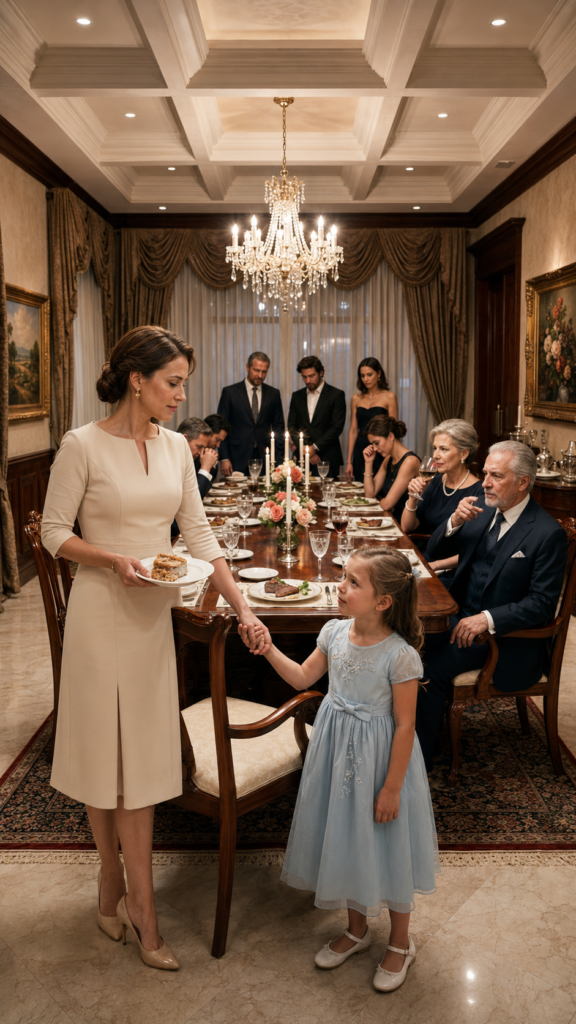
Don Ernesto Valdivia looked directly into his 9-year-old granddaughter's eyes and said, with a calm that froze the dining table:
—You either eat it, or you go hungry.
In front of the little girl was a cheap disposable plate, the kind used at children's parties, filled with wet dog food.
The entire dining room fell silent.
On the long mahogany table, the other guests had juicy steaks, buttery mashed potatoes, roasted asparagus, and crystal glasses filled with expensive wine.
Sofía, the birthday girl, had tears filling her eyes.
She wore a lilac dress with embroidered flowers that she had chosen herself at the local market. She had styled her hair with braids and white bows because she wanted to look beautiful for her grandparents.
She wanted them, for once, to look at her with pride.
Her mom, Daniela, stood still for a few seconds.
Not because she didn’t feel rage.
But because the rage was so immense that it felt like it had extinguished her insides.
Daniela was the only daughter of Ernesto and Rebeca Valdivia, a couple known in Las Lomas for their real estate ventures, their elegant dinners, and their public donations to foundations where there were always photographers.
To society, they were fine people.
To Daniela, they were the parents who never forgave her for falling in love with a mechanic.
Pablo, her husband, had died three years earlier when a truck ran a stop sign on Calzada de Tlalpan and crashed into the van he was driving back from the shop.
Sofía was only six when she lost her dad.
Since then, Daniela had been working as a supervisor in a supermarket in Coyoacán, 45 hours a week, sometimes more when inventory came around.
They lived in a tiny apartment in Iztapalapa, with thin walls, secondhand furniture, and a refrigerator filled with Sofía's drawings.
They had no luxuries.
But they had movie nights on Fridays, quesadillas for dinner, laughter in the living room, and a picture of Pablo next to a candle that Sofía lit when she missed him.
The Valdivias never accepted that life.
—We warned you that man was no good for you—Rebeca told Daniela the day of the funeral, still wearing designer sunglasses—. Look what he left you.
Ernesto was more direct.
—Come back to this house, quit that mediocre job, and we’ll take care of the girl. But on our terms.
Daniela said no.
Since then, they only saw each other on Christmas, Easter, or when Rebeca wanted to show off “family unity” to her friends.
Sofía, however, kept waiting for affection.
She made them cards, sent voice messages saying “I love you so much,” and asked if someday her grandpa would come to watch her play soccer.
They never did.
So when an invitation arrived in gold for a formal dinner for her 9th birthday, Sofía jumped with excitement.
—Mom, they remembered!—she shouted—. Do you think they’ll finally love me?
Daniela felt a lump in her throat but couldn’t shatter that illusion.
That night they arrived at the Valdivia mansion in Las Lomas at 6 sharp.
There were fountains, gardeners, luxury cars, and an entrance so bright that Sofía whispered:
—It looks like a storybook house.
In the dining room were Uncle Marcelo, his wife Irene, their two teenage children, and Great Aunt Amparo.
No one hugged Sofía.
Rebeca just looked her up and down.
—What a… simple dress.
The little girl lowered her gaze.
Dinner began with comments disguised as courtesy.
Ernesto talked about business, about land, about “ambitious people” and “people who settle for being cashiers their whole lives.”
—My mom is already a supervisor—Sofía said proudly—. Everyone likes her a lot at the store.
Ernesto let out a dry laugh.
—Oh, sweetie. That’s not success. That’s surviving.
Daniela clenched the napkin on her lap.
Then the waiters entered.
Everyone was served steak on white porcelain.
Everyone except Sofía.
The waiter placed the cardboard plate in front of her, containing a brown, shiny, foul-smelling mass.
Dog food.
Sofía looked at the plate, then back at her mom.
—Mom… what did I do wrong?
Daniela stood up so quickly that the chair screeched against the floor.
—What the hell is this?
Ernesto smiled.
—A lesson.
Rebeca cut her meat as if nothing had happened.
—If you want to raise her like a poor person, let her learn from childhood what awaits her.
—She’s 9 years old—Daniela said, her voice breaking.
Ernesto pointed at the plate.
—And she’s old enough to understand that your failure has consequences. Let her eat.
Sofía began to cry.
—But it’s my birthday...
No one moved.
Marcelo stared at his steak.
Irene looked down.
Aunt Amparo trembled but remained silent.
Daniela looked at each one, one by one.
Then she took the dog food plate with both hands and slowly lifted it in front of the entire family.
PART 2
Ernesto thought Daniela was going to throw the plate in his face.
He even smiled, as if he were waiting for her to cause a scene to confirm the story he had been repeating for years:
That his daughter was common.
That Pablo had dragged her into a vulgar life.
That Daniela didn’t know how to behave among “decent” people.
But she didn’t scream.
She didn’t cry.
She didn’t give him that satisfaction.
With one hand she held the plate and with the other grabbed Sofía, who could barely breathe between sobs.
—We’re leaving—said Daniela.
Rebeca let out a cold chuckle.
—Always so dramatic.
Daniela stared at her without blinking.
—No. Dramatic is serving dog food to a little girl on her birthday and calling it love.
The dining room fell silent again.
Ernesto stood up.
—If you cross that door, forget about any help. No school, no inheritance, not a dime. You and that girl are out of this family.
Sofía clung even tighter to her mother’s hand.
Daniela leaned down to her.
—My love, look at me. You didn’t do anything wrong. Nothing. Cruel adults say silly things when their hearts are rotten.
The little girl nodded, but her eyes already had a new wound.
Daniela walked out of the mansion, carrying the plate as if it were something valuable.
Because it was.
It was the proof.
In the car, Sofía completely broke down.
—Does Grandpa hate me because we’re poor?
Daniela parked in front of a pharmacy, got out, opened the back door, and hugged her daughter tightly.
—No, my girl. Your grandpa hates everything he can’t control. That’s not your fault.
Then she bought a plastic container, gloves, and tape.
She stored the dog food without touching it, stuck a label with the date, time, and place.
She didn’t know yet how far this would go.
She only knew that night she wasn’t going to stay buried under the “that’s your grandpa” narrative.
They drove to Clara’s house, a friend of Daniela’s who worked as an emergency nurse.
Clara opened the door and, upon seeing Sofía trembling in her crumpled lilac dress, her smile vanished.
—What happened?
Daniela told her everything.
Clara photographed the plate, Sofía’s condition, her trembling hands, her swollen eyes. She noted that the girl had a racing pulse, irregular breathing, and a panic attack triggered by familial humiliation.
—This wasn’t a cruel joke—Clara said—. This was emotional abuse.
That same night, when Sofía finally fell asleep, clutching her dad’s old sweatshirt, Daniela made a list.
Ernesto.
Rebeca.
Marcelo.
Irene.
The two cousins.
Aunt Amparo.
The waiters.
Everyone had seen.
Everyone had stayed silent.
The next morning, Daniela requested a day off from work and went to the office of Attorney Teresa Aguilar, a lawyer known for handling difficult family cases.
She placed the container on the desk.
—My parents did this to my daughter.
Teresa didn’t speak for a few seconds.
Then she opened the folder, looked at the photos, and said:
—This is going to be entered as evidence. And they will learn that having money doesn’t give them the right to destroy a little girl.
First, they requested a restraining order.
Then, a lawsuit for moral damages and psychological violence against a minor.
Ernesto laughed when he received the papers.
—A lawsuit over a plate of food? Your mother turned out ridiculous—he told Marcelo over the phone.
But he made a huge mistake.
He counter-sued for visitation rights with Sofía, claiming that Daniela was manipulating the girl to keep her away from her grandparents.
With that, the case stopped being a private dispute.
Everything came to light.
Six months later, Daniela entered the family court wearing a simple black dress and her hair tied back.
Sofía wasn’t there.
The therapist had recommended protecting her from hearing her grandparents' cruelty again.
Ernesto arrived in an Italian suit, a gold watch, and three lawyers.
Rebeca appeared with pearls, dark glasses, and a perfectly victimized face.
As if she had been the one humiliated.
Attorney Teresa stood before the judge.
—Your Honor, this case is not about a difference between rich and poor. It’s about two adults who used their economic power to humiliate a 9-year-old girl in front of her entire family.
The first witness was Marcelo.
Daniela’s brother looked worn out.
He had dark circles, an unkempt beard, and a shame he couldn’t hide.
—What did you see that night?—asked Teresa.
Marcelo swallowed hard.
—I saw my dad order that they serve dog food to Sofía while we all ate meat.
—Did you intervene?
He closed his eyes.
—No.
—Why not?
Marcelo began to cry.
—Because my dad threatened to cut me out of the will. And I was a coward. I left my niece alone for money.
A murmur ran through the room.
Irene was next.
She testified that Rebeca had planned “the lesson” days in advance, even asking the cook to buy the cheapest dog food.
That was the first twist that left Daniela frozen.
It hadn’t been an impulse.
They had prepared it.
Aunt Amparo also testified.
She was 82 years old and walked with a cane, but spoke with a firmness no one expected.
—I have known Ernesto since he was a boy. He has always been proud. But that night I saw malice. That little girl asked what she had done wrong, and none of us had the courage. Not me either. And that guilt will accompany me until I die.
Then Teresa presented the plate.
The same plate.
Sealed, photographed, documented.
When it was shown, a woman on the jury covered her mouth.
Another man shook his head in disgust.
Ernesto lost that smug patron smile for the first time.
His lawyer tried to soften it.
—It was an educational metaphor, Your Honor. A clumsy way to show economic consequences.
Teresa turned to Ernesto.
—Do your dogs eat this?
Ernesto frowned.
—I don’t remember.
Teresa displayed a receipt from an exclusive pet store.
There was the second blow.
Rebeca’s poodles ate imported food, four times more expensive than what was served to Sofía.
—So your dogs eat better than your granddaughter when you want to give lessons—Teresa said.
Rebeca turned red.
The judge did not avert her gaze from them.
Then the psychological reports were presented.
Sofía had nightmares, fear of eating in other people's homes, anxiety when someone told her “behave,” and a repeated question in therapy:
“If I’m poor, do I matter less?”
Daniela cried silently upon hearing this.
Not out of shame.
Out of rage.
Because no little girl should have to heal a wound caused by those who were supposed to love her.
When Ernesto took the stand, he still tried to sound superior.
—I just wanted Daniela to react. To seek something better. To stop settling.
Teresa stepped closer.
—And to motivate your daughter, you decided to punish your granddaughter?
—Daniela chose that life—he responded—. She married a mechanic.
—Pablo is dead, Mr. Valdivia.
—Well, her decisions still have consequences.
The silence that fell was heavy.
The judge stopped writing.
Daniela felt something break at last, but not within her.
In her father’s mask.
Everyone had just seen the truth.
It wasn’t concern for Sofía.
It was disdain for Pablo.
Disdain for poverty.
Disdain for anyone who didn’t live by their rules.
The ruling came that same day.
The judge granted the permanent restraining order, denied any visitation rights to the grandparents, and ordered a $500,000 compensation for moral damage, along with therapy for Sofía as long as it was necessary.
Ernesto stood up furious.
—This is an exaggeration! She’s my granddaughter!
The judge gently tapped the desk.
—No, Mr. Valdivia. A granddaughter is not a property. And familial love cannot be used as a weapon.
The news exploded 48 hours later.
“Mexican businessman humiliates granddaughter with dog food at birthday dinner.”
The headline spread across Facebook, local news, and groups.
Ernesto's partners canceled contracts.
A developer with three granddaughters said:
—I deal with tough people, not with those who can break a little girl.
Rebeca lost her place in the club.
She was removed from two boards.
Her friends stopped responding.
The woman who boasted charity in magazines ended up hiding from photographers at her own home’s entrance.
Weeks later, Marcelo visited Daniela’s apartment.
He didn’t come with excuses.
He came with a folder.
—I opened a trust for Sofía. For her college. You manage it. I can’t change what I did, but I want to start paying for my cowardice.
Daniela looked at him for a long time.
—Money doesn’t erase what my daughter saw.
—I know—he said, crying—. My own children asked me why I didn’t defend her. I had no answer. I just know I don’t want to be that man again.
Daniela didn’t forgive him immediately.
But she set a condition.
—If you re-enter Sofía’s life, it will be to protect her. Even if it costs you money. Even if it costs you family. Even if it costs you to look bad.
Marcelo agreed.
And this time, he kept his word.
He went to soccer games, school festivals, simple birthday parties with tres leches cake and piñatas on the rooftop.
He never stayed silent again when someone belittled Daniela.
A year later, a letter arrived from Ernesto’s lawyer.
They requested mediation.
They claimed they were sorry.
That they wanted to see Sofía.
Daniela showed the letter to her daughter, who was now 10 years old and had a calm strength in her gaze.
—Do you want to see them?
Sofía read slowly.
Then shook her head.
—They’re not sad about what they did, Mom. They’re sad because everyone found out.
Daniela said nothing.
She just tore the letter and threw it in the trash.
Sofía’s 10th birthday was in their apartment.
There was pizza, jello, soda, music, 12 kids running around the living room, and a piñata hanging with a string between the window and the bathroom door.
There was no porcelain.
No crystal.
No steak.
But when Sofía blew out the candles, she smiled for real.
Then she asked to speak.
Everyone fell silent.
—Last year my grandparents tried to make me feel like trash because my mom isn’t rich—said the little girl—. But today I understood something. Poor isn’t living in a tiny apartment. Poor is having a huge mansion and not having a heart.
Daniela covered her mouth with her hand.
Marcelo bowed his head, crying.
Sofía hugged her mom.
—We are rich, Mommy. Because here nobody has to earn love.
That phrase hung in the room.
And maybe that’s why the story was shared so much.
Because in Mexico, there are many families where money confuses authority.
Where grandparents think they can humiliate because they “help.”
Where children endure for inheritances, out of fear, out of habit, or the famous “they’re your family.”
But Daniela learned something that night.
Blood doesn’t justify cruelty.
A surname doesn’t give anyone the right to break a child.
And sometimes, to save the one you love the most, you have to rise from the table, carry the proof in your hands, and let those who believe money buys dignity remain alone.