PART 1
—Don't make a scene, Damián. Emiliano has always been a distracted child.
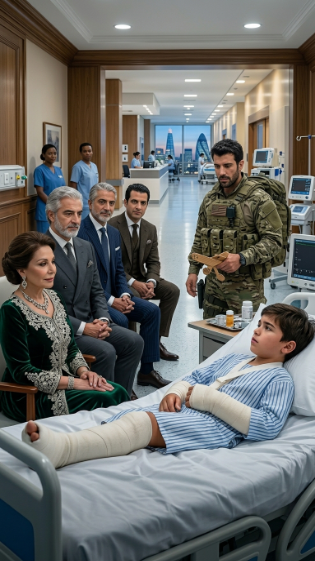
Ofelia Navarro uttered those words without releasing her coffee cup, as if the six-year-old boy wasn’t connected to a respirator just a few feet away.
Damián Ortega had just returned to Mexico after 87 days working as a safety supervisor on an oil platform in the Gulf. He still carried his backpack, and in the pocket of his jacket was a wooden train he had carved for his son during night shifts.
No one had warned him that Emiliano was hospitalized.
When he arrived at his home in Ciudad del Carmen, he found the door locked, the bedroom empty, and the child's drawings ripped from the refrigerator. A neighbor eventually told him, almost in whispers, that an ambulance had left Ofelia's house two nights prior.
At the hospital, Dr. Abril Mendoza ushered him into an office.
—I need you to prepare to hear something difficult.
—Just tell me straight.
The doctor opened a folder and held several X-rays up to the light.
—Emiliano has 42 fractures. Some are recent, but others started healing weeks ago. There are ribs, wrists, a leg, and two fingers affected. We also found small burns and restraint marks.
Damián didn’t raise his voice.
He simply placed both hands on the desk.
—Can a fall do all that?
The doctor shook her head slowly.
—Not from a single fall. Not even from ten.
In the waiting room were Ofelia and her five siblings: Fausto, who owned a transport company; Ramiro, a manager of a junkyard; Efraín, in charge of a “child assistance” association; Saúl, always glued to his phone; and Benjamín, the youngest, who avoided looking at Damián.
The six of them were chatting and laughing.
Ofelia stood the moment she saw him.
—I'm glad you made it. The boy ran out to the yard, tripped, and…
—42 —Damián interrupted her.
The laughter died down.
Fausto approached with a twisted smile.
—Watch your tone, brother-in-law. We all did what we could while you were off who knows where.
Damián stared at him for several seconds.
Fausto braced for a shove. Ofelia anticipated shouts. The others had their phones ready.
But Damián just walked past.
By the vending machine, Commander Iván Trejo caught up with him.
—Mr. Ortega, there are three prior reports against that family. All three vanished. The Navarros have friends in the DIF, in the courthouse, and in the municipal presidency. If you lose your cool, they'll use it to take the child from you.
—Take him from me?
Iván lowered his gaze.
—There’s something else. Your mother-in-law submitted documents saying that you abandoned Emiliano.
Damián entered the room, placed the wooden train by the bed, and looked at his son’s bandaged body.
In the file was Ofelia’s signature.
Beneath it was a phrase that froze his blood: “Legal representative of the minor.”
That night, he didn’t threaten anyone.
He photographed every X-ray, every injury, and every document.
Then he called a woman he hadn’t seen in five years.
—Lucía —he said—, I need you to find out who gave my mother-in-law custody of my son.
On the other end, there was silence.
—Damián… that’s not something you just give away.
—Then find out how much they paid.
And while the Navarros celebrated that the “coward” father had not reacted, Damián discovered that the guardianship had been signed four days after he left.
The worst part wasn’t that they had hurt Emiliano.
The worst part was that it had all been planned before he boarded the helicopter.
PART 2
For the next 48 hours, Damián stayed by Emiliano’s side.
He learned the names of the medications, the nurses’ schedules, and every change in the monitors. He didn’t ask unnecessary questions. He listened.
Dr. Abril was the first to understand.
—If the child stays here, Ofelia will try to come in with a court order —she warned—. I can request a transfer to Mérida for complex pediatric trauma.
—Do it today.
The ambulance left at dawn.
Ofelia arrived nine minutes late with a lawyer and two municipal police officers. When she demanded to know the destination, the doctor replied that the information was protected.
For the first time, the woman stopped pretending to be sad.
—You’ll regret this —she said.
In Mérida, Lucía Barragán awaited Damián in a modest office above a stationery store. She had been a military lawyer before dedicating herself to family cases that others rejected.
She placed three documents on the table.
The first was a provisional guardianship. According to the file, Damián had disappeared, and Ofelia was the only one capable of protecting Emiliano.
The second was a psychological evaluation. A doctor Damián had never seen claimed he suffered from “episodes of rage, paranoia, and violent behavior.”
The third was a request to make the guardianship permanent.
—The hearing is in 19 days —Lucía explained—. They want you to react. A hit, a threat, or a video of you yelling would be enough for them to present the dangerous father they’ve already invented.
Damián read each page.
—Who signed?
—Judge Baltazar Córdova. His wife is a partner in a company owned by Fausto Navarro.
—Then we’re not just fighting for custody.
Lucía looked up.
—What are you thinking?
—That no one manufactures 42 fractures to win a family dispute.
That same night, Damián called Sergio Beltrán, an old colleague who was now an auditor in a federal unit against operations with illicit resources.
When Sergio saw the X-rays, he stopped asking personal questions.
—Send me accounts, policies, names of associations, and every hospital where they treated the child.
What surfaced over the next three weeks was darker than anyone could imagine.
The Navarros had built a business around vulnerable minors.
They sought children from indebted families, single mothers, or fathers absent due to work. They obtained temporary guardianships through bought officials. Then they registered illnesses, accidents, and supposed treatments to collect insurance, disability support, donations, and medical reimbursements.
Efraín managed an association called Hands of Hope.
In public photographs, he embraced children and handed out food packages.
In his private accounts, he received money from ghost clinics, transportation companies, and policies contracted in the names of minors he didn’t even know.
Emiliano was particularly valuable because Damián had international insurance through his job.
Each hospitalization generated payments.
Each injury could justify rehabilitation, transfers, medications, and special equipment.
To the Navarros, the boy wasn’t family.
He was a heartbeat invoice.
The missing piece emerged thanks to Benjamín.
The youngest brother called from a payphone.
—I didn’t hit him —he said without greeting—. But I know who did.
Damián didn’t respond.
—Fausto got desperate when Emiliano cried. Ofelia said to keep him sick, not to kill him. I recorded an argument because I thought one day they’d blame me.
—Where’s the recording?
—I can’t give it to you. They’re watching me.
—Then don’t call me until you decide whether you’re afraid of them or of living knowing what you allowed.
Benjamín hung up.
Two days later, a teenager named Ximena arrived at the Mérida hospital accompanied by a social worker.
She was 15 and Ofelia’s niece. Since she was 11, she had lived in the Navarro household. On paper, she was under “family care.” In reality, she cleaned, cooked, and looked after Emiliano without being allowed to leave.
She had an old cellphone hidden in a bread bag.
—Benjamín told me to give this to you —she murmured.
There were 17 audio recordings and 6 videos.
In one, Ofelia said Damián wouldn’t return before the hearing.
In another, Fausto argued over insurance money.
And in the most terrible, Emiliano could be heard pleading not to be locked up while someone said:
—If he doesn’t cooperate, tomorrow we’ll invent another fall.
Ximena also explained the burns.
They used a hot spoon to punish him when he spoke of calling his father.
Dr. Abril had to leave the room upon hearing her.
Damián remained seated.
His hands trembled just once.
—Can you testify?
Ximena looked at the photographs of the boy.
—Yes. But I don’t want to go back to that house.
—You won’t go back.
The Navarros noticed that something was shifting.
The warning came one night on the road to Mérida. Damián was driving when the brake sank without resistance. He slowed down, slammed the truck against the concrete barrier, and managed to stop before a curve.
The hose had been loosened with a tool.
They didn’t cut it.
They wanted it to look like a failure.
Damián left the wrecked truck in front of a shop owned by an acquaintance, where Fausto’s informants could see it.
He didn’t file a local report.
He let them believe the scare had worked.
Meanwhile, Sergio followed the money.
He discovered that Fausto not only laundered resources.
He also stole a portion from more powerful businessmen than him.
He inflated medical expenses, duplicated junkyard invoices, and hid deposits in the children’s association. For years, he had survived by distributing favors.
But the people protecting him tolerated many things, but not two: being stolen from and attracting a federal investigation.
Sergio assembled a file with accounts, policies, and ghost companies.
Lucía prepared another with the fraudulent guardianship, the false psychological evaluation, the vanished reports, and Ximena’s testimony.
Damián did something simpler.
He waited.
Four days before the hearing, Judge Córdova requested leave for “health reasons.”
A DIF director resigned.
Two police officers stopped answering calls.
The municipal president publicly returned a donation from Hands of Hope.
Fausto called all his contacts.
No one answered.
Ofelia called Damián.
—What did you do, you scoundrel?
He watched Emiliano sleep.
—Nothing that you didn’t do first.
The operation began at 1:20 PM on a Tuesday.
Federal agents secured the junkyard, the transport offices, the association, and a clinic that existed only on paper. They froze 23 accounts and found files on 14 minors.
Fausto was arrested in a restaurant.
Ramiro handed over bank keys.
Efraín blamed Ofelia.
Saúl attempted to flee to Tabasco.
Benjamín voluntarily presented himself and confirmed the audios.
The brothers who had laughed together in the hospital began accusing each other before the day was over.
The hearing was held in Mérida before a judge with no ties to the Navarros.
Ofelia arrived dressed in black, a golden rosary in her hands.
—I’m a worried grandmother —she declared—. Damián abandoned his son to go after money.
Lucía presented the employment contracts, recorded video calls, and messages where Damián asked to speak with Emiliano, while Ofelia responded that the boy was asleep or sick.
Then Dr. Abril spoke.
She explained that the 42 fractures corresponded to different dates. She described the burns, the malnutrition, and the extreme fear of the minor.
Finally, Ximena entered.
Ofelia looked at her as if she could still command her to be silent.
The teenager took a deep breath.
—I lived in that house. I saw how they locked him up. I hid food for him. And I heard when they said they needed another hospitalization before collecting the insurance.
The videos were not played in full to protect the minors.
The judge saw enough.
The provisional guardianship was annulled due to fraud.
The permanent request was denied.
Ofelia was placed under investigation for violence, trafficking, fraud, and criminal association.
When she left the courtroom, her brothers, trusted lawyers, and the trucks that usually waited for her were gone.
There were only two agents.
Emiliano legally returned to his father.
But justice didn’t erase the damage.
For months, the boy slept with the light on. He was scared when someone closed a door. Sometimes he hid food under his pillow.
Damián never forced him to speak.
He sat on the floor next to his bed and repeated:
—I’m here. No one is going to take you away.
Ximena entered a protection program and, with Lucía’s help, began studying at a school in Mérida.
Dr. Abril visited Emiliano every two weeks.
Sergio continued the investigation until seven officials were prosecuted.
One Sunday, almost eight months later, Damián found his son drawing in the yard.
It was a huge train with open windows.
—Where is it going? —he asked.
Emiliano didn’t look up.
—to pick up children.
—And who drives it?
The little boy pointed to a silent figure next to the locomotive.
—You. But you don’t shout, because the children are scared.
Damián had to look away.
The Navarros expected to find an angry man.
They had prepared cameras, false reports, and witnesses to turn his rage into a cage.
They never imagined that the father they called a coward would understand something they had forgotten:
The borrowed power disappears when it ceases to be useful.
And sometimes the strongest person in a room isn’t the one who pounds the table.
It’s the one who holds every piece of evidence, protects those who can still speak, and waits for the exact moment for all the lies to collapse on their own.