PART 1
—The problem is Renata's, not mine. In my family, men are good for that.
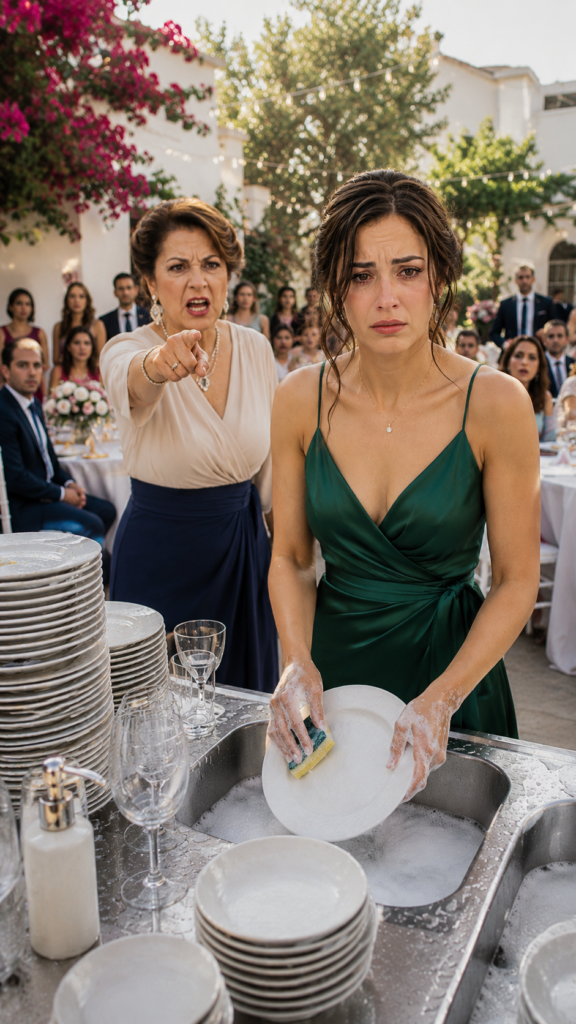
Iván said it, lifting his tequila glass, as if he had just told a joke during Sunday dinner.
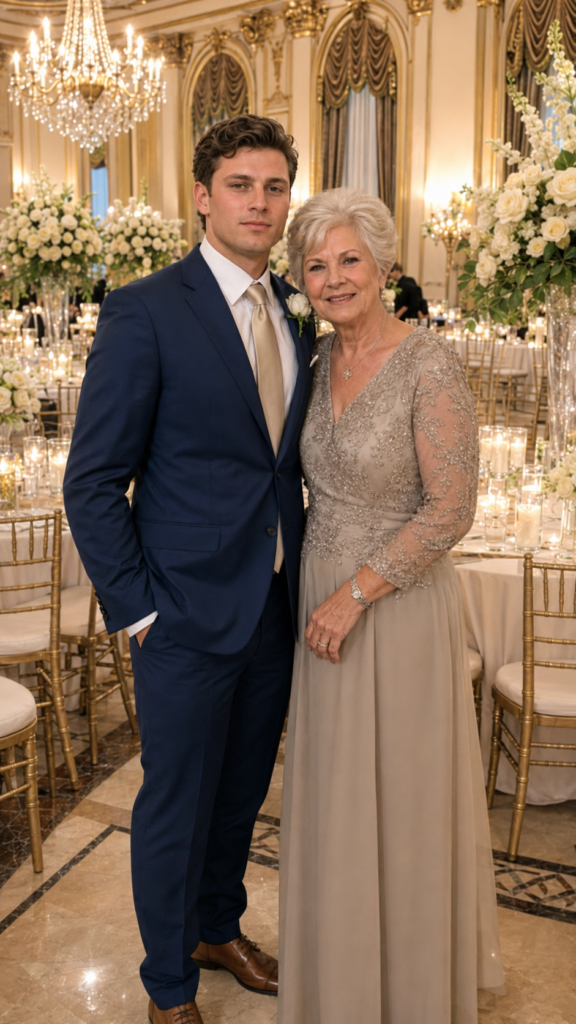
The table fell into an awkward half-silence. There were his uncles, his cousins, his mother, his pregnant sister-in-law, six months along, and even Renata's mother, who had come for the first time to eat birria at the Aguilar household in Tlaquepaque.
Renata felt her face ignite.
She said nothing.
She just lowered her gaze to her plate, tightened the napkin over her thighs, and swallowed her tears as she had done so many times before.
For three years, she had been trying to get pregnant.
Three years of vitamins, consultations, ultrasounds, blood tests, expensive injections, herbal teas recommended by neighbors, and prayers to the Virgin of Zapopan.
And nothing.
At first, Iván was sweet.
He would kiss her forehead and say:
—Don’t worry, my queen, when God wants.
But then he started with the little comments, the ones that seemed like jokes but cut deep.
When he saw a woman with a stroller in the plaza, he would say:
—Look, she could do it.
When a baby was born in the family, he would let it slip:
—Let’s see when it’s our turn, if it’s even possible.
And when he drank, it was worse.
The blame always fell on Renata.
The strangest thing was Doña Mercedes, his mother.
Alone in the kitchen, she would make chamomile tea, stroke her hand, and say:
—Be patient, dear. Don’t lose faith.
But at the table, in front of everyone, she changed.
—In this family, there have never been problems having children. Everything’s fine on the Aguilar side.
Renata couldn’t understand this double face.
Sometimes she thought Doña Mercedes cared for her. Other times, that she was burying her alive with a smile.
One afternoon, Dr. Valeria called her into the clinic in Providencia.
Renata arrived nervous, with a folder full of tests.
The doctor reviewed everything and barely smiled.
—Renata, your results are perfect. Hormones, ovaries, tubes, everything. There’s nothing indicating infertility on your side.
Renata felt the ground shift beneath her.
—Then why can’t I get pregnant?
The doctor lifted her gaze.
—I need to see your husband’s study. The sperm analysis that, according to the records, was requested months ago.
Renata froze.
—Iván told me he didn’t do it. That he didn’t get in line that day.
The doctor fell silent.
That silence spoke more than any explanation.
Renata left the clinic with cold hands and a closed throat.
She recalled that day.
Iván had gone alone to the lab and returned too calm.
—Just a lot of waiting, love. There were too many people.
She also remembered how Doña Mercedes changed the subject every time she mentioned Iván's tests.
—Oh, don’t bother my son with that. He’s fine.
That same afternoon, Renata got home before Iván.
He was still at the car dealership where he worked. Doña Mercedes had gone to the San Juan de Dios market.
Renata didn’t plan anything.
She just walked to the bedroom as if someone were pushing her.
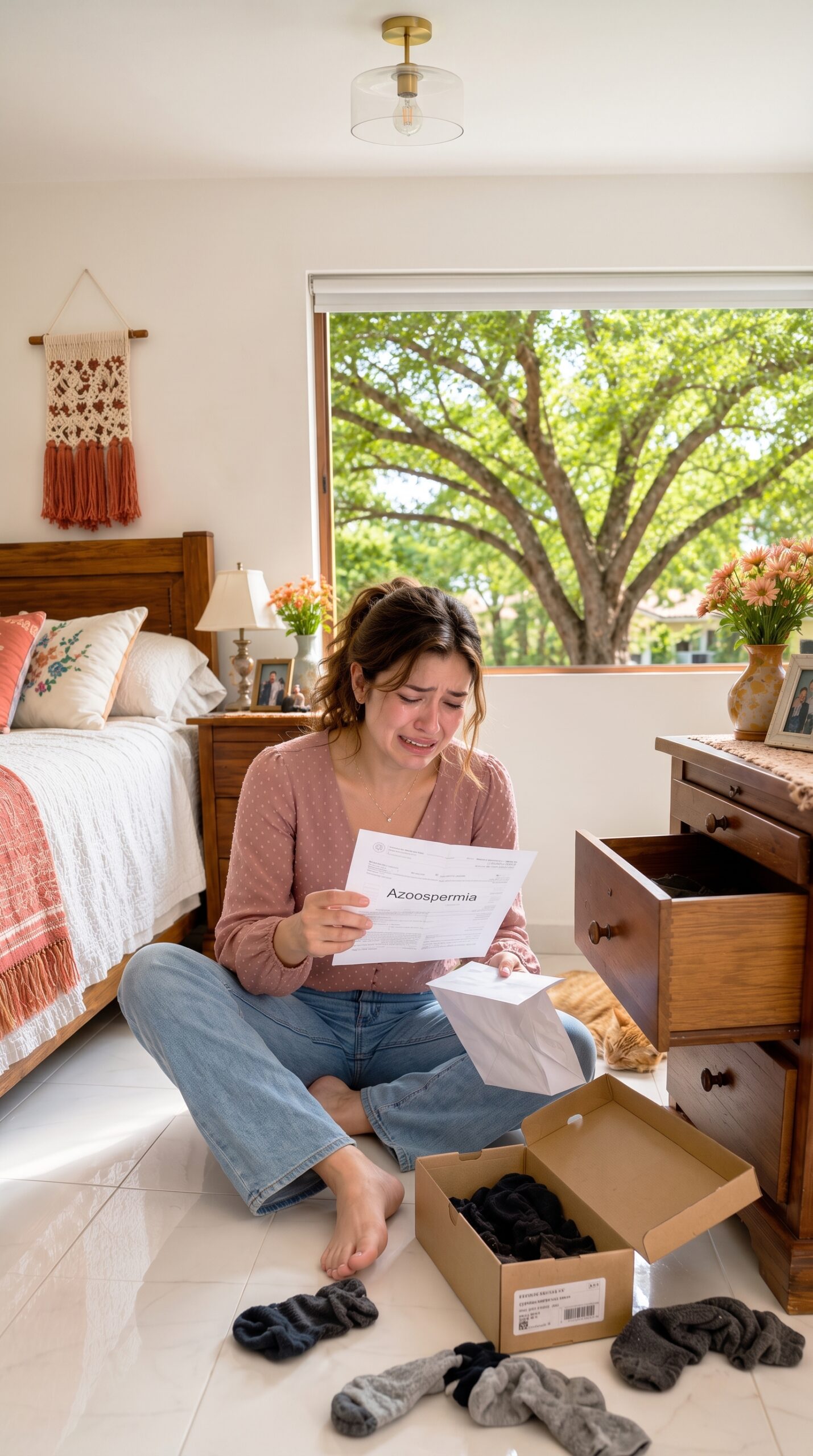
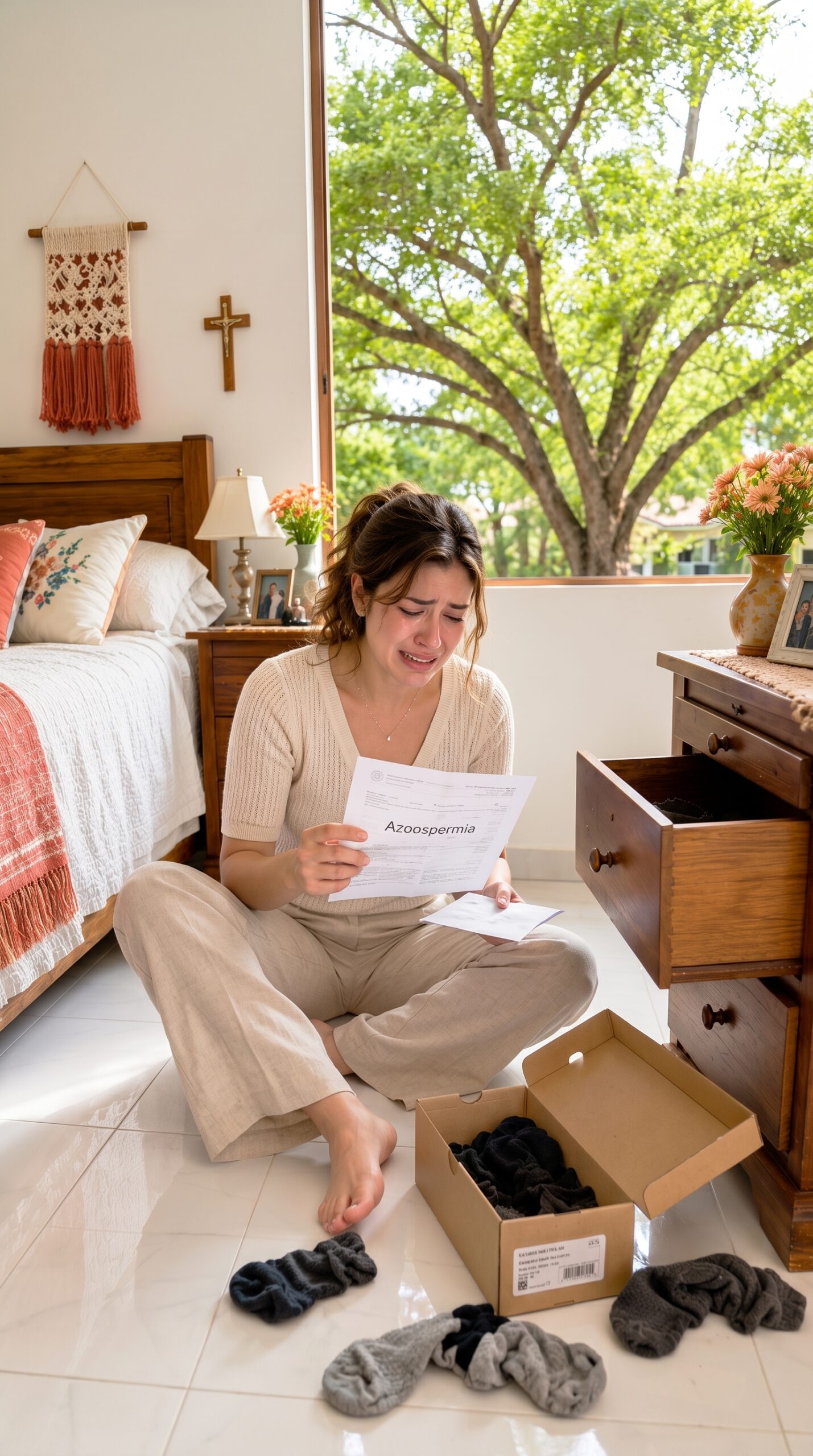
She opened Iván's nightstand.
Socks, old receipts, wires, dead batteries.
She reached deep inside.
Her fingers hit something hard taped inside.
It was a crushed shoebox.
She pulled it out slowly, her heart pounding against her ribs.
Inside was a white envelope, yellowed at the edges, with Iván Aguilar Robles' full name and the seal of a clinic.
Renata opened it.
One word exploded in her eyes:
Azoospermia.
Total absence of sperm.
Renata fell back onto the floor.
Three years carrying the blame. Three years hearing that she was the dry one, the useless one, the woman who couldn’t give anyone grandchildren.
And the diagnosis was his.
But just as she was about to put the paper away, she saw another document underneath, older.
Dated twenty-two years ago.
When Iván was eleven.
And above it, in Doña Mercedes' shaky handwriting, was a handwritten note:
“May my boy be saved. The rest I will carry. Even if everyone hates me.”
PART 2
Renata read that phrase once, then again, then a third time.
She didn’t understand.
Saved from what?
Iván wasn’t a sick child in her memories. To her, Iván had always been the tall, boastful man, the one who styled his hair perfectly before going out, the one who couldn’t stand losing even in family lottery games.
But the box still held more papers.
At the bottom, she found an old IMSS folder, bent, with water stains and a letterhead that squeezed her chest:
Pediatric Oncology.
Renata felt her anger getting stuck with something heavier.
She opened the folder.
There were medical reports, nursing notes, blood tests, signed authorizations.
Iván Aguilar Robles, 11 years old.
Acute lymphoblastic leukemia.
Intensive treatment.
8 months hospitalized.
3 critical relapses.
Renata turned the pages with clumsy fingers.
There was the story no one had told her.
The boy in the photo she had once seen at Doña Mercedes' house, thin, bald, with an IV in his arm. The photo her mother-in-law had snatched from her hands, saying:
—That’s not meant to be seen.
Renata thought they were hiding a shame.
No.
They were hiding a war.
The treatment that saved Iván’s life had also left him unable to have biological children.
That was what the document said in cold, clean, brutal words.
“Probable permanent infertility.”
Renata shut her eyes.
Suddenly, hatred wasn’t so easy anymore.
A part of her wanted to cry for that child who almost died.
But another part, the most hurt, remembered the adult man raising his glass and saying:
—The problem is Renata.
Cancer didn’t force him to humiliate her.
The illness didn’t put those words in his mouth.
He chose that.
Every Sunday. Every baptism. Every meal where she pretended she didn’t hear.
Renata took pictures of all the documents with her phone. Then she placed the box back exactly as it was.
That night, when Iván arrived, she already had the folder open on the bed.
He walked in, taking off his watch.
Upon seeing the papers, he froze.
He didn’t ask anything.
He just said:
—Did you go through my things?
Renata let out a dry laugh.
—Is that what worries you?
Iván swallowed hard.
—Renata, this wasn’t how I wanted you to find out.
—And how did you want it? After another three years? After leaving me without dignity in front of your whole family?
He sat on the edge of the bed.
For the first time, he didn’t seem the confident man everyone knew.
He looked like a scared child.
—I was afraid of losing you.
Renata looked at him with red eyes but a firm voice.
—No, Iván. You were afraid of them knowing that you couldn’t. And to save your pride, you put me in the middle like a punching bag.
Iván ran his hands over his face.
—My mom told me I didn’t have to tell anyone. That it was my business.
—Your mom wasn’t the one who mocked me in front of my own mother.
He raised his head.
—I was desperate.
—I was too. And yet I didn’t destroy you.
The phrase hung heavy in the room.
Renata went to the closet and pulled out a suitcase.
Iván stood up quickly.
—Don’t leave. We can adopt. We can look for another option. We can fix this.
Renata folded a blouse without looking at him.
—The problem was never that you couldn’t have children. The problem was that you preferred to see me broken than to be vulnerable.
Iván cried.
And Renata, though it hurt, didn’t stop.
Because some tears come too late. And late tears don’t erase three years of public shame.
Before leaving, Renata went down to the kitchen.
Doña Mercedes was preparing beans in a clay pot. Seeing her with the suitcase, she turned pale.
Renata placed a copy of the studies on the table.
Doña Mercedes didn’t need to read them.
She just sat down slowly, as if suddenly all the years had come crashing down on her.
—You know.
Renata nodded.
—I know about Iván. I know about the leukemia. I know about the treatment. I know you wrote that note.
Doña Mercedes gripped her apron tightly.
—I was given 30 minutes to decide, dear. 30 minutes. One treatment had more risks, but maybe it would preserve his fertility. The other offered him more chance of survival, but it could leave him without children.
Her voice broke.
—I signed for life. I signed to have my son alive, even if one day he hated me for everything else.
Renata felt a knot in her throat.
For the first time, she saw Doña Mercedes not as the cruel mother-in-law but as a mother forever trapped in a hospital room.
But that didn’t heal everything.
—You left me carrying a guilt that wasn’t mine.
Doña Mercedes shut her eyes.
—Yes.
She didn’t defend herself.
That hurt more.
—Why? —Renata asked—. Why did you say those things at the table? Why did you make me look like the bad one?
Doña Mercedes lifted her gaze.
Her eyes were already filled with water.
—Because my son is a coward, Renata. I always knew.
Renata stood frozen.
She hadn’t expected that.
—I saved him when he was a child, but I couldn’t save him from becoming a man who hides. I knew he would never tell you the truth. I knew he would have you there, trying, wasting your body, your years, your hope.
Doña Mercedes wiped her cheeks with the back of her hand.
—If I told you the truth, I would betray my son. If I stayed quiet and treated you kindly, you would stay. So I did the only thing I could think of.
Renata whispered:
—Make me hate you.
Doña Mercedes nodded.
—So you would leave. So one day you could say: “I can’t stand this house anymore.” So you could get out in time. I was cruel to you on purpose, dear. Not because I didn’t care for you. But because I didn’t know how to love you another way without breaking my son.
Renata was left speechless.
The woman who had served her tea and then humiliated her at the table didn’t have two faces.
She had one heavy burden.
Doña Mercedes had spent her life choosing to be hated so that another could survive.
First Iván.
Then Renata.
That didn’t make her innocent.
But it made her human.
And that was harder to hate.
The divorce came two months later.
Renata didn’t create a scandal on social media. She didn’t post screenshots. She didn’t send the studies to the family group.
She could have.
She could have destroyed Iván’s image just as he had destroyed hers.
But she chose not to repeat the same cruelty under another name.
At the first hearing, Iván arrived looking worn, thin, without the arrogance he once had.
He apologized in front of the lawyer.
Renata only replied:
—I hope one day you understand that you didn’t lose your wife for being sterile. You lost her for being a liar.
Iván bowed his head.
There were no shouts.
Just that phrase, which exposed him more than any scandal.
Over time, Renata moved to a small apartment near Chapalita.
She returned to work at her accounting firm. She adopted a mixed-breed dog she found outside an Oxxo in the rain. She named her Chispa.
At first, the nights weighed heavily on her.
It hurt to see strollers, diaper ads, pictures of other people’s babies.
But little by little, she understood something nobody had told her gently:
A woman is not worth by the children she can have.
Nor by those she cannot.
She is worth by what she decides to do with her life when others try to define it by a wound.
A year went by.
On a Thursday afternoon, an Iván cousin texted her.
“Renata, sorry to bother you. Doña Mercedes is in a rest home downtown. Her memory is failing. Sometimes she asks for you.”
Renata stared at the message for a long time.
She could choose not to go.
No one forced her.
That woman had hurt her for three years.
But she had also tried to push her out of a lie, even if she did it in the worst way.
On Saturday, she bought chamomile tea, some cinnamon cookies, and went.
The rest home smelled of bleach, old flowers, and chicken broth.
Doña Mercedes was sitting by a window, smaller than in her memories, wearing a lilac sweater, with her hands still on her lap.
Renata approached slowly.
—Good afternoon, Doña Meche.
The old lady looked at her as one looks at a stranger with something familiar in their eyes.
—Are you a nurse?
Renata smiled sadly.
—No. I came to have tea with you.
She poured it into a plastic cup.
Doña Mercedes took it carefully, sipping it.
For a while, they didn’t talk.
Outside, a vendor was shouting:
—Sweet potatoes!
And for some reason, that sound so Mexican, so street-like, so life going on, made Renata want to cry.
When Doña Mercedes finished the tea, she patted Renata's hand.
—Have faith, dear —she said softly—. It will come soon.
Renata froze.
Those were the same words as before.
But now they didn’t sound like a lie.
They sounded like the only thing that woman knew how to offer when she couldn’t fix anyone’s pain.
Renata held her hand.
She didn’t fully forgive her.
Nor did she hate her as before.
Sometimes life doesn’t provide clean closures, nor perfect villains, nor victims without rage.
Sometimes it just leaves two women sitting by a window, one remembering too much, and the other forgetting everything.
Renata stayed there until the evening fell.
Before leaving, she adjusted the blanket over Doña Mercedes' legs.
The old lady murmured:
—My boy is going to be saved, right?
Renata felt her heart break.
She didn’t respond immediately.
Then she squeezed her hand and said:
—Yes, Doña Meche. He was saved.
And although no one in that family had come out unscathed, Renata understood something that burned inside her:
There are people who hurt you while trying to protect someone else.
That doesn’t absolve them.
But it forces you to wonder how many stories we judge without knowing what old role, what diagnosis, what fear, or what guilt each person hides at the bottom of a drawer.