PART 1
For 32 years, Don Ernesto Salgado had sold bolillos, conchas, and empanadas in a small bakery in Puebla. He had never thrown out a customer, not even the most rude ones.
Until that morning.
His shop was not fancy. It had a glass counter with a shattered corner, dark wooden shelves, an old coffee maker that wheezed like a freight truck, and a rusty bell hanging over the door.
But to Ernesto, this place was home.
Every day he watched neighbors enter who were not just looking for bread. Some needed to talk for 5 minutes. Others sought to hear their name spoken with affection. Many simply craved someone to look at them without judgment.
At 8:10, Julián Ramírez almost always arrived.
He was a bricklayer, 46 years old, and wore the fatigue of his labor like a cloak. His boots were often coated in dust, his jacket bore cement stains, and his hands were cracked and rough.
Yet he was one of the most educated men in the neighborhood.
—Good morning, Don Ernesto. The usual, please.
Ernesto already knew what to prepare: 2 chicken empanadas.
Never coffee.
Never sweet bread.
Always 2 empanadas and the exact change.
The baker had been wondering for months who the second empanada was for, but he never questioned it. There were silences that deserved respect.
That morning, Julián entered as several people were lined up. He took his place at the end, careful not to brush against anyone.
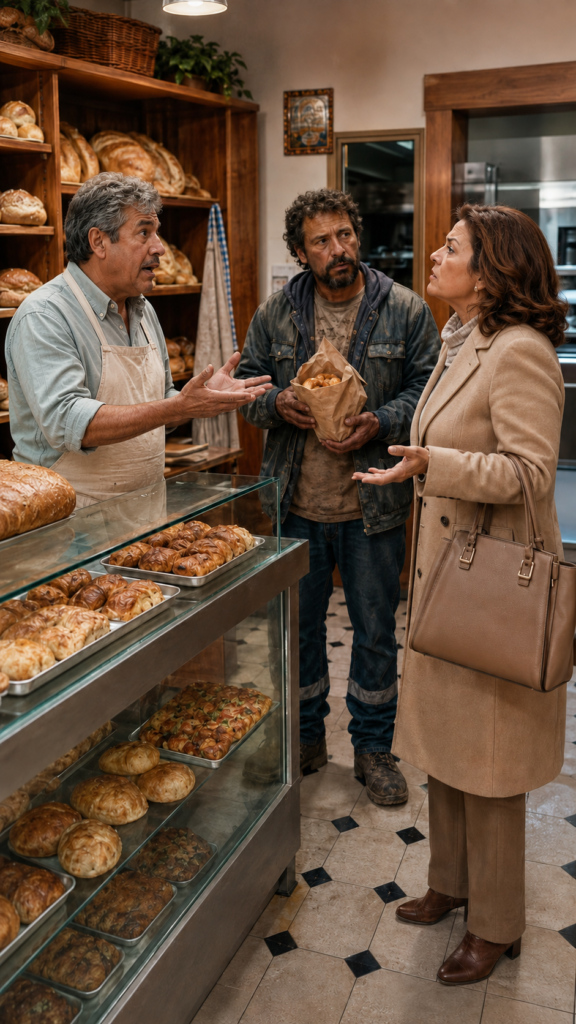
Behind him appeared a woman in her mid-fifties, wearing a beige coat, carrying a designer bag, with perfect nails and a perfume so strong it filled the shop.
Her name was Beatriz, though no one knew that yet.
First, she observed Julián's boots.
Then his jacket.
Next, his hands.
Julián felt her gaze and slightly lowered his head.
Beatriz let out an exaggerated sigh.
—There should be a separate line for people coming from construction sites. One walks in for bread and ends up breathing dust.
The bakery fell silent.
Julián didn’t respond. He merely stepped aside.
—I can come back later, Don Ernesto.
Ernesto felt a pang at the way he said it. It didn’t sound like courtesy; it sounded like habit. As if Julián had spent years learning to shrink himself so others could feel big.
The baker took the 2 best empanadas, placed them in a bag, and set it in front of him.
—You’re not going anywhere. It’s your turn.
—I don’t want any trouble, murmured Julián.
—You’re not causing any.
Beatriz stepped forward, chin raised.
—Well, if the show is over, can I be served?
Ernesto took a deep breath.
—Today, I’m not selling you anything, ma’am.
Her eyes widened.
—Excuse me?
—Anyone can enter here with dust on their clothes. What I won’t accept is someone coming in with contempt on their lips.
Beatriz tightened her grip on her bag.
—This is disrespectful!
—Disrespectful is humiliating a man for coming from work.
The woman looked around, expecting support, but no one spoke.
—I won’t ever come back.
—That decision is yours.
Beatriz stormed out, furious. The old bell rang with a sharp clang.
Julián wanted to pay for the 2 empanadas, but Ernesto only charged him for 1.
—I don’t want charity, he said.
—It’s not charity. It’s respect.
The next day, Julián returned and left a folded sheet of paper on the counter.
—My daughter made this.
It was a drawing of the bakery. Ernesto appeared in an enormous apron, and Julián held a bag. Above, in childish writing, it read:
“Here, the bread tastes like home.”
Ernesto hung the drawing behind the counter, unaware that just days later, the girl would come in alone with news that would chill the entire neighborhood.
PART 2
The girl was named Sofía and she was 9 years old.
She arrived one Thursday around noon, with a purple backpack slung over one shoulder and her hair hastily tied up. She stood by the door, clutching a few coins in her hand.
Ernesto recognized her from the drawing, even though he had never seen her.
—You must be the artist.
Sofía glanced at the paper stuck behind the counter and smiled faintly.
—My dad said he put it in the best place.
—And he spoke the truth.
The smile faded.
—My dad can’t come.
Ernesto set down the tray he was holding.
—Did something happen to him?
—He fell off a scaffold. It wasn’t that high, but he hurt his foot, and the boss said he wouldn’t pay him for the days he misses.
The girl took out the coins.
—He asked for 1 empanada. Just 1. He said not to spend more.
Ernesto then understood for whom the second empanada had always been. Julián bought one for himself and one for his daughter before taking her to school.
He prepared a bag with 2 empanadas, 4 bolillos, and 2 conchas.
Sofía’s eyes widened.
—I can’t afford this.
—One empanada is for your dad, the other for you. The bolillos were extras, and the conchas were misshapen.
The girl inspected the perfectly round pieces.
—They’re not misshapen.
—Don’t tell anyone. You’d ruin my reputation.
Sofía giggled, but then her expression turned serious.
—My dad will get mad.
—Tell him it’s not a gift. It’s an advance payment for another drawing.
She accepted and left, accompanied by a neighbor who was waiting for her on the corner.
On Monday, the bell rang again, and Beatriz walked in.
She didn’t hold her chin high.
Her eyes were swollen. She stood close to the door, as if doubting her right to enter.
Ernesto continued arranging bolillos.
—Good morning, she said.
—Good morning.
Beatriz walked up to the counter and saw the drawing.
She read slowly:
“Here, the bread tastes like home.”
—The daughter of the man I insulted made this, right?
Ernesto nodded.
—I’ve thought a lot about what happened. I acted terribly.
The expression took the baker by surprise.
—I’m not here to justify myself, she continued. My father was a bricklayer. His name was Tomás. He came home covered in dust, and my mom would put newspapers on the floor. When I was a child, I would run to hug him, not caring about his clothes.
Beatriz looked down at her well-kept hands.
—He built houses for 40 years so I could study. And the other day I saw the same boots my father wore…but instead of remembering him, I felt contempt. Honestly, I don’t know when I became someone like that.
Her voice cracked.
—I want to apologize to that man.
—His name is Julián.
—I want to apologize to Julián.
—You can offer your apologies. He will decide if he wants to listen.
Beatriz nodded and bought 1 bolillo. Before leaving, she wanted to drop a large bill in the tip jar but pulled her hand back.
—This wouldn’t fix anything.
—No.
—Can I come back tomorrow?
—The door was never closed to you. Only to contempt.
On Thursday, at 8:10, the bell rang.
Julián entered, leaning on crutches. Sofía walked beside him, clutching a blue folder against her chest.
—You should be resting, said Ernesto.
—If I keep sitting, I’m going to go crazy.
The baker served 2 empanadas. Julián left the exact change.
5 minutes later, Beatriz walked in.
Upon recognizing him, she stopped.
Sofía approached her father. Julián stiffened, though he did not lower his head.
Beatriz moved slowly.
—Good morning.
—Good morning, he replied.
—I want to apologize. What I said was cruel. You hadn’t done anything to me. I treated you as if you were worth less because of your clothes and your boots. I have no excuse.
Julián remained silent.
—When I got home that day, Julián said, my daughter asked why I was so serious. I can handle being looked at poorly. I’ve lived through it many times. But I don’t want her to learn that she must lower her head for being the daughter of a bricklayer.
Beatriz looked at Sofía, and her eyes filled with tears.
—You’re absolutely right.
—I accept your apologies, said Julián after a long silence. Not because I’ve forgotten, but because I don’t want to carry what you said every day.
Beatriz breathed shakily.
—Thank you.
Sofía opened her folder.
—I also brought something.
She took out a new drawing and placed it on the counter.
It depicted the bakery with the bell, Ernesto behind the glass, Julián with his boots, an old woman buying bread, a child gazing at the conchas, and Beatriz waiting her turn.
They were all in the same line.
Above it read:
“When there is respect, no one is surplus.”
No one spoke for several seconds.
Ernesto had to turn toward the coffee maker to hide his wet eyes.
—This one goes next to the other, he said.
—It has to stick close, ordered Sofía.
As Ernesto placed the drawing, Beatriz looked at Julián.
—My father would also be ashamed of me.
—Don’t speak for someone who can no longer respond, he said. Better do something that would have made him proud.
That phrase shifted the atmosphere.
The next day, Beatriz returned with a photograph of her father wearing a helmet and a stained shirt. She asked to leave it next to the drawings.
She started greeting the workers, learning their names, and when someone made a classist comment, she would respond:
—Dust can be wiped away. Bad manners take more work.
When the story spread through the neighborhood, some congratulated Ernesto, while others said he had exaggerated. Julián ended the gossip with a single phrase:
—She made a mistake and apologized to my face. Stop using me to continue humiliating her.
He didn’t want revenge. He wanted Sofía to learn that defending dignity did not mean destroying another person.
Weeks passed.
The injury healed, but the boss didn’t pay for the lost days and then reduced his work.
Ernesto discovered this when Sofía stopped accompanying him on Saturdays, and the 2 empanadas turned into 1.
—I’m not hungry in the morning, Julián lied.
—And I was born yesterday, replied Ernesto.
Julián got annoyed when the baker tried to help him.
—I don’t need charity.
—Then I need a job.
Ernesto pointed to a back wall of the bakery. It had dampness, cracks, and old electrical wiring.
—I want to repair this, but I don’t trust just anyone.
Julián examined the place.
—It’s more work than it looks.
—That’s why I need you.
The agreement allowed Julián to earn fairly without feeling like he was receiving charity. Later, other neighbors hired him to fix roofs, bathrooms, and facades.
Beatriz hired him to repair a wall and paid the full price. When he finished, she placed her father’s photograph under the new roof.
—He would have checked every line, she said.
—Then it better be straight, Julián replied.
They didn’t become close friends, but they learned to coexist without pride filling the entire room.
Sofía continued bringing drawings. In one, Ernesto was closing the bakery at night, but the light remained on.
—Why did you leave the light on? he asked.
—Because places that make people feel good never turn off completely.
Ernesto handed her a concha.
Julián frowned.
—Don Ernesto…
—I pay for artistic work.
—You always invent something.
—And you always pretend to be mad.
Months later, the cold season arrived. One morning, Ernesto lifted the metal curtain and found a piece of cardboard stuck to the glass.
It read:
“Thank you for seeing us as people and not as appearances.”
It had no signature.
He placed it next to the drawings and the photo of Tomás.
That same day, Julián arrived with Sofía and a small box.
—It’s not much, he said.
Inside was a new bell, simple, made of shiny metal.
—The old one hardly rings anymore. I fixed it with a friend, but it was better to make another.
Ernesto held the piece carefully. It wasn’t expensive or luxurious, but it was made by hands that knew the value of building.
They installed the bell between the two of them.
Sofía was giving orders like the site boss.
Beatriz, who arrived while they were working, held the ladder. An old lady pushed away the curious onlookers, and a child asked to be the first to try it.
When they finished, Ernesto opened the door.
The bell rang clear, clean, and strong.
Everyone fell silent.
The bakery was still small, the counter still scratched, and the accounts didn’t always add up.
But it was no longer the same place.
Every time someone walked in, a bell sounded, built by the man a woman had once tried to make feel less.
Julián continued buying 2 empanadas.
Sofía kept drawing.
Beatriz kept coming in with courtesy, looking at the people first.
And Ernesto continued opening at 6 in the morning, convinced that some things aren’t hung on the wall for decoration, but to remember.
Not to forget that the dust from a pair of boots can come from building the house where another sleeps peacefully.
Not to forget that a phrase can break someone’s pride.
Not to forget that asking for forgiveness takes courage, but changing takes even more.
Since then, a rule was written on a small piece of cardboard next to the tip jar:
“Here, everyone waits in the same line.”
Because the flour can be cleaned.
The cement can be shaken off.
The bread runs out.
But dignity is not negotiable.
And as long as Don Ernesto could lift the curtain each morning, that bell would ring the same for everyone.