PART 1
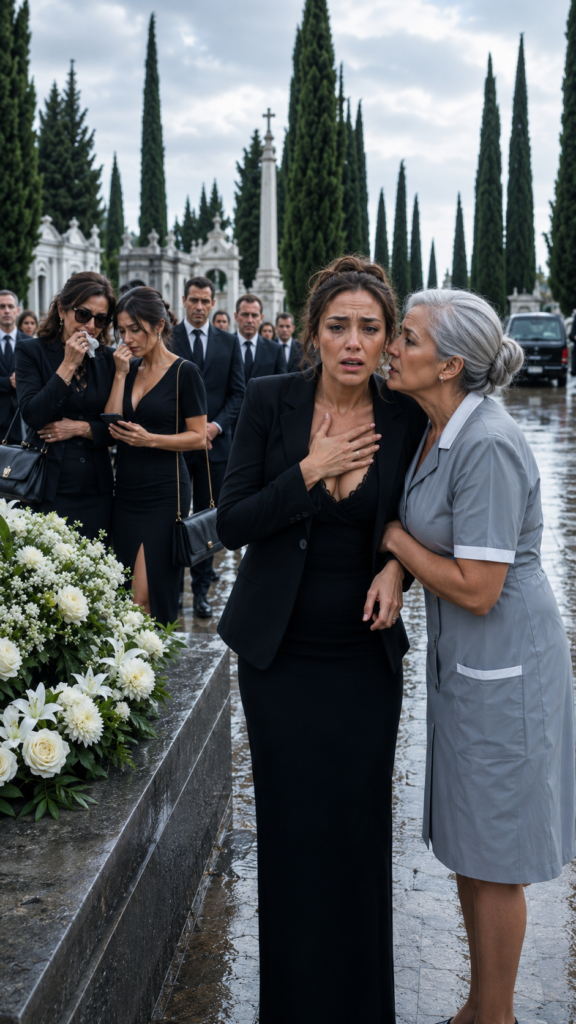
The casket of Andrés Valdivia still smelled of fresh flowers when Claudia arrived at the house with her two kids, drenched by the rain.
Mateo, 16, carried a bag with the clothes for the wake. Sofía, 9, hugged a denim jacket that had belonged to her dad.
It was 4:20 PM in Naucalpan, and the sky poured down as if it, too, were mourning.
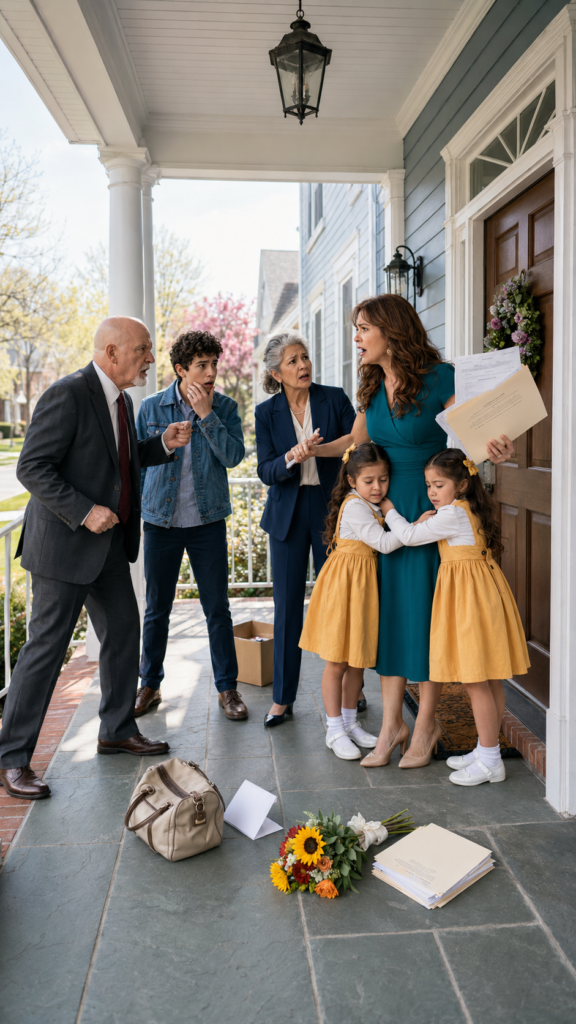
But upon reaching the gate of the house where they had lived for 12 years, Claudia found her in-laws standing at the entrance.
Don Ernesto Valdivia held the keys in his hand.
Doña Beatriz, his wife, clutched a black folder against her chest, as if she had just won a war.
—This is where you stop, Claudia —Ernesto said, his face betraying no emotion—. This house always belonged to the Valdivias.
Claudia thought she must have misheard.
She had just buried her husband. She could hardly breathe without feeling her chest crack.
—This is the house of my children —she replied, her voice trembling—. Andrés and I paid for it together.
Doña Beatriz looked her up and down.
She took in Claudia’s simple black dress, her wet shoes, her hair plastered to her face by the rain.
—Oh, please. Andrés supported you for too many years. He’s not here to keep carrying you.
Sofía hid behind her mother.
Mateo clenched his fists.
—Don’t talk to my mom like that.
Ernesto stepped forward.
—You shut up, kid. You’re on someone else’s property.
—My dad lived here —Mateo said, his eyes red—. We live here.
Ernesto’s hand shot out.
The slap resonated louder than thunder.
Mateo stumbled against the gate, bringing his hand to his cheek. Sofía screamed so loudly that a neighbor opened the curtain from the second floor.
Claudia felt something inside her dim.
She didn’t cry.
She didn’t scream.
She just hugged Mateo and checked his face, as the rain dripped down their backs.
Then Beatriz grabbed Claudia’s left hand and yanked at her wedding ring.
The metal scraped against her finger.
—This ring was from my family —Beatriz said—. It should never have been on your hand.
Claudia looked at her as if she were a stranger.
For years, she had cared for Andrés during his chemotherapy, had slept sitting up in hospitals, had sold her car to pay for medications that insurance wouldn’t cover.
And this woman, who every Christmas said, “You’re like a daughter,” now called her a burden.
—You’re going to go live with your sister —Ernesto ordered—. The appraisers are coming tomorrow. This house is being sold, and with what we get, we’ll pay off family debts.
—Appraisers? —Claudia whispered.
Beatriz smiled faintly.
—A house like this is worth millions. Don’t think we’re going to let a freeloader waste it.
Claudia took Sofía by the hand and helped Mateo to his feet.
She said nothing more.
She walked to the car, opened the back door, and helped her children inside, trembling from the cold and rage.
In the glove compartment, there was a manila envelope, sealed with tape.
Andrés had given it to her two months before he died.
“Open it only if my parents do something to you,” he had said, with that rare calm of someone who knows they’re leaving.
Claudia broke the seal.
Inside was a handwritten letter.
“Clau, my love: if you’re reading this, it means they did exactly what I feared. Don’t argue. Don’t believe anything they say. The house is in your name through a trust. The cabin in Valle de Bravo is too. My shares are protected for you, Mateo, and Sofía. But the most important thing is in the red USB drive. My parents forged documents to try to sell everything. Call lawyer Marcela Rivas now.”
Claudia looked up.
On the other side of the windshield, Ernesto laughed in the rain while talking on the phone.
Beatriz was putting the ring away in her coat pocket.
Then Claudia pulled the red USB drive from the envelope and dialed the lawyer’s number.
When she said Andrés's name, the lawyer’s voice changed instantly.
—Claudia, don’t get out of the car. Don’t hand over anything. I’m on my way with patrols and certified copies.
Ernesto saw her talking on her cell and scoffed.
—Are you calling your sister to come pick you up?
Claudia rolled down the window just enough.
—No. I’m calling Andrés’s lawyer.
Ernesto’s smile died right there.
And when Claudia lifted the red USB drive between her fingers, Beatriz went pale as if she had just seen a ghost return.
PART 2
The first patrol arrived 18 minutes later.
Behind it came a gray truck with plates from Mexico City. Marcela Rivas stepped out, a lawyer in a navy suit, hair tied back and sharp gaze.
She didn’t greet Ernesto.
She didn’t greet Beatriz.
She went straight to Claudia’s car.
She opened the back door, saw Mateo’s swollen cheek and Sofía hugging her dad’s jacket as if it were a lifeline.
—Andrés knew this could happen —she said in a low voice—. And that’s why he left everything protected.
Claudia couldn’t respond.
Her throat was knotted.
Marcela straightened and walked toward the gate.
—Don Ernesto, doña Beatriz, you are invading a property that legally belongs to Claudia Martínez de Valdivia as the primary beneficiary and administrator of the family trust.
Ernesto laughed out loud.
—Trust? Don’t be ridiculous, lawyer. My son bought this house before he got married. This house is a Valdivia.
Marcela opened her portfolio.
She took out three folders, each with notarized seals, certified copies, and signatures.
—Eight months ago, when Andrés was still lucid and had a favorable medical report, he transferred this property to the Valdivia-Martínez Trust. Claudia is the holder of use, residence, and administration. The children are irrevocable beneficiaries.
Beatriz tightened the bag where she held the ring.
—Andrés would never have left us out.
—He didn’t leave you out —Marcela replied—. He assigned you a monthly rent from a separate account and left you the apartment in Cuernavaca. What he didn’t leave you was permission to throw out his widow and children on the day of his burial.
The police officer approached Mateo.
—Did the man hit you?
Mateo looked at his mom.
Claudia nodded slowly.
—Yes —the boy said—. He hit me because I defended my mom.
Ernesto raised his hands.
—It was a correction. In my family, that’s how we educate.
The police officer looked at him seriously.
—He’s a minor. And you have no authority over him.
Beatriz tried to walk toward the house, but Marcela stopped her with a phrase.
—Also, return the ring.
Beatriz pretended not to understand.
—What ring?
Marcela produced a sheet of paper.
—The wedding ring is listed in Andrés's personal instructions as an exclusive asset of Claudia. If you don’t hand it over, we’ll add theft to the complaint.
Beatriz’s face hardened.
—It was my mother’s.
—And your son gave it to his wife —Marcela said—. Like it or not.
The police officer extended his hand.
Beatriz slowly pulled out the ring, as if handing over that metal burned her pride.
Claudia received it.
But she didn’t put it on.
She held it tightly in her fist, squeezing it so hard it left a mark on her skin.
Ernesto wanted to enter the house to “retrieve important things,” but Marcela insisted it be done with supervision.
That’s when the first strong blow came.
Inside Andrés's study, on the desk, was another black folder.
It wasn’t Andrés's.
It was Ernesto’s.
It contained a sale contract already prepared to sell the house for 8,700,000 pesos to a real estate agency in Polanco.
The document had a forged signature from Claudia.
It also had a supposed authorization from Andrés dated three weeks after his death.
The police officer looked at the paper and then at Ernesto.
—How did the man sign if he was already deceased?
Ernesto didn’t answer.
Beatriz brought her hand to her mouth.
Marcela opened the red USB on her laptop, right there on the dining table.
Recordings appeared.
The first was of Ernesto speaking with a corrupt notary.
“My son can’t handle another chemo. When he dies, the widow won’t understand a thing. We’ll pressure her, throw her out, and sign as if she had agreed.”
The second was Beatriz.
“Take the ring from her as soon as you can. That woman shouldn’t keep anything that smells of our family.”
Claudia felt her legs give way.
Not from surprise.
From confirmation.
Andrés had lived his last months knowing his own parents were waiting for his death to attack his family.
Sofía appeared in the dining room doorway, still wet, with Andrés's jacket pressed to her chest.
—Did my grandma want to take our house? —she asked.
No one answered.
And that silence was crueler than any scream.
Ernesto tried to snatch the laptop.
The police officer held him by the arm.
—Don’t make this harder.
—He’s my son! —Ernesto roared—. I built the Valdivia name!
Claudia, who had remained silent until then, stepped forward.
—Andrés wasn’t a name. He was a dad. And you waited until we buried him to throw his children out into the rain.
Beatriz began to cry, but not as someone who regrets.
She cried like someone who knows they’ve been caught.
—We lost our son too.
—No —Claudia said—. You lost control over him. My children lost their dad.
That phrase fell heavy.
Even the neighbor, watching from the sidewalk with an umbrella, lowered their head.
Marcela asked the police to secure the documents.
She also requested protection measures.
That same night, they changed the locks of the house.
Ernesto and Beatriz left with two small suitcases, escorted by police, while several neighbors watched from their windows.
No one applauded.
No one shouted.
But everyone understood.
The family that sat in the front row at mass had just been exposed as the same that wanted to leave two children out on the street.
Before leaving, Ernesto pointed at Claudia.
—You brainwashed Andrés. Because of you, he betrayed us.
Claudia held his gaze.
—No. Andrés knew you better than I did. That’s why he protected me before he died.
Beatriz wanted to say something, but Sofía jumped in.
—My dad wasn’t just yours.
The girl said it with a small, broken voice, but firm.
And that phrase hurt Beatriz more than any charge.
The next day, Claudia sat in Marcela’s office.
Fatigue showed in her back, in her dark circles, in the way she held the coffee cup without drinking.
Marcela explained everything to her.
Andrés had discovered, six months earlier, that his parents were trying to move family properties into their names to then sell them.
He had also found emails where Ernesto requested advances from buyers, promising to deliver the house “without tenants” before the end of the month.
—Tenants? —Claudia asked.
Marcela lowered her gaze.
—That’s what he called you and the kids.
Claudia closed her eyes.
It hurt her, but it didn’t destroy her.
She had already cried too much in hospitals, in bathrooms at night, in parking lots, in pharmacies where she couldn’t afford everything.
Andrés had left her something more than possessions.
He had left her a way out.
Three weeks later, Ernesto and Beatriz filed a lawsuit to invalidate the trust.
They claimed Andrés was not in his right mind.
It was their last attempt.
On the day of the hearing, Claudia arrived with Mateo and Sofía.
Mateo still had a yellow bruise on his cheek. Sofía wore a bracelet made from blue thread, her dad’s favorite color.
Marcela presented videos of the signature before the notary.
In them, Andrés appeared thin, tired, but completely aware.
His voice sounded weak, but clear.
“I want my wife and my children to live without fear. I do not authorize my parents to dispose of this house or any asset intended for them.”
Then another video appeared.
It was Andrés alone, looking at the camera.
“Dad, Mom, if you ever see this, it’s because you did what I asked you not to do. Don’t punish Claudia for having loved me better than you could respect me.”
Beatriz broke down in tears.
Ernesto lowered his head for the first time.
But it was too late.
The judge dismissed the lawsuit in less than an hour.
Furthermore, he ordered a report to the Public Prosecutor’s Office for document forgery, attempted real estate fraud, theft, and assault against a minor.
The real estate agency stated that Ernesto had received an advance of 450,000 pesos for a sale he couldn’t complete.
The notary who agreed to prepare the false papers was also under investigation.
Justice didn’t arrive with music or pretty phrases.
It arrived with stamps, files, subpoenas, and frozen accounts.
Two months later, Claudia returned to the house without fear.
She painted the door blue.
She changed the curtains Beatriz had always criticized.
In the garden, Mateo planted a lemon tree because Andrés said a house without a tree looked like an office.
Sofía placed a painted stone by the entrance.
It read: “Here lives Dad in our hearts.”
One Sunday afternoon, Claudia found one last letter in the safe.
It was for her.
She read it in the kitchen, as the sun streamed through the window.
“Clau, I’m sorry for leaving you this battle. I would have liked to stay to fight it with you. But if I know anything, it’s that you aren’t a weak woman. You are the house of our children. Don’t let anyone convince you that you came to visit a life you built with me.”
Claudia cried silently.
Then she took the ring from the little box where she had kept it since that day.
She put it on again.
Not because she needed to prove she belonged to the Valdivias.
Not because she wanted to carry a last name.
She put it on because Andrés had chosen her while he was alive and had defended her even after death.
The news of the case spread on Facebook.
Some said Claudia had been harsh to sue her in-laws in the midst of her mourning.
Others said no grandmother who steals a ring and leaves children out in the rain deserves compassion.
But Claudia didn’t argue with anyone.
She knew the truth.
Family isn’t measured by blood or by deeds.
It’s measured by who cares for you when you’re broken.
And by who waits until you bury the dead to take even the roof over your head.