PART 1
Elena Salgado never imagined that the cry of a baby could open a door to the very hell she had been trying to escape for three months.
At 31 years old, she had worked as a neonatal nurse in Guadalajara and knew how to distinguish between a newborn's tantrum, pain, and true hunger.
She also knew what it was like to lose everything.
Her husband, Julián, died in a car accident. Just 12 days later, her newborn twins passed away from respiratory complications that no doctor could stop.
Elena survived, but only on the outside.
She locked her house, covered the door of the nursery with a sheet, and accepted a temporary consultancy in Madrid to avoid hearing the silence of the empty crib.
The cruelest part was that her body still produced milk.
Every morning, that physical pain reminded her of the children she could no longer feed.
On the night of her return, she boarded a private jet bound for Toluca. She just wanted to sleep.
But somewhere over the Atlantic, a baby began to cry.
The sound filled the cabin. Passengers lowered their gazes, and the flight attendants exchanged nervous glances.
No one approached.
At first, the girl cried out with all her might.
Then her voice grew weak, choppy, almost breathless.
Elena jolted awake.
This was no dream.
This was dangerous hunger.
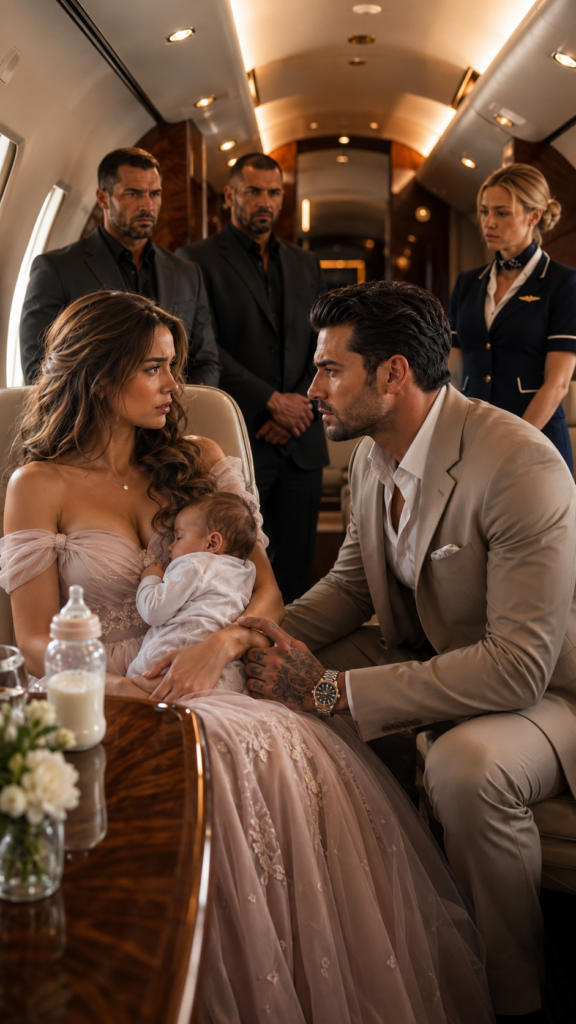
At the front of the plane, a man held the baby. He was tall, broad-shouldered, impeccably dressed in a gray suit, with tattooed hands.
Elena recognized him.
Gael Montenegro.
In Mexico, his surname was linked to construction companies, ports, politicians, and businesses no one dared to explain. Some called him an entrepreneur. Others, in hushed tones, called him a kingpin.
Around him were four armed men.
Yet, Gael seemed terrified.
He brought the bottle to the girl's mouth again, but she turned her head and let out an almost imperceptible whimper.
"She doesn't want it, sir," a flight attendant whispered.
"I know that already."
Elena felt a stab in her chest. The milk seeped through the pads she still wore.
She forced herself to look out the window.
This wasn’t her daughter.
This wasn’t her problem.
Approaching Gael Montenegro was a terrible idea.
Then the baby let out one last whimper.
Elena stood up.
The cabin fell silent.
One of the bodyguards moved forward, but Gael stopped him with a hand.
"She’s dehydrating. How long has it been since she ate?"
"Almost seven hours."
"That’s too long."
Gael watched her with suspicion.
"Do you know anything about newborns?"
"I was a neonatal nurse."
Elena looked at the girl and said something she never thought she’d offer again.
"I can feed her."
Minutes later, behind a screen, she held the baby against her chest.
The little one latched on immediately.
The crying stopped.
And Elena, feeling that warm breath on her skin, began to cry silently.
For the first time since her children’s death, she didn’t feel empty.
When she returned the sleeping girl, Gael no longer looked at her as a stranger.
He looked at her as if she had just become someone indispensable.
The plane landed in Toluca at dawn.
Elena grabbed her bag and walked toward the exit, but the bodyguards blocked the aisle.
"You saved my daughter," Gael said.
"I’m glad she’s okay. Now let me pass."
He slowly shook his head.
"You can’t go back home."
Elena felt the blood freeze in her veins.
Gael showed her a phone.
On the screen was a photograph sent six minutes ago: the facade of her house in Guadalajara and an armed man forcing the door.
PART 2
"What the hell does this mean?" Elena asked, stepping back.
Gael didn’t raise his voice.
"It means someone on this plane took a picture of you while you were feeding Renata. They sent it before we landed and looked up your address."
"Why would they want to hurt me?"
"Because my daughter wasn’t refusing the bottle out of whim."
Gael handed the container to one of his men. Elena smelled it and detected a medicinal, slightly bitter aroma.
Her experience rushed back.
"This isn’t regular formula."
"I know."
The baby had received a small dose of sedative in a previous feeding. The amount wasn’t enough to kill her immediately but enough to weaken her.
The next bottle contained more.
Renata rejected it because the taste was different.
If Elena hadn’t stood up, someone would have insisted until they forced her to drink.
"Then call the police," she demanded.
Gael let out a humorless laugh.
"There are police who work for my family and others who work against it. Tonight, I don’t know which are worse."
Elena wanted to run, but four armed men remained by the door.
"I’m not your property."
"No."
"Then stop treating me like I am."
For the first time, Gael lowered his gaze.
"I’ll take you to a safe place. Just until we find out who gave the order."
"That’s kidnapping, no matter how nicely you put it."
He didn’t respond.
They transported her in an armored truck to a residence hidden among the forests of Valle de Bravo.
The place looked like a magazine: huge windows, stone floors, cameras in every corner, and men watching even the gardens.
To Elena, it felt like an expensive prison.
Renata woke up crying before dawn.
Gael tried to calm her, but the girl was searching for food. Elena could have refused. She had plenty of reasons.
Yet, the baby wasn’t to blame for carrying the Montenegro surname.
She fed her once more and then demanded conditions.
"I’ll stay for 48 hours. I want a phone, internet access, and the freedom to talk to my sister. No one will enter the room when I’m with Renata. Also, I want complete toxicology tests."
"Done."
"And you won't say again that I can’t leave."
Gael looked at her for several seconds.
"Done."
That morning, the family arrived.
Doña Mercedes Montenegro, Gael’s mother, appeared dressed in black, with a gold rosary between her fingers and an expression colder than marble.
By her side walked Iván, Gael’s younger brother, accompanied by his wife and two lawyers.
"So, she’s the wet nurse," said Mercedes, looking Elena up and down.
"Her name is Elena," Gael corrected.
"A stranger nursing my granddaughter. What a disgrace."
Elena pressed her lips together.
"The disgrace is that a baby goes seven hours without eating surrounded by adults too afraid to touch her."
Iván let out a short laugh.
"She’s got spirit, brother. Be careful, she might want to take the house too."
Gael stepped toward him.
"Someone tried to kill Renata."
Silence fell over the room.
Mercedes crossed herself, but Elena noticed something strange: she didn’t ask if the baby was okay.
She asked where the bottle was.
The analysis arrived at noon.
There were traces of crushed clonazepam and a compound used to induce arrhythmias. The full dose would have stopped Renata’s heart before she even reached Mexico.
The nanny, Marisol, had prepared the feedings in Madrid. Gael ordered her to be located, but the woman had disappeared.
Iván immediately blamed the family of Renata's mother.
Sofía had died six weeks earlier from bleeding after childbirth. She came from a humble family in Puebla and was never accepted by the Montenegros.
"Maybe someone from your family wanted revenge," Iván insinuated.
Elena looked at Gael.
"Why would your own family want to kill the girl?"
He fell silent.
It was the oldest lawyer who answered.
Gael’s father had left a trust. If Renata survived her first 60 days, 60% of the family group’s shares would fall under Gael’s control as the guardian of the heiress.
If the baby died before then, control would be divided between Mercedes and Iván.
Renata was 54 days old.
Six days to go.
"Seriously, is all this about money?" Elena murmured, horrified.
"In this family, money has always been worth more than blood," Gael replied.
That night, Elena found Gael sitting next to the crib.
He wasn’t wearing a jacket or carrying visible weapons. He was just holding a photograph of Sofía.
"She asked me to take Renata out of this world," he said. "I promised her no one would touch our daughter."
"And yet she was almost poisoned on your own plane."
Gael closed his eyes.
The blow hurt because it was true.
Elena felt compassion, but didn’t forget that she was still held captive.
"Protecting isn’t locking up," she told him. "You can love your daughter and still become someone who takes away others' freedom."
Gael looked at her as if no one had ever dared to speak to him like that.
"What do you want me to do?"
"Start by finding out who among your men took my photo."
They reviewed the plane's cameras. All passengers appeared except during a cut of 83 seconds.
One of the bodyguards, Beto, insisted that the system had failed.
Elena remembered something.
While feeding Renata behind the screen, she had heard the sound of a metal bracelet clinking against a glass.
Doña Mercedes wore a wide gold bracelet.
But she wasn’t on the plane.
At least, that’s what they thought.
The official record showed 11 passengers. The takeoff weight indicated 12.
In the rear section, there was a private compartment without a camera, reserved by the family.
Gael ordered the fingerprints found on a glass stored there to be checked.
They matched Mercedes.
She had traveled hidden from Madrid.
When Gael confronted her, his mother denied nothing.
"Renata wasn’t supposed to reach 60 days," she said with a chilling calm. "Your father built this empire for his children, not for the daughter of a provincial nurse."
"Sofía was my wife."
"Sofía was your weakness."
Iván paled.
"Mom, shut up."
Mercedes turned to him.
"Are you afraid now? You got the medication. You paid Marisol."
Gael lunged at his brother, but Elena placed Renata between them before he could strike.
"If you cross that line, they win," she said. "Your daughter doesn’t need another violent man. She needs a father."
Gael froze.
Renata opened her eyes and squeezed one of his fingers.
Then the real twist happened.
Marisol appeared at the entrance accompanied by federal agents and Elena's sister.
She hadn’t fled.
Gael had located her hours earlier, but Elena, distrustful of everyone, had secretly sent copies of the analyses and the flight record to a prosecutor she knew from her hospital work.
Marisol agreed to testify.
Mercedes had threatened to kill her eight-year-old son if she didn’t tamper with the bottles. Iván had transferred the money and Beto sent the photograph of Elena to eliminate the only witness capable of explaining why Renata was still alive.
The agents arrested Mercedes, Iván, and Beto.
They also delivered to Gael an order to testify about his family’s businesses.
The bodyguards put their hands on their weapons.
Gael could have ordered a massacre.
Instead, he raised his hands.
"No one shoots," he said. "My daughter has already paid enough for this surname."
Before leaving with the agents, he looked at Elena.
"The door is open. You can go back to Guadalajara."
She responded without softening her voice.
"It was always open. You were the one who needed to understand."
Gael faced an investigation that destroyed much of his empire. He collaborated with the prosecution, handed over documents, and lost companies, allies, and the protection he had bought with fear for years.
Mercedes and Iván were prosecuted for attempted homicide, organized crime, and threats.
Renata completed 60 days under federal protection.
Elena stayed with her for three more weeks, but this time by her own choice.
She helped establish a safe feeding plan and taught Gael how to hold her, calm her, and recognize every signal.
Then she returned to Guadalajara.
She finally entered the room of her twins.
She cried for hours, folded the tiny clothes, and stored two blankets in a box. She didn’t stop loving them. Nor did she try to replace them with Renata.
She understood something more difficult: helping another baby didn’t betray her children’s memory.
Months later, Elena returned to the hospital and opened a program for mothers who had lost their babies and were still producing milk.
None would have to go through that grief feeling strange, guilty, or alone.
Gael never again told her she couldn’t leave.
When he needed advice about Renata, he called and asked first if she wanted to talk.
Some people said Elena should have denounced him from the very first moment. Others insisted she should never have helped a man like him.
She only knew one thing.
A hungry baby doesn't choose the family she's born into, but adults do choose whether to repeat violence or stop it.
And that night, inside a plane full of weapons, the bravest person wasn't the kingpin everyone feared, but the broken woman who stood up when everyone else decided to look the other way.