PART 1
"Dad… that lady is Mom."
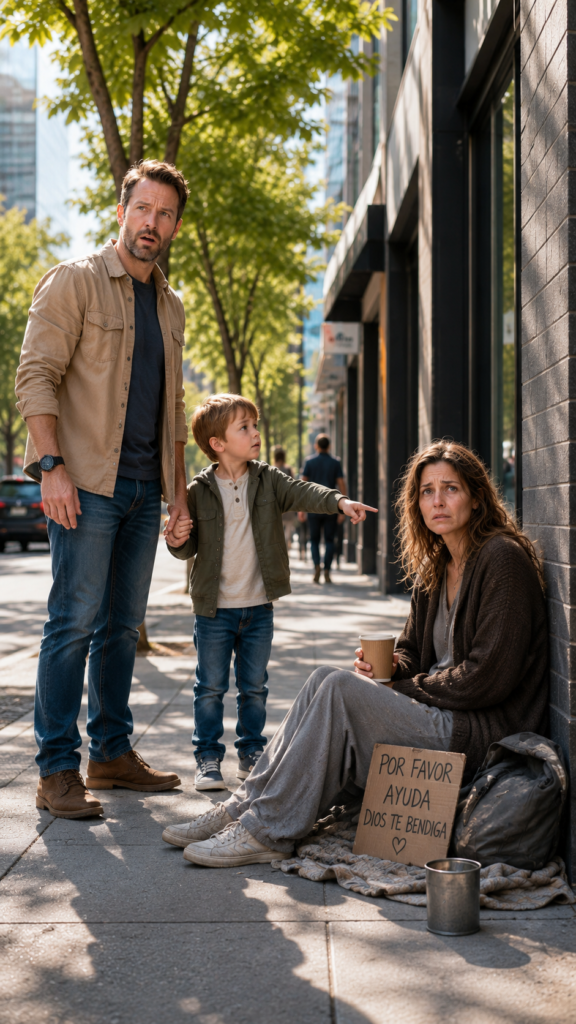
Diego said it almost in a whisper, standing on the sidewalk in front of the Coyoacán Market as people passed by with bags of bread, corn, flowers, and coffee in cardboard cups.
Andrés Villarreal thought he must have misheard.
His son was 8 years old and had been asking the same question every night for 3 years: "Does Mom still watch over me from heaven?"
So when the boy squeezed his hand and pointed to a corner next to a closed pharmacy, Andrés felt a cold punch in his stomach.
There she was, a woman sitting on cardboard.
She wore an old sweater, her hair tangled, her sneakers torn, and a plastic cup clutched in her hands. She looked like one of those people the city hurried past to avoid feeling guilty.
"No, Diego," Andrés murmured. "Your mom is dead."
But the boy shook his head.
"No, Dad. Look closely. It really is her."
Andrés wanted to pull him back, to protect him from this cruel illusion. His wife, Inés Morales, had died 3 years ago in a car accident. He had seen the coffin, received condolences, held Diego at the wake while the boy trembled with tears.
But then the woman lifted her face.
The noise of the market faded away.
Her cheeks were sunken. Her lips cracked. Her eyes seemed heavy with hunger, fear, and sleepless nights.
But they were her eyes.
The same eyes Inés had when she laughed in the kitchen. The same eyes that cried when Diego was born. The same eyes Andrés had tried to forget just to keep breathing.
The woman looked at him.
First with terror.
Then with a pain so deep it felt like his knees were shattering.
Diego let go of his father's hand and ran to her.
"Mom!"
The woman awkwardly opened her arms as if she couldn’t believe she could still embrace someone.
"My little sun," she whispered.
Andrés froze.
Only Inés called Diego that.
No one else.
A woman screamed for someone to call an ambulance. A vendor threw a jacket over her. Andrés picked up the woman and nearly recoiled at how light she was.
At the hospital, the doctors said she was dehydrated, malnourished, and showed signs of having lived under constant threats.
Hours later, Andrés entered the room.
"Inés," he said with a broken voice. "I buried you."
She closed her eyes.
"You didn’t bury me."
Andrés stopped breathing.
"Then who?"
Inés looked at him as if that truth burned her mouth.
"My sister Mónica."
Inés’s twin sister.
The unstable woman who always asked for money, disappeared for months, and returned crying.
Andrés felt the room spinning.
"Who did this?"
Inés clenched the sheet with trembling fingers.
"Arturo Robles."
His partner.
His best man.
The man who had comforted Diego at the funeral.
And Andrés felt that no one would believe what was about to come to light.
PART 2
Arturo Robles was not just any acquaintance.
For 10 years, he had been Andrés's closest partner. Together they built Villarreal & Robles Construction from a small office in Narvarte to a respected company in Mexico City.
Arturo attended family barbecues. He brought gifts for Diego. He toasted with Inés at Christmas and called her "sister-in-law," even though they weren’t blood.
After the supposed accident, he was the one who handled everything.
"Andrés, you can't deal with this right now."
"I'll handle the insurance."
"I'll talk to the lawyers."
"Inés would have wanted you to stay strong for Diego."
Andrés, shattered, believed him.
Now, sitting beside the bed where his wife seemed to have returned from the dead, he understood he had entrusted his pain to the man who had created it.
Inés began to slowly recount everything.
Mónica had arrived at her house one rainy night, banging on the door like a madwoman. She had an old backpack, a broken phone, and an envelope full of documents.
She claimed Arturo was looking for her.
At first, Inés thought her sister had gotten into trouble again. Mónica had always lived between debts, bad friendships, and unfulfilled promises.
But this time was different.
Inside the envelope were false contracts, copies of signatures, bank statements, and deeds related to family properties in Tlalpan, Xochimilco, and Querétaro.
Arturo was using shell companies to transfer properties from the construction company before a real estate project that would multiply their value was announced.
If Andrés signed the last set of documents, he would lose almost everything without realizing it.
"Inés confronted him," she explained, her gaze lost on the wall. "I told him he had 24 hours to confess the truth to you."
But Arturo didn’t confess.
That same night, Inés decided to take Mónica to a borrowed house near Valle de Bravo. She thought they could hide there and gather evidence.
Arturo followed them.
He arrived furious.
First, he tried to convince them. Then he threatened. In the end, when they tried to escape, everything turned into rain, highway, and screams.
Mónica was driving.
Inés recalled the headlights of a truck coming too close. She remembered the impact against the wall. She remembered the smell of gasoline and the sound of her sister stopping breathing.
When she woke up, she was in a private clinic.
Arturo was beside her bed.
"Don’t do anything stupid," he said. "To everyone, you’re dead. And if you try to come back, Diego will pay."
Andrés felt his blood boil.
"Is that why you didn’t come back?"
Inés started to cry silently.
"He sent me pictures of Diego coming out of school. Pictures of you going into the office. He told me he had people near the house. I was weak, confused, without documents. He made me believe that if I showed up, they would kill me."
For months, Arturo moved her from one place to another.
First, to a clandestine clinic. Then to a house in Puebla. After that, to a tenement in Ecatepec, where they took her phone and kept her under surveillance.
When Inés finally managed to escape, she had no identification, money, or secure way to seek help. She lived hidden, using false names, sleeping where she could.
"I went to Diego’s school a few times," she confessed. "From a distance. I just wanted to see him breathe."
Andrés covered his face.
Three years had passed, hating fate, not knowing his wife was just a few streets away, surviving in fear.
Diego, sitting outside the room, listened to fragments of the conversation.
When he entered, he carefully climbed onto the bed and hugged his mom as if someone could take her away again.
"Don’t leave," he pleaded.
Inés squeezed him against her chest.
"I never wanted to leave, my little sun."
Andrés wanted to storm out right then and find Arturo.
He wanted to smash his face in front of everyone.
But Inés stopped him.
"Don’t give away your freedom. Diego has lost enough already."
That sentence forced him to think.
That night, Andrés called Commander Mariana Cortés, an investigator specialized in property fraud and financial organized crime. She had worked with his father years ago and still owed him a favor.
Mariana arrived at the hospital before midnight.
She listened to Inés for nearly 2 hours. She reviewed names, dates, notaries, truck plates, bank movements, and companies linked to Arturo.
In the end, she said something that changed the strategy.
"If Arturo thinks Inés is still lost, we have the advantage."
For the following weeks, almost no one knew that Inés was alive.
They registered her under another name in a private clinic. Diego visited her secretly after school, bringing drawings, cookies, and a sun doll he had kept since he was a child.
At first, he didn’t want to let go of her hand, not even to go to the bathroom.
Inés also didn’t know how to sleep without waking up scared.
Every noise in the hallway made her tremble.
Meanwhile, Mariana built the case.
They found transfers to accounts in Cancún and Monterrey. Altered contracts. Videos from toll booths near Valle de Bravo. An insurance policy collected by Arturo in the name of the company.
And then came the hardest blow.
In an old backpack that Inés had managed to keep, there was Mónica’s phone.
It had a cracked screen, but an expert recovered deleted audio.
In one of them, Arturo's voice was heard.
"If Inés talks, the child will be the price. And if Mónica is already dead, better. That way everyone believes the complete story."
Andrés listened to the audio once.
After that, he couldn’t listen again.
Rage trembled in his hands.
Mariana was clear.
"With this, he falls. But if we take him down privately, he’ll say it’s a setup. We need the truth to reach him where it hurts the most."
The opportunity came 2 weeks later.
Arturo would receive an award at a hotel on Paseo de la Reforma for "business leadership and social commitment."
The audacity was at another level.
That night, the hall was filled with politicians, businesspeople, journalists, and officials. There were giant screens showing Arturo's face, white flowers on the tables, and cameras ready to capture his speech.
Andrés arrived dressed in black.
Arturo saw him and smiled as if nothing were wrong.
"Buddy," he said, embracing him. "Good to see you. Inés would be proud of you."
Andrés felt like vomiting.
But he didn’t respond.
He only told him:
"Tonight, you’ll be recognized as you deserve."
Arturo laughed, thinking it was a compliment.
He went up on stage to applause. He spoke of honesty, family, hard work, and the duty to protect Mexican heritage.
Then the doors of the hall opened.
First, the waiters turned.
Then the journalists.
Then the entire place fell silent.
Inés appeared at the entrance.
She wore a simple dark blue dress and a beige coat. She still looked fragile, but her eyes were no longer fearful.
Next to her was Diego, holding her hand.
Arturo turned pale.
The microphone trembled in his hand.
"No," he murmured. "It can’t be."
Inés walked down the central aisle.
She didn’t shout.
She didn’t make a scene.
She didn’t need to.
When the truth enters fully, even liars run out of air.
She stopped in front of the stage.
"Arturo," she said firmly. "For 3 years, you told my husband I was dead. For 3 years, you let my son cry in front of a grave that wasn’t mine."
The guests began to murmur.
Phones were raised.
Journalists turned on their cameras.
Arturo tried to smile.
"Inés is confused. She’s suffered a lot. She needs help."
She nodded slowly.
"Yes. I suffered a lot. Because of you."
At that moment, Commander Mariana entered with agents, forensic experts, and boxes of evidence.
The screens changed.
They no longer showed Arturo's face.
They showed false contracts.
Bank statements.
Copied signatures.
Shell companies.
Videos from the highway.
And then Mónica's audio played.
Arturo's voice filled the hall:
"If Inés talks, the child will be the price."
Diego squeezed his mom's hand.
Andrés felt something inside him break and at the same time, come together. Finally, the pain had a name. Finally, the grave, the tears, and the nights without answers had a culprit.
Arturo rushed off the stage looking for a side exit.
Two agents blocked his path.
"This is a trap," he shouted. "Andrés, you know me."
Andrés walked toward him.
He looked at him as one looks at someone who no longer wears a mask.
"I gave you my home. I gave you my friendship. You sat at my table. You embraced my son while knowing his mother was alive."
Arturo didn’t respond.
For the first time, he had no speech.
Inés stepped forward.
"Mónica died because of your ambition. I lost 3 years. My son lost 3 years. And you wanted everyone to applaud you for being a family man."
Agents put handcuffs on him in front of everyone.
Some guests cried. Others deleted photos with him. Others pretended they barely knew him.
But the video had already gone viral.
In less than an hour, all of Mexico was talking about the businessman who received an award and ended up handcuffed for faking the death of his partner’s wife.
Then came the investigations.
Arturo’s accounts were frozen. Several notaries were brought to trial. The properties were returned to their owners. The construction company was intervened, and Andrés closed the company he had once built with the man who betrayed him.
But legal justice didn’t fix everything.
Inés had to learn to walk down the street without looking back every 5 seconds.
Diego had to learn that his mom didn’t disappear when he closed his eyes.
Andrés had to forgive himself for not doubting the funeral, even though Inés repeated that the guilty one wasn’t the one who was deceived, but the one who used love as a weapon.
They moved to Querétaro, to a smaller house.
It had no luxuries.
It had bougainvilleas, a bright kitchen, and a room where Diego stuck yellow suns on the wall.
One afternoon, while the three of them were having sweet bread with chocolate for dinner, Diego looked at his dad and said:
"I knew it was her."
Andrés smiled with tears in his eyes.
"Yes, champ. You saw what I was afraid to look at."
Inés kissed her son’s head.
And in that simple silence, they understood something many never accept:
Sometimes the truth doesn’t come with lawyers or documents.
Sometimes it’s sitting on a sidewalk, broken on the outside, waiting for someone to recognize it.
And sometimes, a child’s voice is enough to unearth an entire life.