PART 1
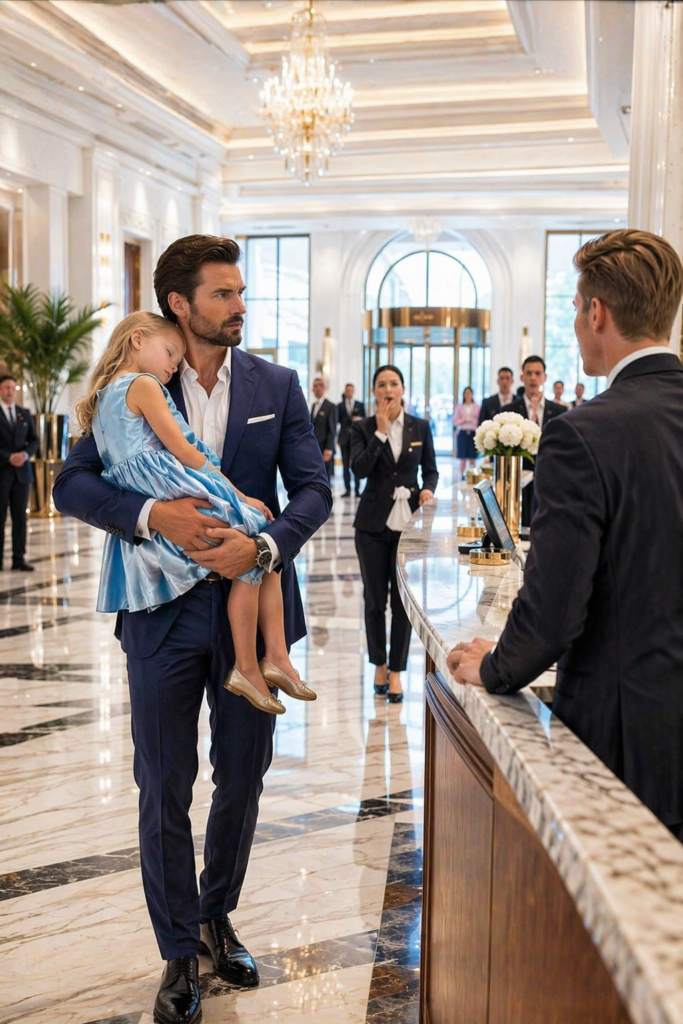
It was nearly 12:30 at night when Julián Cárdenas entered the Gran Alameda Hotel on Paseo de la Reforma, carrying his six-year-old daughter Lucía in his arms.
The girl was asleep against his chest, her curly hair stuck to her forehead, clutching a little stuffed monkey close to her heart.
They had arrived late from Monterrey due to a delayed flight, rain over the city, and a taxi that was stuck for 20 minutes near the Angel of Independence.
Julián wore a gray sweatshirt, worn-out jeans, and wet sneakers. He didn’t look like a businessman. He didn’t look like a millionaire. He didn’t look like anyone important.
And it was precisely for this reason that he would discover the truth about his own hotel that night.
He approached the counter with a low voice, careful not to wake Lucía.
“Good evening. I need a room. Whatever you have available. My daughter is exhausted.”
Behind the counter, a young receptionist named Diego looked him up and down before tapping on the computer.
He didn’t greet the girl. He didn’t smile. He didn’t ask if they needed water, a blanket, or help with their luggage.
He just saw the sweatshirt, the wet sneakers, and an old backpack slung over Julián’s shoulder.
“I’m sorry, sir. We don’t have any available rooms.”
Julián lifted his gaze toward the digital board behind the reception. There were lights on several room numbers. Besides, moments earlier, he had seen a couple without a reservation check in, laughing, with small suitcases and an expensive bottle peeking out from a bag.
They had been registered.
“I just saw you gave a room to a couple without a reservation,” Julián said, calmly. “I have a valid card. I can pay any rate.”
Diego pressed his lips together.
“Those rooms were pre-assigned.”
Lucía stirred in his arms and murmured something in her sleep.
Julián took a deep breath.
“My daughter has been traveling for hours. I’m not asking for a favor. I’m asking for a room.”
Then Ricardo Salvatierra, the hotel’s general manager, appeared. Impeccable suit, expensive watch, cold smile.
“Is there a problem?” he asked, though his gaze had already decided who the problem was.
Diego lowered his voice.
“The gentleman insists on staying, but I’ve already explained that there’s no availability.”
Ricardo looked at Julián as one might look at a stain on a white tablecloth.
“Sir, given the hour, the comfort of our guests, and the atmosphere of the lobby, I think it would be best if you sought accommodation elsewhere.”
Julián didn’t move.
“For the atmosphere of the lobby?”
“We are taking care of the experience of those who are indeed staying here.”
The words fell like ice.
A woman near the sofas turned her head. A bellboy stopped arranging suitcases. The concierge, Marisol, stood still next to a table with tourist brochures.
Julián looked down at Lucía, still asleep, unaware of the shame they were trying to impose on her father.
“I have a sleeping daughter in my arms,” he said. “I haven’t shouted. I haven’t disturbed anyone. I just asked for a room.”
Ricardo smiled without warmth.
“And now you’re disturbing everyone.”
Julián felt something break inside, but he didn’t raise his voice.
He looked at the marble, the chandeliers, the fresh flowers, the perfectly pressed uniforms. He looked at the hotel he had built from scratch, thinking of his father, Don Aurelio, who had worked 25 years as a night watchman in hotels where no one called him by his name.
Julián had vowed to build a different place.
That night he understood that perhaps he had only built more expensive walls.
“I want your full name and your position,” he said.
Ricardo blinked.
“My name is on my name tag.”
“Say it.”
The lobby seemed to run out of air.
“Ricardo Salvatierra. General manager.”
Julián nodded.
Then he walked toward the central sofas, beneath the largest chandelier, carefully seated Lucía beside him and took out his cellphone.
Ricardo followed him with his gaze, irritated.
He didn’t call just yet.
First, he needed to know if this was a one-night error or a disease rooted deep within.
Lucía barely opened her eyes.
“Daddy… are we at the room yet?”
Julián stroked her hair.
“Not yet, my love.”
Across the lobby, Ricardo discreetly signaled to the security guards.
And when two men began to walk toward them, Lucía tightened her grip on her stuffed animal and asked softly:
“Daddy… why do they want to kick us out?”
PART 2
The two guards crossed the lobby as if they had already been told the story before hearing it.
One was older, with a weary face, named Pablo. The other was younger, with a tough demeanor, named Iván.
They positioned themselves beside Julián and Lucía, close enough for everyone to understand the message.
Ricardo approached from behind them, hands clasped in front of his body, trying to make the humiliation seem like procedure.
“Sir,” he said, “you’ve been informed that we cannot accommodate you tonight. This is private property. You need to leave.”
Julián lifted his gaze.
“I’m sitting quietly with my daughter.”
“You were asked to leave.”
“I was denied service after you gave a room to people who arrived after me.”
Ricardo clenched his jaw.
“I’m not going to discuss this in the lobby.”
“How convenient.”
A guest pulled out their phone. Then another. A lady by the bar pretended to check her messages but was recording.
Marisol, the concierge, turned pale.
Ricardo saw the phones, and his expression changed.
In that moment, Julián understood something with brutal clarity: Ricardo was not ashamed of what he did. He was ashamed of being seen.
“Escort him out,” he ordered.
Lucía stood up next to her father.
“Why are they kicking us out?” she asked.
She didn’t say it dramatically. She said it with that honesty that only children have when they still believe adults should be fair.
No one answered.
“We didn’t break anything,” she said.
“No,” Julián replied softly. “We didn’t break anything.”
“We didn’t shout.”
“No.”
“We just wanted to sleep.”
The question left the entire lobby uncomfortable.
Iván stepped forward.
“Sir, let’s go.”
Julián took Lucía’s hand. It was trembling.
That ended the test.
He pulled out his cellphone and called Tomás Arriaga.
Tomás was no ordinary employee. He was the CEO of Grupo Cárdenas Hotels, the first man Julián had hired when the company grew too large to manage alone.
He answered on the second ring.
“Julián?”
“I’m in the lobby of the Gran Alameda. With Lucía. We were denied a room. They gave a room to a couple without a reservation after me. The manager just asked security to remove us.”
There was silence.
Then Tomás spoke with a dangerous calm.
“Who is the manager?”
“Ricardo Salvatierra.”
Another silence, briefer this time.
“I’m upstairs in the executive suite, preparing for tomorrow’s meeting. Don’t move from that lobby.”
“I wasn’t planning to.”
Julián hung up.
Ricardo looked at him with a mix of annoyance and doubt.
“Calling someone doesn’t change the situation.”
Julián put his phone away.
“It already did.”
The private elevator chimed.
It was a soft sound, like any other that night. But this time everyone turned.
The doors opened, and Tomás Arriaga stepped out first, in a dark suit and serious expression. Behind him came Claudia Rivas, head of human resources, with a tablet in hand. Next to her, Esteban Mena, corporate lawyer, surveyed the lobby as if he were already gathering evidence.
Tomás walked straight toward Julián.
He stopped in front of him and bowed his head respectfully.
“Mr. Cárdenas,” he said in a clear voice, “I offer my profound apologies to you and Miss Lucía for having made you wait.”
Silence fell in pieces.
Diego stopped typing.
Ricardo barely opened his mouth.
Iván looked at the manager, then at Julián, then at the floor.
Lucía tugged at her father’s sleeve.
“Who is he?”
“Mr. Tomás works with me,” Julián said, not taking his eyes off Ricardo.
Tomás turned to the staff.
“He is Julián Cárdenas, the sole founder and owner of Grupo Cárdenas Hotels. This hotel belongs to him.”
No one breathed.
The bartender stood frozen. The woman who was recording lowered her phone. A guest murmured, “No way.”
Ricardo lost color.
“Mr. Cárdenas… I didn’t know who you were.”
Julián looked at him.
“I know. That’s the point.”
“If I had known…”
“That’s also the point.”
The phrase cut off his voice.
Julián took a step toward him, without shouting, without making a scene, with a calm heavier than any threat.
“You didn’t need to know my last name to treat me with dignity. You didn’t need to know how much money I have, what company I founded, or what hotel is mine. You just needed to see a father with a tired little girl asking for a room.”
Ricardo looked down at Lucía.
Julián's voice hardened for the first time.
“Don’t look at her now as if you suddenly see a little girl. She was a little girl when we walked in.”
Ricardo turned his gaze away.
Julián turned toward Diego.
“You said there were no rooms.”
Diego swallowed hard.
“I thought…”
“Thought what?”
Diego didn’t respond.
The wait was worse than a scolding.
“I made an assumption,” he whispered.
“Yes,” Julián said. “You did.”
Then he looked at Ricardo.
“And you took that assumption, turned it into authority, and called security when I asked for explanations. That’s not hospitality. That’s not leadership. That’s not a mistake under pressure. That’s a failure of character in a position where character is part of the job.”
Ricardo tried to defend himself.
“I’ve managed this hotel for five years with excellent results.”
“Excellent for whom?”
There was no response.
Julián looked around the lobby.
“There are people here who witnessed what happened. Some recorded it. Some stayed silent. Some wanted to speak but didn’t dare. I understand the fear. But silence protects the wrongdoer when no one dares to name the harm.”
Marisol dropped her head, her eyes filled.
Julián turned back to Ricardo.
“My father worked 25 years guarding hotel doors where guests threw keys at him as if he were invisible. He came home at dawn with a fatigue that didn’t go away with sleep. I built this company because I believed a hotel could be more than a place where the rich feel comfortable.”
Lucía pressed against his side.
“And tonight —” he continued — “my daughter saw adult men decide that her dad seemed like a problem before he did anything.”
Ricardo murmured,
“I apologize.”
“Really?”
“Yes, of course.”
“No. You apologize because I’m the owner of the hotel.”
Ricardo’s silence answered for him.
Julián nodded once.
“Ricardo Salvatierra, you are terminated effective immediately.”
A murmur swept through the lobby.
Ricardo froze.
Tomás looked at Claudia.
“Escort him to collect his things. Access canceled now.”
“It’s already in process,” she replied.
Ricardo clenched his fists.
“Are you going to fire me here, in front of everyone?”
Julián didn’t change his expression.
“You tried to kick me out here, in front of everyone.”
The phrase hit him harder than a shout.
Ricardo looked at the phones, the faces, the employees who had feared him for years. He had nowhere to hide anymore.
He adjusted his jacket with a sad gesture, as if he could still save a bit of dignity after denying it to others.
Then he followed Claudia toward the office.
Diego remained behind the counter, breathing rapidly.
“Please,” he said with a broken voice, “I need this job.”
Julián approached.
“Marisol also needs hers. So does Pablo. So do the housekeepers, the cooks, the bellboys. Needing a job doesn’t give you permission to use it to make someone feel lesser.”
Diego wiped his tears.
“I’m sorry.”
Julián observed him.
He thought of his first job, washing dishes in a restaurant in Guadalajara, where a supervisor asked him to enter through the service door even though that day he was dressed as a customer.
“You are suspended while your case is reviewed,” he said. “Not fired tonight.”
Diego looked up, surprised.
“But understand something. It’s not a pardon because you cried. It’s responsibility because you can still learn. If you return to that counter, it will be after real training: values, prejudices, power, dignity. Not pretty phrases to repeat like a parrot.”
Diego nodded.
“Yes, sir.”
“And you’re going to write a letter.”
“To you?”
“To yourself. About what you saw when I entered, what you decided, and what it cost another person before it cost you.”
Afterward, Julián walked toward the guards.
Pablo looked embarrassed. Iván, scared.
“You knew this was wrong,” Julián said to Pablo.
“Yes, sir.”
“Why didn’t you speak?”
Pablo looked down.
“Because I thought I was going to get fired.”
Julián took a deep breath.
“That fear is real. But in my company, preventing someone from being humiliated is not indiscipline.”
Then he looked at Iván.
“And you?”
Iván could barely say,
“I was just following orders.”
Julián shook his head sadly.
“Don’t let that be the best phrase you can say about yourself.”
Then he approached Marisol.
She was motionless.
“You saw it,” he said.
“Yes,” she whispered.
“And you knew it was wrong.”
“Yes.”
“Why didn’t you speak?”
Marisol’s face broke.
“Because Ricardo controls the schedules. Because my mom is sick and the medicines cost a fortune. Because I’ve seen what happens to those who contradict him. I was scared.”
Julián’s voice softened.
“That at least is honest.”
“I’m sorry.”
“I don’t need your apology. I need your courage next time. And I need to ask myself why this hotel made having courage seem dangerous.”
Marisol raised her gaze.
Julián turned to Tomás.
“Starting tomorrow, Marisol will be the interim supervisor of guest relations while we conduct a complete review of our internal culture.”
Marisol opened her mouth.
“Sir, I…”
“You recognized the line. Now you will have the authority to protect it.”
A tear rolled down her cheek.
“I won’t waste it.”
Lucía tugged on her dad’s hand.
“Can we sleep now?”
A strange sound swept through the lobby. It wasn’t laughter. It was relief mixed with shame.
Tomás approached.
“The owner’s suite is ready.”
Julián shook his head.
“No.”
Tomás understood instantly.
“Give us a standard room,” Julián said. “The same kind of room I requested when I entered.”
That night, Lucía fell asleep in four minutes.
Julián stayed by the window, looking out at the wet city, thinking that a company is not what its founder says in interviews. It’s what happens at midnight when he enters without a suit and no one recognizes his name.
By morning, the video was already on Facebook, TikTok, and Instagram.
It showed Ricardo saying, “Escort him out.” It captured Lucía asking, “Aren’t you supposed to help?” Then Tomás appeared, coming down the elevator and calling Julián by his last name.
By 8:00, half of Mexico was commenting.
Some said Julián was a hero. Others said he only mattered because he was rich. Some defended the manager. Others shared stories of hotels, restaurants, and stores where they were made to feel like they were in the way.
Julián didn’t read it all.
He read enough.
That same day, he ordered a review of three years of complaints, denied accommodations, security reports, and internal grievances. Training ceased to be a boring video that no one watched. It became an uncomfortable, mandatory, and real conversation.
Because the harm wasn’t in the video.
The harm had occurred earlier, when a little girl learned that her dad could be treated like a problem just because of how he looked.
Three months later, Julián returned to the Gran Alameda unannounced.
Lucía insisted on accompanying him. She wore a yellow coat, shiny sneakers, and her stuffed monkey under her arm.
“Are we going to do another secret test?” she asked.
“Something like that,” he replied.
The lobby looked the same: marble, flowers, soft music, elegant light.
But something felt different.
Near the entrance, there was a weary family. Father, mother, and two children with backpacks, plastic bags, and wet shoes. They looked worried, as if they had already spent more than they could afford.
Marisol saw them before they reached the counter.
She walked toward them with a warm smile.
“Welcome. I’m Marisol. It looks like the city gave you a rough arrival, didn’t it?”
The mother let out a tired laugh.
“Is it that obvious?”
“Only because CDMX sometimes welcomes everyone this way,” Marisol said. “First, let’s warm you up. Then we’ll sort out the room. Hot chocolate for the kids?”
The little ones looked at their parents.
The dad said, embarrassed,
“We don’t want to cause any trouble.”
Marisol didn’t let her smile falter.
“You’re not a trouble. You’re guests.”
Julián felt Lucía take his hand.
They watched as Marisol guided the family to the sofas, how a bellboy brought towels for their wet coats, how the mother covered her face for a second to avoid crying from relief.
Lucía looked up at her dad.
“Shouldn’t it have looked like this from the start?”
Julián swallowed the lump in his throat.
“Yes, my love. Exactly like this.”
Later, when they went up to a standard room again, Lucía settled her stuffed animal between the pillows.
“Daddy.”
“Yes?”
“If someone doesn’t know you own something, they should still be nice.”
Julián smiled sadly.
“Yes.”
“And if they’re only nice when they find out, then it doesn’t count.”
He stroked her hair.
“It doesn’t count, Lucía.”
The little girl yawned.
“I liked that you didn’t shout.”
“Why?”
“Because then they had to listen to you.”
Julián turned off the lamp.
Outside, the city continued to shine, full of doors. Some opened easily. Others only opened for those who seemed deserving.
And some had to be rebuilt by people who never forgot what it felt like to be on the other side, carrying a sleeping child, hoping someone would simply say:
“Come in, you belong here too.”