PART 1
The storm raged furiously over Mexico City when Adrián Valdés strode into Hospital Ángeles as if he owned the building.
His designer coat was soaked, and the reception guard had quickly realized that making him wait was a terrible idea.
For 15 years, Adrián had transformed a small lab in the Narvarte neighborhood into Valdés Biotechnology, a company valued in the billions.
He had outmaneuvered investors, politicians, and health inspections. He wouldn’t lose control over a mysterious call.
But thirty minutes earlier, an unknown woman had called his private phone.
—Camila Robles was admitted two hours ago. Room 203. You need to come now.
The call ended without further explanation.
Camila was his ex-wife.
They had been divorced for seven months, seven months without talking, and seven months communicating only through lawyers.
Adrián arrived convinced it was another ploy: money, blackmail, or one last fight over the divorce settlement.
However, as he reached the hallway, he saw a sign that froze his blood.
“Maternity and Recovery.”
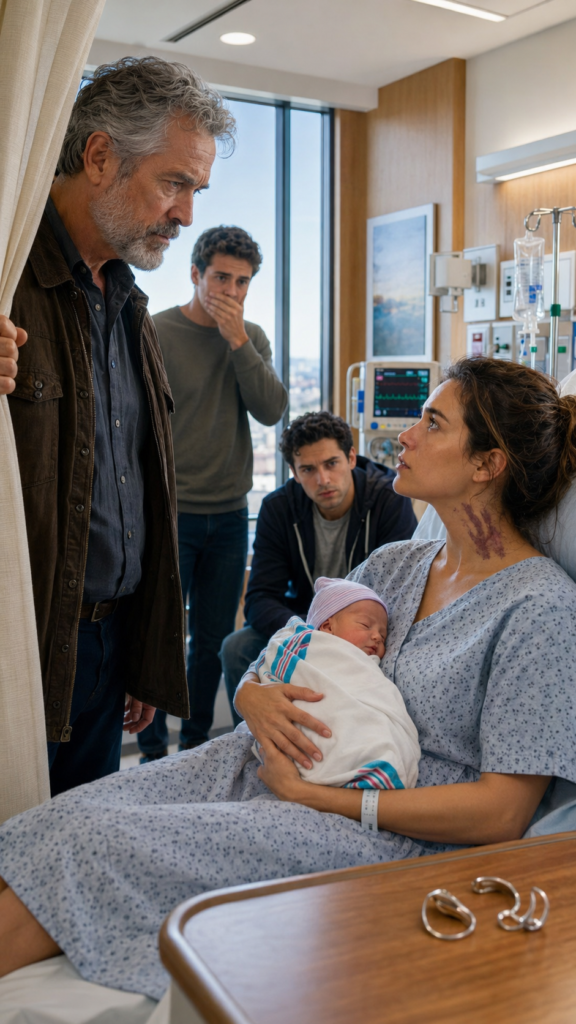
He pushed open the door to room 203.
Camila was sitting on the bed, pale and exhausted. Then he saw what she was holding.
Two newborns.
A boy slept against her left arm. A girl wore a pink hat and frowned just like Adrián when something annoyed him.
He stood frozen.
—What does this mean?
Camila didn’t cry or try to embrace him.
—I wanted to tell you sooner.
—Tell me what?
She looked at the babies.
—that you are their father.
Adrián felt the air vanish.
The first question out of his mouth was also the cruelest.
—How do I know they’re mine?
Camila remained still. Then she offered him the girl.
—You don’t. Hold her.
—I don’t know how.
—Learn. My arms are shaking.
Adrián took the little one with a clumsiness he had never shown in a meeting. When she opened her eyes and gripped his shirt with a tiny hand, something inside him shattered.
—Her name is Renata —Camila whispered—. He is Mateo.
They were names chosen without him.
—Why didn’t you tell me?
—I called you three times. Your assistant said everything had to go through the lawyers. I sent you emails and a certified letter. Your legal team returned it unopened.
—That couldn’t have happened.
Camila pulled out a sheet with the letterhead of the firm representing Adrián.
The text stated that he did not wish to receive “unverified pregnancy claims” and that any paternity issues would be resolved after the birth.
At the bottom was the signature of Mauricio Peralta, his lawyer and trusted man for nine years.
—I never authorized this.
—I believe you tonight —she replied—. I didn’t before.
At that moment, Lucía Ferrer, Camila’s lawyer, entered and placed a folder on the table.
—Someone tampered with the divorce messages and concealed the pregnancy —she said—. Furthermore, there’s a person who stands to gain millions if Adrián dies without heirs.
Adrián’s phone rang. It was Mauricio.
Adrián rejected the call.
Seconds later, a message arrived:
“Don’t acknowledge those babies. Camila hasn’t told you why she disappeared during the last month of her marriage.”
Adrián looked up.
—Where have you been, Camila?
She gripped the sheet and replied:
—I went to see your mother.
What she added next made Adrián realize those two babies weren’t the only secret buried that night.
PART 2
Camila revealed that, three weeks before asking for the separation, she had secretly visited Elena Valdés, Adrián’s mother, who had supposedly been incapacitated by a stroke for 18 months.
Elena had told her something impossible.
Adrián’s father hadn’t abandoned the family.
He had discovered that executives at Valdés Biotechnology were using genetic samples and fertility records without consent. When he threatened to report them, they framed him and forced him to disappear.
—Your mother asked me not to trust Mauricio —Camila said—. I wanted to tell you, but you arrived with him and four advisors. You said you didn’t have time.
The next morning, Camila received photos of Adrián entering a hotel with an executive.
Lucía opened the folder and showed that the images had been manipulated. She also revealed that someone had intercepted emails, forged Adrián’s signature, and hired a private investigator to follow Camila.
Everything had been paid for with company money.
These weren’t mere mistakes.
Someone had patiently widened every crack in the marriage.
—Why didn’t you ask me about the photos? —Adrián demanded.
—Because I spent two years asking you if you still saw me —she replied—. You never answered.
The truth left him defenseless.
Lucía then explained the financial motive.
If Adrián died without children, control of much of Valdés Biotechnology would fall into the hands of three administrators of the family trust.
One was Mauricio.
Another was the CFO.
The third was Elena, but her supposed illness had sidelined her from all decision-making.
So Mateo and Renata weren’t just unexpected children.
They were the heirs who could prevent two men from taking the empire.
Lucía received a call. Someone had attempted to erase the prenatal paternity test from Elena’s locked office.
Only Adrián and Miriam Salgado, the family assistant for 26 years, had access.
Adrián called Miriam.
She answered, breathless.
—I did it. I went in to check that they hadn’t changed the result. Mauricio knows they were born.
—Where are you?
—With your mother. Listen to me: Elena wasn’t the victim of a stroke. She was slowly poisoned to prevent her from revealing the changes in the trust.
Another voice came on the line.
—Stop asking questions you’re not prepared to answer —Mauricio said.
The call dropped.
An employee entered with a bouquet of white calla lilies. The card bore Elena’s handwriting:
“The children are yours, but not for the reason you imagine. Don’t trust the test.”
Adrián wanted to run to find Mauricio, but Camila stopped him.
—Stay for them, not for your pride.
For the first time in his life, he turned off his phone and sat between the cribs.
He changed diapers, prepared bottles, and listened to the complete story of the pregnancy. Camila had faced the first ultrasound alone, where she discovered two heartbeats.
She also confessed that, after the divorce, she returned to the fertility clinic where they had frozen embryos years ago.
—I didn’t want to trap you —she said—. I just refused to let the end of the marriage erase the dream of becoming a mother.
Adrián felt shame.
He had thought Camila was looking for money, when she had been preparing for months to raise two children they had both desired.
At dawn, he went to Elena’s apartment.
He expected to find a bedridden woman. Instead, he saw her sitting by the window, leaning on a cane, with a completely lucid gaze.
—Forgive me —she said—. I pretended not to recover because Mauricio was monitoring my doctors and my accounts.
Elena handed him a memory stick with old records.
She explained that Daniel Valdés, Adrián’s father, had uncovered a network selling genetic information of patients to private investors.
Mauricio, then a young lawyer, helped hide the movements and fabricated financial charges against Daniel.
Daniel fled to Canada to gather evidence, but died 16 years ago from a hereditary heart disease.
The same disease that Adrián had suffered from since childhood.
—What does that have to do with the twins? —he asked.
Elena took a deep breath.
The clinic where Camila underwent the transfer belonged to a group acquired by Valdés Biotechnology.
The couple’s embryos had been subjected, without authorization, to an experimental procedure to correct the cardiac mutation.
To do so, they used a protective variant found in the preserved samples of Daniel.
That’s why the prenatal test, deliberately compared to a profile archived under Adrián’s name, could yield confusing results.
Mateo and Renata were biological children of Adrián and Camila.
But they also carried a small protective genetic fragment from their grandfather.
—Mauricio used my children as an experiment —Adrián murmured.
—Yes —Elena replied—. And he hid the pregnancy because, if you had no heirs, he would control the trust along with the CFO.
Adrián felt nauseous.
His divorce hadn’t been solely caused by the conspiracy. He had emotionally abandoned Camila long before.
However, Mauricio had exploited every silence, every absence, and every wound to separate him from the only person capable of bringing him closer to the truth.
Lucía arrived with a prosecutor specialized in health crimes.
—If you turn over this evidence —she warned—, you could lose the company.
Adrián looked at the memory stick in his hand.
For years, he believed that love meant paying bills, solving problems, and building walls against poverty.
Now he understood those walls had also kept out his wife, his mother, and his own children.
—Then let it cost me the company —he replied—. But there will be no secret deals or money to buy silence.
That same day, a public investigation began.
Mauricio surrendered through his lawyers. The records revealed falsified consents, altered files, stolen samples, and illegal payments.
The authentic test appeared as well: an independent test confirmed that Adrián was the father of the twins.
When he returned to the hospital, Camila was feeding Mateo.
—You’re back —she said.
It wasn’t an observation.
It was a test.
Adrián sat beside her and told her everything. Camila cried upon learning that the embryos had been modified without her consent.
—Are they healthy?
—They’ll be checked by independent specialists. Never anyone from my company.
After that, Adrián said something she had never heard him admit.
—I’m scared.
Camila took his hand.
He didn’t ask her to come back or use the babies to repair the marriage.
He resigned as CEO, sold part of his shares, and created a legal fund to support affected families.
Valdés Biotechnology lost value, executives were fired, and the clinic closed under supervision.
The newspapers spoke of the fall of an empire.
Adrián called it cleansing.
In the following months, he and Camila learned to be parents separately before attempting to be a couple.
There were coffees, walks, conversations without lawyers, and apologies without conditions.
Adrián arrived when he promised.
Camila spoke up when she felt invisible.
Trust didn’t return due to a spectacular revelation, but through hundreds of small decisions.
A year later, doctors confirmed that Renata and Mateo were healthy. The intervention had been illegal and should never be justified, even though the inherited variant from Daniel might protect them from the disease.
Adrián, along with Camila, founded a medical ethics and patient advocacy organization.
She agreed to lead communications with one rule:
—If a family doesn’t understand what they’re signing, it gets rewritten.
Adrián never returned to the main office.
He learned to hold two babies, leave meetings for a fever, and clean bean puree off the ceiling without calling six employees.
One afternoon, when the twins turned one year old, an envelope arrived without a return address.
Inside was a photograph of Daniel in Canada next to Mauricio.
On the back, it read:
“Your father forgave me before he died. I spent 16 years not deserving that forgiveness. Calling you at the hospital was the first honest thing I did.”
Mauricio had been the anonymous voice.
He had caused the disaster, but in the end, he also opened the door that allowed the truth to be uncovered.
—Do you believe him? —Camila asked.
—I think he called —Adrián replied—. Forgiveness doesn’t mean trusting again. Maybe my father just wanted the story to end in a place different from hate.
Two years later, Adrián and Camila remarried at a courthouse in Coyoacán.
There was no press, no businessmen, no luxury hall.
Elena stood by their side. Miriam held Mateo because he refused to walk straight. Renata held her mother’s bouquet and tore off half of it before the ceremony.
Adrián didn’t promise to control the future.
He promised to always ask who Camila was becoming.
She promised not to disappear before telling him she felt alone.
Years later, Camila painted a picture of the hospital: two cribs, the city washed by the rain, and a scared man holding a newborn as if the world had just become fragile.
—What does it represent? —Adrián asked.
—The night you finally arrived —she replied.
He had believed his legacy was a company, then thought it was his children.
In the end, he understood that the true legacy wasn’t what remained after death.
It was everything he could heal when a person decided to stop running, open the door, and stay.