PART 1
Claudia had been watching her husband leave every Saturday for two years, wearing the same blue shirt, the same brown belt, and the same ironed lie.
— I have to cover a shift, love. You know how the job is.
And she nodded.
Because after 18 years of marriage, 2 children, a mortgage in Ecatepec, and bills that never stopped coming, one learns not to disturb the water when it still seems calm.
Javier was not a bad man.
He didn’t shout. He didn’t drink. He didn’t disappear during the week. He arrived on time, checked Diego’s homework, bought sweet bread for Natalia, and even warmed Claudia’s feet on cold nights.
That’s why she swallowed her doubts.
She swallowed the fact that for months he had been coming home smelling strange. Not of a woman’s perfume. Not of a motel. It was another scent. Clean, strong, like hospital alcohol mixed with cheap soap.
She also swallowed that he slept with his cell phone face down.
And that on Saturdays, before leaving, he would put on a little perfume, comb his hair carefully, and check himself in the mirror as if he were about to see someone important.
Claudia thought the worst.
Then she scolded herself.
“How ugly it is to distrust a man who works hard for his family,” she would tell herself.
Until one Saturday she woke up with a fever.
Her throat burned, her bones ached, and Javier was already in the kitchen, fastening his watch.
— Don’t go — she pleaded, wrapped in a blanket. — I feel very bad.
He touched her forehead, and his face hardened.
— I’ll be back early. I promise. I can’t miss this, they’re short-staffed.
He left her a chamomile tea by the bed and went.
Claudia waited an hour.
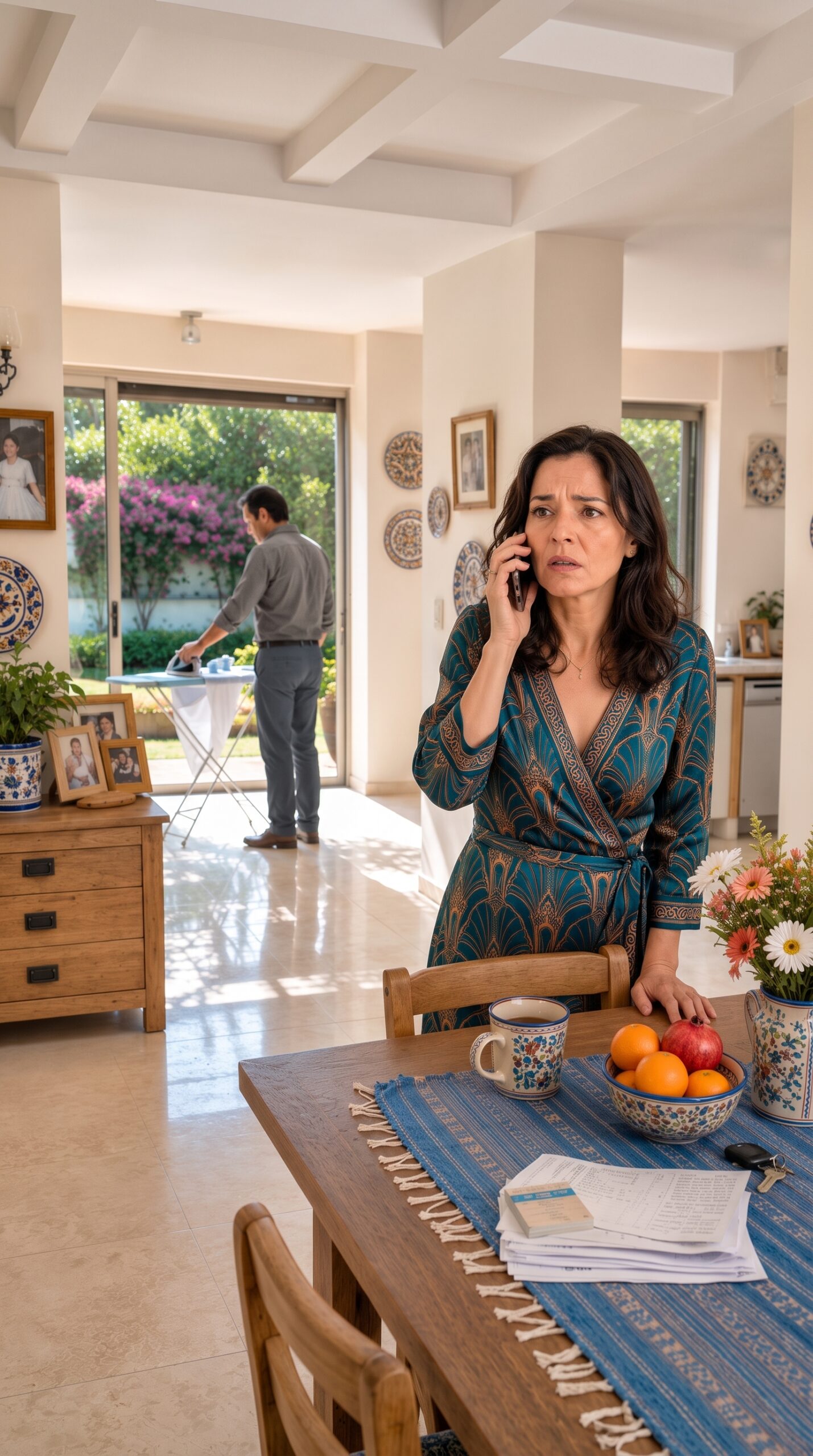
Then, with fever spinning her thoughts, she called the logistics company where Javier supposedly covered shifts.
The receptionist took a while to answer.
— Mr. Javier Medina? — the girl repeated, uncomfortable. — Ma'am, he no longer works here.
Claudia slowly sat up.
— What do you mean he doesn’t work there?
— He resigned 8 months ago. Well... he was let go. We haven’t had any record of him since then.
The fever dropped suddenly.
She didn’t cry. She didn’t scream. She just stared at the shirt Javier had ironed that morning, the imprint of the ironing board still marked on the fabric.
Then she opened the drawer where he kept receipts, old keys, and car papers.
Under an expired policy, she found a rental contract.
Apartment 7.
Doctores neighborhood.
3 blocks from the General Hospital.
Signed 7 months ago, in the name of Javier Medina.
Claudia felt a hollow space in her chest, but she kept searching.
In the shared account, there were monthly charges of 4,500 pesos every 5th day. Also, payments at a pharmacy, oxygen rental, adult diapers, and something labeled “clinical bed.”
That didn’t look like a lover.
But it didn’t look like a simple explanation either.
The following Saturday she pretended to be better.
She made Javier coffee, kissed him on the cheek, and watched him leave in his blue shirt.
She waited 20 minutes.
Then she took the keys, stuffed the divorce papers she had printed at a stationery store into her bag, and drove to the Doctores neighborhood with frozen hands.
The building was old, with peeling walls and a musty smell. She climbed to the second floor.
Apartment 7.
She knocked.
Inside, a low television was playing.
A neighbor peeked out.
— Are you here to see the lady? Poor thing. The boy is the only one who visits her.
Claudia pushed the half-open door.
The smell hit her.
Alcohol. Medicine. Sweet death.
And from the room, an old, broken voice said:
— Javier? Is that you, son?
Claudia stopped breathing.
That voice had hated her for 18 years.
It was Doña Consuelo.
Javier’s mother.
The grandmother her children believed was dead.
PART 2
Claudia stood frozen at the entrance, with the divorce papers crumpling inside her bag and the rage turning into something heavier.
She was not a young woman.
There were no high heels by the bed, no foreign underwear, no expensive perfume hidden in the bathroom.
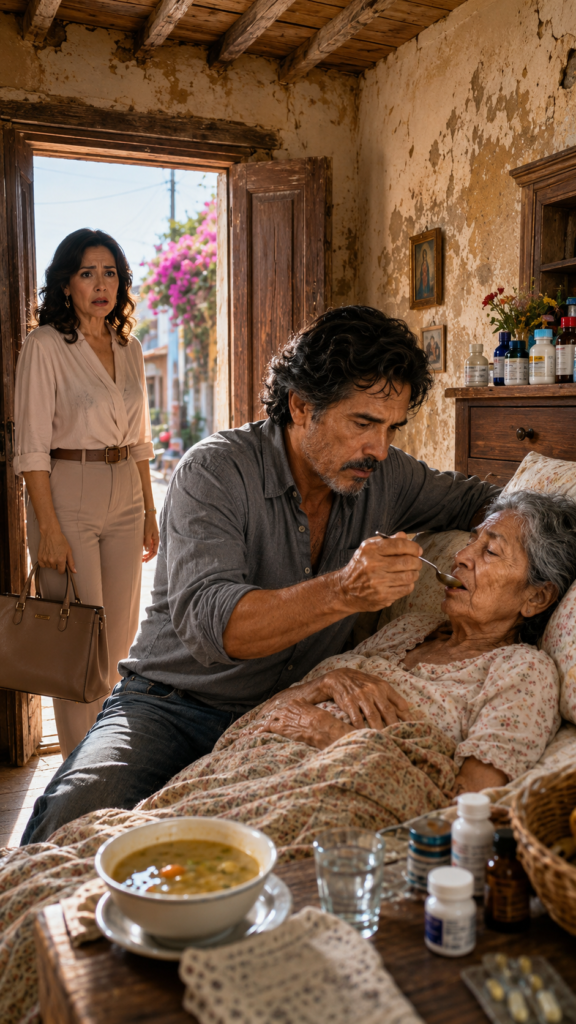
There was a clinical bed in the middle of the living room, an oxygen tank, bottles of pills organized by schedule, and a little Virgin of Guadalupe taped to the wall.
In the room, Doña Consuelo called again.
— Son… my mouth is dry.
Claudia didn’t respond.
That woman had been buried in her house long before she died. Claudia had erased her with a phrase spoken at 24, with a baby in her arms and her heart full of humiliation.
“That lady will never step foot in my house again. And I will tell my children that their grandmother is dead.”
And she did.
She invented a tomb for Diego and Natalia.
She invented an absence easier to explain than the pride of adults.
The apartment door opened 10 minutes later.
Javier entered with a pharmacy bag in one hand and 2 ham sandwiches in the other.
Upon seeing her, he turned pale.
The bag fell to the floor.
Medicine boxes rolled to Claudia’s feet.
— Clau...
She raised a hand to silence him.
She didn’t want Doña Consuelo to hear. Not yet.
She pulled him into the hallway and closed the door.
— 8 months without working there — she said, her voice so low it was frightening —. 8 months looking me in the face.
Javier looked down.
— Yes.
— And every Saturday you came here?
He swallowed hard.
— Yes.
— To take care of her?
Javier wiped his face with the sleeve of his blue shirt.
— My siblings left her in a government nursing home. When I went, she was in a hallway, tied to a chair with a sheet because she kept getting up and falling. She had sores, Claudia. She looked at me and said, “Get me out of here, even if it’s to die somewhere else.”
Claudia gritted her teeth.
— And you didn’t think to tell me?
— Of course I thought.
— Then why didn’t you?
Javier let out a broken, humorless laugh.
— Because you killed her in this family 18 years ago. How could I tell you I had resurrected her in a rented room?
The phrase hurt more because it was true.
Claudia wanted to defend herself. She wanted to remind him of everything.
That Doña Consuelo had called her greedy when she got pregnant with Diego.
That she had said in front of her sisters-in-law that Claudia had trapped Javier with a baby.
That she hadn’t gone to the civil wedding.
That she hadn’t wanted to hold her newborn grandson.
That when Natalia was born, she sent word through a neighbor not to look for her, that she had no grandchildren from “that girl.”
All of it was true.
But it was also true that Claudia had locked the door and then thrown the key into a well.
— I wasn’t going to let her into the house without asking you — Javier said —. I didn’t want to break you. I didn’t want the kids to hate you for what you said. And I couldn’t leave her alone either. She’s my mom, Claudia. Good or bad, she’s my mom.
She looked at him as if she didn’t know him.
For 2 years she imagined a lover.
For 2 years she thought the blue shirt was for someone else.
And there he was, with red eyes, bringing diapers, IV fluids, and sweet bread to a woman who could barely remember her name.
— Does she know who you are? — Claudia asked.
Javier slowly shook his head.
— Sometimes. Sometimes she thinks I’m 12. Sometimes she asks about my dad. Sometimes she tells me not to let my wife in.
Claudia felt a punch in the stomach.
— Why?
— Because she’s embarrassed for you to see her like this.
Claudia opened the door without asking for permission.
Doña Consuelo was lying down, almost sunken into blankets. Her white hair was stuck to her forehead, her lips cracked, and her fingers so thin they looked like twigs.
When Claudia entered, the old woman turned her head with difficulty.
— Are you the one with the insurance? — she asked.
Claudia stood still.
Javier tried to intervene, but she stopped him.
— Yes — Claudia lied —. I came to check on how you are.
The old lady barely smiled.
— Oh, how kind. Please sit for a moment, dear.
Dear.
That word, uttered by that mouth, tightened something in her chest.
Claudia sat on the edge of the bed.
Doña Consuelo groped for her hand. Claudia hesitated for 1 second but gave it to her.
The old woman’s skin was cold.
For 18 years, Claudia had imagined that hand as a claw. As the hand that snatched away peace, family, and dignity.
Now it was just a sick hand.
— I have a son — Doña Consuelo murmured —. A very good one. Javiercito. He doesn’t know how to say no.
Claudia looked toward the door. Javier was standing, head down.
— It shows — she replied.
— But I hurt him a lot — the old lady said, staring at the ceiling —. Him and his wife.
Claudia felt her heart stop.
— His wife?
Doña Consuelo closed her eyes.
— I treated her badly. Very badly. She was a girl. She came pregnant and I, like a fool, thought she was going to take him from me. As if children were potted plants that one can just put in the living room so no one moves them.
Claudia squeezed the old woman’s hand without realizing it.
— And did you never apologize?
Doña Consuelo let out a slow breath.
— I didn’t know how. First it was anger. Then pride. After, shame. By the time I wanted to, many years had passed. With what face does one knock on the door one kicked shut?
Claudia’s eyes filled with tears.
— Sometimes one also closes doors — she said, almost in a whisper.
The old lady didn’t seem to hear her.
— I watched the children from afar.
Claudia lifted her gaze.
— What children?
— My grandchildren — Doña Consuelo whispered —. A boy and a girl. Comadre Licha showed me pictures. Once I went to the girl’s kindergarten. Just to see her come out. I didn’t get close. I was afraid her mom would chase me off in front of everyone.
Claudia remembered that afternoon.
Natalia was 5 years old. She wore two pigtails with yellow bows. Claudia had seen a woman standing across the street, with a grocery bag pressed against her chest.
She recognized her.
And instead of crossing, she put Natalia in the car and drove away.
For years, she told herself she had protected her daughter.
In that room, she understood she had also taken away a grandmother.
— I loved them — Doña Consuelo said —. Even from a distance. I really loved them.
The word “really,” clumsy on the old woman’s lips, broke something.
Claudia bowed her head and cried silently.
Javier entered with a glass of water. Upon seeing her like this, he said nothing. He just approached to adjust his mother’s oxygen hose.
— Claudia? — Doña Consuelo suddenly said.
The room froze.
Claudia looked up.
The old lady’s eyes were clearer. For a moment, they were there. Present.
— Yes — she replied, trembling —. I’m Claudia.
Doña Consuelo tried to sit up but couldn’t.
— Forgive me.
It wasn’t a speech.
There was no long explanation.
Just that fractured word, pushed from a body that was barely holding on.
Forgive me.
Claudia could have answered her with 18 years of pain.
She could have told her that she came too late. That her grandchildren grew up without her. That Javier carried a horrible lie alone because both of them were too proud.
But she saw her so small, so finished, so far from the woman who once humiliated her in a kitchen, that she could only take her face between her hands.
— I did ugly things too — she whispered —. I also erased you.
Doña Consuelo blinked.
Then she faded away again.
— Has Javiercito come back from school yet? — she asked.
Claudia closed her eyes.
That was the punishment.
The apology had come full, but only for 1 minute.
As she left the room, she took the divorce papers from her bag.
Javier looked at her terrified.
She ripped them into 4 pieces, not because everything was forgiven, but because that story no longer fit into an infidelity trial.
— I’m going for the kids — she said.
Javier quickly shook his head.
— You don’t know how they’ll react.
— I do know — Claudia replied —. It will hurt them. And they have the right to know.
She drove back to Ecatepec with trembling hands.
In the living room, she found Diego playing on his phone and Natalia doing homework at the table.
Diego was 17. Natalia, 14.
She sat them in front of her.
She didn’t sugarcoat anything.
She told them that their paternal grandmother was alive. That she was very ill. That Javier secretly cared for her on Saturdays. That she, Claudia, had lied to them since they were children because she didn’t know how to handle her pride or her pain.
Natalia started crying first.
Diego didn’t cry.
That was worse.
— So we’ve had a grandmother all this time? — he asked.
Claudia nodded.
— Yes.
— And you decided for us?
There was no answer that was enough.
— Yes — she said —. And it was wrong.
Diego got up from the chair.
— You always told us not to lie in this house.
Claudia lowered her gaze.
— I know.
— No, Mom. You don’t know. Because a lie of 1 day is understandable. An 18-year one isn’t.
Javier arrived shortly after.
Diego didn’t want to look at him.
— You lied too — he told him.
— Yes — Javier replied —. And I’m sorry.
Natalia, with her wet face, asked something that broke everyone.
— Can we still see her?
Claudia took the keys.
— That’s why I came. Let’s go right now.
That afternoon, the four of them arrived at apartment 7.
Doña Consuelo was awake.
She didn’t immediately understand who those tall, beautiful kids were standing at the door as if they didn’t know whether to enter a wake or a stranger’s house.
Javier leaned closer to her.
— Mom, these are Diego and Natalia.
The old woman looked at the boy.
Her mouth trembled.
— Dieguito?
Diego froze.
She lifted a hand, just barely.
— How you’ve grown, son.
That was enough.
Diego walked to the bed and bent down. He let her touch his face as if she wanted to memorize in 10 seconds what she couldn’t see in 17 years.
Natalia approached afterward.
Doña Consuelo confused her with a young Claudia.
— Don’t cry, girl — she said —. Don’t let an old bitter woman ruin your life.
Natalia cried louder.
For 3 days they went to the apartment.
There were no miracles.
There was no perfect reconciliation, one that feels like a cheap novel.
There were lucid moments, others not.
There were awkward silences.
There were complaints in the car.
There was one night when Diego told Claudia he loved her, but didn’t know if he could trust her the same way. And Claudia accepted that blow because it was fair.
Doña Consuelo died on a Tuesday at 6:20 in the evening.
Javier held her right hand.
Claudia, the left.
Diego and Natalia stood at the foot of the bed.
When the hose stopped moving and the room was too still, no one screamed.
Only Natalia said:
— She left when we finally arrived.
And that phrase hung in the air like a sentence.
After the funeral, they returned to the apartment to pick up their things.
There was hardly anything.
An old wardrobe.
A gray shawl.
A small radio.
A bag with little saints.
On top of the wardrobe, they found a shoebox tied with red string.
Javier said that his mom never let him open it.
Claudia placed it on the bed.
Inside were hand-knitted sweaters.
Small, medium, large.
Each collar had a name embroidered.
Diego.
Natalia.
Diego.
Natalia.
They counted them.
18 sweaters.
1 for every winter Claudia hadn’t opened the door.
Underneath, there were cut-out photos: Diego in primary school uniform, Natalia at her first communion, a family photo taken at a school fair where, in the background, a woman with a black bag could barely be seen, watching from afar.
Doña Consuelo had been there.
On the edge.
Always on the edge.
There was also an envelope.
Javier opened it carefully.
The letter said that she didn’t know if her grandchildren would ever touch that clothing, but that knitting was the only way she found to hug them without bothering anyone.
Diego brought his hands to his face.
Natalia hugged a blue sweater with her name.
Claudia couldn’t touch anything for several minutes.
Because she understood that the villain is not always one person.
Sometimes a family breaks because everyone has a piece of reason and too much pride to let it go.
Javier had lied.
Doña Consuelo had hurt.
Claudia had erased.
And the children paid the price of a war they never chose.
Since then, the blue shirt for Saturdays hung in the back of the closet.
Claudia didn’t wash it.
It still smelled a little of the hospital, of cheap soap, and of goodbye.
Diego kept the oldest sweater, even though it didn’t fit him on one arm.
Natalia put a photo of Doña Consuelo in her room, not because she remembered her as a grandmother, but because she wanted to remember what happens when adults stay silent for too long.
Claudia and Javier stayed together, but not as before.
They had to learn to say ugly truths without hiding them under the rug.
Sometimes Diego still asks why.
Sometimes Claudia still doesn’t know how to answer.
She only looks at the shoebox and thinks that 18 winters can be folded into a bed, but they cannot be returned.
Because some apologies do arrive.
But they arrive late.
And when a door is crossed at the end of life, the most painful thing is not finding hatred on the other side.
It’s finding love stored away, intact, waiting for someone who was also afraid to touch.