PART 1
—A woman like you should never have entered this family.
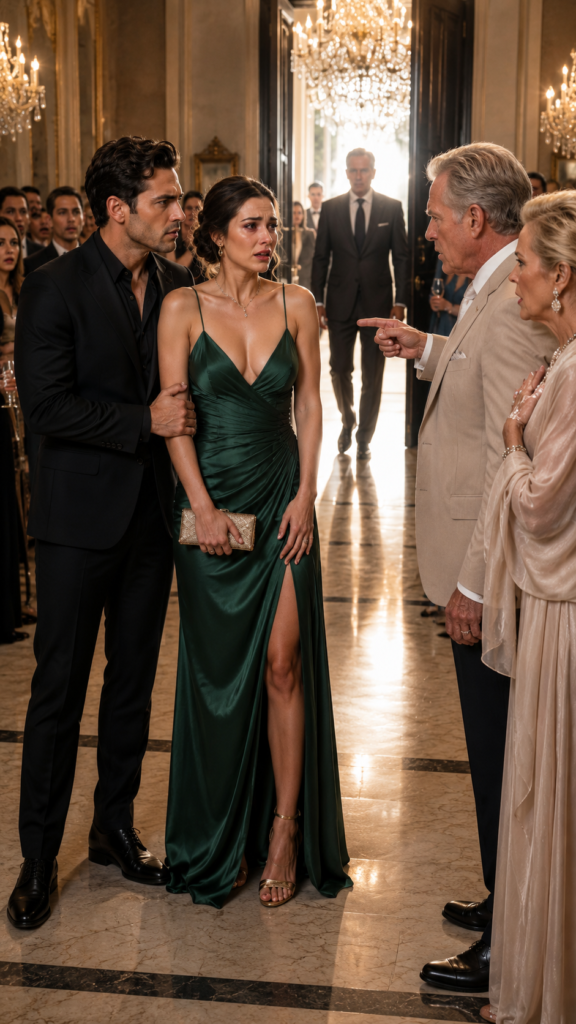
Rogelio Montemayor's words fell like a stone in the illuminated garden of his mansion in Bosques de las Lomas, just as guests raised their glasses to toast the 40th anniversary of Montemayor Construcciones.
Businessmen, politicians, architects, social reporters, and board members filled the space. All dressed as if attending a magazine wedding. And amid that luxury stood Mariana Castillo, alone, her face set, hands cold.
She wore no diamonds. No designer handbag. Her dark green dress was elegant yet simple. Her hair was tied back, and her small earrings barely sparkled under the garden lights.
For Rogelio, that was enough to despise her.
Beside her, Daniel Montemayor, her husband, clenched his jaw.
—Dad, that’s enough. Don’t talk to her like that.
Rogelio let out a dry laugh.
—Are you going to defend her in front of everyone? Her? A woman who, in two years, has never been able to say where she comes from?
A murmur spread among the tables.
Mariana swallowed hard. She had heard that tone before, during family meals, at Christmas, in private gatherings. But never in front of so many people.
This night was no ordinary party. Montemayor Construcciones was about to compete for the industrial corridor of Bajío, a multi-billion peso project. The final decision rested with Consorcio Altamirano, led by Samuel Altamirano, a reserved investor who rarely appeared in public.
Rogelio had been trying to impress him for nine months.
And still, he chose to humiliate his daughter-in-law on the most important night of his company.
Mariana had met Daniel during a reconstruction brigade after flooding in Veracruz. While others arrived with cameras, she showed up with muddy boots, carrying supplies and listening to families.
Daniel fell in love with the way she looked at people.
Rogelio, on the other hand, never accepted her.
—Women like her know how to pretend very well —he would say.
Eugenia, Daniel's mother, was no different. That night she wore an antique emerald brooch, a family heirloom, and kept touching it as if it were a crown.
Minutes earlier, Mariana had greeted Don Beto, the gardener.
—Did your wife come out of the hospital?
—Yes, Mrs. Mariana. Thank you for remembering. You were the only one.
Eugenia saw her and murmured:
—Of course, she feels at ease with the help.
After two drinks, Rogelio decided to strike.
—This family has history. It has a name. It has prestige. And you, Mariana, have nothing to offer but a pretty face and a story no one can verify.
Daniel stood up.
—We’re leaving.
Rogelio pointed at him with rage.
—If you leave with her, you lose your job, your shares, and any inheritance. Think carefully, man.
Daniel took Mariana’s hand.
—I choose my wife.
Some guests lowered their gazes. Others took out their cellphones.
But as Mariana and Daniel walked toward the exit, Eugenia shouted:
—My brooch!
Everyone turned.
The woman clutched her chest, desperate.
—My emerald brooch is missing.
She searched her shawl, her purse, the table. Then she looked up at Mariana.
—You were next to me a few minutes ago.
Mariana felt the blow before she heard it.
—You can’t be implying that.
Eugenia pointed at her purse.
—Check her.
Daniel stepped in front of her.
—Don’t you dare.
But Rogelio called the head of security.
—Victor, check her bag. If she has nothing to hide, she won’t have a problem.
Mariana looked at everyone. No one defended her.
Then she placed her bag on the table.
—Check it here. In front of everyone. Since you decided to tarnish my name.
Victor pulled out a wallet, some keys, tissues, a cellphone, a notebook, and a small medal of the Virgin.
Nothing else.
The brooch didn’t appear.
Daniel demanded an apology.
Rogelio remained unfazed.
—She may have hidden it in the car.
Mariana turned pale.
At that moment, her cellphone vibrated.
The message read:
“I’m at the entrance.”
The main gate opened, a black SUV slowly advanced, and Victor, the head of security, lost color as he recognized the man who stepped out.
—Mr. Samuel Altamirano...
And Mariana understood that no one in that garden could imagine what was about to happen.
PART 2
Samuel Altamirano entered the garden without visible escorts, without entrance music, and without needing to raise his voice.
He was nearly 60, with gray hair, a perfectly tailored gray suit, and that calm demeanor of men who don’t need to flaunt power because everyone knows they possess it.
Conversations faded one by one.
Rogelio Montemayor stood still for a few seconds. Then he smiled with a rigidity that was almost painful and walked toward him.
—Mr. Samuel, what an honor to have you. I’m very sorry you arrived in such an uncomfortable family situation.
Samuel didn’t shake his hand.
His eyes scanned the table where Mariana’s belongings lay: her wallet, her keys, her notebook, her medal. All exposed as if they were evidence of a crime.
Then he looked at Eugenia, Rogelio, Daniel, and finally Mariana.
—Uncomfortable is not the word —he said—. This looks like a humiliation.
The silence became heavy.
Rogelio tried to control the scene.
—It was a misunderstanding. A family jewel went missing, and we just wanted to clarify it.
—Clarify it? —Samuel asked—. Or did you need an excuse to accuse someone you never wanted to accept?
Eugenia lowered her gaze but didn’t apologize.
Mariana took a deep breath. For the first time that night, relief showed in her eyes.
—You arrived late —she murmured.
Samuel approached her with a tenderness that confused everyone.
—No, daughter. I arrived just in time to see who you are when you think no one important is watching.
The word “daughter” fell like a bomb.
Daniel turned to Mariana.
—Daughter?
Rogelio opened his mouth but couldn’t say anything.
Samuel stood next to Mariana and addressed all the guests.
—Yes. Mariana Castillo Altamirano is my daughter. The woman they called poor, a gold digger, and a thief is my only child.
A murmur exploded among the tables.
A woman dropped a glass. A board member held his forehead. Someone whispered “no way” without realizing everyone heard him.
Daniel slowly released Mariana's hand, not out of rejection, but surprise.
—Your dad is Samuel Altamirano?
Mariana nodded, her eyes glistening.
—Yes.
—Why didn’t you ever tell me?
The question didn’t sound aggressive. It sounded hurt.
Mariana swallowed hard.
—Because since I was a child, I saw how people changed when they heard my last name. They stopped talking to me and started talking to my father’s money. When I met you in the mud, in destroyed houses, and families who had lost everything, you treated me as a person. I didn’t want to lose that.
Daniel looked at her in silence.
—I wanted to know if your family could love me without knowing who I was —she continued—. I wasn’t trying to prove anything to you. I was trying to prove if there was a heart in this house.
Rogelio shifted uncomfortably.
Samuel didn’t take his eyes off him.
—And tonight the answer is quite clear.
Rogelio raised his hands, feigning calm.
—Mr. Samuel, let’s not allow a family matter to ruin a business relationship. Montemayor Construcciones has 40 years of prestige.
Samuel pulled a black envelope with the Consorcio Altamirano seal from his jacket and placed it on the table.
—That’s exactly why I came. I didn’t come to celebrate. I came to observe.
Rogelio frowned.
—Observe?
—Before awarding a multi-billion peso project, I needed to know how this company behaves when it thinks power is on its side.
No one moved.
Samuel looked at Mariana's bag again.
—And what I saw was classism, abuse, and an accusation without proof.
Eugenia tried to approach.
—I was desperate for my brooch. Any mother would have reacted the same.
Mariana raised her hand.
—Don’t say that. You didn’t react out of fear. You reacted with malice.
Eugenia froze.
—That’s not true.
Before she could continue, Chayo, the housemaid, appeared. She had worked for the Montemayors for 16 years. She entered from the hallway with a velvet box in her trembling hands.
—Mrs. Eugenia… I’m sorry, but I found this in your dressing room.
She opened the box.
The emerald brooch sparkled under the garden lights.
The guests held their breath.
Chayo was shaking.
—You took it off when you went to change your shawl. You asked me to keep it, but then I got called to the kitchen and left it there.
Daniel let out a bitter laugh.
—They accused her of being a thief for something that was in your room.
Mariana didn’t cry. That made it all hurt more.
—They weren’t looking for the brooch —she said with a broken calm—. They were looking for an excuse to throw me out.
Eugenia pressed her lips together.
—It was a misunderstanding.
Samuel shook his head slowly.
—No. It wasn’t just a misunderstanding.
Rogelio turned to him.
—What do you mean?
Samuel looked at the head of security.
—Victor, play the hallway video.
Victor froze.
Rogelio hardened his face.
—There’s no need for that.
—Yes, there is —Samuel replied—. Tonight you demanded to search my daughter’s bag in front of everyone. Now everyone can see the truth just as clearly.
Victor connected his phone to one of the garden screens.
The image showed Eugenia entering her room, taking off the brooch, and leaving it on the dresser. Then Rogelio appeared at the door.
The audio was low, but enough.
—If we don’t find anything, we press —Rogelio was saying—. Today Daniel has to choose. Either her or us.
Eugenia replied:
—Let them check her in front of everyone. That’ll take away her dignity.
The entire garden froze.
It hadn’t been an accident.
It hadn’t been an impulse.
It had been a trap.
Daniel looked at his parents as if he had just discovered two strangers.
—Did you plan this?
Rogelio tried to stay firm.
—I did it for you.
—For me? —Daniel stepped toward him—. Humiliating my wife was for me?
—That woman was pulling you away from your future.
Daniel clenched his fists.
—No, dad. She was pulling me away from you. And now I understand why.
Eugenia began to cry, but her tears no longer convinced anyone.
—Daniel, we’re your family.
He looked at Mariana.
—She is too.
Rogelio lost control.
—I am your father. Everything you have came from me.
Daniel struggled to breathe.
—And everything I am, I don’t want it to come from you.
The blow was harder than any scream.
Samuel opened the black envelope and revealed several signed sheets.
—Montemayor Construcciones was one of the three finalists for the Bajío industrial corridor. They had competitive numbers, experience, and technical capacity.
Rogelio clung to that phrase like a lifeline.
—Then let’s talk privately. We can fix this.
Samuel looked at him coldly.
—Not everything gets fixed privately when the damage was done publicly.
The guests kept recording. Some were already sending the videos. The reputation Rogelio had maintained for 40 years began to crumble in real time.
—Consorcio Altamirano withdraws Montemayor Construcciones from the process —Samuel declared.
Rogelio paled.
—You can’t do that over a family dispute.
—I can do it for lack of ethics. And tonight, the lack of ethics was recorded from several angles.
A board member bowed his head. Another stood up and left without saying goodbye.
Daniel carefully gathered Mariana's things: the wallet, the keys, the notebook, the medal. Then he placed everything in her bag and handed it to her as if returning a part of her dignity.
—Let’s go —he said.
Rogelio shouted from the main table:
—If you cross that door, you forget about this family.
Daniel stopped, not releasing Mariana's hand.
—Maybe this family forgot how to be human long before I left.
No one responded.
Mariana walked toward the exit with her back straight. Not as a defeated woman, but as someone finally stopping asking for permission to exist.
Samuel walked behind them.
Before leaving, he turned to Rogelio.
—The last name doesn’t give education. It just reveals faster when someone lacks it.
The phrase hung in the garden.
That same night, the video began circulating on Facebook, TikTok, and group chats.
By 6:30 AM, headlines were up:
“Businessman Accuses His Daughter-in-Law of Theft and Discovers She’s the Daughter of the Investor He Needed.”
By 7:00, Consorcio Altamirano released a brief statement:
“Human dignity, respect, and a culture of ethics are essential conditions for any strategic alliance.”
It didn’t mention the Montemayors.
It didn’t need to.
By 9:30, two important clients requested to review their contracts. By 11:00, a bank requested an urgent meeting. By 1:00 PM, the board summoned Rogelio.
He arrived furious, still believing he could impose fear.
But he found everyone seated in silence.
Clara Robles, the board president, spoke plainly.
—Rogelio, a company that builds cities cannot destroy people in its own home.
—It was a family matter.
—It was classism, abuse of power, manipulation, and reputational damage. And it was all recorded.
For two hours, they discussed. Rogelio tried to blame Mariana, Samuel, Daniel, the guests, the networks.
Everyone but himself.
In the end, the board voted to temporarily suspend him from the executive direction while they investigated other internal complaints.
Because the video opened a door.
Employees who had been silent for years began to recount how Rogelio humiliated laborers, secretaries, drivers, and suppliers. A receptionist said he called her “replaceable” for asking permission to take her son to the doctor. An engineer recounted being threatened with dismissal for demanding overdue payments.
The fall wasn’t because of Mariana.
Mariana was just the spark that illuminated everything that was already rotten.
Rogelio left the building without an escort, chauffeur, or anyone to open the door for him.
For the first time in 40 years, he walked alone.
Meanwhile, Mariana and Daniel moved into a small apartment in Colonia Narvarte. It had no huge garden or marble fountain. The kitchen was narrow, and the table wobbled a bit.
But no one there called her a thief.
On their first night, they had noodle soup and quesadillas, sitting at the counter. Daniel couldn’t stop looking at her.
—I could have told you before —Mariana said.
He took her hand.
—Yes. But my family could treat you well without needing to know.
She lowered her gaze.
—That was all I wanted to prove.
Six months passed.
Montemayor Construcciones survived, but no longer under Rogelio’s command. The company implemented protocols against labor abuse, mandatory training, and an anonymous reporting channel. Many said it was late, but at least for the first time someone was listening.
Eugenia called Mariana 11 times.
Mariana didn’t answer.
On the seventh day, she received a long message from her mother-in-law:
“Forgive me. I got carried away. I didn’t know who you were.”
Mariana replied with just one line:
“The problem was never that you didn’t know who my father was. The problem was that you believed I was worth less without him.”
Eugenia didn’t write again.
Daniel officially resigned his shares in the family business. Samuel offered him a position at Consorcio Altamirano, but Daniel set a condition.
—I don’t want to come in as a son-in-law. I want to start from the bottom.
Samuel observed him for a few seconds.
—That means reviewing files, visiting sites, listening to complaints, and earning every peso.
Daniel nodded.
—That’s exactly what I need.
And so it began.
Visiting sites in Hidalgo. Talking to workers. Listening to families affected by poorly planned projects. Learning that a company is not measured only by the buildings it delivers but by the lives it touches while constructing them.
One Sunday afternoon, Samuel came to dinner with them. Mariana prepared green enchiladas, and Daniel burnt the tortillas a little, but they all laughed.
There were no photographers. No waiters. No guests pretending to smile.
Only family.
After dinner, Samuel asked Mariana:
—Do you regret hiding your last name?
She looked at Daniel, who was washing dishes with his sleeves rolled up and the clumsiness that was the sweetest in the world.
—No. It hurt, but it showed me the truth.
—What truth?
Mariana smiled sadly.
—That some only respect when they recognize money. Others take your hand when they believe you’re about to lose everything.
Weeks later, Rogelio sent a handwritten letter. He didn’t ask to recover the contract or return to the company. For the first time, he didn’t speak of prestige.
“Mariana, my mistake was not knowing who your father was. My mistake was believing you needed to be the daughter of someone important to deserve respect.”
Mariana read it in silence.
She didn’t cry.
She didn’t tear it up.
She put it in a drawer.
Daniel asked her:
—Are you going to reply?
She looked out the window. Below, a street vendor was passing by, shouting with that neighborhood joy that no mansion can buy.
—Maybe someday. Forgiveness doesn’t always mean opening the door right away.
That night they went for a walk in the park. There were children running, couples eating esquites, and ladies chatting on the benches.
Daniel took Mariana’s hand.
She no longer needed to hide her last name.
But she also didn’t need to use it as a shield.
Because that night, in a house where they tried to make her feel small, Mariana left a lesson that everyone ended up repeating:
The respect that appears only when power is discovered is not respect.
It’s fear disguised as education.