PART 1
The first time Mariana's baby cried, her husband smiled.
It wasn't a smile of tenderness or pride. It was a cold, heavy smile, the kind that can turn a room full of flowers into a prison cell.
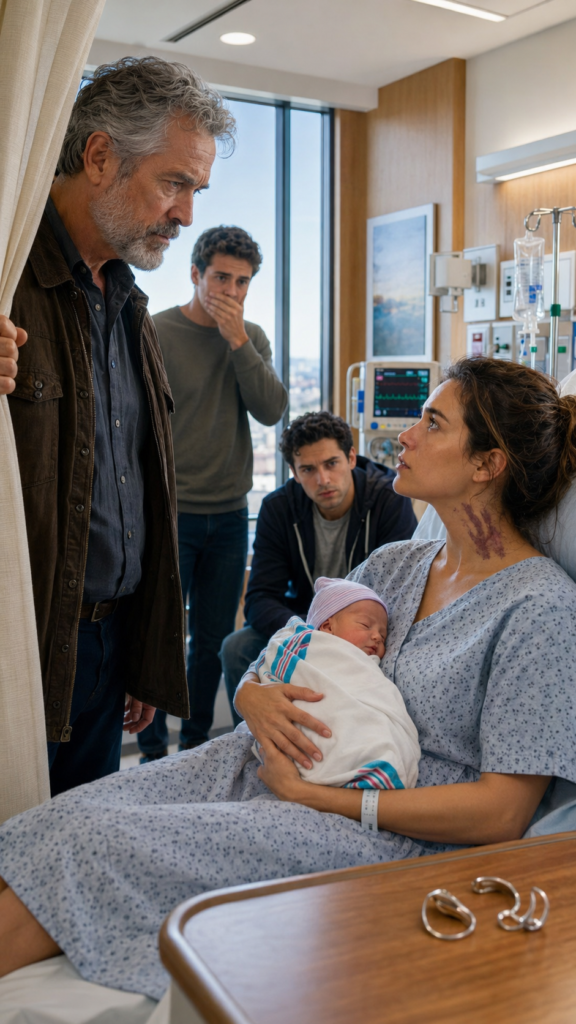
Mariana lay in the bed of Hospital Ángeles in Puebla, her newborn son pressed to her chest. Only six hours had passed since her delivery. Her hair was damp, her lips cracked, and dark marks were set around her neck.
They were fingerprints.
Her husband, Emiliano Rivas, sat by the window, his shirt perfectly pressed and a silver balloon floating behind him that read: “THE BEST DAD.”
—He already understands who's in charge of this family —Emiliano said, looking at his father with a repugnant calm—. He needed a lesson.
Don Octavio Rivas, her father-in-law, let out a dry laugh.
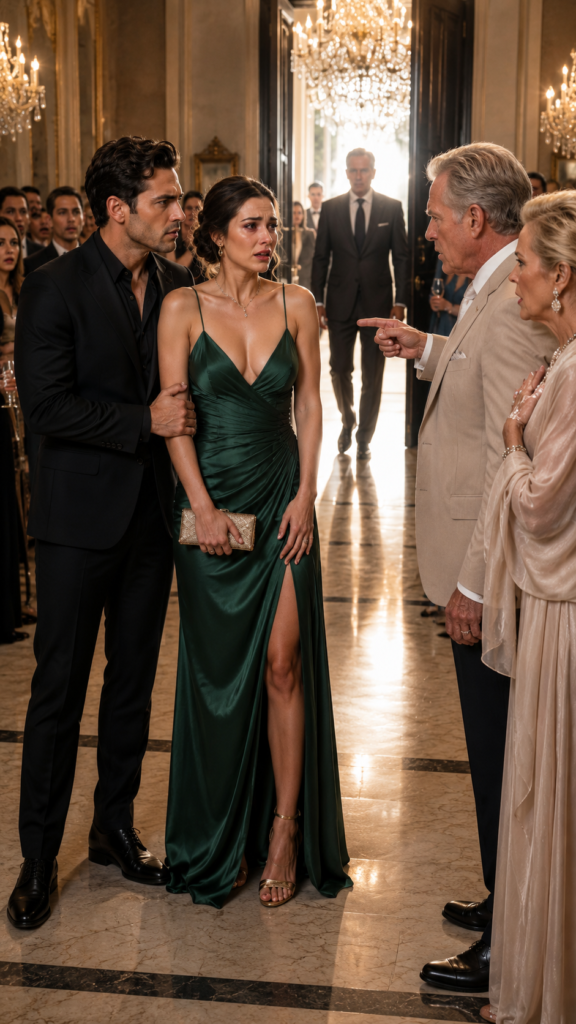
He was a tall man with gray hair, owner of auto workshops and half a block of shops in Cholula. Everyone greeted him with respect. Some out of affection. Most out of fear.
—Don't exaggerate, Mariana —Octavio said, arms crossed—. Women after childbirth get sensitive. They start making things up.
Mariana pressed the baby closer to her chest.
The boy was named Mateo. She had chosen that name because her mother, before she died, always said that children with soft names grew with good hearts.
But Emiliano wanted to name him Octavio, after his father.
—My son will carry my family's name —Emiliano said, rising slowly—. You don't decide here.
Mariana swallowed hard.
It hurt to speak. It hurt to breathe. It hurt to exist in that room where everyone pretended that the flowers could cover the fear.
—His name is Mateo —she whispered.
Emiliano's chair scraped against the floor.
—What did you say?
Just then, the door swung open.
Don Ramiro, Mariana's uncle, walked in.
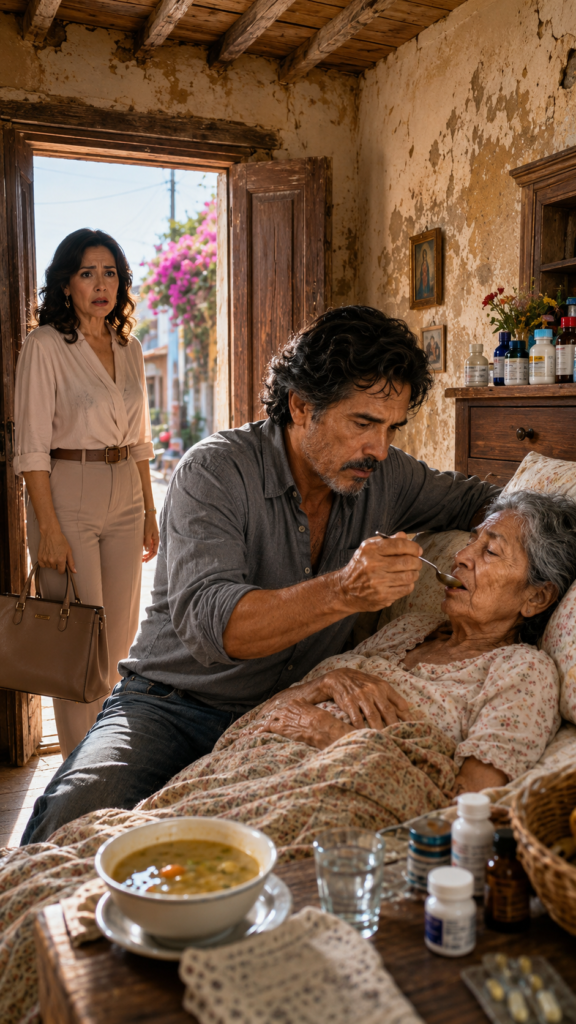
He brought a bag of sweet bread, an old brown sweater, and worn shoes that made soft sounds against the floor. He was 72, walked with a slight limp, and wore hearing aids in both ears.
To anyone, he seemed like a quiet old man.
To Mariana, he was the only man who had never failed her.
Ramiro froze when he saw her.
First, he looked at the baby. Then at Mariana's pale face. Finally, at the purple marks on her neck.
The room ran out of air.
—Who did this to you, honey? —he asked.
Emiliano let out a chuckle.
—Oh, uncle, don’t get involved. Nothing serious. I just taught her who's in charge now that we're a family.
Don Octavio was about to laugh too, but he couldn't.
Ramiro set the bag of bread on the tray. He slowly closed the door. Then he pulled the curtain across the room, isolating them from the hallway.
After that, he took off his hearing aids and placed them next to a glass of water.
—Close your eyes, Marianita —he said in a voice too calm.
But Mariana didn't close them.
She saw Emiliano frown, confused.
She saw her father-in-law step back.
And she saw the exact moment the sleeve of Ramiro's sweater rolled up, revealing an old military tattoo on his forearm: a black dagger piercing through a broken crown.
Don Octavio turned pale as paper.
His lips trembled.
—No… —he murmured—. You can't.
Emiliano turned to him, annoyed.
—Dad? What’s wrong with you?
But Octavio couldn't answer.
The man who always intimidated everyone doubled over and vomited on the hospital's immaculate floor.
Mariana felt her heart stop.
Because in that moment, she understood something that had never been told to her.
Her husband hadn't messed with a defenseless woman.
He had messed with the only niece of the man her father had been trying to forget for thirty years...
PART 2
Emiliano looked at his father as if he suddenly didn't recognize him.
—What the hell is happening? —he asked, but his voice no longer sounded so sure.
Don Octavio remained bent over, breathing heavily. His eyes never left the tattoo on Ramiro's arm.
The old man hadn’t raised his voice. Hadn't struck a blow. Hadn't done anything except stand before them with a calm that was more frightening than any threat.
—Octavio Rivas —Ramiro said—. Finally, I see you again.
Mariana blinked, confused.
She knew very little about her uncle's past. The family only said he had been a soldier, that he had served many years and then retired without ever talking about what he had seen. When Mariana was a child, Ramiro taught her not to lower her head, to keep copies of important documents, and to call the police before explaining too much.
But he had never told her why.
Octavio wiped his mouth with the back of his hand.
—Ramiro… I didn’t know she was your niece.
—That’s why you thought you were brave, right? —Ramiro replied.
Emiliano clenched his fists.
—Listen, old man, I don’t know what history you have with my dad, but this is my wife. My son. My family. So back off.
Ramiro didn’t even look at him at first.
He walked to Mariana's bed, adjusted the blanket over her shoulders, and looked at the baby with a tenderness that finally made her release a tear.
—What’s his name? —he asked.
—Mateo —Mariana said.
—Mateo —Ramiro repeated—. Beautiful name.
Emiliano let out a false laugh.
—He’s going to be called Octavio. I already said so.
Ramiro turned slowly.
—You will no longer decide anything about her or that child.
Emiliano took a step forward, but Octavio pulled him back by the arm in desperation.
—Don’t provoke him! —he whispered.
—Provoke him? —Emiliano looked at him with contempt—. This old man?
Ramiro took his hearing aids from the tray, not to put them back on, but to tuck them into his pocket. Then he pulled out his old cellphone, the kind with a cracked screen, and dialed a number.
—Commander Salgado —he said when they answered—. I’m at Hospital Ángeles. Room 312. I need a squad car, a social worker, and to notify the Public Ministry. There’s domestic violence against a woman who just gave birth and a risk to a minor.
Emiliano froze.
—You can't do that.
—I just did.
Don Octavio closed his eyes as if he had just heard a sentence.
Mariana didn't understand why a simple call had shattered the Rivas' arrogance. Until Ramiro looked at Octavio and released the truth.
—Thirty years ago, your father-in-law had another name in the northern barracks: “The Boss of Transfers.” He used shell companies to move weapons, money, and people. He hid behind workshops, cranes, and political favors.
Octavio raised his head, furious and terrified.
—Shut up.
—I was part of the operation that dismantled his network —Ramiro continued—. And he was the only one who managed to escape before the others fell. Since then, he has lived peacefully, pretending to be a respectable businessman.
Emiliano looked at his father.
—That’s a lie.
But Octavio didn't deny it.
That silence was the first real blow to Emiliano.
Mariana felt a chill. Everything fell into place: the strange phone calls from her father-in-law, the men waiting outside family parties, the favors no one explained, the way everyone lowered their voice when Octavio entered.
Ramiro pulled out a folded file from inside his coat.
—I came because Mariana sent me a message last night. It only said: “Uncle, I’m scared.” And since she never asks for help, I did two things before coming: I called a lawyer and had this family's background checked.
Emiliano swallowed hard.
—She’s my wife —he repeated, but now it sounded like a child throwing a tantrum.
—No —Ramiro said—. She’s a woman you almost choked while carrying a newborn.
Mariana looked down at the baby.
Mateo slept, oblivious to it all, with his tiny hand closed around his mother’s gown.
Then the door opened.
Two nurses, a doctor, and a hospital guard entered. Behind them were two municipal police officers.
Emiliano's expression changed in seconds.
—This is a misunderstanding —he said, raising his hands—. My wife is tired. She had a difficult delivery. She got hysterical and...
—No —Mariana interrupted.
Everyone turned to look at her.
Her voice trembled, but she didn’t stop.
—It wasn’t a misunderstanding. He grabbed me by the neck because I didn’t want to name our son after his father. He told me that if I screamed, he’d say I was crazy from the hormones. His father was here. He saw everything.
Don Octavio stood still.
Emiliano looked at her with hatred.
—Mariana, be careful what you say.
Ramiro stepped between them.
—The one who needs to be careful is you, kid.
The doctor examined the marks on Mariana's neck and requested clinical photographs. A nurse carefully took the baby to check him as well. Mariana felt fear at being separated from Mateo, but the nurse whispered to her:
—Don’t worry, mom. No one’s going to take him away from you.
And that phrase broke her completely.
She cried like she hadn’t been able to since the night before.
The patrol asked Emiliano to step out into the hallway. He tried to call a lawyer, then a friend from the prosecutor's office, then his father. But Octavio didn’t answer him. He was too busy looking at Ramiro.
—If you open that folder, you’ll drown us all —Octavio murmured.
Ramiro looked at him without blinking.
—No, Octavio. You all drowned yourselves. I just brought the lamp.
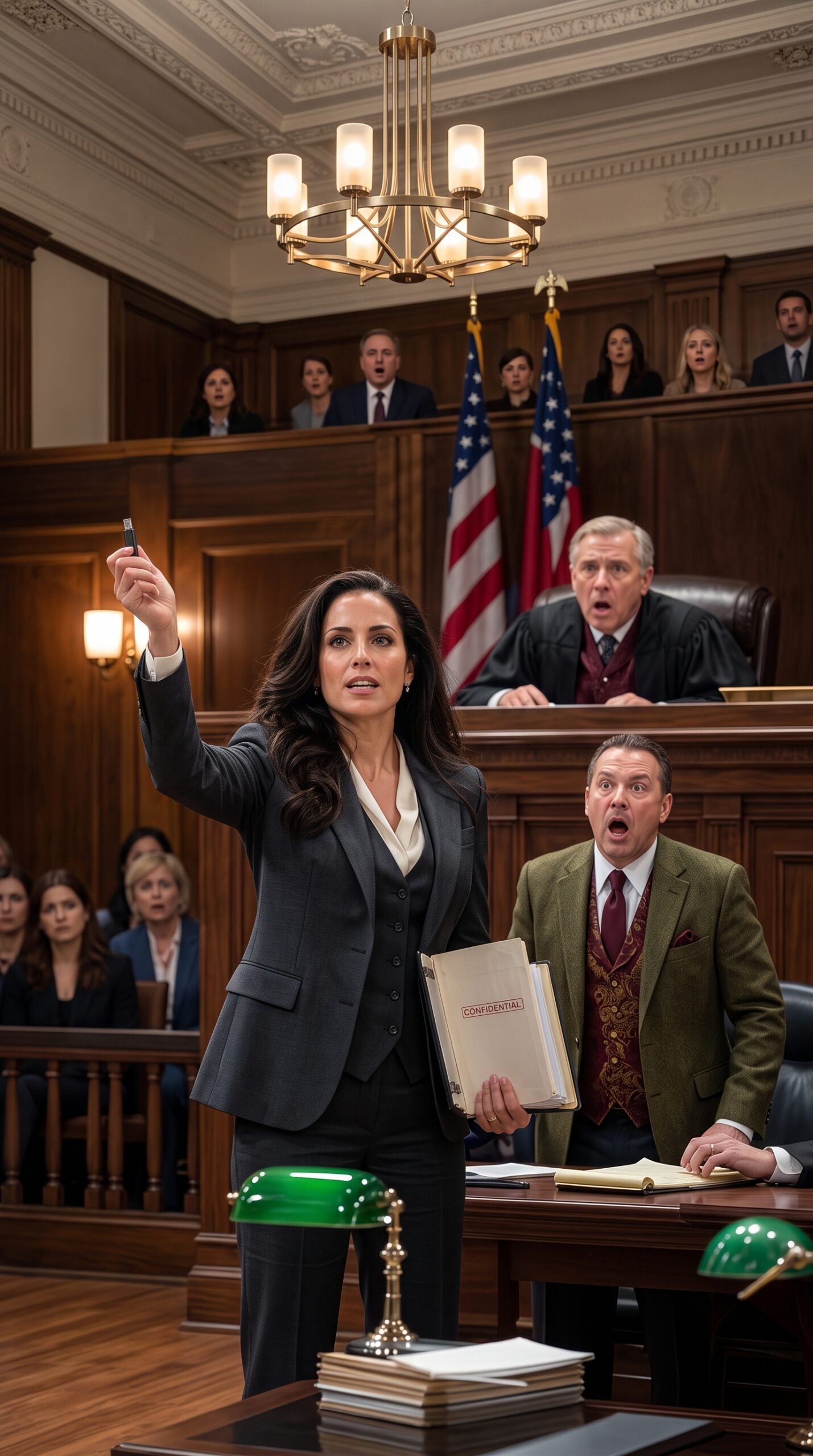
Mariana's lawyer arrived 20 minutes later. Her name was Lucía Esquivel, a woman in a navy blue suit with a firm gaze. She brought printed copies of the messages Mariana had sent to her uncle over the months.
“He doesn’t let me go out alone.”
“He says my salary now belongs to the house.”
“He took my card.”
“His father told me that a pregnant woman doesn’t report because no one believes her.”
“If something happens to me, it was Emiliano.”
Emiliano turned pale when he read them.
—That was taken out of context.
But the second surprise came when Lucía played an audio.
It was Emiliano's voice, recorded the night before.
“If that kid is born and you give him another name, I swear you’ll learn the hard way. My dad raised my mom like this, and look, she never left.”
The room fell silent.
Even one of the nurses covered her mouth.
Octavio closed his eyes, not from shame, but from rage. Because the recording not only incriminated Emiliano. It also exposed the poison he had sown in his own home.
But the strongest twist didn’t come from Mariana.
It came from Emiliano's mother.
Doña Teresa appeared at the hospital door with dark glasses and a plastic bag full of documents. No one had called her. She had arrived because a nurse, a friend of her niece, had alerted her that her son was being detained.
Emiliano smiled slightly when he saw her.
—Mom, tell them this is an exaggeration.
Teresa took off her glasses.
She had an old bruise beneath her left eye.
—No, son —she said in a broken voice—. Not anymore.
Octavio looked at her as if he wanted to pierce her.
—Teresa, don’t you dare.
She entered slowly and placed the bag on Mariana's bed.
Inside were photographs, old medical reports, unratified complaints, and a handwritten letter.
—I’m sorry, Mariana —Teresa said—. I saw how my son was becoming like his father, and I did nothing. I thought if you stayed quiet, at least you’d survive. How foolish I was.
Mariana didn’t know what to say.
Teresa gently touched the baby's blanket.
—That child won’t grow up believing that hurting a woman is being a man.
Octavio lost control.
—Traitor!
Ramiro barely moved, but it was enough for Octavio to fall silent.
The police escorted Emiliano out of the room. This time he didn’t walk like he owned everything. He walked looking at the floor, with neighbors from other rooms peeking through the doors and murmuring.
The balloon reading “THE BEST DAD” continued to float by the window.
A nurse untied it and threw it in the trash.
In the following days, the case exploded in Puebla. Not out of morbid curiosity, but because someone leaked the story of the woman who reported her husband from the hospital bed with her newborn in her arms.
The Rivas family tried to control the narrative. They said Mariana was unstable, that she was looking for money, that she wanted to destroy a good man.
But then the evidence came out.
The medical photographs.
The audios.
The messages.
Teresa's documents.
And Ramiro's old file on Octavio.
The Prosecutor's Office opened two investigations: one for domestic violence against Emiliano and another for Octavio's hidden businesses. Several “important friends” stopped answering their phones. The workshops were inspected. The accounts were frozen.
Emiliano asked to see Mateo.
Mariana refused until a judge authorized it under supervision.
For the first time, no one called her exaggerated.
Ramiro stayed with her for weeks. He slept in a chair next to the crib, with his hearing aids on the table and his tattooed arm covered again by his brown sweater.
One afternoon, Mariana asked him why he had never told her about Octavio.
Ramiro looked out the window.
—Because I wanted you to live without fear, honey. Not to inherit my wars.
Mariana held Mateo against her chest.
—But you came.
Ramiro smiled sadly.
—I was always going to come.
Months later, Mariana entered the courthouse with her baby in her arms. She had an emotional scar no one could see, but she walked tall. Teresa testified against her husband and son. She cried, yes, but she did not retract.
When the judge issued protection measures, suspension of contact, and a criminal process for Emiliano, Mariana did not celebrate.
She only closed her eyes.
It wasn’t revenge.
It was air.
Outside the courthouse, a reporter asked her what she would say to other women living something similar.
Mariana looked at Mateo, then at Teresa, then at her uncle Ramiro.
—Not to wait for the blow to be worse to ask for help —she said—. And that when a family protects the aggressor to “save face,” they also become guilty.
That night, the publication went viral.
Thousands of women shared their own stories. Others defended Emiliano, saying that “couple problems are solved at home.” And there the debate ignited.
Because in Mexico, there are still people who confuse family with silence.
But Mariana learned something she never forgot:
Love doesn’t choke.
Love doesn’t threaten.
Love doesn’t demand obedience.
And if a man needs to destroy a woman to feel like the head of his house, then he’s not the head of anything.
He’s just another coward waiting for no one to close the curtain.