PART 1
The train's whistle sliced through the sunset as if the sky had shattered in two.
Miguel Hernández, a widowed farmer of 43, was making his way back to his adobe house on the outskirts of Dolores Hidalgo, Guanajuato, walking alongside the old tracks that cut through the cornfields.
He was not a man of conflict.
Since his wife passed away three years prior, Miguel had known only to work the land, tend to his chickens, and await calls from Sofía, his 12-year-old daughter, who studied in León and lived with her grandparents during the week.
But that afternoon, the peaceful life he had defended so fiercely crumbled into pieces.
First, he heard a scream.
Not an animal.
Not the wind.
It was a woman calling for help with a desperation that froze his blood.
Miguel dropped the bag of tools and ran.
Stones dug into his boots, dust burned his throat, and the train's whistle grew closer.
When he rounded the bend, he was left breathless.
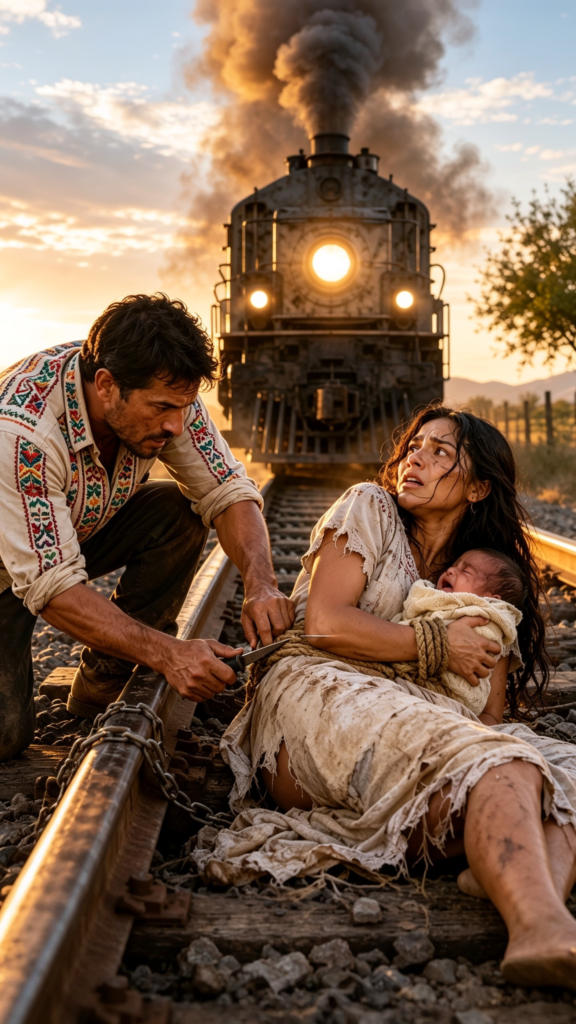
On the tracks lay a young woman bound.
Her wrists were tied with thick rope, one ankle shackled to rusted metal, and her dress was shredded from struggling.
But that wasn’t the worst of it.
Clutched to her chest, wrapped in a dirty blanket, was a baby crying softly, as if she no longer had the strength to live.
“Oh God!” Miguel shouted.
He knelt beside her and drew the knife he always carried at his belt.
The woman opened her eyes just enough to see.
“My girl... please... save my girl...”
Miguel cut through the first rope.
The train was now visible in the distance, enormous, black, roaring like a beast.
The tracks vibrated beneath his knees.
“Hold on, girl. Just hold on a little longer.”
The rope gave way.
Then the chain.
Miguel pulled the woman with one arm and shrouded the baby with the other. They rolled onto the gravel just as the train thundered past them in a brutal cacophony.
For several seconds, no one spoke.
Only the weak cries of the baby and Miguel's shattered breathing filled the air.
The woman embraced her daughter as if pulling her back from the other world.
“Thank you…” she whispered.
Miguel looked into her eyes and understood something.
That woman was not merely afraid.
She held a secret capable of destroying someone very powerful.
He took her to his home, where Doña Carmen, his 70-year-old neighbor, nearly dropped her cane upon seeing the marks on her wrists.
“Who did this to you, daughter?”
The young woman trembled.
“If I say his name, he’ll kill us all.”
At that moment, a black truck appeared in front of Miguel's house.
No one could believe what was about to happen…
PART 2
The truck halted, kicking up dust in front of Miguel’s rusty gate.
It was not normal for such a vehicle to drive down that dirt road.
In that area, only tractors, old trucks, and sweet bread vendors passed by in the morning.
Three men dressed in black emerged from the truck.
They didn’t look like police.
Nor did they seem lost.
One of them walked to the door and knocked twice, sharply, firmly, as if the house already belonged to him.
Miguel signaled to Doña Carmen to hide the young woman and the baby in the back room.
Then he stepped outside.
“Good afternoon,” said the man, removing his sunglasses. “We’re looking for a woman.”
He pulled out a folded photograph.
It was the same young woman Miguel had just rescued.
“I don’t know her,” Miguel replied.
The man smiled.
“Look, Mr. Miguel, we’re not here to cause trouble. We just want to spare you from problems.”
Miguel felt a blow to his chest.
“How do you know my name?”
The man moved closer.
“We know many things. We know you live alone. We know your daughter’s name is Sofía. We know she’s 12 and studies in León. A real pretty girl, by the way.”
Miguel clenched his fists.
“Don’t speak about my daughter again.”
“Then don’t get involved in matters that aren’t yours.”
The man left a white card on a flower pot.
It had no name.
Just a phone number.
“If you remember anything, call. If you don’t, we’ll understand that you prefer to learn the hard way.”
The three men got back into the truck and drove away.
Miguel stood frozen until the dust settled.
When he entered, the young woman was standing, pale, cradling her baby.
“I told you,” she murmured. “They came. They’ll be back.”
“Who are they?”
She took her time answering.
“People from Eduardo Salvatierra.”
Doña Carmen crossed herself.
That name was known all over Guanajuato.
Eduardo Salvatierra owned gas stations, warehouses, lands, and even sponsored political campaigns. He appeared in photos with mayors, businessmen, and deputies.
In public, he was a family man.
In private, according to the terrified eyes of that woman, he was something else entirely.
“My name is Valeria,” she finally said. “And my baby’s name is Emma.”
Miguel offered her water.
Valeria drank, her hands trembling.
Then she began to recount what she had swallowed alone for weeks.
She had worked as a nursing aide in a private clinic in León. There, she met Eduardo when he brought his mother for an appointment.
He was attentive.
Polite.
He spoke sweetly to her.
He sent her flowers.
He told her his marriage was dead, that he only lived with his wife for the kids, that he would soon divorce.
Valeria, who came from a humble family in Silao, believed his words.
“I fell in love like a fool,” she said, wiping away tears. “I really thought he was a good man.”
When she became pregnant, Eduardo changed.
First, he stopped answering.
Then, he blocked her number.
And when Valeria went to find him at his residence in a private neighborhood, she discovered the whole truth.
Eduardo was not separated.
He had no intention of getting a divorce.
His wife organized charity events, and his kids attended expensive schools.
Valeria didn’t ask for a house.
She didn’t ask for a last name.
She didn’t ask for millions.
She only wanted Eduardo to acknowledge Emma and stop threatening them.
But Eduardo was unwilling to tarnish his image.
Days later, two men intercepted her outside her apartment.
They offered her 400,000 pesos to disappear.
“With that, you can start anew wherever you want, gorgeous,” they said. “But if you refuse, the boss will get angry.”
Valeria refused.
Then the hell began.
They slashed her tires.
They broke into her room.
They left a photo of Emma sleeping on her pillow.
One night, she received a call.
“Little girls stop crying when they stop breathing.”
Doña Carmen let out a sob.
Miguel felt anger rise from his stomach.
“Did you go to the police?”
Valeria let out a bitter laugh.
“I went twice. The first time they told me they couldn’t do anything without proof. The second time, a commander advised me to take the money. He said: ‘It’s not worth it to get involved with that family, little girl.’”
Miguel lowered his gaze.
He knew that kind of fear.
The fear of the poor when the rich feel entitled to the law.
“Yesterday they put me in a truck,” Valeria continued. “They beat me. They took me to a warehouse. I heard one say on the phone: ‘Make it look like an accident. The train does the clean work.’”
She hugged Emma tighter.
“When I woke up, I was on the tracks.”
Miguel said nothing for a while.
Then he stood up.
“Tomorrow we’re going to León.”
Valeria shook her head in desperation.
“You don’t understand. Eduardo buys police, buys lawyers, buys anyone.”
“Then we won’t go with just anyone.”
Doña Carmen looked at Miguel in surprise.
“And with whom, son?”
Miguel took a deep breath.
“With someone who owed my wife a favor.”
The next morning, before the sun rose, Miguel took Valeria, Emma, and Doña Carmen in his old truck.
They didn’t go to the local police station.
They didn’t go to just any public prosecutor.
They went to a specialized prosecutor's office for violence against women in León, where Mariana Ríos worked, a lawyer who years ago had been helped by Miguel's wife during a rural health campaign.
Mariana received them seriously.
At first, she listened in silence.
But when Valeria recounted the track incident, her expression changed.
“I need proof,” she said. “Something solid. Something they can’t make disappear.”
Valeria reached into the frayed hem of her dress.
From there, she pulled out a small USB drive, wrapped in plastic.
“I hid it before they grabbed me.”
Miguel looked at her in surprise.
“What’s on it?”
Valeria swallowed hard.
“The truth.”
Mariana plugged the USB into a computer.
The video appeared.
Eduardo Salvatierra was seen in an elegant office, a glass of whiskey in hand.
Before him stood the two men who had threatened Valeria.
The voice was clear.
“I don’t want scandals. The woman and the child disappear today. If a body appears on the tracks, no one asks questions. Are we clear?”
One of the men asked:
“And what if someone sees her?”
Eduardo replied without blinking:
“Then that gets taken care of too.”
Doña Carmen covered her mouth.
Valeria closed her eyes.
Miguel felt nausea.
But the video didn’t stop there.
The recording continued, and a woman entered the office.
Elegant.
With expensive jewelry.
It was Paulina, Eduardo’s wife.
Valeria paled.
“It can’t be…”
Paulina left an envelope on the desk.
“Here are the photos of the baby. I’ve confirmed she is indeed your daughter.”
Eduardo became irate.
“I told you I would handle it.”
Paulina coldly replied:
“No, Eduardo. You created the problem. I’m going to clean up the shame.”
At that moment, everyone understood the real twist.
Not only had Eduardo ordered Valeria silenced.
His wife also knew about Emma.
And far from protecting an innocent baby, she had helped turn her into a burden.
Mariana paused the video.
“With this, not only he falls. The entire network falls.”
Within 24 hours, an operation was set in motion.
The prosecutor’s office requested state support due to the risk of flight and local complicity.
That night, Eduardo Salvatierra was at a private dinner in his home, surrounded by businessmen and politicians, toasting to a new gas station.
When the door knocked, he was irritated.
“Who interrupts at this hour?”
Upon opening, he saw armed agents.
“Eduardo Salvatierra, you are under arrest for attempted feminicide, threats, and criminal association, among other charges.”
Eduardo attempted to laugh.
“Do you know who I am?”
Mariana appeared behind the agents.
“Yes. That’s why we come with a federal order and cameras rolling.”
Then Eduardo spotted Valeria in the back, holding Emma in her arms.
His face drained of color.
“You should be dead.”
That comment was recorded by everyone.
Paulina rushed down the stairs, screaming it was an injustice.
But when the agents showed her part of the video, she froze.
“I just wanted to protect my family,” she said.
Valeria looked at her with sadness that weighed heavier than the anger.
“And my daughter, what was she? Trash?”
Paulina didn’t respond.
For the first time, there was not enough money to buy silence.
Neighbors came out to record.
Guests hid away.
Politicians erased photos from their social media that same night.
The news exploded throughout Guanajuato.
“Businessman arrested for attempting to murder a nurse and her baby.”
But for Miguel, what hit hardest was not seeing Eduardo in handcuffs.
It was hearing Valeria declare without looking down.
She recounted everything.
The threats.
The money.
The warehouse.
The tracks.
And when she was asked who had saved her, she turned to Miguel.
“A man who had no obligation to intervene. But he had more courage than all those who were supposed to help.”
Miguel lowered his gaze, his eyes filled with tears.
For years, he had thought that since his wife’s death, his life was merely about enduring.
Working.
Keeping quiet.
Surviving.
But that afternoon, as he ran toward the tracks, something inside him had awakened.
The case continued for months.
The two men from the truck confessed in exchange for reduced sentences.
One declared that Eduardo paid 250,000 pesos to make the “problem disappear.”
The other handed over messages where Paulina asked that there be no mistakes.
The commander who advised Valeria to accept money also fell.
The clinic where she worked supported her publicly, and several women began to report other abuses by influential men who believed themselves untouchable.
Valeria did not return to León.
With Mariana's help, she secured protection, psychological treatment, and a job at a community clinic near Dolores Hidalgo.
Doña Carmen became like a grandmother to Emma.
Sofía, Miguel’s daughter, carefully carried her when she visited on weekends.
And Miguel began to repair a vacant room in his house so Valeria and the baby wouldn’t have to keep sleeping in the living room.
One afternoon, six months later, Valeria found Miguel sitting on the porch, watching the train pass in the distance.
The sound no longer seemed a threat.
It felt like a defeated memory.
“Sometimes I dream that I’m still tied there,” she confessed.
Miguel didn’t interrupt.
“But then I wake up and Emma is breathing beside me. And I remember someone did come.”
Miguel smiled sadly.
“I thought I was no longer capable of saving anyone.”
Valeria took his hand.
“You saved two lives, Miguel.”
He looked over the sunlit field.
“No. You all saved mine too.”
In the distance, the train whistled again.
Emma let out a giggle in Doña Carmen’s arms.
And for the first time in years, Miguel’s house didn’t feel empty.
But the question lingered in the town, on social media, and at every table where someone read the story:
How many women aren’t saved because fear weighs more than justice?
And how many powerful people remain free because no one dares to run toward the cry before the train passes?