PART 1
Alejandro Santillán didn't need to shout for the Veracruz boardwalk to fall silent.
All it took was raising one hand, clenching his jaw, and looking at his two bodyguards with those cold eyes everyone knew too well. Around him, the vendors of elotes continued their shouts, balloons danced in the salty air, and children ran near the sea.
But for him, everything turned off in an instant.
Diego, his seven-year-old son, had vanished.
—Find him. Now.
Bruno, his trusted man, swallowed hard. He had worked for Santillán for years and knew that when the boss spoke softly, something grave was about to happen.
Alejandro was not just any desperate father. In Veracruz, everyone knew who he was, although few dared to say his full name. Owner of warehouses, transport companies, and restaurants on the outside; head of shady businesses on the inside. For twelve years, he had ruled the port as if the streets, the docks, and even fear itself belonged to him.
But Diego was his only weakness.
Since Valeria, the boy's mother, had died two years ago in an attack aimed at him, Alejandro had turned his son's life into an elegant prison. Huge house, cameras, bodyguards, tutors, expensive toys, private doctors.
Everything, except freedom.
They checked the bathrooms. The playground. The carousel. The ice cream stands. The parking lot. Every second felt like a stone dropping into Alejandro's chest.
Then he saw him.
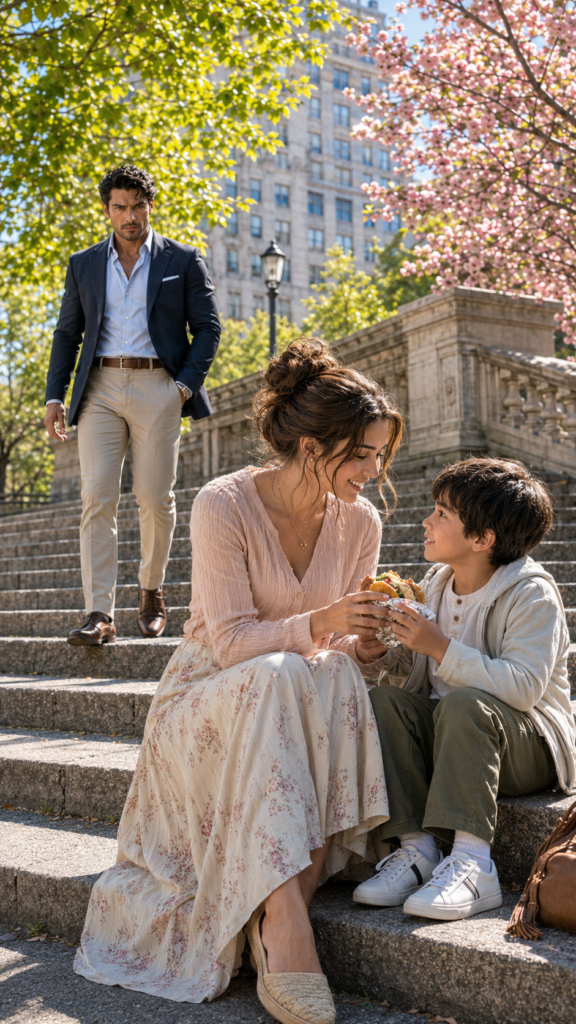
Diego was sitting on a stone staircase, away from the noise, next to an unknown woman. He wasn’t crying. He didn't seem scared. He held half a hamburger wrapped in a napkin in his hands.
The woman wore worn-out sneakers, a denim jacket, and her hair tied back carelessly. She looked tired, but there was a firm sweetness on her face. She tore her own food in half and offered the other half to the boy.
—Here, sweetheart. You look hungry.
Diego looked at her with a trust Alejandro hadn’t seen in a long time.
Mariana Cruz didn’t know who that boy was. She had arrived from Xalapa three months ago with her five-year-old daughter, Sofía, a broken suitcase, and a life full of bills to pay. In the morning, she cleaned offices. At night, she served tables in a small eatery.
To her, Diego was just a rich boy who looked too sad.
—Are you lost? —she asked.
—No —Diego replied—. I just hid a little. They always follow me. To school, to the bathroom, to the park. My dad buys everything, but he’s never there.
Alejandro felt those words slice open his chest.
Mariana didn’t judge him.
—Sometimes adults think caring means locking you up. But a child also needs someone to sit with him, even if it’s just to share half a hamburger.
Diego smiled.
Alejandro stepped forward.
—Dad…
Mariana jumped to her feet.
—Sir, I’m sorry. I didn’t know he was your son. I just saw him alone and thought that…
Alejandro pulled out a bundle of bills.
—Thank you. Here, take this.
Mariana looked at the money and shook her head.
—No, sir. I shared because I wanted to. If I charge, it’s not kindness anymore. It’s business.
Bruno's eyes widened. No one rejected Santillán.
Mariana grabbed her old bag and walked toward the bus stop.
That night, Diego repeated her name six times before falling asleep.
And Alejandro, unaware that someone close was watching him with envy, called Bruno.
—Find out everything about Mariana Cruz. But don’t let anyone touch her.
Bruno lowered his gaze, hiding a strange smile, because no one could believe what was about to happen.
PART 2
The report arrived two days later, inside a cream-colored folder.
Mariana Cruz, 28 years old. Single mother. Five-year-old daughter named Sofía. No criminal record. No debts with anyone dangerous. No partner. No protection. Lived in a small room behind an old tenement in the Centro neighborhood, where the walls sweated humidity and the roof leaked during heavy rains.
She worked cleaning offices from 6 AM to 1 PM. Afterward, she hurried to pick up Sofía from a neighbor and entered Doña Licha's eatery until nearly midnight.
Still, she sent money to Xalapa for her mother’s medications.
Alejandro read those pages more than once.
He expected to find a trap, a lie, a hidden connection. Something that would justify his distrust. But there was nothing.
Just a poor woman who had given half of her dinner to a child she didn’t even know.
That same night, Alejandro appeared at the eatery.
He didn’t enter with all his bodyguards. He left them outside, next to the black truck. For the first time in years, he understood that his mere presence could fill a place with fear.
Mariana came out of the kitchen with a stained apron, splattered with sauce and coffee. When she saw him, she froze.
—You’re Diego’s dad.
—Yes.
—If you’re here to offer me money again, you can save your breath.
Alejandro took a deep breath.
—I'm not here to pay you. I came to thank you properly.
—Consider it done.
He lowered his voice a bit.
—Diego can’t stop talking about you. I want to invite you to lunch. You and your daughter. In a public place, during the day, with people around. You choose where.
Mariana studied him with distrust. There was something hard about this man, something that smelled of danger. But there was also something broken when he mentioned his son.
—One meal —she said—. I’ll bring Sofía. If I feel uncomfortable, I’ll leave.
—Deal.
On Sunday, they met at a family restaurant in Boca del Río. There were children running around, waiters carrying trays, and the smell of fried fish. Sofía arrived with a shoeless doll, hidden behind her mother’s legs.
Diego, who lived surrounded by imported toys, offered her a box of crayons as if it were the most important gift in the world.
—Want to draw sea monsters? —he asked.
Sofía looked at him seriously.
—Only if mine can have three heads and eat enchiladas.
Diego burst into laughter.
Alejandro stood frozen.
He hadn’t heard that laugh since before Valeria’s death.
Mariana noticed and spoke softly.
—Kids don’t remember how much their toys cost. They remember who sat on the floor to play with them.
That phrase hit harder than any threat.
From that day on, Alejandro tried to change.
He arrived home early. Burned pancakes. Learned to make chocolate milk without lumps. Sat on the carpet to assemble puzzles. Read stories with silly voices that made Diego laugh until he cried.
One night, sitting on the edge of his bed, he apologized.
—I thought giving you everything was caring. The truth, son, I was leaving you alone.
Diego hugged him around the neck.
—I didn’t want more toys, Dad. I wanted you to have dinner with me.
Alejandro closed his eyes because there was no greater punishment than hearing the truth in a child’s voice.
But peace didn’t last long.
One afternoon, Mariana left the eatery with a bag of bread for Sofía. She was walking toward the bus stop when Doña Licha caught up with her and grabbed her arm.
—Honey, do you know who you’re talking to?
Mariana followed her gaze.
Alejandro was getting out of a black truck. The street changed abruptly. A vendor stopped shouting his offers. A traffic cop looked the other way. Two men who had been smoking left without finishing their cigarettes.
—It’s Santillán —whispered Doña Licha—. The one from the port. The one who decides who works, who pays, and who disappears. Stay away, for your girl’s sake.
Mariana’s blood ran cold.
That night she didn’t answer calls. The next day she changed her route. When Diego saw her from the car and waved excitedly, she hugged Sofía and walked faster.
The boy's face fell.
Alejandro understood she already knew.
He went looking for her alone, without bodyguards, without a truck parked in front of the door. Mariana barely opened a crack.
—I know who you are —she said—. And I have a daughter to protect.
—I know.
—Then don’t come back.
Alejandro held her gaze but didn’t try to impose himself.
—I didn’t come to ask for your trust. I came to tell you the truth.
Mariana wanted to shut the door, but something in his voice stopped her.
He told her about Valeria, his wife. About the night an enemy ordered a shooting against his truck to punish him. About how Diego saw blood, screams, and red lights before turning six. About how Alejandro, instead of healing with his son, chose to lock him behind walls, believing that this way no one would ever touch him again.
—I became what everyone fears —he said—. And I thought that kept him alive.
Mariana had tears in her eyes, but she didn’t lower her guard.
—I’m scared of you, Alejandro. But I also saw how you look at your son when he smiles.
He nodded.
—I’m not a good man. But I want to stop being this man.
Mariana slowly closed the door.
She didn’t know Bruno was hiding around the corner, listening to every word.
Bruno had served Santillán for years. He had gained money, power, respect. But if Alejandro left the dark business, he would have nothing. To Bruno, Mariana wasn’t a good woman. She was a threat.
That night, he sold the information to Óscar Varela, known at the port as El Chacal.
—The boss has a weakness —Bruno said over the phone—. Her name is Mariana Cruz. And she has a girl.
On Friday, Mariana left the eatery late. She carried two bolillos, some change for tips, and a drawing that Sofía had made for her on a napkin.
The alley was almost empty.
A white truck cut her off.
—Miss Mariana —said a tall man—. Our boss wants to talk.
She stepped back.
—I don’t know any boss.
The man smiled.
—But we know Sofía.
Mariana stopped breathing.
They took her phone, her bag, and forced her inside.
The call reached Alejandro before midnight.
—Santillán —said Varela's voice—. I found you, sweetheart. Come alone to the old dock, or the hamburger lady doesn’t come back.
Alejandro didn’t shout. He didn’t break anything. He just looked at Bruno.
And then he saw the mistake.
Bruno was pale before anyone mentioned the place.
—You did this —Alejandro said.
Bruno tried to deny it, but a bodyguard took his phone away. There were the messages, the shared location, and three recent deposits.
—For money? —Alejandro asked.
Bruno let out a bitter laugh.
—For survival, boss. A poor waitress was making you good. And good men don’t rule the port.
Alejandro looked at him with a sadness full of disgust.
—I wasn’t becoming good. I was being reminded that I could still choose.
That night, Alejandro did something no one expected.
He didn’t go to the dock alone.
He called the ministerial police, the Navy, and a prosecutor who had been wanting to take down Varela for years. He handed over locations, names, routes, accounts, and warehouses. Everything he had kept as a lifeline for twelve years.
—If I’m going to fall —he said—, I’m going to fall cleaning my son’s path.
At the old dock, Varela awaited a desperate man. He received patrols, sailors, and a search warrant. His men ran like rats. Some dropped their weapons. Others tried to negotiate.
Mariana was tied to a chair inside a warehouse, pale, with a dry mouth and marked wrists. When Alejandro knelt in front of her and untied the rope, she didn’t see the boss of the port.
She saw a broken father.
—Sofía… —she whispered.
—She’s safe with Doña Licha. So is Diego.
Mariana broke into tears.
Alejandro didn’t touch her until she held onto his arm to get up.
Bruno was arrested that same night. Varela too. And before dawn, Alejandro testified for six hours at the Prosecutor’s Office. He handed over evidence against his enemies and against his own businesses. He didn’t ask for special treatment. He didn’t ask for applause. He only asked that they protect the children.
The news exploded in Veracruz.
The most feared man at the port had toppled his own empire for a woman who shared half a hamburger with his son.
But the moment that broke everyone’s heart happened outside the Prosecutor’s Office.
Mariana emerged wrapped in a blanket. Sofía ran to her crying. Behind came Diego, with red eyes, trembling as if he were afraid to approach.
—I’m sorry —the boy said—. It’s my fault they hurt you.
Mariana knelt and hugged him.
—No, sweetheart. You’re not to blame for adults’ wickedness.
Diego buried his face in her neck.
—I thought I was going to lose my mom too.
Silence fell heavily.
Sofía hugged Mariana from one side. Diego from the other. Mariana didn’t correct the boy. Not because she wanted to erase Valeria, but because she understood that sometimes the word mom doesn’t come from blood, but from the place where a child finds refuge.
Alejandro broke down right there.
The man who had made others look down for years cried in front of police, reporters, and strangers.
Months later, he sold his tainted properties, closed routes, handed over warehouses, and opened a legal transport company. He also funded a community kitchen near the market where Mariana had worked so many nights.
She didn’t forgive him immediately.
She demanded therapy for Diego, real security for Sofía, and a life without shadows. She made it clear she didn’t want stories of a repentant prince or pretty promises.
—Changes aren’t just talked about, Alejandro. They’re upheld —she warned him.
And he accepted.
Six months later, on the same stairs of the boardwalk, Mariana pulled out a bag of simple hamburgers. Sofía and Diego ran, watching the boats, inventing strange names for the seagulls.
Alejandro sat down beside her without visible bodyguards, without an expensive watch, without that untouchable man’s gaze.
Mariana split a hamburger in two and gave half to Diego.
The boy smiled just like that first afternoon.
Alejandro looked at the sea and understood that true wealth had never been in the docks, nor in the black trucks, nor in the men who feared him.
It was in a poor woman who didn’t sell her kindness, in two children who deserved to grow up without terror, and in a truth that bothers many: sometimes, those who seem to have nothing are the ones who end up saving it all.