PART 1
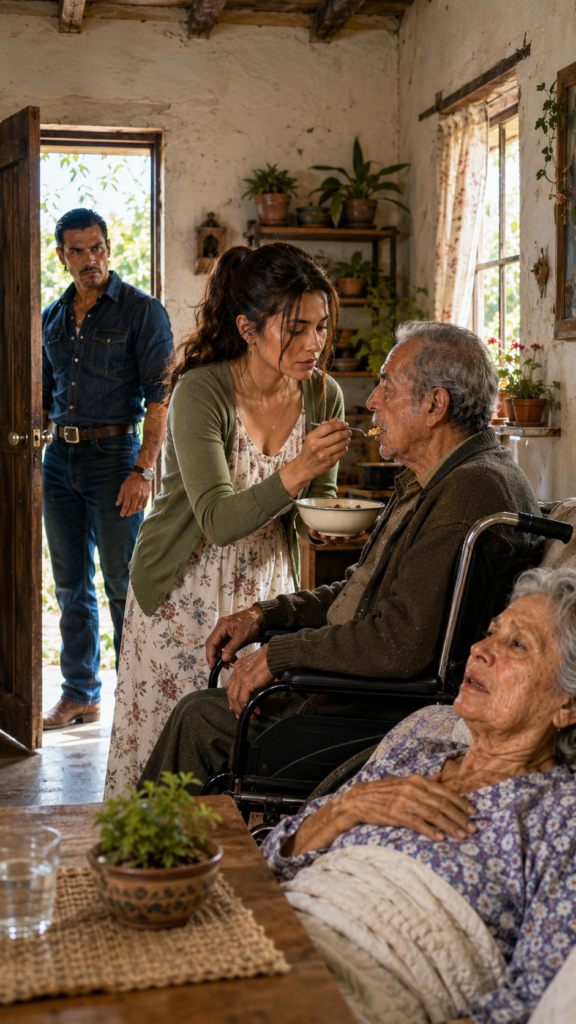
Emiliano Rivas felt his chest close up as he opened the door to his parents' house and found a stranger feeding Don Julián as if she had been doing it her entire life.
She wasn't a nurse. No uniform, no badge. Just a woman around 27 years old, hair tied back, muddy sneakers, and a worn blue jacket that smelled of rain and laundry soap.
In the kitchen of that old house in the Portales neighborhood, steam rose from the pot on the stove. Doña Ofelia, his mother, nervously folded overdue bills. In a small chair, a six-year-old boy was drawing an axolotl with an orange crayon.
Emiliano hadn’t visited his parents in seven months, always caught up in a contract, a debt, or an “urgent” problem with his private security company. But seeing the spoon in the woman’s hand stirred something deeper than anger: shame.
—Who are you? —he asked, his tone sharp.
The woman didn’t drop the spoon.
—Marisol. I live at 32. Your dad isn’t finished yet.
—I asked what you’re doing in my house.
—Preventing him from drowning in soup, sir.
Don Julián barely opened his eyes. Half of his body no longer obeyed him since the stroke. Yet he lifted his chin.
—Don’t talk to him like that, Emiliano. She’s been here more than you have.
The words fell like a stone.
Doña Ofelia lowered her gaze. The boy stopped coloring. Marisol took a small step, positioning herself between the boy and Emiliano, like a mother who already knows the danger before it knocks on the door.
—The agency stopped sending caregivers since November —Doña Ofelia said—. They said there was no staff for this area.
Emiliano clenched his jaw.
He paid 68,000 pesos a month for 24-hour care.
He walked to the refrigerator. It held vegetables, unsweetened milk, tortillas, shredded chicken, and medications neatly organized with colored tape.
—Who bought all this?
—Marisol helps us when she can —Doña Ofelia whispered.
—I don’t help —she corrected—. I just buy when I can. Then your mom gives me what she can spare.
Emiliano left six 500-peso bills on the table.
—Don’t come back. Tomorrow there will be a nurse.
Marisol took only one bill.
—It was 284 pesos. I’ll leave change when I have coins. And don’t talk to me like you’re buying me, because I really won’t allow it.
Emiliano wasn’t used to someone speaking to him like that.
Then, from the street, a loud bang resonated against the building door, and a drunken voice shouted:
—Marisol! I heard you’re getting money from a rich guy! Open up, it’s my turn too!
The boy dropped his crayon and started to cry.
Emiliano watched as Marisol’s face drained of color, and no one could believe what was about to happen…
PART 2
The bang sounded again, louder, as if the old door was going to break in two.
Marisol took the boy by the hand.
—Leo, go with Doña Ofelia to the room. Now.
The boy obeyed without question.
—Who’s outside? —he asked.
—No one you should care about.
—If he’s kicking my parents’ door, I care.
Marisol tried to pass, but Emiliano stood in front of the hall.
—You don’t have to go out alone.
She let out a bitter laugh.
—Then they charge for the favor.
Emiliano opened the door.
Outside stood Víctor Rangel, Marisol’s ex-husband. His shirt was unbuttoned, his eyes bloodshot, and a crooked smile on his face. In one hand, he held a bottle; in the other, the pink receipt of a rent debt.
—Hey —Víctor said—. And who’s this suited guy? Your new bank?
Emiliano didn’t raise his voice.
—Back off.
Víctor laughed.
—It’s family business, dude. She’s my wife.
Marisol appeared behind him, pale but firm.
—I stopped being your wife when you abandoned me with Leo sick and took even the blender.
Víctor pointed at her.
—Rogelio said someone paid 22,400 pesos of your rent. If you have a benefactor, I have rights too.
Don Julián banged his good hand on the table.
—That man doesn’t enter.
Emiliano stared at Víctor without blinking.
—Tomorrow at 9:00, I want to see you at the family court on Niños Héroes.
Víctor blinked.
—What?
—Child support. Abandonment. Threats. And the hospital debt you put in her name.
The ex-husband stopped laughing.
Marisol also froze.
—How do you know that?
Emiliano didn’t know yet. But he had learned that cowards always hide papers.
—Because I’ll know everything before dawn —he said.
That night, Emiliano didn’t sleep.
He ordered a review of the agency payments and debts in Marisol’s name. At 3:17, he received three folders that twisted his stomach.
The first stated that Marisol worked from 10 PM to 6 AM washing hospital uniforms for 10,200 pesos a month. She slept four hours, took Leo to elementary school, and still stopped by Don Julián and Doña Ofelia’s house.
The second contained the truth about Víctor: he owed 94,800 pesos in back child support, 31,600 for medical expenses due to Leo’s severe bronchitis, and 12,000 from a loan he took out using Marisol’s ID.
The third was the worst.
For seven months, someone from his own family had collected the 68,000 pesos a month from the agency. The signatures of “service received” weren’t from Doña Ofelia. They were from his sister Ximena.
490,000 pesos.
Ximena had bought a used truck and paid for a trip to Cancún with the money meant for caring for their parents.
The next morning, Emiliano gathered everyone in the Portales house. Ximena arrived, perfume wafting, wearing dark glasses on her head, along with her husband, two cousins, and an aunt who always defended “the blood.” Marisol didn’t want to be there, but Doña Ofelia took her hand.
—You’re staying, daughter. This house didn’t save itself.
Ximena entered, her perfume thick in the air.
—Oh, please. Is the neighbor a saint now? She probably saw my brother has money and stuck to him like gum.
—I won’t put up with insults —Marisol said.
—Then don’t meddle in other families —spat Ximena—. My mom doesn’t need handouts from a laundress.
Then Don Julián spoke slowly, scraping each word.
—Your mother needed soup, Ximena. She needed the gas turned off. She needed someone to clean me up when I soiled myself. And you only needed my signature to steal.
The room fell silent.
—I managed! Emiliano never came.
Emiliano connected his phone to the television. Marisol appeared carrying bags in the rain, turning off the open stove, lifting Don Julián off the floor with a neighbor's help, and leaving at dawn with Leo asleep in her arms.
Then Ximena appeared, entering just once, taking photos of receipts, and storing envelopes.
—Here are the fake invoices —Emiliano said—. Here are the transfers. Here’s the signature you forged from mom. And here’s the call where you say: “As long as my brother pays, let the old folks manage.”
Ximena lost strength in her legs.
—Emiliano, I’m your sister.
—They are your parents.
Doña Ofelia looked at her daughter with a pain so pure that she didn’t need to scream.
—I gave birth to you —she whispered—. Did we really mean less than some vacation?
Emiliano left two documents on the table.
—You will return every peso. Today you will sign an agreement. If not, tomorrow it goes to the Public Prosecutor’s office.
—You’re going to report me for a stranger.
—No. I’m going to report you for our parents.
Marisol wanted to leave, but Leo came out of the room with his drawing. On the page, Don Julián was sitting, Doña Ofelia had impossible braids, and Marisol held a huge pot. In one corner was a man in a black shirt with a bag of bread.
—Mom —Leo said—, has the man who was shouting left?
Emiliano closed his eyes.
That same day, the lawyer filed the lawsuit against Víctor. The ex-husband arrived at the courthouse thinking he would mock, but found 14 pages of debt, threatening messages, hospital receipts, and a provisional order to withhold his salary wherever he worked.
Víctor laughed at first.
—I don’t even have a job.
The lawyer showed him another paper.
—Yes, you do. You get paid in cash at a motorcycle workshop in Tlalnepantla. There are witnesses already.
The smile fell away.
—Marisol can’t do this to me.
The judge looked at him over her glasses.
—She’s not doing it to you. You did it to yourself for six years.
The final blow came when Víctor tried to claim that Marisol was a “bad mother” for working at night. Doña Ofelia, leaning on her cane, asked to speak.
—If that woman works at night, it’s because a man left. And if during the day she cared for two old people who weren’t hers, imagine how she cares for the child who is.
Marisol covered her mouth to keep from crying.
Víctor left the courthouse with a recognized debt and a warning: if he ever approached the house drunk again, the report for threats would proceed without negotiation.
Emiliano did the only thing he could do without making Marisol anyone’s property.
He canceled the contract with the fraudulent agency. Hired a real caregiver for the mornings. Forced Ximena to sell the truck and deposit the first payment of what she stole. He repaired the gas installation and changed the locks.
He offered Marisol a salary for the hours she wanted to keep helping.
She said no.
—I don’t want to owe my life to anyone.
—It’s not a debt —Emiliano replied—. It’s work.
—I already have a job.
—Then it’s respect.
Marisol looked at him for a long time.
—I’ll accept only three afternoons —she said—. With a contract. No strange favors. No trucks following me. No men at my door.
Emiliano nodded.
—Deal.
Two months passed. The house stopped smelling of dampness and fear. It smelled of coffee, soup, and sweet bread from the corner. Doña Ofelia started watering her pots again. Don Julián remained ill, but he no longer ate alone or stared at the door.
Emiliano began to arrive on Sundays without bodyguards. At first, he would drop off the bags and leave. Then he would stay to wash dishes and learned that his dad hated squash.
One afternoon, Leo finished his drawing of the axolotl. He gave it to Don Julián with a note that said: “For my borrowed grandpa.”
Doña Ofelia cried.
Marisol wanted to correct it, but Don Julián beat her to it.
—You don’t correct what comes from the heart, girl.
That Sunday, Emiliano left an envelope on the table. Marisol tensed.
—we already said no.
—Open it before you fight.
Inside wasn’t money. There was a letter signed by Doña Ofelia and Don Julián. It said Marisol wasn’t a servant, nor interested, nor an intruder. She was the person who had cared for that family when blood became an excuse.
It also said that if anyone tried to tarnish her name, they would be witnesses.
Marisol clutched the letter to her chest.
—This is worth more than any bill —she whispered.
Emiliano looked down.
—I thought paying everything fulfilled my duty.
Doña Ofelia touched his hand.
—No, son. Fulfilling your duty was coming.
That was when Emiliano, the man many feared, cried silently.
Not because of Marisol. Not because of fear of Víctor. He cried because he understood he had left his parents alone in a house full of payments, but empty of children.
And Marisol continued to come three afternoons a week. Not because Emiliano was rich. Not because Víctor had been scared. But because some bonds are formed with hot soup, crayons, timely paid bills, and the courage to not abandon those who can no longer ask for help.
In the end, many neighbors said that Marisol was lucky because a powerful man protected her.
But Doña Ofelia always replied the same:
—No, dear. We were lucky that she didn’t become as cold as the people who hurt her.