PART 1
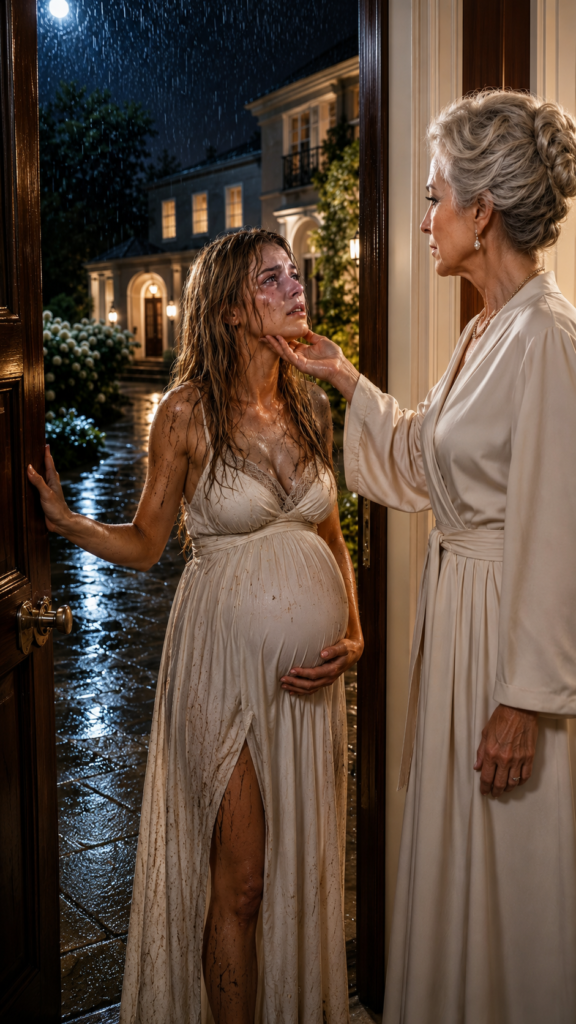
At 12:18 at night, the rain fell so hard on Coyoacán that it seemed determined to uproot the trees.
Victoria Salvatierra was reviewing some documents in her study when she heard three knocks on the door.
These weren’t normal knocks.
They were desperate blows, the kind that don’t ask for permission but scream for help.
When she opened the door, she saw Mariana, her daughter, lying on the floor of the entrance, barefoot, soaked, with a torn dress and both hands pressed against her eight-month belly.
Her cheek was bruised.
Her lips were split.
One knee scraped.
But what froze Victoria’s blood was Mariana’s gaze: she wasn’t looking at her mother, she was staring at the street, as if still waiting for someone to emerge from the darkness to take her away.
—Mom... —she sobbed—. Emiliano said the police work for him.
Victoria immediately knelt and embraced her.
For years, the newspapers had called her “the toughest federal judge in the country.” She had signed orders against businessmen, politicians, and corrupt leaders. She had seen files that would rob anyone of sleep.
But that night, she was not Judge Salvatierra. She was a mother watching her pregnant daughter arrive as if she had just escaped from a prison.
—Is the baby moving? —she asked, trying not to break.
Mariana nodded.
—Yes... but I had to run. He took my phone, locked the gate, and said that if I called anyone, nobody would believe me. That you couldn’t do anything either.
Emiliano Alcázar had entered that family with a magazine smile, expensive suits, and a wedding in San Miguel de Allende that everyone called “perfect.”
A businessman in medical logistics from Guadalajara.
Donor for hospitals.
Friend of commanders, councilors, and prosecutors.
The typical man who publicly helped sick children and privately turned a house in Zapopan into a marble cage.
For two years, Mariana had hidden bruises with makeup.
She had invented falls.
She had stopped answering calls.
She had learned to smile at dinners while her hands trembled beneath the table.
Victoria led her to the sofa, covered her with a blanket, and called a trusted doctor. Then she closed the curtains, turned off the front lights, and checked the security cameras.
Then her phone vibrated.
It was Emiliano.
Return her. She is my wife. My daughter is in her womb. If you hide her, tomorrow you’ll have neither house nor name left.
Victoria read the message twice.
She didn’t scream.
She didn’t cry.
She just remained too still.
Then she walked to her study, opened a safe hidden behind some constitutional law books, and took out a folder sealed with red tape.
Mariana looked at her from the sofa.
—What is that?
Victoria placed the folder on the desk.
—The reason your husband should have stayed quiet tonight.
Mariana didn’t understand.
Victoria approached, tucked Mariana’s wet hair behind her ear, and kissed her forehead.
—Six hours ago, I authorized the federal intervention of the communications of Emiliano Alcázar and several leaders protecting him.
Mariana stopped crying.
Outside, a patrol passed slowly in front of the house.
No siren.
No lights.
Just slowly, as if someone wanted to warn that they already knew where she was.
Then the doorbell rang.
Once.
Then again.
Afterwards, heavy knocks against the door.
—Victoria —said Emiliano’s voice from outside—. Open before this becomes an embarrassment.
Mariana clutched her hands to her belly.
Victoria looked through the peephole.
Emiliano was standing in the rain, smiling, accompanied by two bodyguards and a municipal commander.
And in that moment, Victoria understood he hadn’t come to negotiate.
He had come to take her by force.
PART 2
Victoria opened the door just enough for the chain to stay on.
Emiliano Alcázar stood under the entrance light in a black coat, impeccable shoes, and that arrogant smile he wore when he wanted to seem polite before destroying someone.
Next to him was Commander Rueda, a burly man with a trimmed mustache and a lowered gaze.
Behind them, two black SUVs idled, their tinted windows and engines purring in the early morning.
—My wife is upset —Emiliano said, as if explaining something very simple—. The pregnancy has made her sensitive. I came to take her before she makes another scene.
Victoria looked at the commander.
—And to attend to an upset pregnant woman, you need bodyguards?
Rueda cleared his throat.
—Ma’am, we received a report of a possible emotional crisis. We just want to verify that Mrs. Mariana is okay.
Victoria let out a dry laugh.
—What touching efficiency. I wish you arrived like this when a woman reports abuse.
Emiliano’s smile hardened.
—Don’t misjudge me, Victoria. Mariana is carrying my daughter. She belongs in my home.
The word “belongs” fell like a slap.
From the living room, Mariana whispered:
—Don’t let him in, Mom.
Emiliano heard her.
—Honey, enough —he said with a fake tenderness that was disgusting—. You’re embarrassing yourself. Come with me, and we’ll fix this as a family tomorrow.
Mariana didn’t respond.
Victoria raised her phone.
—Repeat that.
Emiliano moved closer to the crack in the door.
—Record whatever you want. Who do you think they’re going to believe? A hysterical pregnant woman or the man who finances half the city?
That was his first mistake.
The second was thinking he was still talking to a scared mother-in-law.
—I know judges, prosecutors, congressmen, commanders —he continued—. I pay campaigns, donate ambulances, put medications where the government can’t. Important people answer my calls.
Victoria looked at him without blinking.
—Federal judges don’t run campaigns, Emiliano.
For the first time, something shifted in his eyes.
Commander Rueda took half a step back.
—A position doesn’t protect you —Emiliano said, now without a smile.
—No —Victoria replied—. Evidence does.
At that moment, Emiliano’s phone rang.
He stepped back a few meters in the rain, annoyed, believing that the night still belonged to him.
He didn’t know that line had been legally intercepted for weeks.
He didn’t know that the FGR was investigating his companies for money laundering, drug theft, clandestine warehouses, and monthly payments to municipal leaders.
He didn’t know that every threat didn’t vanish into thin air but fell directly into a federal courtroom where agents listened in real-time.
—Don’t stop the trucks —he ordered over the phone—. The old lady just wants to scare me. If they signed something, I would know by now.
Victoria almost felt pity.
Almost.
Through the back door, Doctor Jimena entered, accompanied by an undercover federal agent. They made no noise. They didn’t turn on lights. They moved like those who know a life depends on every second.
Mariana squeezed her mother’s hand.
—Are you going to send me far away?
—I’m going to take you to a place where he can’t touch you —Victoria said—. And I’ll stay here.
—Mom, no. He is capable of anything.
Victoria took her daughter’s face in her hands.
—Honey, for years he made you believe you were alone. Tonight he’s going to find out how many people were waiting for you to speak up.
The doctor quickly checked on Mariana. The baby had a steady heartbeat, but Mariana was dehydrated, in shock, and showing clear signs of violence.
—She has to leave now —Jimena said softly.
At 2:43 AM, Mariana exited through the back door, wrapped in her mother’s oversized jacket, escorted by the federal agent.
Emiliano remained at the main entrance, believing he had her cornered.
At 3:10, Victoria received another message.
Last chance. By dawn, you’ll beg you obeyed.
Victoria didn’t respond.
She forwarded it to the federal prosecutor.
Then she turned off the lights in the living room, sat by the window, and watched the black SUVs wait in the rain.
Emiliano didn’t know his drivers had already been identified.
He didn’t know that four warehouses in Tlajomulco were surrounded.
He didn’t know that a vacation house in Tapalpa had agents waiting for the final order.
But his worst mistake had yet to happen.
It happened at 4:52 AM when he called Commander Rueda and said the phrase that sank him forever.
—If the girl talks, they’ll disappear the mother first.
He didn’t shout.
He didn’t hesitate.
He didn’t sound desperate.
He sounded like someone who had ordered things like that before.
And that phrase changed everything.
What until then was a financial investigation turned into a federal emergency due to a direct threat against a pregnant victim and a judicial authority.
At 6:03 AM, Emiliano entered his corporate office in Puerta de Hierro with a coffee in hand and three bodyguards behind him.
At 6:05, federal agents burst through the glass doors wearing black vests and carrying judicial orders.
At the same time, they raided four warehouses in Tlajomulco, a medical shipping office in Guadalajara, a property in Tapalpa, and the municipal command’s files where Rueda hid false reports.
The city woke up to news exploding everywhere.
Commander Rueda arrested.
Alcázar Logistics seized.
Warehouses with stolen medications located.
Councilman linked to bribery network.
Front companies frozen by the FGR.
Emiliano tried to call the state prosecutor.
No answer.
He called a congressman.
Voicemail.
He called the police chief.
Line disconnected.
He called a businessman who always owed him favors.
The number no longer existed.
For the first time, the man who always found someone to buy didn’t find anyone.
An agent took the phone from his hand.
—You’re under arrest, Mr. Alcázar.
Emiliano let out an incredulous laugh.
—Do you know who I am?
The agent looked at him with no emotion.
—Yes. That’s why we’re here.
Hours later, news reports showed Emiliano handcuffed, still trying to keep his chin up, as if his expensive suit could cover everything leaking from his warehouses.
—It’s a political persecution! —he yelled in front of the cameras—. They’re fabricating everything against me!
Then he saw Victoria on the other side of the street, next to the federal prosecutor.
She wasn’t there as the judge of the case.
As soon as Mariana reached her door, Victoria had informed the family conflict and stepped away from any future decision.
That was the difference between authority and corruption.
Authority submits to the rules.
Corruption only respects them when convenient.
—Did you do this? —Emiliano spat.
Victoria stepped close enough for him to hear her over the cameras, rain, and reporters’ shouts.
—No, Emiliano. You did this. I just signed where the evidence pointed.
He clenched his jaw.
—You will regret this.
The prosecutor raised an eyebrow.
—Thank you for the new threat. That’s also been recorded.
And then Mariana arrived.
She stepped out of a federal truck in flat shoes, a wide coat, and a bare-faced expression.
The bruise on her cheek was visible to everyone.
She walked slowly, one hand on her belly and the other holding a medical folder.
Emiliano paled.
—Mariana, love, don’t do this. You’re confused. You know I love you.
She looked at him without trembling.
—You told me no one would believe me —she said—. That’s why I brought proof.
The phrase ignited fire among the reporters.
Mariana opened the folder.
Inside were medical reports, screenshots of messages, audio recordings, photographs of bruises, call logs, and a USB drive with security videos from the house in Zapopan.
But the strongest twist wasn’t in the folder.
It was in the cell phone Emiliano had taken from her weeks before.
The federal agent had recovered it during the raid.
In a deleted conversation, experts found messages between Emiliano and Rueda where they planned to declare Mariana “unstable” after the delivery to take away the baby and lock her in a private clinic.
Emiliano didn’t just want to silence her.
He wanted to take his daughter away from her.
When Mariana heard that, she covered her mouth with one hand.
Victoria closed her eyes for a second.
And for the first time that morning, the federal judge revealed the broken mother inside her.
—Not with my granddaughter —she whispered.
In the following weeks, Emiliano’s network fell piece by piece.
Notebooks of bribes appeared, fake invoices from foundations, accounts in Panama, audios where he ordered to pressure witnesses, and videos where his bodyguards beat employees trying to resign.
Three police officers accepted guilt.
A councilman tried to escape through the border.
Commander Rueda ended up testifying against Emiliano to reduce his sentence.
But what hurt Emiliano the most wasn’t losing warehouses, SUVs, watches, or houses.
What hurt him the most was watching Mariana speak.
The same woman who used to lower her gaze in restaurants.
The same one who made excuses for her bruises.
The same one who smiled at charity events while inside she calculated which door of her own house was still open.
Mariana testified for four hours.
She didn’t yell.
She didn’t exaggerate.
She didn’t seek pity.
She just told the truth.
She recounted how Emiliano would check her phone.
How he canceled her cards.
How he fired her friends from the foundation.
How he called her “crazy” every time she cried.
How he threatened to take the baby away if she tried to leave.
Emiliano’s lawyers objected, requested pauses, tried to tarnish her name.
But there was no argument capable of erasing audios, messages, medical reports, recorded threats, and a pregnant woman who had arrived barefoot at her mother’s door.
Two months later, Mariana gave birth to a healthy girl.
The baby was born with huge eyes, clenched fists, and a cry so loud that Doctor Jimena smiled.
—This girl came with character.
Mariana hugged her against her chest.
—Then she looks like her grandmother.
Victoria couldn’t respond.
She only kissed her daughter’s forehead and cried silently, not out of sadness, but because for the first time in a long while, both of them were safe.
Emiliano learned of the birth from preventive custody.
His accounts remained frozen.
His properties secured.
His name vanished from plaques, foundations, elegant dinners, and false smiles.
Those who once called him “friend” now said they barely knew him.
A year later, Mariana stood barefoot on her mother’s terrace again.
But this time it wasn’t midnight.
It was Sunday afternoon.
There was no rain.
No patrols circling.
No threatening messages.
Just a sleeping baby in her arms and a house that no longer smelled of fear.
—Do you miss being feared? —Mariana asked, looking at the garden.
Victoria took a sip of coffee.
—No. I prefer to be underestimated.
Mariana smiled.
Inside the house, the girl woke up and began to cry.
It was a normal cry.
Clean.
Full of life.
It wasn’t a plea.
It wasn’t terror.
It wasn’t a woman begging for someone to believe her.
It was the sound of a family that had survived.
And that afternoon, it became clear something many still debate in Mexico: justice doesn’t always come with sirens, cameras, or speeches.
Sometimes it arrives barefoot, beaten, and pregnant, knocking on her mother’s door at midnight.
And it all begins when someone finally dares to open.