PART 1
The news fell on the table like a blessing.
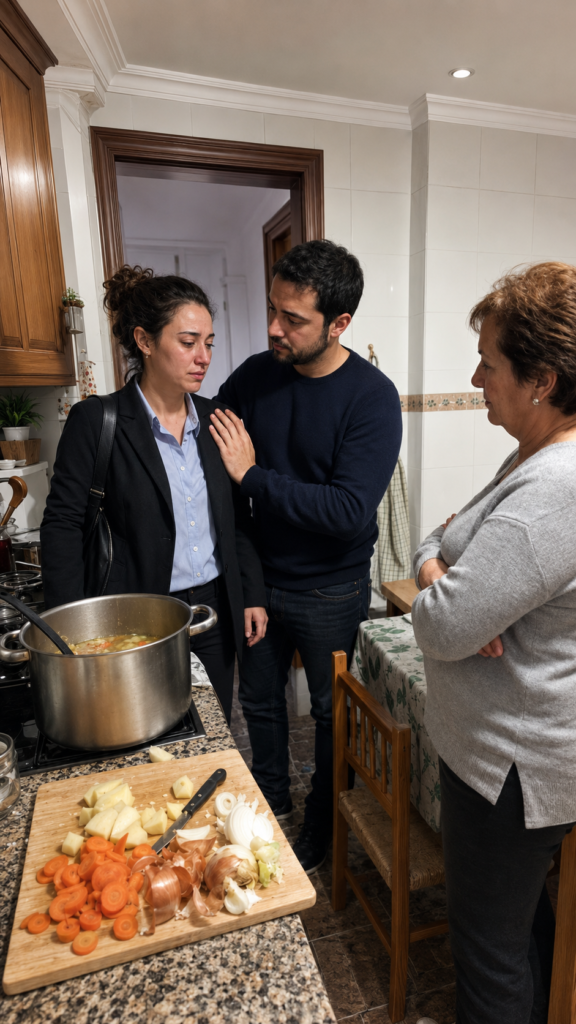
In the Mendoza household, in a quiet neighborhood of Guadalajara, everyone was gathered for Sunday lunch. There was pozole, tostadas, sodas, children running between the chairs, and that family custom of talking loudly to avoid the uncomfortable.
Ricardo, the eldest son, stood up with a huge smile.
He took his wife Pamela's hand and announced:
—We’re having baby number 5.
The room exploded with applause.
Doña Alicia crossed herself, excited.
—Oh my God, another little angel for the family.
Don Manuel hugged his son with pride, as if Ricardo had won an award.
Pamela touched her belly, though nothing showed yet, and smiled, glancing sideways at Claudia, her sister-in-law.
Claudia didn’t applaud.
At 32 years old, working as an administrative manager in a private clinic, she lived alone in a small apartment near Avenida Chapultepec.
She had no husband.
She had no children.
And for that reason, her family had decided, for years, that her time didn’t hold the same value as everyone else’s.
When Ricardo’s 4 kids fell ill, they called Claudia.
When Pamela wanted to go to the salon, they called Claudia.
When there was a school meeting, an emergency, a birthday party, forgotten homework, or diapers to buy, they called Claudia.
They never asked.
They only informed.
Doña Alicia turned to her with complete nonchalance.
—Claudia, you’ll have to help them more now.
Claudia set her glass down on the table.
—No.
The silence was immediate.
Even the children stopped running.
Ricardo frowned.
—What do you mean, no?
—I’m not going to take care of your kids every time you want to rest.
Pamela let out a dry laugh.
—Come on. Now it turns out that the lady has a super busy life?
Claudia took a deep breath.
—Yes. I have a life. And you’ve treated it like it doesn’t matter for years.
Doña Alicia put her hand to her chest.
—Family is family.
—Family doesn’t mean using someone for free until they’re worn out.
Ricardo slammed his fingers on the table.
—You’ve always helped.
—Because you never gave me a choice.
Pamela leaned forward, her voice thick with venom.
—You should be grateful. You don’t have your own family. This is training for you.
The phrase hurt more than a scream.
Not because Claudia believed it was true, but because no one defended her.
Not her mother.
Not her father.
Not her brother.
Claudia stood slowly.
—You’re right about one thing. Here, I don’t have a family that respects me.
She grabbed her bag and walked toward the door.
Doña Alicia followed her, annoyed.
—You’ll get over this tantrum by tomorrow.
Claudia barely turned.
—No, Mom. Tomorrow it begins.
That night, she cried in her apartment until she fell asleep.
At 7:38 in the morning, an unknown call woke her up.
—Am I speaking with Miss Claudia Mendoza?
—Yes.
—I’m Officer Ramírez from the Guadalajara Police. We need you to come in for a statement.
Claudia sat up abruptly.
—Statement about what?
The officer paused.
—Your brother and sister-in-law registered you as responsible for 4 minors. But the children were found alone. One of them was barefoot, near the avenue.
Claudia felt the air leave her.
And as the officer continued speaking, she realized that the worst had not even begun.
PART 2
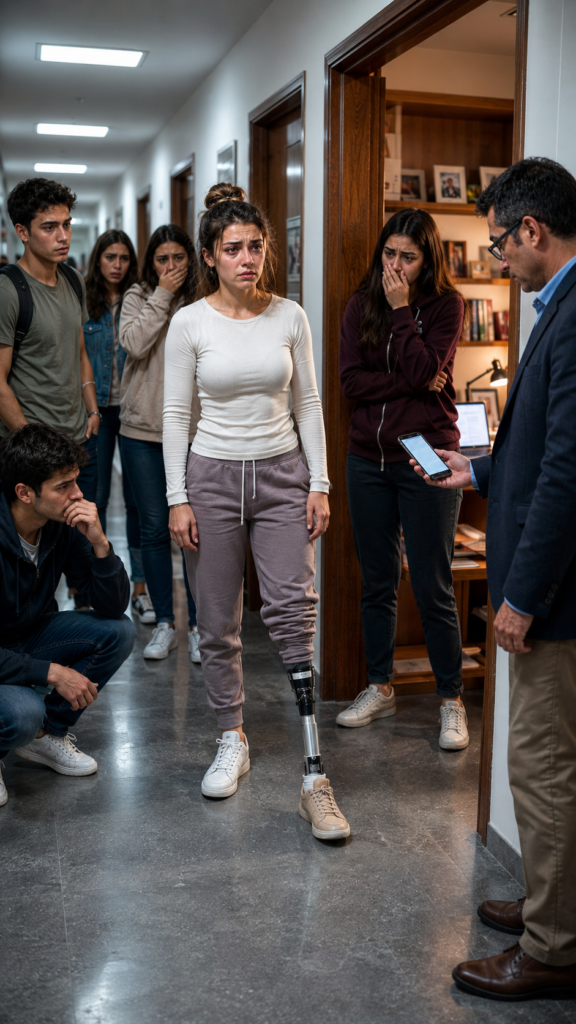
Claudia arrived at the precinct with her hair poorly tied back, frozen hands, and a folder clutched against her chest.
She didn’t know if that folder would save her.
All she knew was that inside it were years of messages, audios, and screenshots where her family treated her as though she had been born to serve them.
Officer Ramírez received her in a small room.
He was around 40, with deep-set eyes and a serious but not cruel voice.
—Before we continue, the children are fine —he said—. A neighbor called when she saw the 3-year-old crying outside the house, barefoot.
Claudia closed her eyes.
—I wasn’t watching them.
—That’s what we need to clarify.
The officer placed a transparent bag on the table.
Inside was a torn sheet from a notebook.
Claudia recognized Pamela’s handwriting.
“Claudia is watching the kids until 1 PM. She knows. We went to the hospital.”
Claudia felt nauseous.
—that’s a lie.
—Did your brother or your sister-in-law ask you to watch the minors this morning?
—No.
—Did you agree?
—No.
—Can you prove it?
Claudia opened the folder.
First, she showed a message from Ricardo sent days before:
“This Saturday we’re dropping off the kids. Don’t make plans.”
Then another from Pamela:
“Don’t be exaggerated. You have no real responsibilities.”
Next, she played an audio from Doña Alicia:
“Claudia, a woman without children should support her family. It costs you nothing.”
The officer listened in silence.
Claudia showed another message, sent the night before at 10:17.
It was from Pamela.
“You’re going to regret this. No one says no to this family and gets away with it.”
Ramírez lifted his gaze.
—This changes things significantly.
Claudia pressed her lips together.
—They’re going to say it was a misunderstanding.
—They already did.
She let out a bitter laugh.
Of course.
In her family, everything was a misunderstanding when Ricardo did something wrong.
It was a misunderstanding when Pamela insulted.
It was a misunderstanding when Doña Alicia manipulated her.
But when Claudia said “no,” then she was selfish, cold, resentful, a bad aunt.
Half an hour later, voices were heard in the hallway.
First came Doña Alicia, her face red with rage.
Behind her came Don Manuel, quiet as always.
Ricardo appeared with wrinkled shirt and a furious look.
Pamela entered last, one hand on her belly and the other on her designer bag.
—Was it you? —Pamela spat—. Did you call the police on a pregnant woman?
The officer responded before Claudia could.
—No, ma’am. A neighbor called upon finding your child alone in the street.
Pamela fell silent.
Ricardo pointed at his sister.
—She should have been there.
Claudia stared at him without looking down.
—No. You wanted me to be there. It’s not the same.
The officer placed the note on the table.
—I need to know who wrote this.
No one responded.
But Pamela looked down.
And Claudia understood that the lie had just shattered in front of everyone.
—Who wrote the note? —Ramírez repeated.
Doña Alicia stepped forward.
—It was a misunderstanding, officer. Claudia always watches the kids. She probably just forgot.
The officer didn’t even blink.
—I didn’t ask that, ma’am.
Ricardo cleared his throat.
—Look, officer, my sister is dramatic. She got mad yesterday, but we all know how she is. She’ll get over it.
Claudia felt a knot in her throat.
That’s how they had erased her her whole life.
Not as an adult.
Not as a woman with a job, exhaustion, and the right to rest.
But as someone who threw tantrums until she obeyed again.
—I didn’t get over it —she said.
Pamela clenched her jaw.
—You don’t understand what it’s like to be pregnant and exhausted.
Claudia looked at her with a calmness that even surprised the officer.
—No. But I understand what it’s like to be exhausted from raising children that aren’t mine while everyone tells me I should be grateful.
The silence was heavy.
Ramírez tapped the table with a pen.
—The note.
Pamela took a deep breath.
—I wrote it.
Doña Alicia closed her eyes.
Don Manuel raised his gaze for the first time.
Ricardo turned red.
—Pamela…
—Did Miss Claudia agree to watch the kids this morning? —the officer asked.
Pamela crossed her arms.
—She always agrees.
—That wasn’t my question.
Pamela looked at Ricardo, hoping he would save her.
But Ricardo said nothing.
For the first time, Pamela was alone with her own words.
—No —she finally admitted—. She didn’t agree.
Claudia felt something inside her chest break and settle at the same time.
It wasn’t joy.
It was relief.
The sad relief of someone discovering she wasn’t crazy, that she wasn’t exaggerating, that her pain had a name.
Ramírez took notes.
—So you left a false note to attribute responsibility to a person who hadn’t given consent.
Pamela placed her hand on her belly.
—I thought she would come. She always comes.
That phrase shattered Claudia completely.
She always comes.
That had been her sentence for years.
The reliable one.
The single one.
The one without children.
The one who can.
The one who must.
The one who never says no.
Doña Alicia tried to approach.
—Daughter, understand. Your brother had an urgent appointment with Pamela. The kids were sleeping. We thought nothing would happen.
Claudia looked at her with tear-filled eyes.
—One child was in the street, Mom. Barefoot. He could have gotten lost. He could have crossed the avenue. Something horrible could have happened.
Doña Alicia didn’t know what to say.
—And yet —Claudia continued— you’re more concerned about looking bad than about what you did.
Don Manuel covered his face with one hand.
For years, he had been the silent man of the house.
He never shouted.
He never insulted.
But he also never defended.
And Claudia had learned too late that silence can also be a form of betrayal.
—I’m sorry —he murmured.
Claudia looked at him.
—Why?
Don Manuel swallowed hard.
—For letting them load everything onto you. For thinking that because you didn’t have children, your time was available.
Doña Alicia began to cry.
—I just wanted the family to be united.
Claudia shook her head.
—No, Mom. You wanted me to hold the peace even if it broke me inside.
The process wasn’t like in the novels.
There were no dramatic screams or handcuffs in front of the cameras.
It was colder.
More real.
The DIF opened a family review. The neighbor testified that she saw the child leave alone through the front door. The police report stated that Claudia never agreed to care for the minors.
Ricardo and Pamela had to present a formal childcare plan.
They also received a warning and were summoned for interviews.
But the hardest punishment didn’t come on paper.
It came when Pamela could no longer say it was all Claudia’s fault.
It came when Ricardo had to pay a babysitter by the hour and discovered that what his sister had done for free for years cost money, energy, and life.
It came when Doña Alicia realized that “helping the family” had just been a pretty phrase to disguise abuse.
That night, Claudia returned to her apartment.
She didn’t turn on the television.
She didn’t open social media.
She just sat on the couch and breathed.
Her cell phone vibrated.
Message from Ricardo:
“Enough already. Don’t make this bigger.”
Claudia didn’t reply.
Then came one from Pamela:
“I’m pregnant. I don’t need stress. Hope you’re happy.”
She didn’t respond either.
After that, an audio from her mother appeared.
She didn’t open it.
For a month, Claudia blocked everyone.
At first, it hurt.
Every Sunday, she felt a hole in her chest, as if her body were waiting for the usual call.
“Come for the kids.”
“Bring them medicine.”
“Stop by the school.”
“Stay a little.”
But the silence began to heal.
Claudia resumed having coffee with her friends without checking her phone every 5 minutes.
She signed up for pottery classes.
She slept late on Saturdays.
She bought flowers for her apartment, not for a birthday party.
And one afternoon, walking on Chapultepec, she understood something that changed her life:
Helping wasn’t wrong.
What was wrong was disappearing so others could live comfortably.
Six months later, baby number 5 was born.
Claudia sent a simple gift: a white blanket, diapers, and a card.
“May he grow healthy, loved, and cared for by those who chose to bring him into the world.”
Nothing more.
Doña Alicia called her crying days later.
—Your brother says you’re very cold.
Claudia took a deep breath.
—No, Mom. I’m free.
There was silence on the other end.
—Are you coming on Sunday?
—Yes. But I’m only going to eat. If anyone tries to leave me kids, I’m leaving.
This time, Doña Alicia didn’t argue.
On Sunday, Claudia arrived in a blue blouse, her hair down, and a tranquility no one recognized.
The 4 kids ran to hug her.
She hugged them back tightly because they had never been the enemy.
The problem was the adults who confused love with obligation.
Pamela barely greeted her.
Ricardo didn’t look at her.
Don Manuel poured her water and said softly:
—I’m glad you came.
Claudia nodded.
Not everything was fixed.
Maybe it never would be.
But something had changed forever.
At the end of the meal, Pamela lifted the baby and asked:
—Claudia, can you hold him for a bit while I go to the bathroom?
The whole table froze.
Claudia looked at the baby.
Then looked at Pamela.
—Yes. For a bit.
She held him carefully, rocked him for a few minutes, and handed him back when Pamela returned.
Then she grabbed her bag.
—I’m leaving.
Doña Alicia stood up, surprised.
—So soon?
Claudia barely smiled.
—Yes. I work tomorrow. And today I want to rest.
No one dared to stop her.
That night, near midnight, her phone rang.
It was Ricardo.
For years, Claudia would have answered with a racing heart, ready to run, ready to save everyone but herself.
This time, she didn’t.
She let it ring until it turned off.
Then she flipped the phone face down, closed her eyes, and breathed.
Some families don’t break when someone says “no.”
They just show who they really were.
And Claudia, for the first time, no longer needed her family to choose her in order to choose herself.