PART 1
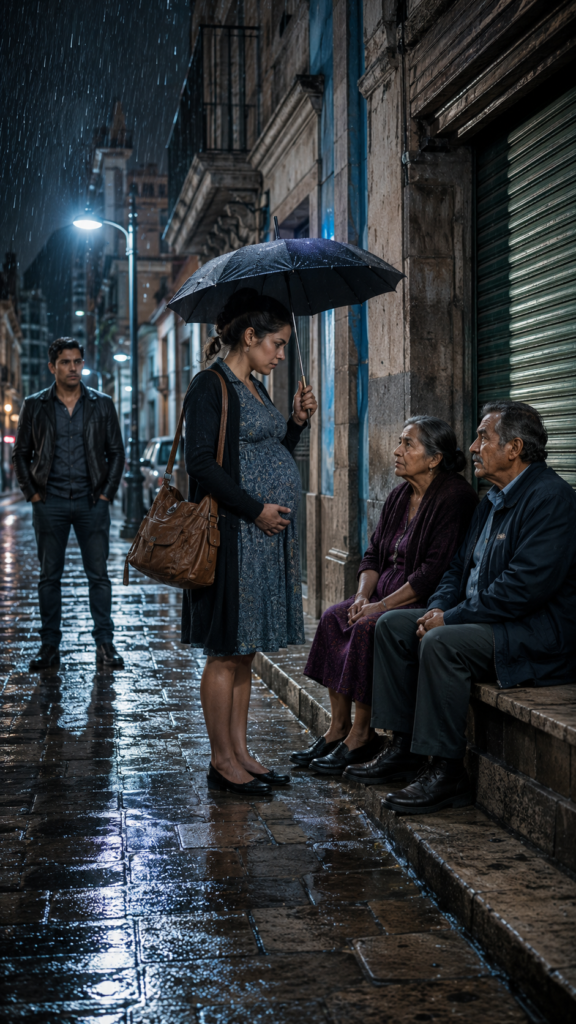
When Lucía Robles found the two elderly people huddled under the awning of a closed pharmacy, she had 980 pesos in her bag, eight months of pregnancy, and an eviction notice folded inside her apron.
The storm had turned the streets of the Guerrero neighborhood into rivers of trash, broken lights, and black water. Lucía was coming home from cleaning offices in Reforma, carrying bolillos, beans, and a liter of milk.
She was 29 years old and had been a widow for four months.
Mateo, her husband, had died falling from a scaffold. The company blamed him, and the landlord wouldn’t accept another week of delay.
Under the awning were a man with white hair and a woman trembling in a soaked rebozo.
“Do you need an ambulance?” Lucía asked.
The old woman lowered her eyes.
“Our son said he would come for the car. He left us with 700 pesos and our bags. It’s been nine hours, and he turned off his cell phone.”
The old man clenched his jaw, furious for having trusted.
Lucía looked at her belly, then at the rain, and then at the woman’s wet shoes.
“My room is small,” she said, “but it’s dry.”
“We’re not your problem,” the man replied.
“Seriously, sir, I’m nobody’s problem either. Let’s go before you get sick.”
They climbed six floors because the elevator had been broken for years. The old woman, named Teresa, stopped four times. Her husband, Julián Barrera, carried both bags without asking for help.
The room had a bed, a wobbly table, and a mattress. It smelled of dampness, but it was dry.
Teresa touched a clean blanket and began to cry.
Lucía heated the beans, tore three bolillos, and served almost all the milk to the elders. She said she had eaten at work. It was a lie.
While they slept, she stayed awake listening to the dripping from the sink.
She didn’t know that Julián had been known, 48 years ago, as “The Silence,” a man whose mere presence emptied bars and silenced mouths.
Nor did she know that Gael Montemayor, a respected businessman and head of a criminal organization, had been watching her for days from the security cameras in the tower where she worked.
Gael had seen Lucía defend a 67-year-old cleaning woman against a supervisor.
“You can fire me,” she said, “but don’t ever humiliate her again.”
Since then, he had been investigating her.
The next morning, Lucía woke up not hearing the drip.
Julián was under the sink with a rusty wrench.
“It’s done,” he said.
Teresa had prepared coffee from a clay pot and was sewing a green cap for the baby.
For the first time since Mateo’s death, someone was waiting for her at home.
That peace lasted five days.
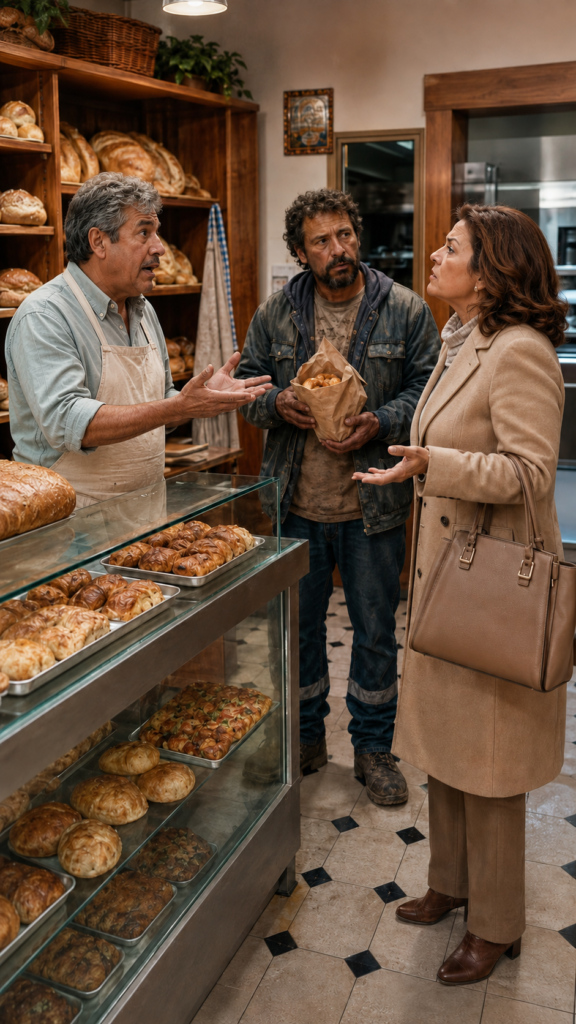
On the sixth, while Lucía was working, her landlord arrived accompanied by two men. He banged on the door and shouted that he would throw her things into the street.
Julián opened.
The landlord pushed him by the shoulder.
“Move aside, old man. That woman owes two months.”
Julián didn’t move.
One of the men raised his fist, but froze upon seeing an old scar behind the old man’s ear.
“It can’t be,” he muttered. “You were dead.”
In that instant, a black car stopped in front of the building.
Gael Montemayor got out accompanied by six men, looked at Julián as if he’d seen a ghost return, and uttered a phrase that left everyone breathless:
“My father died looking for you, Mr. Julián… and now there are people willing to kill that woman to get to you.”
PART 2
Lucía arrived minutes later and found the hallway full of armed men, the landlord pinned against the wall, and Teresa praying by the door.
“What the hell is going on?” she demanded.
Gael ordered his men to put away their weapons. He wore a pristine dark suit, but his face lacked the arrogance of the wealthy whom Lucía cleaned for every night. He looked worried.
“You and your baby are in danger,” he said.
“Because of whom?”
Gael looked at Julián.
The old man closed his eyes. For 48 years he had hidden his past to protect his family. Now that silence threatened the only person who had given them shelter when their own son abandoned them.
“Because of what I was,” he replied.
Lucía wouldn’t allow anyone in until Gael paid the landlord only what was overdue, without buying the building or threatening him. She didn’t want to owe favors to a stranger.
Inside the room, Julián told the truth.
When he was 31, he worked for a group that controlled warehouses, gambling, and smuggling routes in the capital. They called him “The Silence” because he never left witnesses nor asked questions.
One night he received the order to kill Esteban Montemayor, Gael’s father.
He found him in Tacubaya holding a four-year-old boy. It was Gael.
Julián aimed but didn’t shoot.
He saw the same fear in the little boy’s eyes as in his son Rodrigo’s. He lowered the gun, handed Esteban a silver watch, and warned him to flee before dawn.
“That was the last job I accepted,” Julián said. “After that, I became a carpenter. I thought a honest life could erase the other.”
Gael took the same watch from his pocket.
On the cover were engraved three words: “There is still time.”
“My father left it to me before he died,” he explained. “He said a condemned man gifted it to him as a second life. He searched for you for years to thank you.”
Julián took the watch trembling.
Lucía understood why they feared him and that someone had revealed he was still alive.
“Who knew you were here?” she asked.
Teresa paled.
Only one person knew the place.
Rodrigo Barrera, the elderly couple’s son, had appeared two days earlier feigning remorse. Teresa had given him the address because she still believed he would come back for them.
Julián slammed his fist on the table.
“He sold us out.”
The truth was even dirtier.
Rodrigo had mortgaged the house with forged signatures, lost the money in gambling, and ended up owing three million pesos to Baltazar Córdova, Gael’s enemy.
Upon hearing the nickname “The Silence,” Baltazar saw an opportunity to humiliate Gael and recover buried secrets.
Rodrigo provided photos, schedules, and the address in exchange for reducing his debt.
He never imagined that Baltazar had also ordered Lucía’s elimination.
“A poor widow doesn’t leave uncomfortable questions,” he had said.
Gael insisted on moving them immediately to a safe house in Coyoacán. Lucía refused.
“I have a check-up at the health center tomorrow and a shift at night.”
Gael looked at her incredulously.
“Ma’am, they want to kill you.”
“And if I stop working, hunger will kill me too.”
The response hit harder than any threat.
Gael moved millions with a call; she chose between vitamins and gas. For the first time, she felt ashamed of her idea of power.
“I’m not buying your willingness,” he said. “I’m offering you protection.”
“Then protect us without treating us like property.”
Julián let out a brief laugh.
“You’ve got yourself a tough one, kid.”
Gael accepted: Lucía would decide about her work, her money, and who entered the safe house.
But they didn’t have the chance to leave.
At 2:17 a.m., the lights went out in the entire building. Julián looked out the window and saw four unmarked vans parking.
“They arrived early,” he murmured.
Gael called his men, but the signal was blocked. He only had six men downstairs and at least fifteen attackers climbing the stairs.
Teresa wanted to take Lucía to the bathroom, the only room without windows. Lucía took two steps and felt a fierce pain in her abdomen.
The water fell to the floor.
“It can’t be,” she whispered. “There are still five weeks left.”
The contractions began as gunfire shook the building.
Julián took his cane. Inside he hid a thin steel bar he hadn’t used in decades.
“I promised not to be that man again,” he said.
Lucía, doubled over in pain, grabbed his hand.
“Defending us doesn’t make you the monster you were. But dying for guilt doesn’t fix anything.”
The words stopped him.
Julián had confused regret with allowing himself to be destroyed. Lucía reminded him that changing was choosing differently when the darkness returned.
Gael barricaded the door with the table.
“We have twelve minutes until help arrives.”
“We don’t have twelve,” Julián replied upon hearing footsteps.
The first attacker entered through the hallway window. Julián disarmed him with a swift move, but instead of killing him, he pushed him towards Gael.
“Bind him.”
The others burst in through the stairs.
Gael held back the advance while Teresa held Lucía between prayers, screams, and gunpowder.
Then Rodrigo appeared.
He climbed behind Baltazar with a swollen face and his hands tied.
“Dad!” he shouted. “Forgive me!”
Baltazar threw him to the ground.
“Here’s the exemplary son. When he understood we were also going to kill him, he wanted to warn you.”
Rodrigo was crying.
He confessed that he had stolen, sold the house, and given the address. When he found out they would kill Lucía and the baby, he tried to warn them.
“I didn’t do it for you at first,” he admitted. “I did it because I was afraid. I’m trash.”
Teresa wanted to run to him, but Julián stopped her.
Baltazar aimed at Lucía.
“Surrender, and maybe the ambulance will arrive in time.”
Gael stepped in front of the gun.
“Touch her, and you won’t leave alive.”
“Since when does the great Montemayor risk everything for a cleaning woman?”
Gael didn’t look away.
“Since I understood that she has more value with 980 pesos than we do with all our fortunes.”
Baltazar fired.
Rodrigo lunged at him at the same moment. The bullet pierced his shoulder, and both fell. Julián could have killed Baltazar but chose to immobilize him.
Sirens filled the street. Gael had activated an alert from the watch before the blockage.
Baltazar and his men were arrested. Gael provided evidence to a prosecutor who had been investigating them for years.
He also handed over information about his own illegal businesses.
Ramiro, his trusted man, thought he had gone crazy.
“You’re going to lose half an empire.”
“Then it was never an empire,” Gael replied. “It was a cage.”
Lucía was transferred to a hospital. The baby was born that same morning, small but stable.
She named him Mateo Julián Robles: Mateo for his father and Julián for the man who, given the chance to kill again, chose to save.
Rodrigo survived.
In the hospital, he asked to see his parents. Teresa wanted to hug him, but Julián stayed by the window.
“I’m not going to pretend nothing happened,” he said. “You stole from us, abandoned us, and almost killed four people.”
Rodrigo lowered his head.
“I don’t deserve your forgiveness.”
“Maybe not. But deserving forgiveness and having the opportunity to make amends are different things.”
Julián demanded legal proceedings, restitution, and rehabilitation. It didn’t absolve him of the consequences but didn’t abandon him either.
Teresa cried upon hearing the decision.
Some called him compassionate; others said Rodrigo didn’t deserve another chance.
Lucía had a different opinion:
“Forgiveness isn’t erasing the debt. It’s preventing hatred from accruing interest.”
Six months later, an old restored building in the Santa María la Ribera neighborhood opened its doors under the name “Casa Todavía Hay Tiempo.”
It had 14 rooms for the elderly, six for pregnant women without support, a kitchen, and a carpentry workshop.
Julián repaired cribs and taught the trade to young people in rehabilitation. Teresa knitted colorful caps. Lucía resumed her nursing studies and managed the place without letting Gael decide for her.
Gael shut down criminal businesses, faced investigations, and legalized the rest. He lost allies and accepted that some burdens can’t be fixed with money.
Every afternoon, he visited the house and awkwardly carried little Mateo Julián, making Teresa laugh.
One night, Lucía found him sitting in the yard, watching Julián teach Rodrigo how to sand a table during a supervised outing.
“Do you think he’ll change?” Gael asked.
“I don’t know,” Lucía replied. “Changing isn’t a promise. It’s a decision made every day.”
Gael looked at the sleeping baby in his arms.
“You opened a door when you had nothing.”
Lucía gently shook her head.
“I was scared, hungry, and had 980 pesos. But I also had the chance not to leave two people in the rain.”
That was the legacy left in that house.
Not Gael’s fortune, nor Julián’s legend, nor Rodrigo’s late regret.
It was the certainty that a family doesn’t always come from blood and that helping someone doesn’t mean freeing them from their consequences.
Sometimes loving is giving refuge.
Sometimes loving is telling the truth.
And sometimes, the hardest justice is opening a second door without allowing them to trample the first.