PART 1
Ricardo Villaseñor’s hand never trembled when sealing contracts for 22 million pesos, firing directors, or standing before foreign investors without batting an eye.
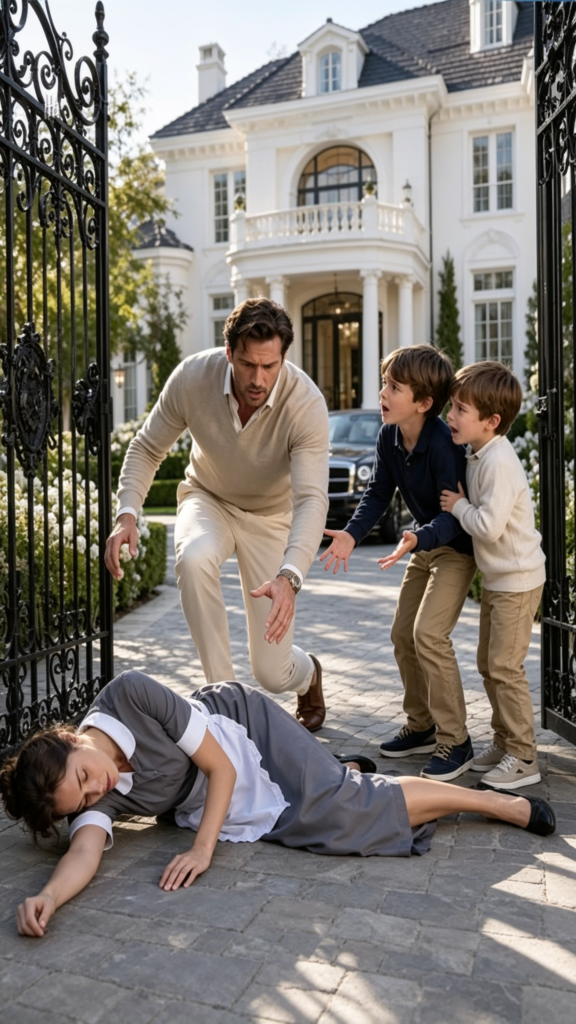
But that afternoon, stepping into his mansion in Lomas de Chapultepec, the scream of his five-year-old twins tore him apart from the inside.
—Dad! Dad, hurry! She’s not waking up!
The driver barely stopped the black SUV in front of the iron gate when Ricardo flung open the door, not waiting. He still wore the navy suit from the meeting in Santa Fe, his tie loose and his phone buzzing violently in his pocket.
On the seat lay a folder of papers that, just ten minutes before, had seemed critically important.
Now, they were worth nothing.
Mariana lay crumpled by the stone path, near the bougainvillea. Her gray work uniform was wrinkled, soaked in sweat, and her face bore a pallor that was not fatigue.
It was fear.
It was a body giving in.
The twins, Mateo and Leo, knelt beside her, crying with a desperation Ricardo hadn’t even seen at their mother’s funeral.
—Mariana —he said, touching her shoulder—. Can you hear me?
She didn’t respond.
Mateo tugged at his sleeve.
—Dad, help her, please. She can’t die.
Leo held Mariana’s hand in his tiny grip.
—Wake up, Aunt Mari… you said we’d make dinosaur pancakes tomorrow.
Ricardo felt something sink in his chest.
Aunt Mari?
Mariana López had only been working in the house for three weeks. She had been hired by Doña Elvira, the long-time housekeeper, the same one who had cared for the mansion since before Valeria, Ricardo’s wife, fell ill.
To him, Mariana was just a name on a payroll.
Twenty-eight years old.
Responsible.
Quiet.
Punctual.
Nothing more.
He didn’t know where she lived. He didn’t know if she had family. He didn’t know why his children had smiled more since she arrived.
He didn’t know anything.
He searched for a pulse in her neck. Weak. Rapid. Barely there.
—We’re going to the hospital —he ordered.
He lifted her carefully. She weighed far too little. Her head fell against his shoulder, and Ricardo caught a whiff of lemon soap, chlorine, and that scent of freshly washed clothes that always lingered in the house without him thinking about who made it possible.
He laid her in the back seat. He removed his jacket, folded it, and placed it beneath her head.
Mateo and Leo climbed in without asking.
One held her hand.
The other gripped her shoulder as if he could prevent her from leaving this world.
Ricardo drove as if the city were ending.
At every stoplight, he glanced in the rearview mirror. Mariana was breathing. Then it seemed she wasn’t. Then yes again.
—Dad —Mateo whispered—, is Aunt Mari going to go to heaven like Mom?
Ricardo almost lost control of the wheel.
—No —he replied, though he had no right to promise it—. Not if I can help it.
Leo cried louder.
—She knows the song of the stars.
Ricardo froze.
That was Valeria’s song.
The one his wife sang when the twins were babies. The one he hadn’t heard since cancer took her away. He had buried it with her because it hurt too much.
But Mariana had found it.
In the emergency room of Hospital Español, Ricardo rushed in carrying her.
—I need help! She fainted at my house. She’s barely responding.
Two nurses lifted her onto a stretcher.
—Any medical history?
—I don’t know.
—Medications?
—I don’t know.
—Did she eat today?
Ricardo opened his mouth.
He didn’t know how to answer.
The nurse looked at him with an expression that burned him. It wasn’t disdain. It was something worse: familiarity.
As if she had seen rich people like him too many times, unaware of the lives that sustained their homes.
When they took Mariana away, the twins clung to his legs.
Ricardo turned off his phone.
For the first time in years, money could wait.
Then he called Doña Elvira.
—Mariana fainted at the gate. I’m at the hospital.
There was silence on the other end.
—Sir… I should have told you something.
Ricardo clenched his jaw.
—Tell me now.
—Mariana hadn’t been well for days. She fainted twice. Once in the laundry room and once in the kitchen.
—And you didn’t tell me?
—She said she didn’t want to cause problems. That she needed the job.
—Problems? —Ricardo repeated, feeling rage and shame at the same time.
Doña Elvira swallowed hard.
—I told her to take one of my pills for her blood pressure and to rest for a bit.
Ricardo closed his eyes.
—You medicated an employee without knowing what was wrong, saw her faint twice, and still let her keep working?
At that moment, the emergency door swung open.
A doctor stepped out with a serious expression.
—Family of Mariana López?
Ricardo stepped forward.
—I’m her employer.
The doctor looked him straight in the eye.
—Then you better listen carefully, because that girl didn’t fall by accident.
PART 2
The doctor led Ricardo to a separate hallway. Mateo and Leo remained seated in the waiting room, hugging each other, their eyes swollen from crying.
—Mariana has severe anemia, dehydration, and unstable blood pressure —the doctor explained—. Her body has been signaling for a long time. If this continues, the next time, she may not wake up so easily.
Ricardo felt a chill run down his back.
—Can I see her?
—A few minutes. But first, I need to tell you something. When we brought her in, the first thing she said was: “Please don’t fire me.”
The phrase hit him harder than any lawsuit, any loss, any crisis meeting.
Please don’t fire me.
As if almost dying worried her less than losing her job.
Ricardo stepped into the cubicle.
Mariana lay on a narrow bed, IV in her arm. Her brown hair was thrown back in disarray. Her lips were dry. Her eyes barely open.
Upon seeing him, she tried to sit up.
—Mr. Villaseñor, I’m sorry. I’ll be back tomorrow. I just fainted. It won’t happen again.
—Don’t get up.
—I really need the job. My mom is sick with heart trouble. Her medications cost a lot. I can work faster. I won’t sit with the kids anymore. I won’t take so long with them.
Ricardo stood frozen.
—Sit with my children?
Mariana lowered her gaze.
—Leo won’t eat if no one stays with him. Mateo has nightmares. Sometimes he hides in the closet because he says if he sleeps, someone else will disappear. I just… I just tried to calm them.
Ricardo felt his throat tighten.
She was apologizing for caring for his children.
She was apologizing for doing what he hadn’t.
—Did you eat today?
Mariana didn’t respond.
—Mariana.
—I had coffee in the morning.
—That’s not food.
—I was going to eat after getting the kids' dinner ready.
Ricardo had to lean against the wall.
In his offices, everyone called him visionary. In that room, he felt like a coward.
—My kids call you Aunt Mari.
A tear rolled down her cheek.
—I told them not to. I work for you. I didn’t want to overstep.
—You also sing Valeria’s song.
Mariana closed her eyes.
—Leo hummed it one night. He cried so hard he could hardly breathe. He told me his mom sang about stars. I didn’t know the lyrics, but he taught me the melody. I looked it up, completed it as best I could, and… it worked.
Ricardo looked at the IV.
The tape on her skin.
The girl who had learned a song from a dead mother because two children were drowning in sadness and their father was too busy to notice.
—I need to know what’s happening in my house.
Mariana went rigid.
—If I answer wrong, will you fire me?
—No.
She looked at him, weary.
—With all due respect, sir, men like you always say no… until one is no longer useful.
Ricardo didn’t defend himself.
Because she was right.
The next morning, he took her back to the mansion. The twins were in the back seat, glued to her like little bodyguards.
The doctor had been clear: real rest, food, treatment, and monitoring. Not “work slower.” Not “a little break.”
Rest.
As they entered through the gate, the kids started crying again.
Ricardo understood why.
The spot where Mariana had fallen was there, visible, clean, silent. A mere stone on the path. Nothing dramatic. Nothing broken.
Just the place where a person had held on until she could not anymore.
Mariana wanted to get down by herself.
—I can walk.
—I know —Ricardo said—. But you walked until you fell. Today you let someone help you before it gets to that.
He offered his arm.
She looked at him as if that gesture came from another language.
Then she barely rested her fingers on the sleeve of his shirt.
Inside the house, everything was perfect.
Marble floors.
Fresh flowers.
Shiny glass.
Magazine silence.
And for the first time, Ricardo hated that perfection.
It was the silence of a home where children had learned not to disturb.
He sat Mariana in the living room.
—I’ll make dinner.
The twins’ eyes widened.
—You? —Mateo asked.
Mariana, still weak, looked worried.
—Sir, no offense, do you know how to cook?
—More or less.
Leo whispered:
—We’re doomed.
For the first time, Mariana let out a small laugh. Almost broken, but real.
Ricardo wanted to hold onto that sound.
But first, he had to do the hard part.
He sat in front of her.
—Tell me about your normal day.
—I clean.
—What else?
—I do laundry.
—What else?
—I sometimes cook.
—The truth.
Mariana looked at the kids.
—I wake up at 4:30 to catch the first bus from Neza. If it’s late, I run because Doña Elvira gets mad if we arrive after 7. I clean, prepare breakfast, help the kids if they have a rough morning, clean bedrooms, bathrooms, the playroom, your office. When they come back, I give them snacks. I fold clothes in the living room so they don’t feel alone. I make dinner. Bath. Pajamas. I read stories. If there are nightmares, I stay until they sleep.
—And then?
—I finish what’s pending.
—What time do you leave?
—It depends.
—Mariana.
—9. Sometimes later.
—And then you take care of your mom.
She nodded.
—How much do they pay you?
Mariana mumbled the amount.
Ricardo felt nauseous.
It was legal. Barely.
But offensive.
He had paid more for a dinner in Polanco and hadn’t even finished the wine.
—I didn’t set that salary —he said reflexively.
Mariana didn’t get angry. That would have been easier.
She was just disappointed.
Ricardo heard his own cowardice.
—Sorry. That was a miserable answer. This is my house. My responsibility.
Then Mateo approached.
—Dad, she didn’t just fall because she was sick.
Mariana’s eyes widened.
—Mateo, no.
Ricardo raised a hand.
—No one is in trouble.
—She sat on the kitchen floor —the boy said—. We brought her water in our dinosaur cups. Doña Elvira told her to rest, but then she left, and Aunt Mari got up because she said if the house was dirty, you would be disappointed.
Mariana covered her face.
—I didn’t say it like that.
—It didn’t matter —Ricardo replied, his voice breaking—. If my children believed I cared more about clean floors than a woman fainting in my kitchen, then I had already failed.
Leo said what broke him completely:
—She was also crying on the phone. She told her mom she couldn’t lose her job because there wouldn’t be any medicine. We pretended we didn’t hear.
Mariana bent forward and cried.
Not dramatically.
With exhaustion.
With that cry of someone who has been strong for too long because no one allowed her to fall.
The twins clung to her knees.
Ricardo stood up.
—I’m going to fix this.
—You don’t have to fix me —she whispered.
—I’m not fixing you. I’m fixing what I allowed.
That afternoon, he canceled meetings for 48 hours. He sent doctors to check on Mariana’s mother. He called his lawyer to audit contracts, schedules, salaries, and benefits for all the staff.
When the lawyer asked if a lawsuit was coming, Ricardo looked at his children leaning against Mariana.
—No —he said—. A conscience is coming.
Then he confronted Doña Elvira in the library.
—Why didn’t you tell me?
—I thought I was exaggerating. Young girls are very dramatic.
Ricardo stared at her without blinking.
He would have let that comment slide before. He would have avoided conflict and returned to work.
Not this time.
—Mariana collapsed at my gate. My children believed another woman they loved was going to disappear. You saw warning signs and decided they were a nuisance.
Doña Elvira pressed her lips together.
—I kept this house running during Mrs. Valeria’s illness. During the funeral. During her mourning.
—And I thank you for that —he replied—. But gratitude does not excuse cruelty.
The woman lowered her gaze.
—From today on, this house will not operate on invisible exhaustion. Mariana will not do four jobs for one salary. No one will hide illnesses out of fear. And if you can’t work like that, you will receive a severance and a recommendation, but you will leave.
As he opened the door, Mateo and Leo were sitting outside.
—Were you listening?
—A little —Leo said.
—How much is a little?
—All of it —Mateo admitted.
Ricardo crouched down.
—I’m not proud of taking so long.
Mateo touched his tie.
—But you’re here now, right?
Ricardo nodded.
—I’m here now.
Leo looked at him seriously.
—Are you going to disappear again into your work?
That question deserved more than a pretty promise.
—I will keep working —Ricardo said—, but I won’t disappear. I’ll take you to school twice a week. I’ll have dinner at home unless it’s a real emergency. If I travel, video call before bed. And Sundays are work-free.
—Are papers an emergency?
—No.
—Rich people shouting?
Ricardo let out a sad laugh.
—Less.
The changes weren’t cinematic.
Ricardo burned sandwiches. Confused lunch boxes. Bought sneakers two sizes too big. Signed a school authorization incorrectly.
But he showed up.
And that mattered more than being perfect.
Mariana started treatment. Her mother received medical attention without her having to choose between paying for medicine or eating. Another employee was hired for cleaning. Mariana had a fixed schedule, mandatory breaks, fair pay, insurance, days off, and overtime pay.
When she saw the new contract, she whispered:
—It’s too much.
—It’s what your work is worth.
—No one pays this.
—Then more people should be ashamed.
The twins changed too. They stopped asking Mariana if she would come back every time she left. They began to talk about Valeria without fear. One night, Ricardo sang the song of the stars for the first time since the funeral.
His voice broke.
The children didn’t laugh.
Mariana, passing through the hallway, placed a hand on her chest and continued walking, leaving him alone with his children and that music that had finally returned home.
Months later, one August afternoon, Ricardo found the twins drawing in the living room.
On the paper were four people in front of the gate: Ricardo with an extremely long tie, Mateo, Leo, and Mariana holding a watering can. The flowers covered the black iron.
Below, in crooked letters, it read:
Family.
Mariana stopped breathing for a second.
—Oh, kids… it’s beautiful, but I’m not—
Ricardo looked at her, and she fell silent.
He knelt by the drawing.
—No one replaces anyone. Your mom will always be your mom. But family can also be those who stay, who care, who help us have less fear.
Mateo nodded as if it were obvious.
—So Aunt Mari is family.
Mariana cried.
Leo climbed onto her lap.
—You work here, but you also love us here.
That phrase unraveled her.
Ricardo then understood something no contract had ever taught him: a huge house is useless if children have to seek love in whispers to avoid disturbing their own father.
Almost a year after the fainting, Ricardo and Mariana stood in front of the same gate. The bougainvillea had bloomed again. The twins ran through the garden, shouting as if life no longer scared them.
Ricardo handed her an envelope.
Mariana looked at it suspiciously.
—That looks like a trap.
—It’s not.
—You always say that when it looks like a trap.
He smiled.
Inside was a renewed contract. Better pay, full benefits, medical support for her mother, and an option to study early childhood education if she ever wanted to.
—You don’t have to sign it —Ricardo said—. That’s the most important thing. If you stay, it will be with clear rights and boundaries. If you leave, I’ll personally recommend you and ensure your mother isn’t left unprotected. My gratitude cannot become a cage.
Mariana read in silence.
Then she looked up.
—You learned.
—I had a good teacher.
She shook her head.
—No. Your children taught you. I just listened when no one else did.
Ricardo accepted the blow.
—I’ll stay —she said—. But with one condition.
—Tell me.
—You never let those children ask for help so quietly that only the staff can hear them again. Never confuse paying bills with being a father. Never allow this house to look perfect while the people inside are falling apart.
Ricardo didn’t respond quickly.
Some promises need weight.
—I promise with actions —he finally said—. Every day.
The twins ran toward them.
—Are we going to have dinner together? —Mateo shouted.
—Yes —Ricardo replied—. Today and tomorrow.
—And pancakes on Sunday? —Leo asked.
—Of course.
—And Aunt Mari?
Mariana smiled through tears.
—I’ll go too.
The two children attempted to hug them at the same time, as if their little arms could bring together everything that had once been broken.
Ricardo looked at the mansion.
For years, he thought success was not needing anyone. He built walls with money, work, and silence. He believed his children were fine because the house was big, the accounts were full, and the staff was paid on time.
But a young woman fainted at his gate, and his children told him the truth.
They didn’t need a bigger house.
They needed their father to come home.