PART 1
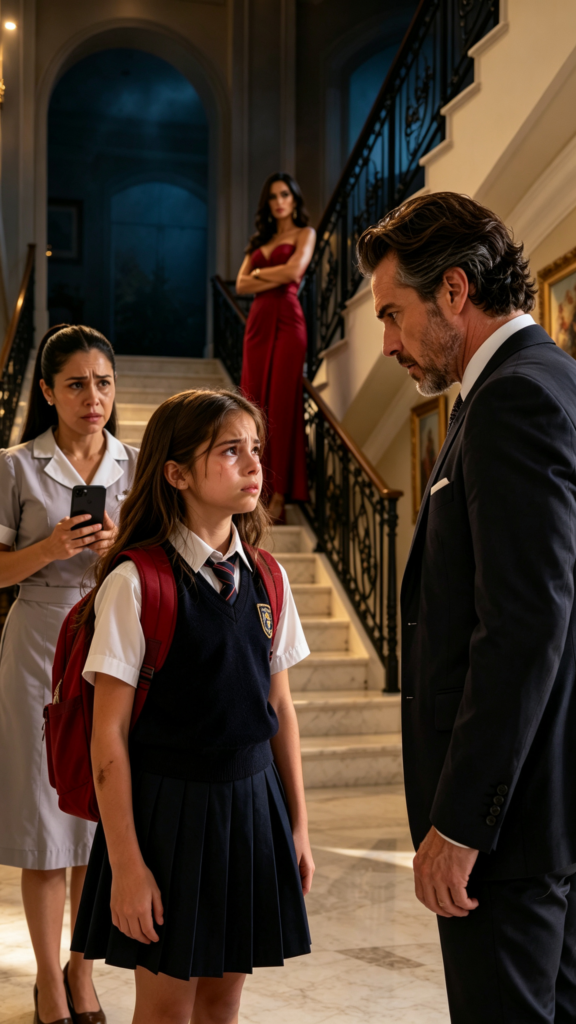
—You promised to pay my mom today. So tell me one thing… why did you leave her crying again?
The voice came out small, but it sliced through the hallway like a blow.
Rodrigo Alcázar stood frozen at the foot of the stairs in his mansion in Bosques de las Lomas. He had just finished a video call with partners from Monterrey and Miami. He still held his blazer in one hand, the expensive watch gleaming on his wrist, and his head buzzing with enormous figures.
But no number prepared him for the sight of a nine-year-old girl standing before him, clad in a school uniform, a purple backpack slung over her shoulder, her eyes blazing with fury.
—Are you talking to me? —Rodrigo asked, bewildered.
—Yes. To you.
A few feet away, by the service entrance, a woman in a blue apron clasped her hands to her chest.
—Ximena, please, be quiet —she pleaded softly—. Don’t disrespect the gentleman.
But Ximena remained unmoved.
—My mom has worked in this house since before sunrise. She cleans bathrooms, washes sheets, irons shirts, serves dinners where no one even looks at her. And she hasn’t been paid for three months.
The silence grew heavy.
Rodrigo turned his gaze to the woman.
—What’s your name?
—Rosa Martínez, sir —she replied, looking down—. I’m sorry for my daughter. We shouldn’t have come here.
—I’m not asking that —Rodrigo said—. I’m asking if it’s true.
Rosa swallowed hard.
—Yes, sir. But Mr. Mauro, the manager, told me it would be settled today. That you had authorized everything.
Rodrigo furrowed his brow.
—I didn’t authorize any payroll delay.
At that moment, Rosa’s phone began to ring. She glanced at the screen and turned pale.
—It’s the landlord —she murmured—. He’s been calling me since this morning.
Ximena pressed her lips together.
—Answer, Mom. On speaker.
—No, sweetheart.
—Let him hear —the girl insisted, turning to Rodrigo—. Let him know why you can’t play with people’s lives.
Rosa answered, her fingers trembling.
—Hello...
A man’s voice exploded from the phone.
—Rosa! That’s enough. Today was the last day. You owe me three months’ rent. If you don’t bring the money by ten, I’ll throw your things out onto the patio tomorrow.
—Mr. Efraín, please. I’m at work. They told me I would be paid today. I have my daughter with me. We have nowhere to go.
—That’s not my problem. I don’t live on promises.
The call ended.
Rosa lowered the phone as if it were burning her hand.
Ximena stared at Rodrigo without blinking.
—Did you hear?
Rodrigo didn’t know what to say.
In that house, there was marble, paintings by famous artists, fresh flowers, and armored trucks. But a woman who worked there could end up on the street that very night.
—Don’t leave —Rodrigo said, his voice dry—. Nobody leaves this house until I understand what’s going on.
He walked to his office, unaware that a girl had just opened the door to the most shameful secret of his family.
And what he found there was not only going to destroy a lie… it was going to split his marriage in two.
PART 2
Rodrigo barely managed to close the office door when Mauro Leal appeared behind him with a funeral face.
—Mr. Alcázar, I was just looking for you.
—What a coincidence —Rodrigo replied—. I’m looking for you too.
Mauro adjusted his tie.
—If it’s about the staff, there was a small hiccup.
—A woman is about to be evicted from her room tonight. Don’t come to me with “hiccups.”
The administrator lowered his gaze.
—Mrs. Ingrid requested to handle those payments personally.
The name of his wife dropped like a stone.
—Explain yourself clearly, Mauro.
—She said the payroll needed to be held off for a few weeks. That you were aware of it. That there were liquidity movements.
Rodrigo moved closer slowly.
—How long has this been going on?
—Three months in some cases. In others, less.
—And you obeyed?
—She is the lady of the house.
—And they are workers, not decorations.
Mauro didn’t answer.
At that moment, Ingrid Alcázar descended the stairs in an emerald green dress, fine heels, and a handbag that cost more than a year of Rosa’s salary. She came down perfumed, made up, ready to go out as if nothing was wrong.
—Rodrigo, I’m late. What drama happened now?
He looked at her with a calm that was terrifying.
—Did you use my name to tell the staff that I authorized delaying their wages?
Ingrid sighed, annoyed.
—Oh, please. I told them that to make them stop bothering me. You know how they are. They always have an urgency, a rent, a sick child, a tragedy. Honestly, they’re exhausting.
Rosa, who was listening from the hallway with Ximena, lowered her head.
Rodrigo felt an old pang in his chest.
He hadn’t been born rich. He grew up in Iztapalapa, in an apartment where his mother sewed others’ clothes until dawn. He remembered watching her wait for late payments from elegant women who always said, “tomorrow.” He remembered the landlord banging on the door. He remembered the fear.
And now the fear lived inside his own house.
—Where’s the money, Ingrid?
She crossed her arms.
—I was going to replace it.
—Where is it?
—I had some expenses. Some losses. Personal matters.
—Speak clearly.
Ingrid clenched her jaw.
—I lost at some private games. Poker. Nothing I couldn’t recover.
Mauro closed his eyes.
Rodrigo felt the air shatter.
—Did you bet the staff’s wages?
—Don’t be dramatic. No one dies from waiting a little.
—Rosa could lose her home today.
—Then let her find another room. That’s how life works.
Rodrigo looked at her as if he were seeing a stranger.
—No. That’s how your life works. Mine doesn’t.
He pulled out his cell phone.
—Santiago, come to the house. Bring personal statements, payroll, house records, and Alcázar Foundation documents. Last six months. Today.
Ingrid lost color.
—The foundation? What do you want to review that for?
Rodrigo saw the fear in her eyes.
That moment said it all.
—Because if you touched salaries, I want to know what else you’ve touched.
—Be careful —she whispered—. There are doors that, once opened, cannot be closed.
—Then let’s open them all.
At 9:30 PM, Santiago Rivas, Rodrigo’s trusted accountant, arrived with a laptop and several folders. They locked themselves in the office. Mauro stayed outside, sweating. Ingrid paced back and forth, sending messages nonstop.
On the desk, Rosa had left a red notebook.
—I noted my worked days here, sir. Not to claim anything. Just to not forget.
Rodrigo opened the notebook.
Each page had dates, extra hours, tasks, pending payments, and little notes: “Ximena without fare,” “back rent,” “buy medicine,” “not enough.”
Rodrigo’s throat tightened.
Santiago reviewed for almost two hours.
When he looked up, he no longer looked like an accountant. He looked like someone who had just uncovered a crime.
—Rodrigo, this is bigger.
—Tell me.
—The withheld payroll matches withdrawals authorized by Ingrid. But there are also transfers from the Alcázar Foundation to personal accounts and to a shell company. They are registered as “community support programs.”
—How much?
Santiago swallowed hard.
—38 million pesos.
The office fell silent.
38 million.
Money intended for scholarships, medical treatments, food supplies, and housing support for at-risk families. Money from donors who trusted Rodrigo because he spoke about helping those no one listened to.
And in the meantime, Rosa was pleading for her pay.
Rodrigo carefully closed the red notebook.
—Pay all the staff today. Back wages, overtime, and one extra month of compensation.
—Tonight? —Santiago asked.
—Tonight. If the bank won’t allow transfers, certified checks. And send Rosa the three months’ rent directly to the landlord. But make it clear: it’s not charity. It’s restitution.
Then he stepped into the dining room.
Ingrid was sitting with a glass of wine, trying to appear calm.
—You already did your hero show —she said—. What’s next?
—You’re going to return every peso.
—I was going to do that.
—Not with promises. Today. From your investments, jewelry, accounts, properties. From wherever it comes.
She let out a bitter laugh.
—Are you going to destroy me over a housekeeper?
Rodrigo slammed his hand on the table.
—Don’t ever call her that again.
Ingrid froze.
—You’re choosing strangers over your wife.
—I’m choosing what’s right over what’s comfortable.
—You still think like a poor man.
Rodrigo took a deep breath.
—Yes. And thank God I still remember what it feels like.
That phrase left her speechless.
The next day, the Alcázar mansion filled with lawyers, auditors, and murmurs. Mauro was suspended. The staff contracts were reviewed. Fixed pay was established, clear receipts, record of overtime, written vacations, and incapacity.
But the real blow came at the Alcázar Foundation meeting.
The table was filled with businessmen, advisors, and lawyers who knew one thing: scandals get buried quickly when there’s enough money.
Don Hernán, one of the oldest advisors, spoke first.
—Rodrigo, we can replace the 38 million and manage it internally. If this gets out, the press will destroy you.
Rodrigo laid the red notebook on the table.
—If Rosa had stolen a thousand pesos, what would you do?
No one answered.
—You would report her —a lawyer said, uncomfortable.
—So if a rich woman steals 38 million, does the rule change?
The silence was brutal.
Rodrigo looked at everyone.
—I founded this because my mother once begged for money she had already earned. If I hide this to save my name, I’m just like the people who humiliated us.
The report was filed that week.
The news exploded on a Friday: “Businessman’s Wife Diverts Foundation Funds and Domestic Workers’ Salaries.” By noon, reporters were outside the house. By afternoon, the business council requested Rodrigo to temporarily step down from his company’s management.
He agreed.
—Aren’t you going to fight for your position? —Santiago asked him.
Rodrigo looked at the red notebook.
—Today I have to fight for something more important.
The hearing was two weeks later in Mexico City. Ingrid arrived without jewelry, without perfect makeup, without that arrogance she used as a shield.
The judge spoke of breach of trust, restitution, fines, conditional freedom, and mandatory community service. Since the money was returned and Rodrigo cooperated from the beginning, Ingrid did not serve time. But she was marked legally and publicly.
Before finishing, the judge looked at her intensely.
—Mrs. Alcázar, you didn’t just move numbers. You took food, rent, medicine, and opportunities from real people. Do you understand?
Ingrid lowered her gaze.
—Yes, your honor.
Outside the courthouse, a reporter asked Rodrigo:
—Was it worth losing power, reputation, and perhaps your marriage for this?
Rodrigo thought of Rosa, of Ximena, of the landlord’s call, and of his mother counting coins on an old table.
—Yes —he replied—. Because money comes back. Dignity, when it breaks, costs much more.
Months later, Rosa walked through the house without fear. She no longer asked for permission to exist. She had a contract, receipts, and a payment date that no one could change.
Ximena returned one afternoon with a folded sheet.
—Mr. Rodrigo, I made you a drawing.
It was a simple house, not a mansion. There was a woman, a girl, and a man in a suit standing next to an open door. Above it read, in crooked letters:
“A house where no one begs for what they have already worked for.”
Rodrigo stared at the paper for a long time.
—It’s the most beautiful house I’ve ever seen —he said.
Rosa wiped a tear away.
—My daughter says that rich people are not those who have a lot of money. They are the ones who fulfill their promises.
Rodrigo looked back at his mansion behind him.
For years he believed that house showed how far he had come. Now he understood it could also show how far he had strayed.
Because sometimes justice doesn’t start in a courtroom.
It starts when a girl, tired of seeing her mother cry, dares to look a powerful man in the eye and ask him why he lied.
And that’s when you truly get to know a person.
Not by what they have.
But by how much they are willing to correct when no poor person can force them.