PART 1
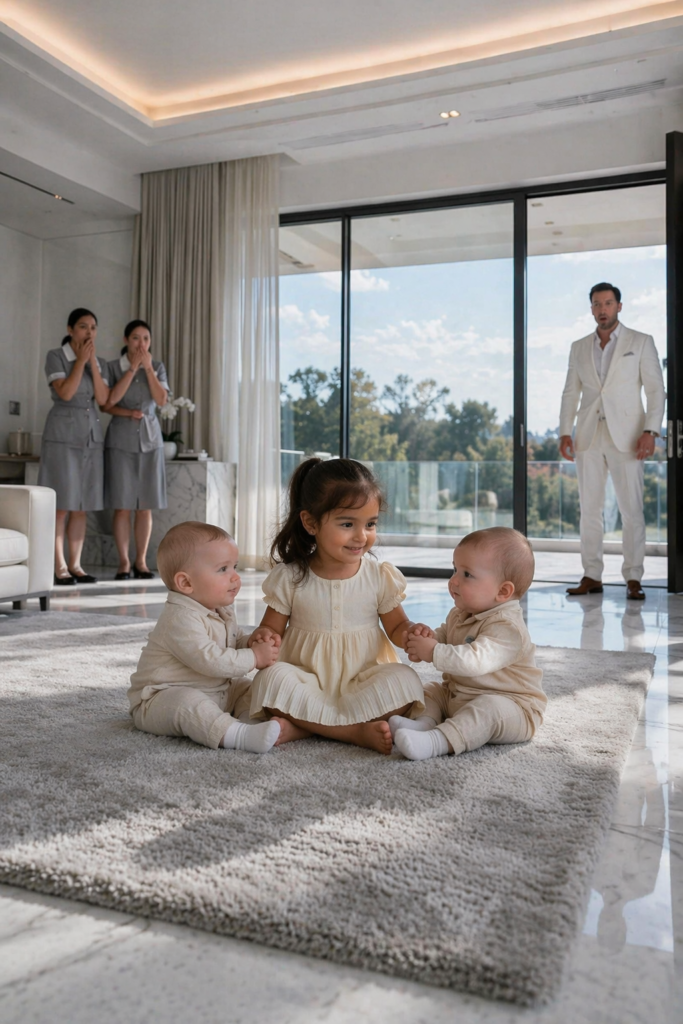
In the most luxurious house in Lomas de Chapultepec, no one could calm the Salvatierra twins.
Not the nannies with perfect English.
Not the private pediatricians who arrived in armored trucks.
Not the ridiculously expensive toys that filled half the room, toys the children didn’t even touch.
Álvaro Salvatierra's mansion had Italian marble, enormous windows, a garden with jacarandas, and a pool that was always warm.
But inside, that house felt like an abandoned hospital.
Cold.
Silent.
Broken.
Every night, at 9:20, Lucía began to cry.
Then Santiago followed.
They were only 2 years old, but they cried with a sadness that seemed too big to fit in such small bodies.
Álvaro, their father, owned clinical laboratories and private hospitals in three states. At 42, he was used to resolving everything with money, lawyers, or a phone call.
But with his children, he could do nothing.
Because the children didn’t want more toys.
They wanted Valeria, their mother.
Valeria had died 1 year and 8 months before, from a sudden aneurysm. One morning she was making chilaquiles in the kitchen, and minutes later, she was on the floor while the twins cried in their little chairs.
Since that day, Álvaro never went back to have breakfast there.
He also never listened to music in the house again.
He hid in meetings, trips, and business dinners. He claimed he was working to provide security for his children, but Doña Meche, the housekeeper, knew the truth.
Álvaro wasn’t working.
Álvaro was running away.
Doña Meche had been with the Salvatierra family for 21 years. She was short, serious, one of those women who didn’t need to shout for everyone to straighten up.
It was she who hired Irene Morales.
Irene was 30, came from Nezahualcóyotl, and had been cleaning houses since she was 15. She didn’t come with fancy letters or recommendations from illustrious last names.
She had rough hands, tired eyes, and a strange calmness for looking at someone else's pain.
—This house weighs a lot, honey —Doña Meche warned her.
From upstairs came the first cry.
Irene looked toward the stairs.
—Houses don’t weigh by themselves. They weigh when no one wants to talk about what happened.
Doña Meche fell silent.
She hired her that same day.
What no one expected was for Irene to arrive accompanied.
The next day, she walked through the service entrance with a bucket, a gray backpack, and her son Mateo holding her hand.
The boy was 4 years old, wearing worn-out sneakers, messy hair, and carrying a wooden truck that his grandfather had carved for him before he died.
Upon hearing the twins cry, everyone tensed up.
Mateo lifted his head.
—They’re looking for someone —he said.
Irene bent down quickly.
—No, my love. Don’t get involved.
But Mateo had already climbed three steps.
Doña Meche wanted to stop him, but something in his little face kept her still.
In the children's room, Lucía was crying, clutching a pink blanket. Santiago was lying on the carpet, kicking with a red face.
Mateo entered fearlessly.
He didn’t tell them to be quiet.
He didn’t say everything was okay.
He simply sat in front of Santiago and placed his truck on the carpet.
He pushed it gently.
The toy touched the boy's foot.
Santiago stopped screaming for one second.
Mateo whispered:
—If you want, you can throw it back.
Santiago looked at him with tear-filled eyes.
Then he took the truck and pushed it.
Lucía walked over, still sobbing.
Mateo opened his backpack and took out a wrinkled photo of a smiling woman.
He placed it next to the truck.
—He misses someone too —he said quietly.
And for the first time in almost two years, the Salvatierra twins fell completely silent.
PART 2
Doña Meche came down the stairs with her hand pressed against her chest.
She had seen child psychologists leave that house without knowing what to say.
She had seen nannies cry in the laundry room.
She had seen Álvaro lock himself in his office, pounding the wall because he couldn’t stand hearing his children suffer.
But she had never heard that silence.
It wasn’t the usual cold silence.
It was a soft silence.
As if someone had finally opened a window.
Irene stood in the doorway of the children's room, pale with embarrassment.
—I’m sorry, Doña Meche. I told him not to come upstairs. Mateo doesn’t understand yet where he can go.
Doña Meche looked at the three children sitting on the carpet.
Santiago was pushing the truck toward Lucía.
Lucía was sending it back to Mateo.
And Mateo was playing calmly, as if that mansion were just any yard in his neighborhood.
—Don’t scold him —Doña Meche said—. That boy did in five minutes what no one could do in months.
That afternoon, Álvaro arrived at 8:35, speaking on the phone in a harsh voice.
He came angry about a medical equipment purchase that hadn’t gone through.
He entered expecting the usual screams.
But the house was quiet.
There were no cries.
No doors slamming.
No employees running around with scared faces.
Álvaro slowly lowered his phone.
From the family room, he heard laughter.
Then another.
He walked slowly, as if afraid of breaking something.
What he saw took his breath away.
Lucía was sitting on the carpet with a blanket on her head, pretending to be a queen.
Santiago wore a crooked paper crown.
And in front of them, a strange boy pushed a wooden truck around a tower of blocks.
—Watch out, queen —Mateo said—. This truck brings tamales for the castle.
Santiago burst out laughing.
Álvaro stood frozen.
His children hadn’t laughed like that since Valeria was alive.
Irene came out of the kitchen with a tray and almost dropped it.
—Mr. Salvatierra, I apologize. It’s my son. I had no one to leave him with today. I promise it won’t happen again.
Álvaro didn’t respond immediately.
He watched his children.
He looked at that scratched, old, simple truck.
A toy that cost nothing had achieved what he couldn’t buy.
—What’s his name? —he asked.
—Mateo.
The boy turned.
—Are you the dad?
Álvaro swallowed hard.
—Yes.
Mateo looked at him seriously.
—Then sit down. Dads also play, right?
Irene closed her eyes, dying of embarrassment.
Doña Meche covered her mouth to keep from laughing.
Álvaro Salvatierra, the man who made hospital directors tremble, took off his jacket and sat on the floor.
He didn’t know what to do.
Not with his legs.
Not with his hands.
But Lucía crawled over to him and placed the paper crown on his head.
—King Dad —she said.
Álvaro broke inside.
That night, he didn’t go into his office.
He had dinner in the playroom, sitting in a tiny chair that barely fit him. He ate cold quesadillas, pretended Mateo's truck was an ambulance, and allowed Santiago to smear beans on his shirt.
The next day, everyone noticed.
Álvaro arrived earlier.
Then he started canceling dinners.
After that, he stopped traveling on weekends.
His partners asked if he was ill.
Doña Meche quietly said:
—No. He’s returning home.
Mateo became part of that routine without intending to.
He wasn’t a therapist.
He wasn’t family.
He wasn’t a rich kid invited to play.
He was just a boy who wasn’t afraid of sadness.
When Lucía cried, Mateo didn’t say “not now.”
He sat beside her and waited.
When Santiago threw a toy, Mateo didn’t get angry.
He just said:
—I used to do that when I missed my grandpa.
Irene tried to maintain distance.
—Sir, my son didn’t come to work. I don’t want you to think I’m taking advantage.
Álvaro looked at Lucía sleeping with a hand over the wooden truck.
—Irene, this house has been paying for almost two years to hide the pain. Your son taught us that we can also sit next to the pain without running away.
Irene didn’t respond.
Because she knew too well the houses of rich people.
One day they thank you.
The next they remind you that you came in through the service door.
And that happened on a Saturday.
Renata, Valeria's sister, arrived at noon with dark glasses, an expensive dress, and a crown of flowers to place next to her sister's portrait.
Since Valeria’s death, Renata had become hard, bitter, as if she believed no one had the right to heal before her.
Upon entering the living room and seeing the twins playing with Mateo, she stopped dead in her tracks.
—And who is that boy?
Álvaro replied calmly.
—He’s Mateo, Irene's son.
Renata looked at Irene’s uniform.
Then she looked at the old truck on the expensive carpet.
—Since when do the children of employees play with my nephews?
The air became tense.
Irene pressed her lips together.
Doña Meche stepped forward, but Álvaro spoke first.
—Don’t ever say that again.
Renata let out a dry laugh.
—Oh, please. Someone has to keep order. Valeria would never have allowed her children to grow fond of a strange boy.
Lucía heard her mother’s name and stopped playing.
Santiago did too.
Mateo looked at everyone, confused.
Renata continued, more cruel:
—You’re desperate, Álvaro. First, you abandon your children for your business, and now you let a woman bring her child here to become indispensable. Can’t you see it?
Irene turned red.
—My son isn’t doing anything wrong.
—Your son is taking a place that doesn’t belong to him.
Álvaro stood up.
—Enough.
But Renata didn’t stop.
—No. You stop. My sister is dead, and you allow her to be replaced by a woman who cleans floors and a boy with a market toy.
The silence was brutal.
Irene took Mateo’s hand.
—Let’s go, son.
Lucía started to cry.
Santiago stood up.
—Mateo, no!
Renata crossed her arms.
—See? He’s already made them dependent.
Irene walked out through the service hallway with her back straight, but when she reached the kitchen, tears filled her eyes.
Mateo looked at her, scared.
—Mom, did I do something wrong?
Irene bent down and adjusted his jacket.
—No, my love. Sometimes adults get ugly when they don’t know what to do with their pain.
In the living room, the twins cried like before.
Loud.
Desperate.
As if someone had ripped something from their chests again.
Álvaro wanted to pick them up, but Lucía was screaming:
—Mateo! Mateo!
Santiago was pounding the carpet with his hands.
Renata murmured:
—That proves my point. That boy can’t be their medicine.
Álvaro looked at her with a new sadness.
And for the first time, he understood something he hadn’t wanted to accept.
Renata wasn’t safeguarding Valeria’s memory.
She was using pain to control everyone.
—He’s not their medicine —Álvaro said—. He’s their friend.
Renata was about to respond, but Doña Meche appeared carrying a beige box in her arms.
She held it as if it were something sacred.
—Mr. Álvaro —she said in a trembling voice—. I can’t keep this anymore.
Álvaro furrowed his brow.
—What is it?
Doña Meche looked at Renata.
—I found it in Mrs. Valeria’s closet months ago. I didn’t give it to you before because you couldn’t even hear her name.
Renata turned pale.
—That box belonged to my sister.
—Yes —Doña Meche replied—. And it has a label with Álvaro’s name on it.
The living room froze.
Álvaro opened the box with clumsy hands.
Inside were baby clothes, letters, a hospital bracelet, and a USB drive attached to a note written by Valeria:
“For when this house forgets how to laugh.”
Álvaro felt his legs give way.
Doña Meche plugged the drive into the living room screen.
Valeria appeared pregnant, sitting in the garden, with loose hair and a tired smile.
Renata covered her mouth.
Lucía and Santiago stopped crying upon hearing that voice.
Valeria spoke, looking at the camera.
She said that perhaps everything was her exaggeration, that she would surely live many years, that she would surely grow old watching her children run in the garden.
But she also said that life didn’t always give warning.
Álvaro clenched his fists.
In the video, Valeria took a deep breath.
—If I’m ever gone, don’t turn my memory into a prison. I don’t want my children to live in a house where everyone walks on eggshells to avoid mentioning my name. I want there to be noise, visits, children, dogs, sweet bread, awful songs, and people who love them well.
Renata began to cry.
Valeria continued:
—Álvaro, my love, don’t hide in work. Money doesn’t hug. Meetings don’t tell stories. The children won’t remember how many hospitals you bought. They will remember if you sat on the floor when they came looking for you.
Álvaro pressed a hand to his chest.
Valeria's voice filled the room as if she had returned just to scold them with tenderness.
—And Renata, sister, don’t use my absence to fight with the world. If my children want someone else, let them. Love doesn’t erase me. Love accompanies me.
Renata doubled over in tears.
At that moment, Mateo appeared in the kitchen doorway.
Irene tried to stop him, but the boy was holding his truck tightly against his chest.
Lucía saw him and ran towards him.
Santiago followed her.
The three embraced under the screen where Valeria continued to speak.
Mateo looked at the image and asked quietly:
—Is she the mom they miss?
Álvaro nodded, crying without hiding.
—Yes.
Mateo walked to the table, placed his truck next to Valeria’s portrait, and said:
—Then she can play from there.
No one could speak.
Not Renata.
Not Doña Meche.
Not Irene.
Because that simple phrase held more truth than all the expensive therapies Álvaro had paid for.
Renata approached Irene with a broken face.
—I’m sorry —she whispered—. I was horrible.
Irene did not lower her gaze.
—Yes. You were horrible.
Renata cried harder.
—I thought if they wanted someone else, my sister would disappear.
Irene looked at the twins hugging Mateo.
—Children don’t replace anyone. Children add. It’s us adults who sometimes want to lock love away.
Álvaro heard that like a sentence.
That night he made three decisions.
The first: no one would ever humiliate Irene or Mateo in that house again.
The second: Irene would have a formal contract, insurance, fair hours, and a decent salary, not as a favor, but because her work was worth it.
The third: he would start therapy with his children.
Not to forget Valeria.
To learn to live with her memory without destroying themselves.
The following months were not perfect.
Lucía cried again some nights.
Santiago asked several times about his mom looking towards the door.
Álvaro broke down many times in the bathroom so no one would see him.
But he no longer ran away.
When the crying began, he sat on the floor.
Sometimes with Mateo.
Sometimes with Irene nearby.
Sometimes just with his two children and a photo of Valeria in the middle of the carpet.
The house began to change.
The kitchen smelled of coffee, noodle soup, and warm tortillas again.
The dining room stopped being a museum piece.
In the garden, bicycles, balls, colored chalk, and broken flower pots appeared.
Renata took weeks to return.
When she did, she arrived without dark glasses and with a bag of freshly bought pastries.
She sat next to Irene in the yard, uncomfortable.
—I don’t know how to apologize without sounding fake.
Irene poured coffee in silence.
—Start by not treating people like they’re worth less.
Renata looked down.
—You’re right.
It was the most embarrassing apology of her life.
And also the most necessary.
Over time, Álvaro created a foundation in memory of Valeria to emotionally support children who had lost one of their parents and families of domestic workers.
Irene agreed to help in the children’s workshops but set one condition.
—I don’t want this to be charity so you can look good in pictures.
Álvaro smiled slightly.
—Then it will be serious work.
—And with serious salaries.
—And with serious salaries.
Doña Meche, from the door, murmured:
—Now this house finally has a bit of a mother.
Mateo kept carrying his wooden truck.
Though Álvaro bought him huge tracks, electric trains, and cars with lights, the boy always returned to the same old toy.
One day Santiago asked him why he didn’t use the new ones.
Mateo thought about it a lot.
—Because this one was made by my grandpa when he already knew he was going to die. My mom says that some things hold love even if they’re all scratched up.
Lucía hugged the truck.
—Like my mom in the picture.
Mateo smiled.
—Yes. Just like that.
Years later, when the twins turned 7, Álvaro organized a simple party in the garden.
There was no press.
No politicians.
No perfect tables.
There were children running, jello falling, basket tacos, crooked balloons, and music that was too loud.
In one corner, Valeria’s portrait had fresh flowers.
Renata looked at it and cried silently.
But it was no longer a cry of rage.
It was a cry of acceptance.
Álvaro sat on the grass, with a chocolate-stained shirt, watching Lucía, Santiago, and Mateo push that wooden truck together.
Irene sat beside him.
—Who would have thought that a scratched truck would change a mansion?
Álvaro took a deep breath.
—It wasn’t the truck.
He watched Mateo laughing as the twins chased him.
—It was a boy who wasn’t afraid to sit next to the pain.
Irene smiled.
—Children are like that. They don’t want to fix you. They just stay.
Álvaro looked at the house.
It still had marble.
It still had enormous windows.
It still had black trucks at the entrance.
But it no longer seemed like a mansion where happiness was faked for guests.
Now it was a real house.
With toys in the hallway.
With drawings stuck on expensive walls.
With laughter in the kitchen.
With a photo of Valeria that no longer hurt like a stab.
With Irene walking through the front door.
With Doña Meche smiling more than she admitted.
With Renata learning that loving the dead doesn’t mean locking up the living.
And with Álvaro finally understanding that money can buy cribs, doctors, nannies, and entire mansions.
But it can’t buy the only thing that saved his children:
Someone who sits beside them when they cry.
Without demanding they be quiet.
Without taking their sadness away.
Just saying, with a wooden truck in hand:
—I’m here. You’re not alone.