PART 1
At 8:42 PM, in an elegant apartment in the Del Valle neighborhood, Mariana Salgado understood that a table full of family could also resemble a cage.
She was 33 years old, six months pregnant, and a regional manager for a pharmaceutical chain. The apartment, her husband’s truck, her mother-in-law’s additional credit cards, and even the Christmas dinner had all come from her salary.
But for the Aguilars, Mariana owned nothing.
She was simply "Rodrigo’s wife."
From early on, she had cooked cod, romeritos, turkey, apple salad, and punch. Her back ached so much that several times she had to lean against the kitchen counter just to breathe.
Rodrigo, her husband, arrived at noon, showered, put on expensive cologne, and sat with his father to drink tequila as if they were in a restaurant.
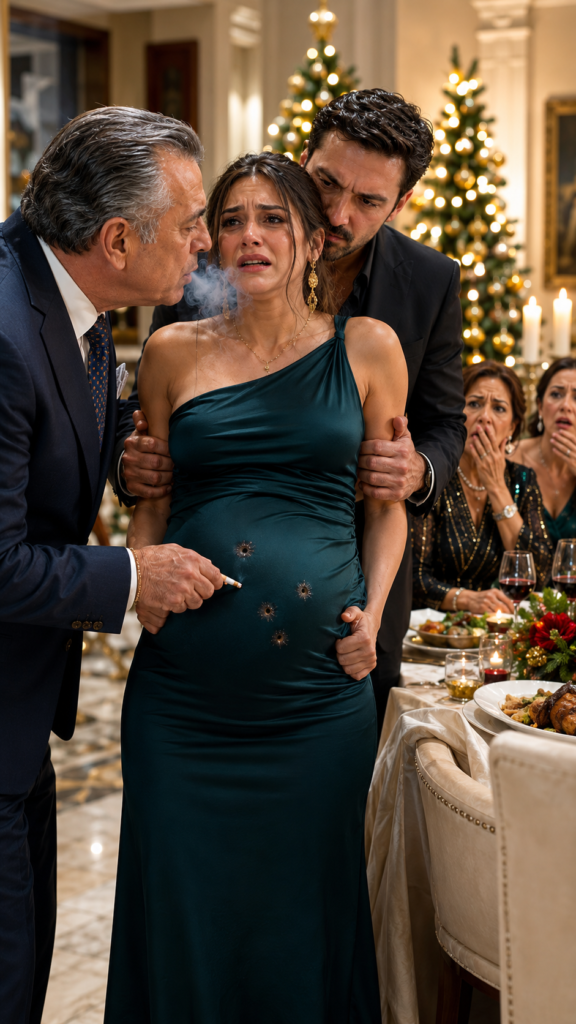
Don Aurelio, her father-in-law, smoked inside the dining room even though Mariana had asked him three times not to.
Doña Graciela, her mother-in-law, watched videos on her phone while criticizing the saltiness of the cod.
And Fernanda, her sister-in-law, recorded stories to show off a Christmas she hadn’t paid for.
—Mariana, we need ice —Rodrigo shouted from the table.
—It’s in the freezer. Can you bring it? My back hurts a lot.
Don Aurelio let out a heavy laugh.
—Look at that. The executive lady wants my son to serve. In this family, men don’t run errands.
Mariana lowered her gaze. For four years, she had tried to convince them with patience, money, and gifts. She had paid debts, medical bills, trips to Acapulco, and bought designer clothes.
The more she gave, the more they demanded.
By 9, everyone was seated. No one waited for her to finish serving. When Mariana finally placed a hand on her belly and asked for silence because the baby was moving a lot, Don Aurelio lit another cigarette.
The smoke hit her directly in the face.
—Please, put it out —she said—. The doctor said smoke can affect the baby.
Rodrigo looked at her with annoyance.
—Don’t start, Mariana. It’s Christmas.
—It’s also your son —she replied, her voice trembling—. Defend him just this once.
The dining room fell cold.
Don Aurelio stood up slowly, pride drunk in his gaze.
—No little girl with money is going to boss me around at my son’s table.
Mariana stepped back, but Rodrigo held her wrists.
—Calm down —he whispered—. Don’t make a scene.
Then Don Aurelio brought the lit cigarette closer to her sweater, right over her belly.
Mariana screamed.
Doña Graciela merely murmured:
—A good wife endures.
And in that second, Mariana stopped crying… because she had just understood that what was coming wasn’t going to be a family fight, but a war.
PART 2
Rodrigo released Mariana when she kicked him in the leg.
It wasn’t hard, but it was enough to break free. With trembling hands, she pulled her phone from her apron pocket and lifted her sweater just enough to photograph the red mark on the fabric.
Then she pointed the camera at the table.
Don Aurelio still held the cigarette in his hand. Rodrigo was pale. Doña Graciela pretended to adjust a napkin. Fernanda smiled nervously, as if this could still become family gossip.
—What are you doing, crazy? —Rodrigo said.
—Evidence —Mariana replied—. Seriously, you’ve crossed the line.
Don Aurelio tried to advance again.
Mariana grabbed the embroidered tablecloth she had bought for "the perfect Christmas" and yanked it with all her strength.
The turkey fell on Rodrigo. The punch spilled on Doña Graciela’s shirt. The romeritos ended up on the floor. The glasses shattered as if someone had burst the façade of a decent family they so proudly displayed.
Fernanda screamed because her new purse got stained.
—You’re sick! —Rodrigo roared.
Mariana took her purse, her IDs, and the folder with her pregnancy medical records.
—No. Sick was when I thought you all were my family.
Before closing the door, she glanced at the apartment she had paid for, penny by penny.
—Enjoy your last Christmas here.
At 10:06 PM, from a hotel room near Reforma, Mariana blocked the first card.
Then the second.
Then the third.
Rodrigo, Doña Graciela, and Fernanda had lived like rich people on someone else’s money. Restaurants in Polanco, gas, manicures, hair dyes, designer sneakers, weekend getaways, and even online gambling.
Everything was coming from Mariana’s accounts.
That night, the ATM told them what she had never managed to say forcefully enough:
declined.
Messages started flooding in before midnight.
“Unblock the card, Mariana.”
“My mom needs to pay for a medication.”
“You’re embarrassing us.”
“Think about the baby.”
Mariana didn’t respond.
The next morning, December 25, she went to the emergency room of a private hospital. The doctor examined the baby, documented the injury, and spoke to her plainly.
—The baby is fine, but this can’t be treated as an accident. You need to file a report.
Mariana nodded.
That same afternoon, she arrived at the building with her lawyer, two police officers, and the administrator.
Rodrigo opened the door wearing the same clothes as the night before.
—What is this?
—The consequence —Mariana replied.
Don Aurelio emerged from the hallway, still arrogant.
—Now you’re bringing cops to scare your in-laws?
The lawyer showed photos, videos, and the medical report.
The police officer asked Don Aurelio to accompany them to make a statement regarding aggression and domestic violence.
The old man turned red.
—I was just teaching her respect!
Mariana stared at him without blinking.
—No. You were teaching me why my son should never grow up around you.
Neighbors began to peek out. Doña Graciela cried, but not for Mariana. She cried because she was seen in flip-flops with shame written all over her face.
Rodrigo tried to grab Mariana by the arm.
—Honey, that’s enough. It’s my dad.
She pulled away.
—And you’re the man who held me so he could hurt me.
That sentence hit him like a slap.
But the public humiliation was only the beginning.
Two days later, Fernanda made a mistake that sunk her completely. She went out to dinner in Roma with a boyfriend who thought she was an heiress, wearing a necklace from Mariana and a purse she had taken from her closet.
Mariana arrived at the restaurant with her lawyer.
She didn’t scream. She didn’t cause a scene.
She simply placed the receipts, the photos of the closet, and the hallway camera captures on the table.
—Good evening —she said—. I’m here for my things.
Fernanda turned pale.
—They’re mine.
The boyfriend read the documents and dropped the napkin.
—So you’re not a businesswoman, but a thief?
Someone at the next table started recording.
Fernanda had to take off the necklace in front of everyone. She cried, cursed, and said Mariana was ruining her.
Mariana simply replied:
—No, Fer. I just stopped paying for the lie.
The next day, Rodrigo and Doña Graciela showed up outside Mariana’s office with a handmade sign:
“Mariana Salgado beats the elderly and abandons her family.”
They thought this would break her.
They were wrong.
Mariana went up to her office, opened the apartment’s camera files, and cut out three minutes: Rodrigo holding her, Don Aurelio bringing the cigarette closer, Doña Graciela saying a good wife endures, and Fernanda laughing.
She posted it on Facebook with a phrase:
“This is the family that claims to be the victim today.”
In less than an hour, the video exploded.
Neighbor groups, denunciation pages, colleagues, local journalists. The story was shared everywhere. People found the profiles of Rodrigo, Fernanda, and Doña Graciela.
The sign became their social sentence.
But the worst wasn’t the video.
The worst was what Mariana discovered afterward.
While reviewing bank transactions for her report, she found monthly transfers from Rodrigo to a woman named Abril. They weren’t small payments. They were rents, flowers, hotels, and tickets to Cancun.
For almost a year, Rodrigo had maintained another relationship while his pregnant wife supported his family.
Mariana felt the pain swell in her chest.
Still, she didn’t cry in front of anyone.
She kept everything.
Bank statements.
Screenshots.
Audios.
Videos.
Medical reports.
And when Rodrigo showed up a week later outside his parents' house, in the rain, with wilted flowers and the look of an abandoned dog, Mariana already knew he was there to perform.
—Forgive me —he said, kneeling—. My dad is sorry. My mom can’t sleep. I love you. I want to raise our son with you.
Mariana watched him from the entryway.
—And what do you need to prove it?
Rodrigo swallowed hard.
—Withdraw the report. Then we can sell the apartment and buy a bigger house… in both our names. To start over.
There it was.
He wasn’t seeking forgiveness.
He was looking for assets.
Mariana pretended to hesitate. She let him go on for a few minutes. Rodrigo talked about therapy, mass, family, and changes. When he left, he left his phone on the couch.
The screen lit up with a message from Doña Graciela.
Mariana didn’t have to guess the passcode. Rodrigo always used 0000.
She opened the chat.
The last audio was from him.
“Don’t worry, Mom. Mariana is sensitive because of the pregnancy. I cry a little, and she withdraws everything. When the baby is born, I’ll convince her to put the apartment in my name. After that, we’ll see how we get rid of her. That woman will calm down when she’s alone with a baby.”
Mariana listened to the audio twice.
Then she sent it to herself.
And she also found messages with Abril, where Rodrigo promised her that soon he would be free and have plenty of money.
At the conciliation hearing, Rodrigo arrived in a blue suit and a huge bouquet of roses.
—Let’s not make this public —he whispered—. We’re a family.
Mariana’s lawyer connected a memory stick to the computer.
Rodrigo’s voice filled the room.
“I cry a little, and she withdraws everything…”
Rodrigo’s face contorted.
He tried to say it was staged. Then the lawyer presented the hospital report, the videos, the threats, the transfers, and the messages with Abril.
The silence was brutal.
The conciliation was closed. The divorce progressed with protective measures, a domestic violence report, and a request to limit Rodrigo’s rights over the baby.
Doña Graciela still tried to play her last card.
She went to find Mariana outside a clinic in Santa Fe with two cousins, saying she only wanted to “talk like women.” But the cameras recorded how they tried to block Mariana’s path.
Clinic security intervened.
Another report.
Don Aurelio, furious because no one treated him like the patriarch anymore, went to Mariana’s parents’ house and smashed the windshield of her car with a cross wrench.
Mariana’s father recorded it from the door.
The police arrived before he could escape.
Rodrigo lost his job when his company reviewed expenses and found false invoices. Fernanda lost her boyfriend, her luxuries, and her image as the good girl. Doña Graciela stopped showing up at family gatherings because no one wanted to sit with her.
Mariana didn’t celebrate any of that.
She didn’t want revenge.
She wanted peace.
Her son was born two months later, healthy, strong, with big eyes. She named him Emiliano Salgado.
She gave him her last name.
Not out of hatred, but for protection.
She sold the apartment after remodeling it. Bought a smaller house in Coyoacán, with a patio, bougainvilleas, and a sunlit bedroom for Emiliano.
Years later, Mariana founded a support network for pregnant women living with domestic violence. She provided legal advice, psychological care, and support to leave before fear convinced them to stay.
One Christmas, Emiliano asked her why they didn’t invite “the other family.”
Mariana hugged him slowly.
—Because there are people who call controlling love, and destruction family.
The boy wrinkled his nose.
—So we’re not like that, right?
Mariana looked at the calm table, the warm punch, her parents laughing in the kitchen, and the white lights of the tree.
—No, my love. We’re learning to love without hurting.
That night, Mariana understood that she hadn’t lost a marriage.
She had walked out alive from a cage.
And although many said she was exaggerating, that she should have endured, that it was better to remain silent "for the baby," she knew the truth:
a child doesn’t need a complete family if that family welcomes him with violence.
He needs a mother who is alive, free, and strong enough to close the door when everyone else demands she stays seated at the table where they are destroying her.