PART 1
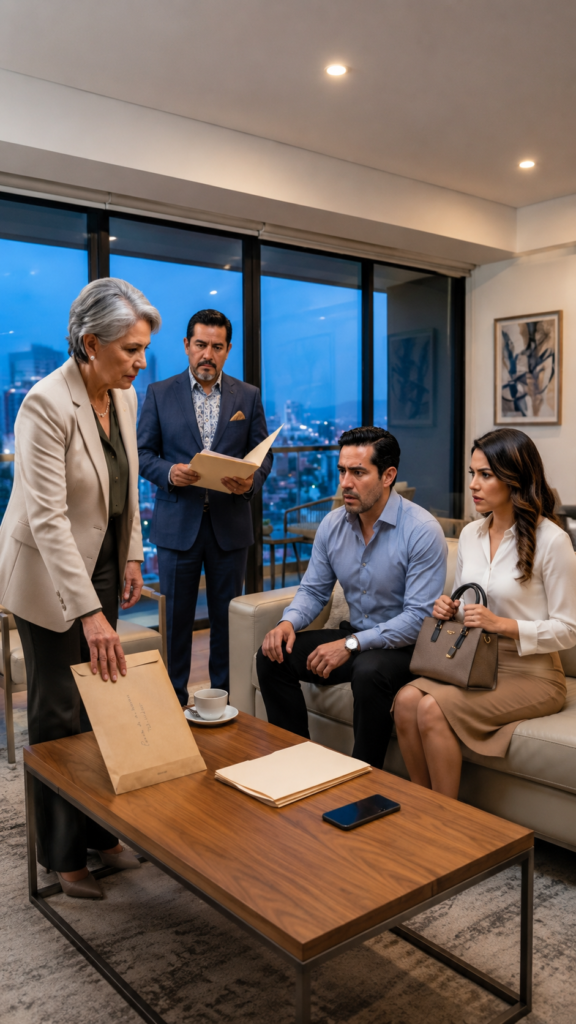
—Starting next month, you’re going to give us 15 thousand pesos, Mariana. And don’t come back with that you can’t, because you earn well and that’s what you’re here for as my son’s wife.
Doña Teresa said it without lowering her voice, sitting at the dining table in Mariana’s apartment, as if she were simply ordering another tortilla instead of demanding someone else's money.
Outside, it rained over the Del Valle neighborhood. Inside, the table was filled with mole, red rice, hibiscus water, and a tension that already smelled stronger than the food.
Mariana Salazar, 35 years old, took a deep breath.
She was the financial director at a pharmaceutical company in Santa Fe. She had a good salary, an apartment purchased before her marriage, and a patience that for five years everyone mistook for obligation.
Every month, she deposited 10 thousand pesos into the Hernández family’s account.
Medicines for Don Ignacio.
Late bills.
Gabriel’s car insurance.
“Loans” for Raúl, the brother-in-law who swore one day he would open a cell phone store in Plaza Meave.
And whims of Fabiola, his wife, who that Sunday was flaunting wine-colored nails and a handbag that, even if no one said it, had also come from Mariana’s credit card.
Gabriel, her husband, sat beside her. He didn’t intervene. He didn’t defend her. He barely looked at his phone, as if his wife’s humiliation was background noise.
—Teresa, if there’s a real medical expense, we’ll review it —Mariana said calmly—. But I’m not increasing the fixed support.
Doña Teresa’s spoon clanged against the plate.
—Support? What a pretty word to hide that you don’t want to fulfill your family obligations. My son gave you his last name, sweetheart. The least you can do is respond.
Raúl let out a chuckle.
—Come on, sister-in-law. For you, 15 thousand is what you spend on office coffees.
Fabiola adjusted her hair.
—Besides, we have a baptism on Saturday. One can’t show up looking all shabby, right?
Mariana looked at Gabriel.
She waited for a word.
Just one.
But he sighed in annoyance.
—Don’t start with your dramas. My mom is just asking for what’s fair.
Then Mariana understood something that hurt more than any insult: they weren’t eating with her; they were billing her.
She laid her fork on the table.
—No. From today on, I want clear accounts. If the money is for medicines, bring me the prescriptions. If it’s for Raúl, say so. If it’s for bags, nails, or expensive dinners, don’t call it family.
Silence fell heavily.
Doña Teresa turned red.
—Listen to the little lawyer. She thinks she’s so important because she wears heels and earns more than my son.
Mariana stood up.
—I’m not your ATM.
Gabriel pushed back his chair.
—Apologize to my mom.
—I’m not going to apologize for setting a boundary.
The first slap crossed her face.
Mariana froze, as if her body was taking time to accept what had just happened. Don Ignacio lowered his gaze. Raúl’s eyes widened. Fabiola didn’t move.
Doña Teresa, on the other hand, murmured:
—That’ll teach her to be so full of herself.
Mariana touched her burning cheek.
—Did you just hit me?
Gabriel was breathing hard.
—And you still answer back.
The second slap sent her crashing against the wall.
Her handbag fell to the floor. A lipstick rolled under the table. No one picked it up. No one shouted. No one said “enough.”
Mariana, with a split lip, looked one by one at the five witnesses.
And then she laughed.
A low, cold laugh that froze the entire table.
—Thank you —she said, wiping the blood away—. Truly, thank you. You’ve made it perfectly clear to me that there’s no family here. Just shameless clients.
Gabriel took a step toward her.
But Mariana lifted her phone with the cracked screen.
—Touch me again and I’ll call the police.
Then she looked at Doña Teresa.
—And starting tonight, this ATM is out of cash.
No one at that table could believe what was about to happen…
PART 2
Gabriel stood still.
Maybe it was the blood on Mariana’s lip. Maybe it was her look. Or perhaps, for the first time in five years, he understood that the woman he had just hit was no longer willing to ask for permission.
Mariana picked up her phone from the floor. The screen was shattered, but it still worked. She dialed Daniel, her trusted assistant.
—Ma’am, is everything okay?
—No. But I’m aware. I need you to do three things tonight.
Doña Teresa let out a laugh.
—Look at her. Now she’s going to call her employees to act important.
Mariana didn’t look at her.
—First, Daniel: block all additional cards linked to my account. Gabriel’s, Teresa’s, Raúl’s, and Fabiola’s. All of them.
Fabiola stood up.
—Hey, my spa appointment is tomorrow!
—Then work and pay for it yourself.
Raúl slammed the table.
—You’re crazy, seriously.
—Second —Mariana continued—: notify the private hospital that I will stop covering the premium packages for Don Ignacio. His basic treatment continues through IMSS, as it should. But no more luxury appointments paid by me.
Doña Teresa clutched her chest.
—You’re going to kill my husband!
Mariana finally looked at her.
—No. I’m going to stop paying for privileges for people who stay silent when I’m thrown to the ground.
Don Ignacio opened his mouth, but said nothing.
And that silence was another slap.
Gabriel tried to snatch the phone from her.
Mariana stepped back.
—If you touch me again, I’ll call 911, and this time everyone will testify.
The word “testify” fell like a bucket of cold water.
—Third, Daniel: tomorrow I want an external audit on Empaques del Norte, a supplier related to Gabriel. Check quality, contracts, emails, and possible conflicts of interest. I’m withdrawing from the committee.
At that, Gabriel paled.
—Mariana, don’t involve my job in this.
—Your job got involved all by itself when you’ve spent three years bragging that my company buys your packaging because you’re a genius.
She left the apartment in the rain.
She didn’t go to her mom’s in Coyoacán. She didn’t want to see her cry when she saw her swollen face. She went to a small studio near Santa Fe that she had rented months earlier “just in case I ever needed space.”
That night, she understood it wasn’t a whim.
It was an emergency exit.
In the bathroom, she took photos of her cheek, her split lip, and her marked wrist. She recorded an audio with the time, place, names of the five witnesses, exact phrases, hits, and demands for money.
Then she called lawyer Arturo Medina, a lawyer who had been a friend of her father’s.
—My husband hit me —she said without crying—. I want a divorce.
The lawyer didn’t ask if she was sure.
—Tomorrow, get a medical certificate. Keep messages, bank statements, audios, screenshots, and deeds. Don’t fight with anger against cynical people, Mariana. Fight with documents.
At 8:00 in the morning, Mariana already had the medical report.
At 9:30, she entered her office with thick makeup and a blue folder.
Daniel was waiting for her with reports. In five years, between deposits, cards, treatments, insurance, car payments, and supposed loans, the Hernández family had received almost 780 thousand pesos from Mariana.
It wasn’t support.
It was drain.
At 11:00, Gabriel appeared in the company lobby, shouting that his wife was a disgrace, that she had left his dad without medicines and that she wanted to take away his job out of revenge.
Security escorted him out while the cameras recorded everything.
At 4:00 that afternoon, the audit found the first email.
Gabriel had pressured to release boxes of defective medications with flaws in the batch numbers. The message said:
“Release it. With my wife, it’s easy to arrange.”
When Daniel showed her the screen, at first, Mariana didn’t feel rage.
She felt shame.
For years, she had defended Gabriel in front of executives, suppliers, and friends. She had presented him as a hardworking, serious, reliable man.
He had used her name as a key.
That same night, Doña Teresa uploaded a video to Facebook from the entrance of a public hospital.
She appeared crying, with a dark shawl and a broken voice.
“My rich daughter-in-law abandoned us. She took my sick husband’s medicines, and now she wants to destroy my son.”
The video spread quickly.
The comments were cruel.
“What a terrible woman.”
“That’s why those who have money become cold.”
“Poor lady.”
“That daughter-in-law deserves to be alone.”
Mariana didn’t respond.
She didn’t go live.
She didn’t insult.
She just saved screenshots, links, times, and names of the pages that spread the video without asking.
Because in her blue folder was already the part of the story that none of the Hernández family wanted to come out.
The next day, at 3:00 PM, Mariana published a statement.
She didn’t cry on camera.
She didn’t shout.
She didn’t create drama.
She uploaded four documents.
The first: a medical report confirming that Don Ignacio was still receiving treatment and consultation for his legal right.
The second: a fragment of the certificate documenting injuries to Mariana’s face and lip.
The third: a screenshot of a message from Gabriel sent at dawn:
“I lost my temper, I hit you, but you also provoked my mom.”
The fourth: a table with transfers and payments for almost 780 thousand pesos.
The internet changed abruptly.
“Then he did hit her.”
“780 thousand pesos and they still call her a terrible daughter-in-law.”
“The lady didn’t want medicine; she wanted an ATM.”
“How horrible that everyone saw and no one helped her.”
Several pages deleted Teresa’s video. One privately apologized, though never publicly.
But it didn’t end there.
A week later, three men arrived at the reception of Mariana’s company. They said they were there for a debt of Raúl: 420 thousand pesos for a loan to open a store that never opened.
They brought a promissory note.
In the document, Mariana was listed as a guarantor.
The signature looked like hers.
But it wasn’t.
Lawyer Arturo requested a copy and sent the paper for analysis. In less than 24 hours, it was confirmed: someone had forged her signature from old documents.
The question was how they had obtained those papers.
The answer came from where Mariana least expected.
Fabiola.
She wrote from an unknown number.
“Mariana, I can’t take it anymore. Teresa wants me to say that you did sign. She says that if I don’t support Raúl, he could go to jail. I have audios. I have messages.”
Mariana replied with just one phrase:
“If you want to save yourself, tell the truth to the Public Ministry.”
Fabiola arrived at the office the next day with dark glasses, no fake nails, and trembling.
She handed over audios where Doña Teresa said:
“Mariana always pays to avoid scandals. Copy her signature and then we scare her.”
She also brought messages from Raúl bragging:
“The lawyer won’t even notice. That old lady prefers to pay rather than make a fuss.”
That was the twist that brought down the Hernández family.
Raúl was summoned for fraud and forgery. Doña Teresa also had to testify. Gabriel lost strength in the company when the audit kept uncovering emails, dubious authorizations, and messages where he used Mariana’s name to close deals.
Don Ignacio called one night.
His voice sounded old, tired.
—Mariana… I knew Teresa was overstepping. But I never thought it would come to this. Forgive me for staying silent.
A knot formed in Mariana’s throat.
Not because she wanted to go back.
But because that silence had been a cage for five years.
—Don Ignacio, I wish you health —she replied—. But my life will no longer pay for your silence’s comfort.
She never called him again.
At the first divorce hearing, Gabriel arrived with scruffy beard and a suit that no longer fit him well. Doña Teresa couldn’t enter because she had a provisional restraining order for harassment.
The judge asked if there was any possibility of reconciliation.
Gabriel lowered his gaze, acting like a regretful man.
—I love my wife. It was a moment of anger. She also knows how to hurt with words. I just want to get my family back.
Mariana’s lawyer placed the medical certificate, the messages, the lobby video, the transfers, the audit emails, and the analysis of the forged signature on the table.
When Mariana spoke, she didn’t cry.
—I’m not here for revenge. I’m here to exit a marriage where my money was treated as an obligation, my work as leverage, and my body as something to be corrected with blows. I want nothing that isn’t mine. But what is mine will not be touched again.
Gabriel looked at her as if he finally understood.
The Mariana who supported everyone no longer existed.
Months later, the divorce was granted. The apartment remained in Mariana’s name because she had bought it before the marriage. The truck that Gabriel used was sold to cover some debts and legal expenses. The cards were canceled. The transfers blocked.
Gabriel had to sign a public apology for defamation. Raúl agreed to repair damages for forgery and was put under prosecution. Doña Teresa deleted her videos and posted a cold, forced apology in the same groups where she had called Mariana a monster.
Fabiola separated from Raúl.
Time later, she sent a message:
“I don’t ask you to forgive me. I just want to tell you that seeing you walk away made me understand that I could too.”
Mariana didn’t respond.
But she didn’t block her either.
Because sometimes a woman wakes up late.
And sometimes, even if it’s late, there’s still time to save herself.
The first dinner Mariana made in her reclaimed apartment wasn’t fancy. She ordered green pozole, bought sweet bread, and played soft music. She invited her mom, who looked at the living room, the new plants, and the table without screams.
—Now it really feels like your home —she said.
Mariana smiled.
She was right.
It used to be a beautiful place full of people who drained her. Now it was a silent home, with light, peace, and a freedom that couldn’t fit on any credit card.
Over time, her story circulated on Facebook as “the woman who shut down the ATM.”
Some said she was cold.
Others said she exaggerated.
Many women wrote to her privately to tell her that they too supported families that despised them.
Mariana almost always responded the same:
“Keep documents. Set limits. Don’t confuse love with debt.”
Because she learned that family isn’t proven by asking for money at the table.
Family is proven when someone is on the floor and you decide whether to lend a hand or take the opportunity to ask for another 5 thousand pesos.
For five years, Mariana believed that being a good wife meant enduring.
That night, she understood that enduring isn’t always a virtue.
Sometimes it’s the pretty way others call your cage.
And if her story makes those who believe a woman should pay, remain silent, and smile uncomfortable, let it be uncomfortable.
Because an ATM can run out of cash.
But a woman who regains her voice never gives change again.