PART 1
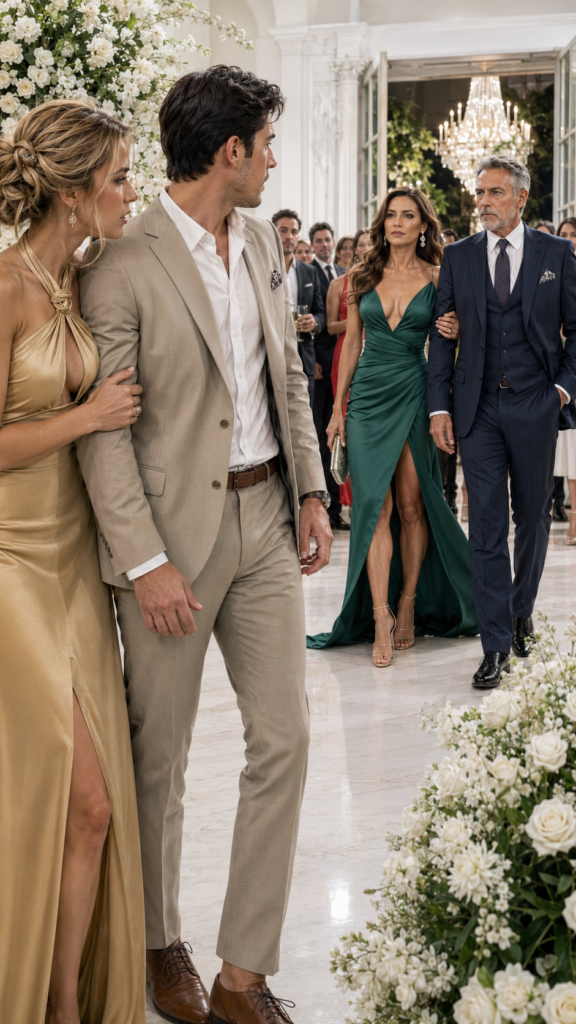
Everything seemed perfect for Rodrigo Santillán that night at the National Museum of Art in the Historic Center of Mexico City.
Italian suit, expensive watch, a new wife on his arm, and a reserved table among businessmen, politicians, and collectors who pretended to discuss culture while calculating who held more power.
Beside him was Renata, his wife of just six months, an influencer with a flawless smile who knew how to pose even when no one asked for a photo.
Rodrigo was happy.
Not for love.
For show.
Then he saw her.
Clara Mendoza entered the room in a simple, elegant dark blue dress, without a single scandalous piece of jewelry. She walked alongside Adrián Valle, owner of one of the most powerful private foundations in Mexico.
Rodrigo clenched his jaw.
Clara was his ex-wife.
The same woman he had spent 15 years presenting as “the one who fixes old paintings,” as if her work as a restorer were a strange hobby and not a respected profession.
Renata followed the direction of his gaze and smiled with poison.
“Is that Clara? Seriously, I thought she looked more... worn out.”
Rodrigo let out a low laugh.
“She always had that obsession with broken things. I guess she identifies with them.”
Renata covered her mouth, laughing.
What Rodrigo didn’t notice was a young woman, a few meters away, recording everything with her phone.
On stage, the president of the foundation called for silence.
“Thank you for joining us tonight. Thanks to your generosity, we have already raised over two million dollars to preserve Mexico's artistic heritage.”
The applause was elegant, cold, from people accustomed to donating without breaking a sweat.
“But tonight we have an announcement that will change the future of artistic conservation in our country.”
Rodrigo looked at Adrián Valle.
Adrián wasn’t looking at the businessmen.
He was looking at Clara.
“Mr. Adrián Valle has decided to donate fifty million dollars to create the Valle Center for Restoration and Artistic Research here, in Mexico City.”
The entire room gasped.
Renata's eyes widened.
Rodrigo stopped smiling.
“And Mr. Valle has personally chosen the founding director of this center. A conservator whose intelligence, ethics, and love for heritage embody exactly what Mexico needs.”
Clara placed a hand on her chest.
“It can’t be,” she whispered.
Adrián leaned towards her.
“Yes, it can.”
The president smiled.
“The founding director will be Clara Mendoza.”
For one second, no one moved.
Then the room exploded in applause.
Cameras, flashes, murmurs, phones raised. Clara walked toward the stage with trembling legs, while Adrián accompanied her without touching her more than necessary, just ensuring she didn’t fall.
Rodrigo felt the floor drop out beneath him.
The woman he had hidden for 15 years had just become the most important one in the room.
And the worst part wasn’t that.
The worst part was that, when Clara took the microphone, her eyes found his among the crowd.
There was no hatred in her gaze.
There was no mockery.
Only peace.
And that peace destroyed him more than any revenge ever could.
PART 2
“Thank you,” Clara said, her voice trembling but firm. “For years I worked restoring pieces that many had already given up for lost. I learned that something damaged isn’t something without value. Sometimes, what’s hurt just needs someone to have the patience to discover its beauty.”
The applause was warmer this time.
Several people stood up.
Adrián, from below the stage, didn’t applaud as the owner of the night. He clapped like someone finally witnessing justice.
Rodrigo lowered his gaze.
Renata was no longer glued to his arm.
She was looking at her phone.
“Rodrigo,” she murmured, pale beneath her makeup. “There’s a video.”
“What video?”
She turned the screen.
There he was, on the museum terrace, laughing at Clara.
“She always had that obsession with broken things. I guess she identifies with them.”
The video had already been shared thousands of times.
The text read:
“Businessman humiliates his ex-wife minutes before a millionaire names her director of a fifty-million-dollar center.”
Rodrigo felt his hands grow cold.
“That can’t be happening.”
Renata stepped back a pace.
“Yes, it’s happening, dude. And my publicist is calling me.”
“Renata, don’t exaggerate.”
She looked at him with a false smile, one used in front of photographers.
“I married you because you were powerful, not because you were dumb enough to insult the woman Adrián Valle came to honor.”
Rodrigo wanted to respond, but words failed him.
By the next morning, Mexico had a new villain.
They called him “The Gala Boyfriend,” even though he was no one’s boyfriend. Memes turned him into a clown. Gossip accounts posted old photos where Clara appeared behind him, always silent, always nameless.
An art critic wrote a thread about Clara’s work.
A journalist dug up interviews where Rodrigo spoke of “supporting female talent” while at home he stifled his own wife’s.
By noon, two investors canceled meetings with his construction company.
By five in the afternoon, a hotel group from Polanco suspended a contract.
Rodrigo locked himself in his Santa Fe office, looking at the city as if the glass could protect him from ridicule.
His partner, Mauricio, entered with a folder.
“The Reforma project wants to review our involvement.”
“What does ‘review’ mean?”
“They’re looking for a way to elegantly get rid of us.”
“They can’t.”
“Yes, they can. There are reputation clauses, Rodrigo.”
“For a video?”
Mauricio took a deep breath.
“For a video that confirmed what many people already suspected about you.”
Rodrigo looked at him as if he had just insulted him.
“Watch it.”
“No. No one fears you like they used to.”
That blow was worse than losing money.
Meanwhile, Clara woke up in her small apartment in the Roma neighborhood with eighty-three unread messages.
Her sister, Lupita, was the first to call her.
“Clara, are you sitting down?”
“I’m trying to understand if what happened last night was real.”
“It’s real. Mom cried. Dad said Rodrigo always got on his nerves. That, coming from Dad, is practically a love letter.”
Clara laughed, then covered her mouth.
She had gotten used to laughing quietly.
To not draw attention.
To not be a bother.
To not shine too brightly so Rodrigo wouldn’t feel less.
That morning, she had breakfast with Adrián on a quiet terrace in San Ángel.
He stood up when she arrived.
“Good morning, Director Mendoza.”
“Don’t start.”
“You should get used to it.”
She sat down, nervous.
“Why me?”
Adrián didn’t respond immediately.
“Eight months ago, I saw a private exhibition of portraits damaged by humidity in a hacienda in Puebla. There was one that seemed impossible to save. A woman with almost erased eyes. You returned her gaze.”
Clara swallowed hard.
“I asked who had restored it. They said your name. Then I looked for more of your work. There was very little published. That annoyed me. Someone with your talent shouldn’t be hidden in footnotes.”
“I don’t know what to say.”
“Don’t say anything. Build the center you would have needed when no one opened doors for you.”
In the following months, Clara stopped living hunched over.
The Valle Center would occupy a renovated old factory near the Alameda: laboratories, a library, conservation rooms, a climatized archive, and scholarships for young restorers from working-class families.
At first, Clara apologized before expressing her opinions.
“Sorry, but the lab needs indirect light.”
“Sorry, but that ventilation system doesn’t work.”
“Sorry, but we need another budget.”
One day, Adrián accompanied her to the elevator and said:
“Clara, you can speak without apologizing for existing.”
She looked at the floor.
“Old habit.”
“Then let’s create new habits.”
The relationship between them grew without scandal.
First came meetings. Then coffee. Then walks in Coyoacán. Books he recommended. Afternoons talking about pigments, history, old wounds.
Adrián never rushed her.
That was what scared her most.
Rodrigo had always demanded quick answers when it suited him, but he asked for patience when she suffered.
Adrián, however, asked what she wanted for dinner as if her desires mattered.
One night, after a meeting with donors, Clara confessed to him in the center’s courtyard:
“I stayed for fifteen years because at first, I thought being chosen was the same as being loved.”
Adrián didn’t interrupt her.
“Then he started correcting me, silencing me, laughing at my work. I became smaller. Less voice. Less pretty clothes. Fewer opinions. Less me.”
“You are not less anything,” he said.
Clara looked at him with tears in her eyes.
“I’m afraid of being someone’s project again.”
Adrián lowered his voice.
“I’d rather lose my place in your life than make you feel trapped.”
That night, she didn’t kiss him.
But for the first time, she wanted to do it without fear.
On the other side of the city, Rodrigo was sinking.
Renata left first.
Then the investors.
Then the bank.
Then the office.
In six weeks, Santillán Developments went from being an untouchable firm to a toxic company. Suppliers demanded upfront payments. Clients sought guarantees. Reporters waited for him outside.
The worst part wasn’t losing money.
The worst part was becoming visible just as he had made Clara invisible.
On a rainy Tuesday, Mauricio placed another folder on his desk.
“There’s an offer to buy our stake in the Reforma project.”
Rodrigo opened it and let out a bitter laugh.
“This is a pittance.”
“It’s the best we’re going to get.”
“Adrián Valle is behind this.”
“No,” Mauricio said. “You’re behind this. He didn’t have to lift a finger.”
Rodrigo fell silent.
Then he said the most absurd phrase of his life:
“I need to talk to Clara.”
Mauricio closed his eyes.
“To apologize?”
Rodrigo didn’t respond.
“To ask her to talk to Adrián, right?”
The silence confirmed it.
“Then you still don’t understand anything.”
But desperation makes proud men ridiculous.
That afternoon, Rodrigo went to Clara’s new apartment in Condesa, a spacious place filled with books, plants, and paintings in the process of restoration.
She greeted him at the door.
She looked different.
Not because of her clothes.
But because of her posture.
“What do you want, Rodrigo?”
He looked around.
“This place suits you.”
“Answer.”
“I came to apologize.”
“Then apologize.”
Rodrigo swallowed hard.
“I’m sorry for the gala. For the video. For the years. For making you feel small. For not seeing what you were.”
Clara crossed her arms.
“Fifteen years is a long time to not see someone who slept beside you.”
“I know.”
“Do you know?”
He clenched his jaw.
Then the truth came out.
“I need you to talk to Adrián.”
Clara didn’t shout.
She didn’t cry.
She just stopped looking at him like someone expecting something from him.
“My company is falling apart,” Rodrigo said quickly. “If he could publicly say this isn’t personal…”
“It’s not personal.”
Rodrigo blinked.
“That’s the worst for you. Adrián isn’t destroying you. People saw who you are and decided not to invest in that.”
“I made mistakes.”
“No, Rodrigo. You made choices.”
He looked down.
“I loved you,” Clara said, her voice barely breaking. “I stood by you when you had nothing. I reviewed your speeches. I remembered your family’s birthdays. I sat by your side when your projects failed. I gave you loyalty when you were nobody and patience when you thought you were everything.”
A tear fell down Rodrigo’s face.
“You lost more than contracts when you lost me.”
“I know now.”
“No. If you knew, you would have come without asking for anything.”
The silence weighed like a sentence.
Clara opened the door.
“I’m not going to talk to Adrián. I’m not going to protect you from the consequences of your character.”
“Clara, please.”
“Goodbye, Rodrigo.”
He looked at her as if he were finally seeing the woman he had had in front of him for fifteen years.
Then he left.
Clara closed the door and cried.
Not because she wanted to go back to him.
But because she finally didn’t want to.
The Valle Center opened the following spring.
Clara wore an emerald green dress and spoke in front of restorers, students, journalists, and families who had never been invited to such spaces.
“This center was born from a simple idea,” she said. “Nothing valuable should be discarded just because someone didn’t recognize its worth. That applies to art. It applies to memory. And it also applies to people.”
The applause filled the building.
Adrián looked at her with shining eyes.
This time, Clara didn’t lower her head.
Outside, across the street, Rodrigo watched from the sidewalk.
His company no longer existed. Renata spoke on podcasts about “closing toxic cycles.” He lived in a rented apartment and did minor consulting for men who once begged him for a date.
He heard a woman pass by him.
“Can you imagine being married to someone like that and not valuing her?”
The man replied:
“There are people who only recognize gold after throwing it in the trash.”
Rodrigo closed his eyes.
For the first time, he didn’t blame Adrián.
He didn’t blame the internet.
He didn’t blame Renata.
He blamed himself.
That night, he wrote a letter.
He didn’t ask for a meeting.
He didn’t ask for obligatory forgiveness.
He didn’t ask for help.
He just wrote that Clara was never small, that he made her feel that way because he couldn’t endure something he couldn’t control. He wrote that she was never boring, that her depth exposed him. That she was never broken, that her gift was always seeing beauty where others saw damage.
Clara received the letter the next day.
She read it once.
Then she tucked it away in a drawer.
Adrián entered her office and found her calm.
“Bad news?”
“No,” she replied. “Just an old chapter learning to end.”
Months later, Adrián proposed to her in the studio, on a rainy morning, while Clara restored the portrait of an unknown woman.
There were no cameras.
No gala.
No spectacle.
Just an antique ring, two coffees on the table, and a man who said:
“I admired you before you remembered you deserved to be admired.”
Clara said yes.
Years later, many continued to tell the story as an elegant revenge: the businessman who humiliated his ex and saw her become the most important woman in the room.
But Clara never told it that way.
She said that value doesn’t start when someone powerful recognizes it.
Applause doesn’t create talent.
The gaze of a millionaire doesn’t make anyone special.
Clara had already been shining before everyone turned to look at her.
And that was the part that hurt the man who lost her the most:
to understand too late that it wasn’t Adrián who made her great.
He just arrived in time to see her stop hiding.