PART 1
At 6:04 in the morning, in front of a humble house in Iztapalapa, Natalia stood frozen, clutching the folder of tickets against her chest as her mother told her she wasn't going on the trip anymore.
The car was running. Her parents' suitcases were already in the trunk. Her father, Don Ernesto, didn't lift his gaze from the steering wheel.
—Mija, you're stronger. You understand — her mom, Doña Rocío, said, adjusting her sweater —. Laura is coming with us in your place.
Natalia felt the air choke her.
That trip to Paris wasn't just a whim. She had planned it for two years. She had worked double shifts at a bakery, sold desserts on Sundays, stopped buying clothes, turned down outings, parties, and even vacations with her friends.
All to fulfill her mother's dream of seeing the Eiffel Tower.
Doña Rocío always joked, half-laughing, that Paris was for the rich, for movie people, not for a family who had barely finished paying off their mortgage.
But Natalia had promised her in silence.
One day, she would get them on a plane.
So that morning, she had everything ready: printed tickets, reservations, travel insurance, museum entries, a boat trip on the Seine, and even a little bag of lavender candies because her mom said they calmed her nerves.
Then Laura showed up.
She came down the stairs with a small suitcase, a huge jacket, and a face paler than usual. She didn’t greet anyone. She didn’t explain. She just threw her luggage into the car as if everything had been decided long ago.
Natalia looked at her dad.
He said nothing.
That silence was worse than any shout.
On the way to the airport, Natalia drove with stiff hands. Her mom was in the back with Laura, whispering to her, stroking her hair, passing her water, asking if she was okay.
Natalia felt an old rage, the kind that doesn’t just appear in a day.
Her whole life, she had been the responsible daughter. The one who understood. The one who didn’t ask for anything. The one who swallowed her anger because “Laura was more delicate.”
But not this time.
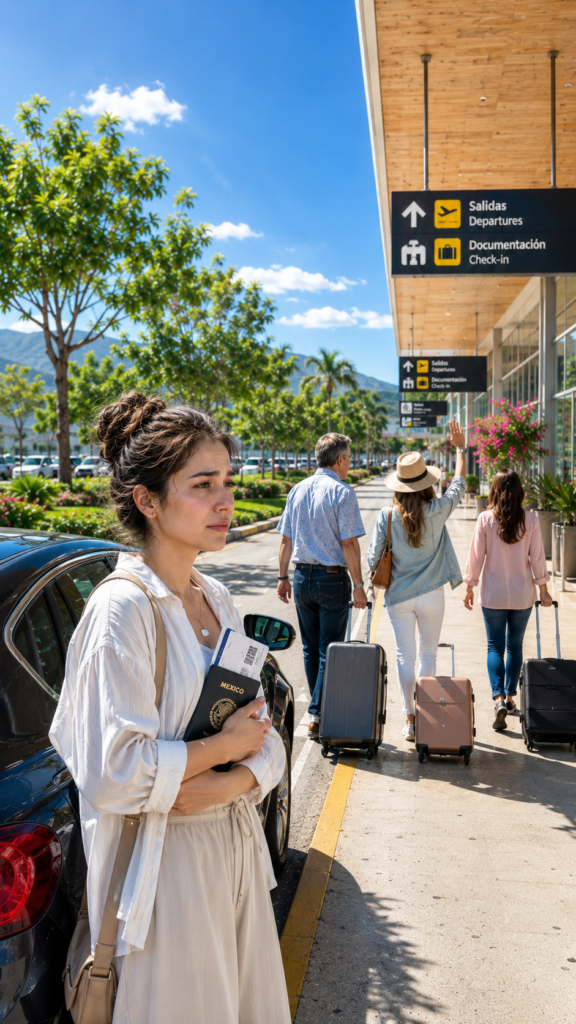
When she dropped them off at Terminal 1 of the AICM, Doña Rocío tried to hug her.
—Don’t be mad, mija. I knew you’d understand.
Natalia didn’t respond.
She watched her parents walk in with Laura. She watched her sister walk away without looking back. She saw how they took her money, her effort, and her place.
She stayed in the parking lot for almost 20 minutes.
Then she opened her phone.
She waited for the flight to take off.
And when the plane left Mexico, Natalia began to cancel everything.
The hotel. Canceled.
The Seine boat ride. Canceled.
The special dinner. Canceled.
The train to Rome. Canceled.
The guided tour. Canceled.
She only left the return tickets.
—Let them feel what it’s like — she murmured, with a calm that even scared her.
The phone started vibrating.
Mom.
Dad.
Laura.
Mom again.
Natalia didn’t answer.
Hours later, when she moved the car, she saw a black bag on the back seat. It was Laura’s.
She opened it with anger, expecting makeup, clothes, or some nonsense.
But inside was none of that.
There were medicine bottles, prescriptions, medical studies, and a folded envelope with the seal of a hospital.
Natalia opened it.
And upon reading a single word next to her sister’s name, she felt the world crumble around her.
PART 2
The word was there, cold, brutal, impossible to ignore.
It wasn’t a suspicion. It wasn’t a misunderstanding. It was a diagnosis signed by an oncologist from the National Institute of Cancerology, dated just 12 days prior.
Laura had cancer.
Natalia stood frozen in the garage, her bare feet on the cold floor, the bag open in front of her like a slap from life.
Her first impulse was to say “no.”
It couldn’t be.
Laura, the same one who mocked her shoes, the one who always made drama about everything, the one who seemed glued to her phone, was sick.
Really sick.
Natalia turned on her phone with trembling hands.
She had 31 missed calls.
Also, a voicemail from her mom.
She played it.
Doña Rocío’s voice sounded broken, with airport noise in the background.
—Mija, please answer. There’s something we didn’t tell you. Laura isn’t well. The doctors said that if she wanted to take this trip with us, it had to be now. After, she might not be able to. She asked us not to tell you anything. She didn’t want you to see her with pity. She didn’t want to ruin your life with her illness. Please, answer.
Then she heard Don Ernesto’s voice, barely a murmur.
—Tell her we love her.
The message ended.
At first, Natalia didn’t cry.
She stared at the screen as if she didn’t understand her own language.
Then it all hit her.
The strange week.
The closed doors.
Laura’s visits to the house.
The conversations that stopped when she entered.
Her dad’s face in the car.
The hand he had placed on her knee before arriving at the airport. That strong, desperate squeeze, which she had taken as guilt.
It wasn’t just guilt.
It was a goodbye that didn’t come out in words.
Natalia sat on the front step. The anger she had felt just hours before turned into shame.
She felt disgusted remembering the calm with which she had canceled everything.
Hotel.
Tours.
Trains.
Meals.
Photos that didn’t yet exist.
Memories that Laura might not get the chance to live.
But there was also another wound, one that didn’t disappear even if the diagnosis changed everything.
Why had no one told her?
Why did they treat her again as if she had no right to feel?
Her whole life had been the same.
When Laura got sick as a child, her parents rushed her to the doctor and left Natalia with a neighbor.
“You’re older, you understand.”
When money was tight, Natalia didn’t ask for new sneakers.
“You’re mature, you understand.”
When Laura cried over anything, everyone turned to her.
Natalia learned to shrink herself to not be a bother.
So, when her mom took the trip away from her face and said “you understand,” something inside her broke.
She didn’t cancel out of malice.
She canceled out of 30 years of feeling invisible.
But now the reality was crueler.
Her sister hadn’t taken a trip from her.
She had hidden a goodbye.
Natalia entered the house, opened her computer, and began to fix what she had destroyed.
Some reservations couldn’t be recovered. Others cost double. One card didn’t process the charge. On another, she had to accept interest that would haunt her for months.
She didn’t care.
She sold a ring she had kept, took out a quick loan, and spoke with a friend who worked at a travel agency.
—Dude, are you sure? This is going to cost you a fortune — her friend said.
—I know.
—And why are you doing it?
Natalia looked at the bag of medicines on the table.
—Because I messed up horribly.
At 11:40 PM, she managed to recover the hotel. At 1:15 AM, she got another Seine tour. At 3:00 AM, she bought a ticket for herself on the first available flight to Paris.
She didn’t sleep.
She showered, packed two changes of clothes in a backpack, and left the house without turning off the lights.
During the flight, she squeezed one of the lavender candies she had found in Laura’s bag. She didn’t open it. She just held it as if it were a silly way to ask for forgiveness.
When she arrived in Paris, she didn’t feel excitement.
Just fear.
She went straight to the hotel. She climbed to the 4th floor. She stopped in front of the door and heard voices inside.
She knocked.
Her dad opened it.
Don Ernesto looked at her as if he had seen a miracle. That serious, stubborn man, who never cried even at funerals, crumbled right then and there.
He hugged her so tightly that Natalia could barely breathe.
—Forgive me, daughter — he said —. I didn’t know how to tell you. I didn’t know how to protect either of you.
Inside, Doña Rocío covered her mouth with her hands.
Laura was sitting by the window, wrapped in a gray jacket. Her hair was tied up, her lips dry, and a tired smile on her face.
—I told you I would come — Laura murmured.
Natalia approached slowly.
She didn’t know whether to hug her, confront her, or kneel down and cry.
—I found your bag — she finally said.
Laura looked down.
—Yeah.
The answer was too calm.
Natalia frowned.
—Yeah, what?
Laura took a deep breath.
—Yeah, I left it.
Doña Rocío closed her eyes.
That was when the twist hit Natalia, breaking her completely.
The bag hadn’t been a mistake.
Laura had purposefully left it in the car.
For weeks, she couldn’t bring herself to tell her sister the truth. She couldn’t bear the thought of Natalia looking at her with pity, choosing her words carefully, stopping living before she died.
So, she devised the clumsiest, most painful plan in the world.
She asked to go on the trip instead of Natalia.
She asked for everyone to seem selfish.
She asked Natalia to get mad.
And she left the bag for her to discover the truth when they were already far away.
—I preferred you to hate me for a while — Laura said, her voice broken —. Than to start saying goodbye to me before my time.
Natalia covered her face.
—But I canceled everything, Laura.
The room fell silent.
Laura lifted her gaze.
—What?
Natalia felt the shame burning her skin.
—I canceled the hotel, the tours, the train, everything. I thought I was being used. I thought that… I truly thought you didn’t care.
Doña Rocío began to cry.
Don Ernesto sat on the bed, defeated.
Laura didn’t scream.
That hurt more.
She just closed her eyes for a few seconds and then smiled with enormous sadness.
—Well, you are my sister — she whispered —. Dramatic, but with style.
Natalia let out a broken laugh.
Then she told her that she had recovered almost everything. Not the same, not perfect, not cheap, but enough.
The next day, the four of them walked slowly through Paris.
Laura tired quickly. Sometimes they had to sit on any bench. Sometimes her face lost color, and Natalia pretended not to be scared.
Doña Rocío looked at the Eiffel Tower with teary eyes. Don Ernesto took blurry photos because his hands were shaking.
Laura mocked him.
—Dad, you look like a Facebook dad, focus better.
Everyone laughed.
For a few hours, the illness stayed away.
It didn’t disappear, but it remained silent.
That night, during the Seine boat ride, Laura rested her head on Natalia's shoulder.
—I didn’t want to take your dream away — she said.
—It was our dream — Natalia replied.
—No. You built it.
—And you saved it.
Laura looked at her, confused.
Natalia swallowed hard.
—If you hadn’t left that bag, I would have been left with anger. I would have spent years believing you all replaced me out of whim. You saved me from becoming a bitter person.
Laura pressed her lips together.
—So we’re even.
But they weren’t even.
They would never be.
Laura died seven months later, in Mexico, in a bed surrounded by flowers, with her mom, her dad, and Natalia holding her hand.
There was no perfect speech.
There was no miracle.
Just a family understanding too late that love can also hurt when it’s hidden.
Later, Doña Rocío confessed to Natalia that Laura had planned to leave the bag from the beginning.
She also told her that Laura didn’t want anyone to know about the canceled trip.
—She said that if you carried that guilt, she wouldn’t be able to leave in peace.
Natalia never told Laura how hard it was to recover everything.
She never mentioned the debt-laden card, the ring sold, or the nights crying in silence.
It was her secret.
Her way of paying.
Years later, Natalia still keeps a lavender candy in her wallet. It’s crushed, old, and odorless.
When she flies, she takes it out during takeoff and squeezes it in her hand.
She doesn’t eat it.
She just holds it until the wheels touch the ground.
As if she could still protect Laura from getting dizzy.
And every time someone tells her that family should always understand everything, Natalia thinks the same:
No, family shouldn’t force you to understand in silence.
Family should have the courage to tell the truth before breaking your heart.