PART 1
—You’re late, Doctor. Someone else has taken your place.
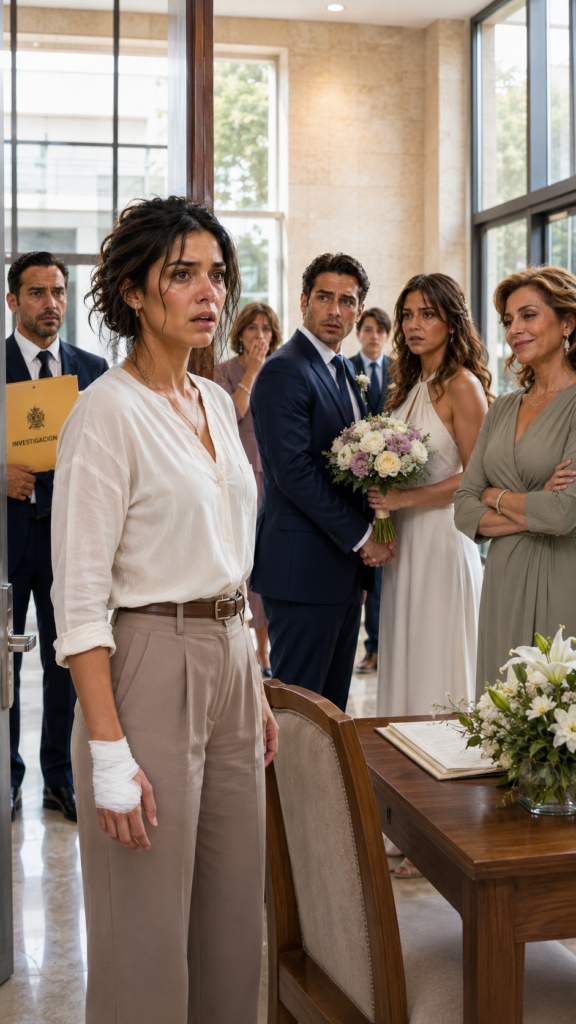
Elena Vargas walked into the Civil Court of Coyoacán, her surgical scrubs wrinkled, hair loose from a haphazard bun, and a stain of iodine on her left sleeve.
She still wore the blue surgical covers over her sneakers. In her right hand, she clutched a small bandage, because less than an hour ago, she had been fighting to save the life of a six-year-old girl on the operating table.
The civil wedding was scheduled for 2:00 PM.
She arrived at 1:57.
She wasn’t late.
But the look on the guard's face froze her blood.
—Room 3, with Judge Murrieta —Elena said, nearly out of breath.
The guard lowered his gaze.
—It’s already started, Doctor.
Elena walked down the hallway, the ridiculous sound of the paper covers rustling with each step.
Chac. Chac. Chac.
As if each step was taking her straight into a shame she couldn’t comprehend.
She pushed the door open.
And the entire court went silent.
At the front stood Alejandro Montalvo, the man with whom Elena had lived for three years, the one who called her “my favorite surgeon,” the one who supposedly understood her long shifts, her sleepless nights, and her emergencies.
But he wasn’t alone.
Beside him stood Camila Robles.
Her best friend since high school.
Dressed in white.
Holding a bouquet of yellow tulips in her hands.
The same tulips Elena had chosen months before.
The judge’s folder was already closed.
The certificate was signed.
Elena’s mother, Doña Rosario, cried in a corner. Her brother Mateo had his fists clenched. Several guests avoided looking at her, as if witnessing her pain was too uncomfortable.
Alejandro looked up.
He didn’t run to her.
He didn’t apologize.
He just swallowed hard.
Then Graciela appeared, Alejandro's mother. Impeccable, elegant, in a navy blue dress, with a smile that was anything but human.
She approached Elena, looked her up and down, and uttered a quiet but venomous phrase.
—I told you, dear. A woman who lives in a hospital can’t form a family. Now leave with dignity.
Elena felt her chest tightening.
Camila didn’t cry.
She just tightened her grip on the bouquet.
Alejandro averted his gaze.
In that moment, Elena understood that nothing had been improvised. The ceremony had been moved up. Her absence had been weaponized. Her vocation had been twisted into guilt.
But when she stepped toward the door, a man in a dark suit appeared in the frame.
He carried a mustard-colored folder under his arm and a discreet badge on his belt.
He looked at Elena as if he had been waiting for her since before everything fell apart.
—Doctor Elena Vargas —he said—, I’m Commander Rafael Ochoa from the Prosecutor’s Office. We need to talk about Alejandro Montalvo… and the bank account that was opened using your signature.
PART 2
The silence that fell in the room was louder than any scream.
Graciela tried to position herself in front of Elena, as if she could still control the scene.
—Officer, this is a family matter. She has nothing to do here anymore.
Commander Rafael Ochoa didn’t even raise his voice.
—Ma’am, this has ceased to be a family matter since irregular transfers of over 2 million pesos appeared.
Alejandro turned pale.
Camila lowered her eyes.
Elena felt the ground shift beneath her, but she didn’t fall. She had spent too many hours in operating rooms, watching bodies open up, blood spill, monitors scream. She knew how to breathe when everything around her spiraled out of control.
The commander invited her into the hallway.
—Doctor, did you know your name appears on a bridge account linked to a company called Montalvo Robles Asesores?
The surname Robles hit her like a blow to the chest.
Camila Robles.
Her friend.
The woman who had slept in her home after breaking up with her first boyfriend. The one who had accompanied Elena to try on dresses. The one who knew exactly how much it hurt to feel the hospital was stealing pieces of her life.
—No —Elena replied—. I don’t know that company.
Rafael opened the folder.
There were copies of contracts, account statements, signatures, printed emails, and transfers dated over 11 months.
—This account was opened in the name of Alejandro Montalvo and yours. Your signature appears on 4 documents.
Elena suddenly recalled a Saturday morning at a branch on Insurgentes.
She had just come off a 32-hour shift. Alejandro took her out for breakfast, told her they needed to sign papers to organize the apartment credit. Camila was waiting outside, saying she was just stopping by to say hello.
Elena signed without reading everything.
She signed because she loved.
She signed because she trusted.
She signed because she was exhausted and never imagined that the man who was going to marry her would use her fatigue as a tool.
—I didn’t know anything —she said, her voice breaking.
—That’s what we suspected —Rafael replied—. But we need your formal statement. Alejandro and Camila were going to be notified today after the ceremony.
Elena looked toward the courtroom door.
Inside were the two of them, dressed like newlyweds, believing they had humiliated her completely.
And Graciela, the mother-in-law who had told her for years things like “a doctor doesn’t know how to run a household” or “my son needs a present wife, not a woman who smells like a hospital.”
Elena slowly removed the blue covers from her sneakers and threw them in a trash can.
Then she wiped a tear away.
—I want to go in.
The commander observed her for a few seconds.
—You can stand next to me. Don’t argue. Don’t sign anything. Don’t respond to provocations.
—I’ve signed too much today without knowing —she said.
When they returned to the courtroom, everyone straightened up.
Alejandro tried to smile, but his face wouldn’t obey.
—Elena, we can talk outside.
—No —Rafael intervened—. First, you will listen.
The commander pulled out the first document.
—Alejandro Montalvo Sáenz, you are formally notified within an investigation for alleged fraud, forgery of consent, and misuse of financial identity.
Alejandro received the paper with trembling fingers.
Then Rafael turned to Camila.
—Camila Robles Santillán, you are also notified as the managing partner of Montalvo Robles Asesores.
Camila dropped the bouquet.
The yellow tulips scattered across the floor like a mockery.
Doña Rosario let out a sob.
—Camila… you used to eat at my house.
Camila began to cry.
—I swear I didn’t know he used your signature like that.
Elena locked eyes with her.
For years she had believed she knew her. She knew her favorite coffee, her fears, her road trip songs, the way she bit her lip when she lied.
And just at that moment, Camila was biting her lip.
—You used my bouquet —Elena said.
Camila blinked, confused.
—What?
—My tulips. Of all the things you could steal from me, you wanted that too.
Alejandro stepped forward.
—Elena, don’t make a scene.
Mateo, Elena’s brother, let out a dry laugh.
—Seriously, dude? You changed girlfriends in the middle of court and still ask her not to make a scene?
Several guests lowered their gaze.
Graciela approached the commander.
—My son doesn’t need to steal. My family has a name.
Rafael opened another page.
—There are also messages where you suggest moving the ceremony up by 30 minutes if Doctor Vargas was still in surgery.
Graciela froze.
Elena felt the pain shift.
It was no longer just betrayal.
It was planning.
Rafael read a portion without exaggeration, in a professional tone:
—“If she doesn’t arrive, better. That way everyone will see she chose the hospital. Camila will know how to be where a wife should be.”
Elena closed her eyes.
It wasn’t an impulse.
It wasn’t a confusion.
It wasn’t a wedding that went wrong.
They had prepared her replacement like one prepares a table.
Alejandro murmured:
—My mom didn’t understand our relationship.
Elena opened her eyes.
—You did understand it. That’s why you used her.
The room fell silent.
Then the judge, who until that moment had seemed eager to become invisible, cleared his throat.
—For civil purposes, this act is subject to review for possible vices in the declaration of intent and for the intervention of ministerial authorities in the case.
Camila raised her face.
—What do you mean subject to review?
Elena almost smiled, but couldn’t.
The woman who had robbed her of a ceremony was now trembling over a piece of paper.
Rafael concluded the proceedings. He handed over dates, names of offices, and subpoenas. He asked Elena to present herself on Monday with a lawyer.
Doña Rosario walked over to her daughter and hugged her tightly.
—Forgive me, daughter. They told me you had notified that you weren’t coming.
Elena pressed her lips together.
—I was saving a little girl, Mom.
—I know —Rosario replied—. And that is worth more than all of them combined.
That phrase broke something inside Elena.
She cried for 10 seconds.
Just 10.
Then she pulled away and looked at Alejandro.
—While you all changed me like I was an empty chair, a six-year-old girl started breathing again.
Alejandro didn’t respond.
He had nothing.
Camila tried to approach.
—Elenita, please...
—Don’t call me that.
Elena’s voice wasn’t loud, but it cut through the air.
—You knew my schedule. You knew if they called me with an emergency I would go in. You knew it hurt to feel like I was never enough. And still, you put on a white dress “just in case.”
Camila cried harder.
Graciela wanted to regain her arrogance.
—One day you will understand that a marriage needs presence.
Elena looked her in the eye.
—No. A marriage needs loyalty. And there was none of that.
Before leaving, Elena picked up a tulip from the ground and placed it on the act.
—How cheap it was for you to believe you had won.
She left the court with her mother and brother.
The guard at the entrance lowered his head, but this time not out of shame. It was respect.
Outside, Mexico City was still alive: honking, esquite vendors, a truck screeching to a halt, old rain stuck to the pavement.
Elena looked at her hands.
Tired hands.
Wounded hands.
Hands that hadn’t held a bouquet, but had held a life.
In the following weeks, the story became a huge gossip among family, colleagues, and neighbors. Some said Elena had been humiliated. Others that Alejandro had done the right thing because “a doctor would never have time.”
And there lay the worst part: there was always someone ready to blame a woman for not fitting the mold.
But the documents spoke louder than the gossip.
Elena’s lawyer, Sandra Mejía, reviewed each statement. She blocked the joint account. Requested certified copies. Proved that Elena had signed under deception and never received benefits from the transfers.
—They used you as a façade —she told Sandra—. Your profession, your good history, your trust. All of that served them.
Elena lowered her gaze.
—I signed.
—You signed in love. That doesn’t make you guilty. It makes you human.
That phrase took months to sink in.
Alejandro wrote to her 23 times.
“We need to talk.”
“My mom got too involved.”
“Camila confused me.”
“I did love you.”
Elena didn’t respond.
Sandra replied for her with 5 cold lines: all communication would be through legal means. Any attempt at contact would be documented.
Alejandro stopped writing.
Camila showed up 1 month later outside the hospital.
She was no longer wearing a white dress or carrying tulips. She wore dark glasses, a swollen face, and a guilt that had come too late.
—I’m going to testify against Alejandro —she said—. He lied to me too.
Elena looked at her from several meters away.
—And when were you going to ask me if I didn’t want to get married anymore?
Camila didn’t respond.
There lay the answer.
She didn’t betray her because she fully believed a lie. She betrayed her because that lie suited her.
—I thought he chose me —Camila whispered.
Elena felt pity, but not tenderness.
—No, Camila. He just needed someone to accept occupying a stolen place.
Camila cried.
Elena kept walking.
The case lasted 9 months.
The company Montalvo Robles Asesores was dissolved. Alejandro faced lawsuits from 3 investors. Camila provided emails, audio recordings, and screenshots to reduce her responsibility. Graciela was called to testify about the messages where she pressured to move the ceremony up.
The cruelest detail appeared in a conversation.
Graciela had written 2 weeks prior:
“If Elena stays in surgery, don’t wait for her. Let her learn that a wife can’t live for strangers.”
Alejandro replied:
“Camila can be prepared.”
And Camila wrote:
“I’ll wear something white, discreet. Just in case.”
Elena read that screenshot in Sandra’s office.
She didn’t scream.
She didn’t cry.
She just said:
—So my wedding wasn’t ruined. They had turned it into a trap.
Sandra nodded.
—Yes.
Sometimes the truth hurts less when it stops hiding.
The six-year-old girl, Sofía, left the hospital 14 days later. Her mother sought out Elena in the hallway and squeezed her hands with a gratitude that needed no words.
—Thank you for staying, Doctor.
Elena felt her chest open up.
Thank you for staying.
Not in the court.
Not with Alejandro.
Not within a family that wanted her small, available, and obedient.
Thank you for staying where a life needed her.
That night, Elena arrived at her new apartment in the Portales neighborhood. She had no dining table. She ate quesadillas sitting on a cardboard box. Her rescued dog, Churro, stole a piece of tortilla and then lay down by her feet as if he understood everything.
Elena cried.
But this time it wasn’t just pain.
It was also relief.
Over time, she learned that Alejandro and Camila didn’t last even a year. Distrust rotted them quickly. He blamed her for testifying. She checked his phone. Graciela said in family gatherings that “modern women destroy homes,” as if she hadn’t helped to push the first one.
Elena didn’t celebrate.
Nor did she forgive.
She simply stopped looking back every morning.
The hospital remained tough. Long shifts. Cold coffee. Parents praying in hallways. Scared children. Days when winning a battle wasn’t enough to forget the losses.
But Elena kept going.
A year later, she was invited to speak with new residents. She didn’t want to. She hated speeches. Still, she accepted.
She stood in front of 35 young people with clean coats and nervous eyes.
—One day, someone will tell you that loving this profession makes you cold —she began—. That by caring for others you neglect your life. That for arriving late to a meal, a party, or even a ceremony, you are worth less.
She paused.
She thought of the broken tulips, the signed act, the blue covers thrown in a trash can.
Then she thought of Sofía leaving the hospital with a pink bracelet and a tired smile.
—Don’t let anyone turn your vocation into shame. Just learn not to give your heart to someone who needs to dim your light to feel important.
At first, there was silence.
Then applause.
Elena stepped down from the podium with trembling hands.
A resident approached her.
—Doctor, my boyfriend says that medicine will always come before him.
Elena looked at her gently.
—Then ask yourself if he would be there for you when someone’s life depends on 1 minute.
The young woman didn’t respond, but her eyes changed.
That night, Elena returned home and understood something that before would have seemed impossible.
The worst day of her life hadn’t taken everything from her.
It had taken a lie.
It had taken a false friend.
It had taken a family that would never have respected her.
And it returned something much more important: the certainty that she didn’t have to apologize for being who she was.
Elena Vargas arrived at the court with wrinkled scrubs, tired hands, and an open heart.
Many wanted to tell this story as a defeat.
The replaced bride.
The abandoned doctor.
The woman who arrived late.
But the complete truth was different.
That day, a girl returned home.
A fraud was uncovered.
A betrayal lost its mask.
And a woman understood that arriving late to a wedding where they planned to humiliate her was, although it hurt like hell, the most brutal and perfect way to arrive on time to her own life.