Anna got a job with a family in Kensington within two weeks.
Two children, a reasonable schedule, a professional arrangement with clear boundaries that she appreciated precisely because they were clear. No decade of accumulated invisible weight. No color-coded schedule on the refrigerator that someone else would quietly reorganize. Just work, which she was good at, and money, which she needed, and evenings that belonged to her.
She was fine.
She told herself she was fine, which she mostly was, except for the Tuesdays when Mia would have had her therapy session and Anna would wonder whether James had remembered to book the next one. Except for the Saturdays that used to be grocery runs. Except for the Sunday mornings that used to be pancakes.
She was fine.
Leo texted first.
Three weeks after the firing, on a Wednesday at 10pm: hey anna. hope ur ok. mia says hi.
She typed back: I'm good, Leo. How are you doing? How's Mia?
Fine. she misses you a lot.
I miss her too. She has my number. Tell her to use it.
ok.
Then, two days later: anna can you come to my match saturday? dad has a thing.
She went. She sat in the stands and watched Leo play football and afterward he found her and she bought him a terrible hot chocolate from the mobile van and they sat on a bench and he talked about the match for twenty minutes and she listened.
"Is Dad okay?" Leo asked, at the end.
"That's a question for him."
"He's been weird."
"Give him time."
Leo turned his cup in his hands. "Claire was at the house last week. She and Dad had a fight. I don't know what about."
Anna said nothing.
"Sophie showed him something," Leo said. "I don't know what. But Dad's been in his study a lot since then."
Anna watched the pitch, where the last of the afternoon light was turning orange.
"He loves you," she said. "That's real. Whatever's going on, that's real."
"I know," Leo said. "I also know that you were the one who showed up."
He didn't say anything else. He didn't need to.
Mia called on a Thursday evening.
Not a text. An actual phone call, the way Mia almost never communicated, which meant it was important enough to be afraid of.
"Hi," Mia said.
"Hi, Mia."
A pause. "Are you busy?"
"I'm making dinner. I can talk."
Another pause. Mia, gathering herself. "I told Dad that he made a mistake."
Anna stopped stirring. "When?"
"Last week. At dinner. Claire wasn't there. It was just us." A breath. "I said — I told him that he should have talked to us before deciding you didn't need to be here anymore. That we should have been part of that conversation. That we're not little kids."
"What did he say?"
"He said I was right."
Anna stood very still in her kitchen.
"He said I was right," Mia said again, like she was still surprised by it, "and he looked — he looked really sad. Like he'd already known but needed someone to say it."
"Mia," Anna said.
"I'm not trying to make you come back. I know it doesn't work like that. I just wanted you to know that I said it. Because you never would."
Anna's eyes were doing something they almost never did.
"You didn't have to do that," Anna said.
"I know," Mia said. "I did it anyway."
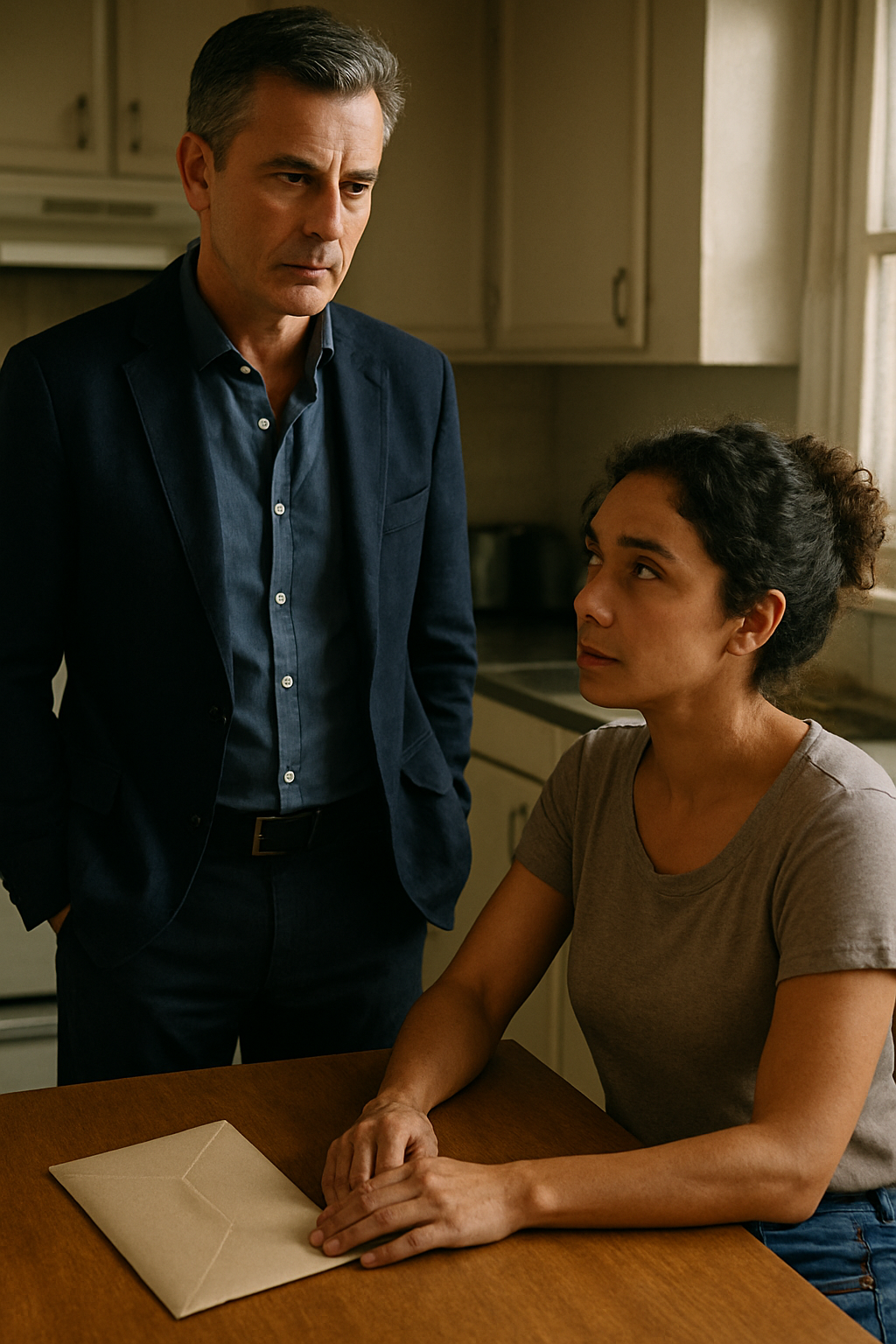
James showed up at her apartment on a Saturday morning.
She saw him through the intercom camera before buzzing him in — the navy wool coat, the still-good-looking face that was carrying something it hadn't carried the morning he fired her.
She let him in.
He stood in her small kitchen — a kitchen that held one person, that was exactly the size of one person's life — and he looked around it the way people look at rooms when they're not looking at rooms.
"I need to say something," he said.
"All right."
He put his hands in his pockets. "Anna. What you were to this family — what you are to those children — I knew what it was. I've always known. I told myself the severance was fair, that the children were grown, that it was the right time. None of that was true. It was convenient." He looked at her directly. "And three years ago, I tried to do the right thing. I put the house in your name because I knew — I have always known — that you deserved something concrete. Something not contingent on whether I was making good decisions. And then I made a bad decision and I took it back and I told myself it was a formality. That was wrong."
Anna looked at him.
"What do you want from me?" she asked. Not unkindly.
"I want to say it out loud," he said. "That you were part of this family. That those children love you. That firing you was the worst thing I've done in a long time." A pause. "I'm not asking you to come back. I'm not asking you to forgive me. I just need you to hear me say it."
Anna sat down at her kitchen table.
"I hear you," she said.
He stood for a moment. Then he took an envelope from his coat pocket and set it on the table.
"It's the deed," he said. "To the lake house. I transferred it back."
She looked at it.
"James," she said.
"You don't have to do anything with it," he said. "Sell it. Keep it. Give it to Sophie. It doesn't matter. What matters is that it's yours." He looked at his hands. "It always should have been."
She didn't pick up the envelope. Not yet.
"Sophie is going to be very pleased with herself," Anna said.
Something shifted in James's face. Something that had been held very carefully for several weeks.
"Yes," he said. "She will be."
They sat in the small kitchen, not quite friends and not quite strangers, in the particular quiet of two people who have said the important thing and are figuring out what comes next.
Outside, the Saturday morning went on. Anna made coffee.
It was a beginning. A different kind of one. Not the ten years, not the before.
Something new, starting here.