Anna Reyes had been with the Whitfield family for ten years when James called her into his study on a Monday morning and fired her.
He did it well. That was the thing. He sat across from her at the desk she had polished for a decade and he said "this isn't a reflection on you" and "the children are older now" and "I want to move in a new direction" and he gave her three months' severance, which was generous, and she sat in the chair and watched his hands — which couldn't quite stay still — and she said, "All right, James."
She did not cry. She would not give the study that.
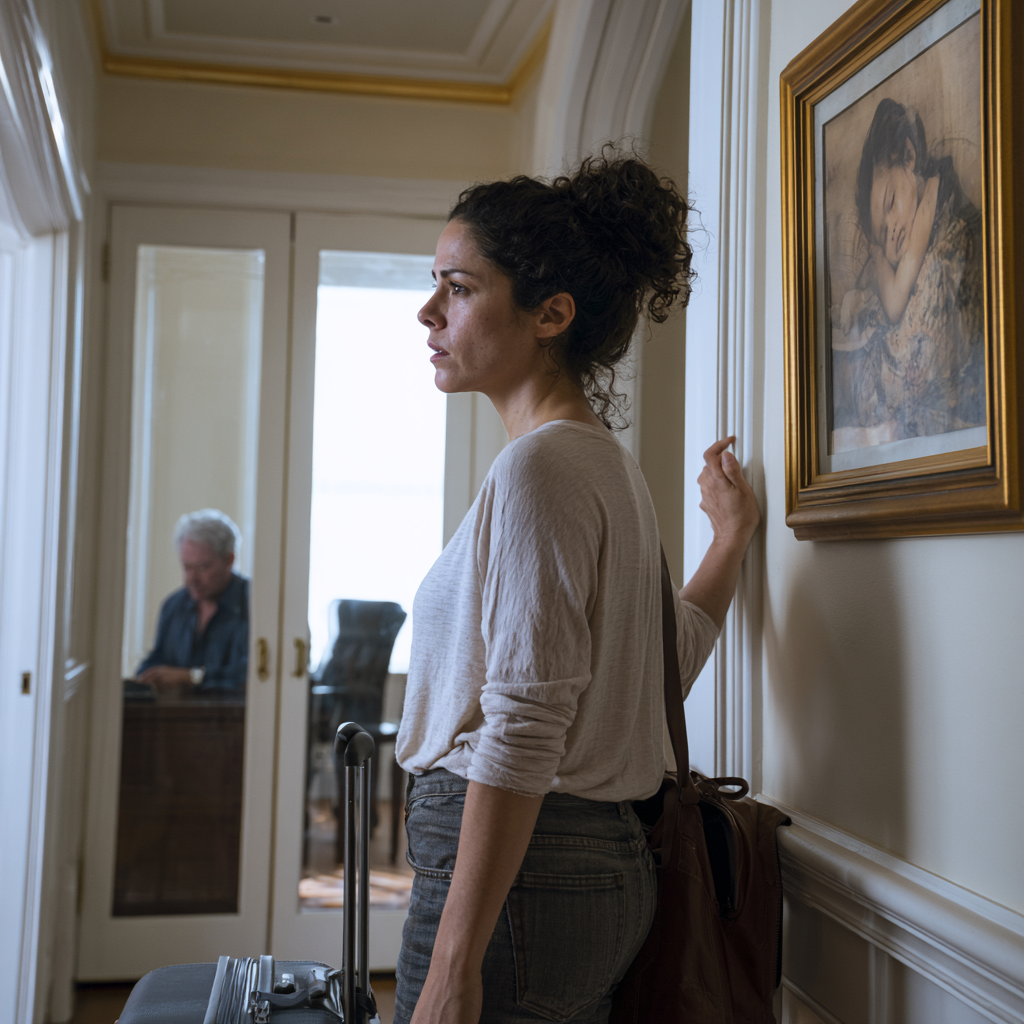
She walked out and closed the door quietly and stood in the hallway and looked at the framed photographs on the wall. Sophie at eleven, gap-toothed and happy. Leo at eight in his football kit. Mia at five, sleeping on Anna's shoulder on the sofa, Anna's hand curved over her hair.
James had not hung that last one. That was Anna.
She had hung it three years ago, and nobody had moved it since.
She had come on a Thursday in April when Sophie was nine and Leo was six and Mia was three and their mother had been gone for four months and nobody in the house was sleeping properly.
The woman before Anna had lasted eleven days. The woman before her had lasted three weeks. The family was in the particular state of a household where everything is technically functioning and nothing is all right.
James Whitfield met her in the living room, which was large and expensive and slightly too clean for a house with three children under ten. A man holding very still.
"The children are adjusting," he said. "Sophie has had some trouble at school. Leo has behavioral things. Mia doesn't sleep more than four hours at a stretch."
"What time does she wake up?"
"Around two. Sometimes one."
"And who goes to her?"
James looked at her. "I go. Or I try to."
Anna looked at him — the slightly too careful way he was holding himself, the expensive suit that didn't quite match the crayon marks on the side of the couch.
"I'll take the two o'clock shift," Anna said. "You'll sleep better if you know someone else has it."
He hired her that afternoon.
She was not, in the ten years that followed, the children's mother.
She was careful about this. Never called herself that, never positioned herself in photographs to fill a space. When Sophie's friends asked, Anna said "I'm Anna, I help James take care of things," and she meant it.
But she was the one at the school plays. She was the one in the emergency contact box after James. She remembered Leo's inhaler and Sophie's lactose intolerance and the particular texture of blanket that Mia needed to sleep. She was the one who sat on the bathroom floor at three in the morning when Mia had her first period at thirteen and was frightened of it. She was the one Sophie called from a party at sixteen — not her father, not a friend. Anna.
James provided. He worked hard. He was not absent — he came to the important things. He tried.
But trying is a different category from being there, and Anna was always there.
The house ran because of her. This was not something James said out loud. It was simply true, the way the pipes in the walls were true — invisible and essential, noticed only when they stop.
Claire Donovan appeared in James's life in the August that Mia turned thirteen.
He mentioned her at dinner — "a friend, a colleague actually" — with the particular tone of a man who has already decided something and is waiting to see if anyone will object.
Claire came to the house the following Saturday.
She was forty-one but looked thirty-nine. Everything about her was precise: the hair, the clothes, the smile that arrived exactly on schedule. She walked through the house the way people do when they're assessing it while pretending to admire it.
She sat in the kitchen and looked at the organized schedule on the refrigerator — Anna's handwriting, color-coded — and said, "Wow, you're very organized. Did you set this up?"
"Anna did," Mia said. "Anna does everything."
Claire smiled at Mia. "How sweet."
Anna smiled back at Claire.
Three months later, Anna noticed that Claire had rearranged the kitchen cupboards. She had put the everyday dishes where the baking things used to be. The baking things were in a box in the utility room.
Anna moved the baking things back.
The next week they were in the box again.
She left them in the box.
January. February. The temperature in the house dropping in ways that had nothing to do with the heating.
James started missing dinners. "Work thing" became the whole sentence. He started canceling the Saturday morning grocery run — which had been a family event since Sophie was twelve — with one or two days' notice. He started saying things like "the kids are practically adults now" and "they don't need as much oversight as they used to."
Leo was sixteen. Mia was thirteen.
In February he said, "I've been thinking — with the children getting older, you might want to start thinking about what's next for you." He said it in the kitchen, while looking at his phone.
Anna said, "Are you giving me notice?"
"Not yet," he said. "Just thinking ahead."
She went home that night — she had her own apartment, she had always kept that, had always known not to let the house become the only thing — and she sat at her kitchen table and she thought about the next morning, and the morning after that, and whether she had misread ten years.
She hadn't. She knew she hadn't.
But knowing and being able to stop it were different things.
The Monday morning in March when James finally did it, Claire's car was in the driveway.
Anna noticed it from the street. She stood by the gate for a moment, keys in hand, and looked at the car.
Then she went in and made breakfast for the children and waited.
James came down at eight forty-five, after Leo and Sophie had already left and Mia was upstairs getting ready for school. He came into the kitchen where Anna was washing up and said, "Do you have a few minutes?"
They went to his study.
He sat behind the desk. He had prepared what he was going to say — she could tell from how careful the opening was.
"Anna, I want to be fair to you," he said. "The children are older now. Mia is thirteen, she's independent. Sophie's at university. Leo doesn't need the same level of day-to-day care. And I think — I think it's time for a change."
"Does Claire want me gone?" Anna asked.
James looked at the desk.
"This isn't about Claire," he said.
"Does she?"
A pause. "She's expressed some — she's felt it might be time to give the house a fresh start. A new configuration."
"A new configuration," Anna said.
"I'm giving you three months' severance. That's fair, Anna. I want this to be fair."
She stood. She said: "All right, James."
She walked out of the study and closed the door and stood in the hallway and looked at the photograph of Mia sleeping on her shoulder.
She did not take it off the wall.
She was packing her room — the small room at the top of the stairs that had been hers for ten years, the one nobody else ever used — when Mia appeared in the doorway.
Thirteen years old. Standing very still in the way that children stand when they are trying not to fall apart.
"You don't have to go," Mia said.
"I do, sweetheart."
"But you don't want to."
Anna folded a jumper. Put it in the suitcase. "It doesn't always matter what we want."
"It should."
Anna looked at her. Mia had her mother's eyes — the one thing James had kept from that marriage — and right now they were doing something they very rarely did.
"Come here," Anna said.
Mia crossed the room and sat on the bed. Anna sat beside her. They stayed like that for a while, not speaking, which was something they had always been good at.
"Will you come back?" Mia asked.
"I'll be around," Anna said. "I'm not disappearing."
Mia didn't say anything.
They both knew that wasn't quite an answer.
The car was packed at noon.
Anna carried the last box through the front door and down the path and loaded it into the boot and closed it and stood with her hand on the car for a moment.
She was not going to cry in front of this house.
She walked to the driver's door.
"Anna."
Sophie Whitfield was standing by the gate.
She was supposed to be at university. She had a morning seminar on Mondays. She was standing by the gate in her good coat, her long dark hair over her shoulder, a manila folder under her arm.
Anna stopped. "What are you doing home?"
"Waiting," Sophie said. "I've been waiting since Friday when Dad told me."
She held out the folder.
"Don't open it here," Sophie said. "Go somewhere quiet. Then read it."
Anna looked at her — the direct dark eyes, the particular quality of stillness that Sophie had always had, the kind that meant she was not going to say more until the moment was right.
She took the folder.
"Sophie," she said. "What is this?"
"Something he almost did," Sophie said. "And then didn't. And I think you should know."
Anna got in the car.
She drove three blocks, pulled over, and opened the folder.
Inside were property transfer documents. The Whitfield lake house — the one the children had grown up going to every summer, the one Anna had driven them to every July for ten years.
Three years ago, James Whitfield had put the lake house in Anna Reyes's name.
Two months ago, he had transferred it back.
She sat in the parked car with the documents in her hands and thought about three months' severance and a "new configuration" and the box of baking things in the utility room.
She had not misread ten years.
He had almost done the right thing.
And then he had chosen not to.