PART 1
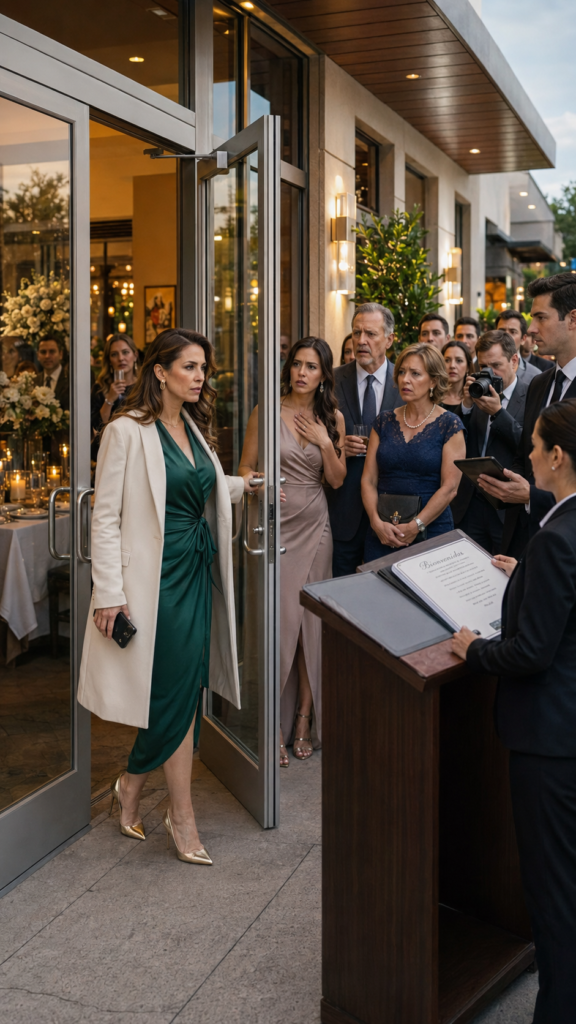
Mariana Soto arrived at the most elegant restaurant in Polanco, wearing a dark blue dress, a light coat draped over her shoulders, and her heart clenched tight, as if she already knew something terrible awaited her.
The party was for Valeria, her younger sister.
She was turning 29 and wanted an "unforgettable" night, the kind that looked outrageously expensive in photos: white flowers, golden candles, an open bar, a three-tier cake, a professional photographer, live music, and a private terrace overlooking Mexico City.
Mariana had paid for all of it.
$25,000.
Not because she had money to spare, but because for years she had confused helping with belonging.
Valeria had always been the favored daughter. The pretty one. The fragile one. The one who "couldn't handle her emotions." Mariana, on the other hand, was responsible, serious, the one who could solve everything without complaint.
If Valeria didn’t pay rent, Mariana transferred the money.
If Valeria racked up debt, Mariana covered it.
If their parents needed to avoid a family argument, Mariana swallowed hard and acted like nothing was wrong.
That night, Mariana thought, foolishly, maybe everything would be different.
Upon arrival, she saw the luxury cars in front of the restaurant, guests stepping out with gift bags, warm lights shining through the windows, and the flowers she herself had approved with the event manager.
For a brief moment, it hurt how beautiful everything looked.
She walked towards the entrance.
The guard checked the tablet.
His professional smile faded.
—One moment, miss.
Before Mariana could ask anything, Valeria appeared at the door in a golden dress, her hair perfectly styled, a champagne glass in hand.
She smiled as if she had rehearsed this scene.
—She can’t come in —Valeria said calmly.
Mariana froze.
Behind Valeria stood their parents, Héctor and Lucía. Her dad let out a low laugh. Her mom looked at the guests, annoyed, as if the problem was Mariana being there and not what they had just done to her.
—Did you take my name off the list? —Mariana asked.
Valeria raised an eyebrow.
—You were never invited.
The guard looked down, uncomfortable.
Mariana searched for her father's eyes.
—Dad…
Héctor took a sip and smiled with disdain.
—Did you really think you were welcome?
The statement hit like a slap.
Some guests stopped. A woman in a red dress pretended to check her phone. A waiter stood frozen by the door.
Lucía moved closer.
—Mariana, don’t make a scene.
It was always the same.
The humiliation was never the scene.
The scene was that Mariana dared to mention it.
Valeria tilted her head, satisfied.
—Tonight is about me. For once.
Mariana almost laughed.
For once.
She had paid for Valeria's bills, her trips, her parties, her credit cards, and even her most absurd whims. But to her family, she was neither daughter nor sister.
She was a bank account with legs.
Mariana could have pulled out her phone and shown the contract, the receipts, the emails, and every transfer right there.
But she understood something.
Valeria wanted to see her scream.
She wanted to turn her into “the bitter one,” “the dramatic one,” “the toxic one.”
So Mariana didn’t scream.
She just turned around, walked to the parking lot, sat in her car, and opened her phone.
She texted Denise Rivas, the event manager:
"Denise, I’m Mariana Soto. I’ve been denied entry to the private event I paid for. Immediately freeze all remaining charges, cancel open bar extensions, and bring the signed contract to the entrance. Do not authorize anything in Valeria’s name."
She sent the message.
Ten seconds later, Denise replied:
"Don't leave."
Mariana looked up at the restaurant.
Valeria was still laughing under the golden lights.
But then Denise came out of the kitchen with a black folder in hand, accompanied by the general manager.
And no one could believe what was about to happen.
PART 2
Denise crossed the hall with quick steps.
The general manager walked beside her, serious, with the face of someone who had just discovered that a client had been humiliated at her own event.
The atmosphere shifted abruptly.
The music kept playing, but softer. Guests turned to look. The photographer stopped taking pictures. The bartender froze with a bottle suspended in mid-air.
Valeria saw the folder, and her smile began to crack.
—What’s this? —she asked, still trying to sound like she owned the night.
Denise didn’t answer.
She opened the folder in front of the reception podium and turned the first page toward the guard, the manager, and the closest guests.
In the contractor’s line was one name.
Mariana Soto.
Not Valeria.
Not Héctor.
Not Lucía.
Mariana.
The manager spoke with a calm that hurt more than a shout.
—Miss Soto is the contracting client for this event. Any changes to the guest list required her direct authorization.
Silence spread like oil on the floor.
Valeria pressed her lips together.
Héctor stopped smiling.
Lucía gripped her purse so tightly that her knuckles turned white.
Mariana stepped out of the car and walked back. She didn’t hurry. She didn’t need to. Each step seemed to lift years of humiliation off her shoulders.
The guard stepped aside.
For the first time all night, Valeria had to move to let her sister pass.
Mariana entered the restaurant.
She saw the flowers, the cake, the glasses, the gifts table, and the terrace decorated as if it were a magazine scene.
Everything had Valeria’s name on it.
But underneath it all was Mariana’s money.
—What did you say? —Mariana asked, looking at her sister.
Valeria let out a nervous laugh.
—Oh, Mariana, don’t be weird. It was a misunderstanding.
Denise checked another page.
—It wasn’t a misunderstanding. At 4:12 p.m., Valeria requested in writing that Mariana Soto be removed from the list.
A woman near the entrance gasped.
A man murmured:
—What a low blow.
Valeria turned to Denise.
—You weren’t supposed to say that!
—It’s part of the event record —Denise replied.
Héctor approached Mariana, lowering his voice.
—We can sort this out privately.
Mariana looked at him with a calmness that unsettled him.
—Privately was when you all laughed at me outside.
Lucía tried to smooth over the scene.
—Honey, your sister was stressed. You know how she is. She didn’t realize what she was doing.
Mariana felt an old fatigue.
That phrase had ruled her life.
Valeria didn’t realize.
Valeria was confused.
Valeria was sensitive.
Valeria needed help.
And Mariana, always Mariana, had to pay the emotional bill and the financial one.
—Freeze the open bar —Mariana told the manager—. No extensions. No additional charges. Nothing I don’t authorize.
The manager nodded.
—Of course.
Valeria’s eyes widened.
—You can’t do this to me on my birthday.
Mariana stared at her for a long moment.
—I’m not punishing you. I just stopped financing my own humiliation.
The words cut through the hall.
Some guests looked down. Others began to whisper. The photographer put away his camera as if he understood that this image shouldn't belong to him.
Héctor clenched his jaw.
—That’s enough.
It was the familiar tone, the tone he had used to silence Mariana since she was a child.
When Valeria broke something and blamed Mariana.
When Valeria borrowed clothes and then cried.
When Mariana asked why one was forgiven everything while the other was expected to endure.
But that night, that tone didn’t work anymore.
—No —Mariana said.
One single word.
Héctor blinked, as if he had never heard her speak like that before.
—You won’t silence me again to protect her.
Lucía tried to touch her arm.
Mariana stepped back.
—No.
Their mom froze.
Valeria, cornered, changed tactics. Her eyes filled with quick, theatrical fake tears.
—You’re cruel, Mariana. You’ve always wanted to see me fall.
Mariana shook her head.
—No. I always wanted to be loved without having to pay for it.
No one responded.
Because that truth was too uncomfortable.
Mariana asked for the final printed bill, canceled any extra authorizations, and left the restaurant without looking back.
That night, upon arriving at her apartment in Del Valle, she opened her online banking.
There were all the transfers.
Valeria’s rent.
Valeria’s credit card.
Valeria’s car insurance.
“Urgent” payments.
“Last time” help.
Mariana canceled them one by one.
Then she wrote a single message:
"Starting today, pay your own bills."
And sent it.
The next morning, Valeria showed up at her door with a bouquet of lilacs and a washed face, as if she wanted to seem humble.
—I messed up —she said—. Honestly, I didn’t want it to happen like this.
Mariana let her in but didn’t say anything.
Valeria placed the flowers on the table.
—Mom pressured me. Dad too. I thought if you came in, you would overshadow me. You know how you are, always so intense.
It wasn’t an apology.
It was the same manipulation wrapped in a new bow.
Then came the real plea.
—I have overdue rent. My cards are maxed out. I just need you to help me this month.
Mariana felt something shatter again, but it didn’t hurt the same way anymore.
—No.
Valeria stood still.
—What do you mean no?
—You’re going to learn to stand on your own.
The tears vanished.
—Now you feel superior?
—No.
—You’re going to end up alone, Mariana.
Mariana opened the door.
—Worse was being accompanied by people who only wanted me useful.
Valeria left, slamming the door.
That afternoon, she posted a crying photo on Facebook.
She wrote that her sister had humiliated her out of jealousy, that she controlled her with money, and that she had ruined her birthday "out of envy."
The comments came in quickly.
"Your sister is so toxic."
"No one should help you only to demand repayment."
"You’re strong, Vale."
Mariana read it all in silence.
For years, Valeria had lived off her money. Now she wanted to live off her version of the story too.
But this time, there was a twist.
Two days later, Mariana received an email from an old colleague named Jimena, who had worked as a production assistant at the event.
The subject line read:
"You need to see this."
Attached was a backstage video.
Mariana opened it.
The footage showed Valeria before the guests arrived. She was by the bar, a drink in hand, laughing with two friends.
Her voice was crystal clear.
—It’s Mariana’s money, dude. She pays even if she doesn’t come. She always pays. That’s what she’s for.
The friends burst into laughter.
Valeria raised her glass.
—I want her out tonight. Let her watch from the street what she paid for.
Mariana paused the video.
For the first time, she didn’t cry.
Not because it didn’t hurt.
But because there were no more doubts.
It wasn’t stress.
It wasn’t confusion.
It wasn’t a misunderstanding.
It was planned cruelty.
Mariana saved the video, gathered contracts, receipts, screenshots, messages, and the restaurant’s record. Then she went to her parents’ house in Coyoacán.
Lucía opened the door with a face full of discontent.
—We’re not here for your dramas.
Mariana walked in, placed the laptop on the table, and played the video.
Valeria’s voice filled the room:
"She pays even if she doesn’t come. That’s what she’s for."
Héctor looked down.
Lucía clutched her chest, but not out of pain. Out of shame.
—This shouldn’t leave the family —Héctor said.
Mariana closed the laptop.
—Valeria already made it public. She just told the lie first.
Lucía tried to defend her.
—Your sister made a mistake.
—No. You all built a queen and passed me the bill.
The silence was brutal.
Mariana took the copy of her parents’ house key from her keychain and left it on the table.
—Don’t count on me anymore.
Lucía stood up.
—Are you going to abandon your family?
Mariana took a deep breath.
—No. I’m going to stop abandoning myself.
She walked out without looking back.
That night, Mariana uploaded a short video to Facebook. She didn’t insult. She didn’t shout. She didn’t give directions or ask for attacks.
She simply told what happens when a family confuses love with obligation, when a daughter becomes an ATM, and when setting boundaries makes you the villain to those who benefited from your silence.
In the end, she showed the contract, the receipts, and a few seconds of Valeria’s video.
It was enough.
The video went viral.
Thousands of people commented.
"It happened to me with my brother."
"My mom also told me not to make a scene."
"Being generous doesn’t mean letting others use you."
The brands Valeria collaborated with began to ask questions. One canceled the contract. Then another. Her friends deleted photos from the party. The guests who defended her left awkward comments or simply disappeared.
Valeria tried to post an apology.
But it sounded strategic.
"I didn’t mean to hurt anyone," she wrote.
Mariana didn’t respond.
Héctor called 11 times.
Lucía sent crying audio messages.
Valeria texted:
"I didn’t think you were capable of letting me fall."
Mariana read the message and deleted it.
Because there was the truth.
They had never feared losing her.
They feared losing what she paid for.
Months later, Mariana accepted a job in Guadalajara as a communications director for an organization that supported women trapped in economic abuse.
She rented a small apartment, with beautiful light in the mornings and a bougainvillea climbing near the balcony.
It wasn’t luxurious.
But it was hers.
No one could take her off the list of her own life.
One afternoon, she recorded one last message for those following her story:
—Family isn’t proven by blood, but by respect. And when respect doesn’t exist, leaving isn’t betrayal. It’s self-love.
The video ended with Mariana smiling slightly, without anger, without tears, without a need for revenge.
Below, in the comments, someone wrote:
"Would you forgive a family like this?"
And the discussion exploded.
Because many understood something Mariana had learned the hard way:
sometimes, peace doesn’t come when you’re asked for forgiveness.
It comes when you stop paying the price for staying.