PART 1
—I hope you finally learn to live like what you are: an unlucky freeloader —Doña Teresa spat as she served beans like she was delivering a sentence.
An odd silence fell over the table.
Mariana left her glass untouched. She had been married to Diego Vargas for two years, and for two years, she had lived under her mother-in-law's roof in a cramped house in Nezahualcóyotl, where the walls heard everything, and the neighbors knew more than family.
Diego lowered his gaze.
As always.
—Mom, don’t start —he murmured, but there was no force behind it, like someone asking for permission to breathe.
Teresa wiped her hands on her apron.
—I’m not starting, dear. I’m just stating the truth. You studied, you work, you’re a good boy. And look where you ended up marrying a girl who has no family.
Mariana smiled faintly.
They thought she had no family because she never talked about the Serrano Valverde clan. They thought she worked arranging frames in a small gallery in Roma. They thought her simple clothes were a sign of poverty and not a choice.
No one in that house knew that her father owned private hospitals, real estate developments, and a cultural foundation that made the news every year.
Mariana had hidden her full surname for a silly and painful reason: she wanted to see if Diego loved her without the influence of money.
At first, she thought he did.
Then she understood that Diego wasn’t cruel, but he was cowardly. And cowardice, when it sits down to eat with you every day, is just as destructive.
For two years, Teresa charged her 8,500 pesos a month to sleep in a damp room. She also asked for gas, water, internet, groceries, and even “contributions” to fix a roof that was never fixed.
Whenever Mariana protested, Diego would touch her hand under the table.
—You know how my mom is. Don’t pay it any mind.
But it mattered.
It mattered every time Teresa called her a freeloader. Every time her sisters-in-law asked if she wasn’t embarrassed to wear the same shoes. Every time Diego’s cousins laughed at her at gatherings, saying she smelled like public transportation.
That afternoon, Teresa pulled a folded paper from her purse and tossed it onto the plastic tablecloth.
—Look what I found in the trash of the young lady.
It was a flyer for cheap room rentals in an old tenement near Tepito.
Mariana had left it there on purpose.
She knew Teresa rummaged through her bags, her drawers, and even her receipts.
—It’s an economical option —Mariana said calmly.
Teresa burst into laughter.
—Economical, she says! You’re going to put my son in there, right? Among cockroaches, drunks, and other people’s laundry.
Diego turned pale.
—Mom, Mariana and I decided to leave. It’s time.
—No, dear. She’s dragging you down. But don’t worry, I’ll go see the princess’s palace.
Teresa’s laughter grew.
—In fact, I’m going to bring your uncles, your cousins, everyone. A welcome feast. So the family can see where my little Diego ended up because he was foolish.
Mariana raised her gaze.
—Fine. I’ll send the location on Saturday at 1.
Diego looked at her horrified.
—What are you doing?
—Inviting them —she replied.
On Saturday, in front of Teresa’s house, seven trucks and five cars gathered. Almost 50 relatives arrived with cruel gifts: bleach, brooms, black bags, mouse traps, cans of sardines, and a broken bucket for “the leaks.”
They all laughed.
Teresa was happy, wearing dark sunglasses and red lips.
Mariana was silent, in a simple blue dress.
When the caravan began to enter Polanco and then headed towards Lomas de Chapultepec, the jokes faded.
—This can’t be —Teresa said, looking at the tall walls, the well-kept trees, and the security cameras.
The GPS marked the arrival at a huge black iron gate.
A guard approached.
—Good afternoon. Are you with Mrs. Mariana Serrano Valverde?
Teresa went dry.
The gate began to open slowly, and Mariana simply said:
—Welcome to my house.
PART 2
The caravan continued down a wide light stone road, surrounded by bougainvillea, jacarandas, and fountains that sounded as if no one had ever screamed in that place.
No one laughed again.
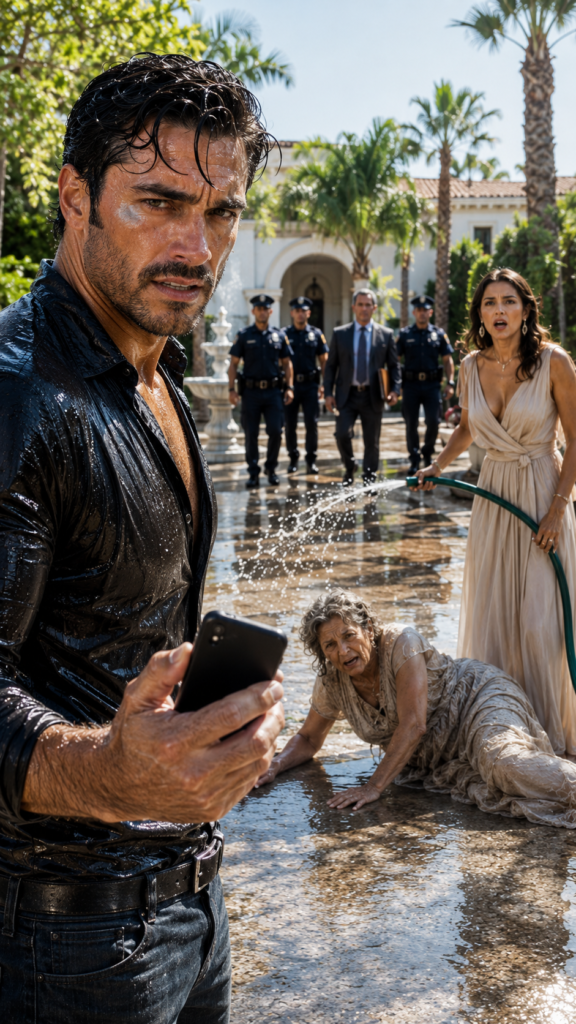
Aunt Rosa hid a bottle of bleach under the seat. A nephew who had been recording lowered his phone when he saw two serious guards walking beside them, not touching anyone but making it clear that every movement was being watched.
Teresa pressed the broken bucket against her chest.
—She surely works here —she said, though her voice trembled—. Maybe she cleans rich people’s houses and wanted to show off.
Diego turned to Mariana.
—Tell me this is a joke.
Mariana didn’t respond.
In the background, the residence appeared. It wasn’t a pretty house. It was a huge mansion, with tall windows, white stone, a perfect garden, and a carved wooden door that looked like something from a movie.
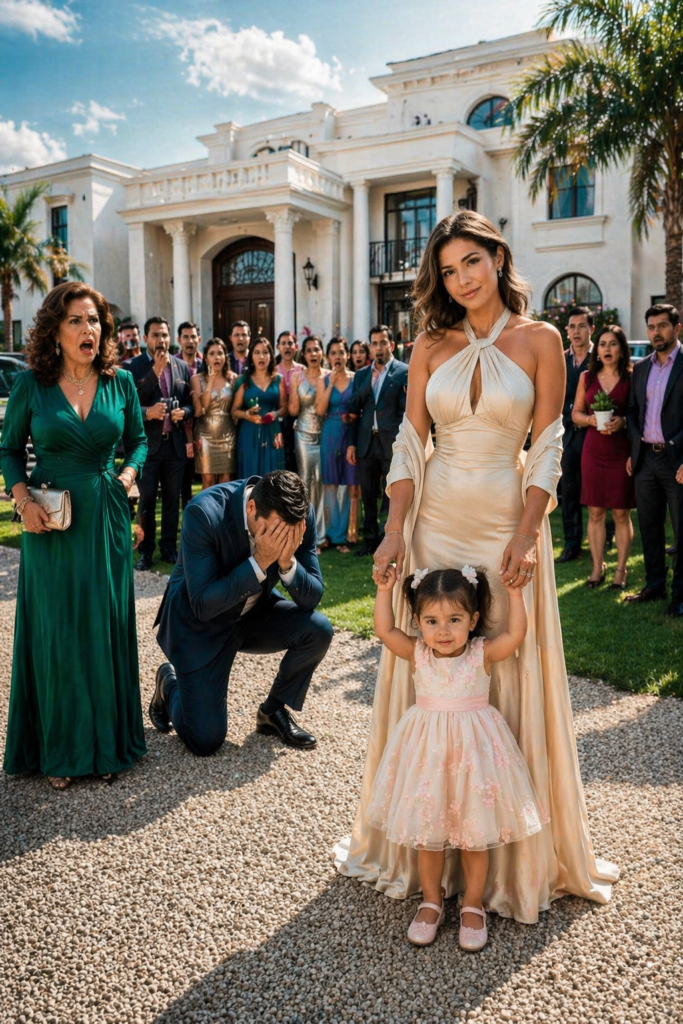
The relatives got out slowly.
Some still carried the brooms and mouse traps. They no longer seemed mocking. They looked like people lost at a party they were never invited to.
Teresa wanted to recover her poison.
—Well, if you’re mopping here, at least they must pay you well.
The main door opened.
Two uniformed maids came out, an older man in a dark suit, and an elegant gray-haired woman with a firm gaze. Then Mariana appeared.
She no longer wore the simple dress.
She was in an ivory suit, her hair tied back, soft makeup, and small earrings. She didn’t look like a guest. She didn’t look like an employee.
She looked like the owner of everything.
—Thank you for coming —she said from the stairs—. Please come in. Not every day does a family arrive with bleach to a welcome party.
An uncomfortable murmur ran through the group.
Teresa swallowed hard.
—Whose house is this?
Mariana took two steps down.
—Mine.
The word fell heavily.
Diego approached with a pale face.
—Did you rent this to humiliate my mom?
Mariana looked at him without anger, and that was worse.
—No, Diego. This house has belonged to my family for 24 years.
The older man stepped forward.
—I am Alejandro Serrano. Mariana’s father. Welcome to Casa Jacarandas.
Several relatives exchanged glances.
The surname Serrano began to bounce in their heads: hospitals, construction companies, museums, foundations, newspaper articles. A cousin even quickly searched on Google and widened her eyes like saucers.
—No way —she whispered.
Teresa turned red.
—So you lied to us! You came into my house pretending to be poor. You ate at my table, used my bathroom, lived under my roof while hiding this.
Mariana took another step down.
—I didn’t live for free, Doña Teresa. You charged me rent, food, electricity, gas, internet, and even for the hallway paint, even though you never painted anything.
—It was family contribution.
—No. It was abuse with a receipt.
Diego blinked, confused.
—Mariana, we can fix this. Everything is cleared up. We’re husband and wife.
She looked at him sadly.
—Husband and wife? When your mom called me a starving woman in front of your uncles, you said it was a joke. When your cousins searched my bag to see if I had money, you laughed nervously. When your mother charged me 8,500 for a room with mold, you asked me for patience.
Diego didn’t know what to say.
—When were you ever my husband, Diego?
Teresa let out a false laugh.
—Oh, my girl, don’t be dramatic. I always knew you had something special. I just wanted to see if you were humble.
Mariana raised her hand.
—Don’t come closer.
Teresa stood half a step away.
—Humble? You rummaged through my trash. You opened my packages. You told your neighbors I was a burden. Once, you left me outside for three hours because, according to you, I hadn’t paid “the key fee.”
The relatives began to lower their gazes.
Some did remember that. Others had celebrated it.
Mariana’s mother, Carmen Valverde, approached with a folder in her hands.
—Hija, here’s what you asked for.
Mariana took it.
Teresa changed her expression.
—What is that?
—Transfers, messages, audios, and videos.
Diego looked at her.
—Videos?
—I set up a camera in my room when I noticed my things were being moved. Not to take revenge. To protect myself.
The silence grew denser.
Mariana opened the folder and showed printed sheets.
—Here are the monthly deposits. Here are the messages where you threatened to kick me out if I didn’t pay more. Here’s the audio where you tell your sister that I was good “for taking money out of Diego while he found a real woman.”
Diego turned toward his mother.
—Did you say that?
Teresa lifted her chin.
—They’re manipulating everything. The rich always do that. They buy proof, buy lawyers, buy truths.
Mariana pulled out another envelope.
—This proof my family didn’t buy. This came from yours.
Teresa lost color.
Diego noticed it.
—What is it?
Mariana handed him the envelope.
—Your father didn’t abandon you like you always believed.
Diego frowned.
—My dad died with nothing. My mom told me so.
Teresa stepped forward.
—Mariana, don’t mess with the dead.
—You messed with him first —Mariana replied.
Diego opened the envelope with trembling hands. Inside were copies of bank documents, a notarized letter, and old account statements.
Mariana spoke slowly.
—Before he died, your dad left 720,000 pesos in your name. It was for your studies, an apartment, or a business. Your mom was the administrator until you turned 25.
Diego could barely breathe.
—I turned 25 five years ago.
Mariana nodded.
—By that time, the account was already empty.
Teresa screamed.
—Liar! That was for the family!
The phrase slipped out before she could stop it.
And everyone heard it.
Diego looked at her as if he were finally seeing a stranger wearing his mother’s face.
—Did you take my dad’s money?
Teresa clenched her fists.
—I did what was necessary to keep you by my side. You were a child. You knew nothing.
—I was 25.
—To me, you will always be my child.
—No, mom. To you, I was always your property.
The phrase sliced through the air.
It was the first time Diego faced Teresa without hiding behind an “that’s just how she is.” Mariana felt something in her chest, but it wasn’t hope. It was mourning. Because some words arrive when there’s no home left to save.
Teresa changed tactics.
She put her hands over her chest, like a victim of a tragedy.
—Look how he talks to me. After everything I did for him. After raising an ungrateful son alone.
Aunt Rosa tried to defend her.
—Well, Teresa could have made a mistake, but Mariana shouldn’t have hidden that she was rich either.
Mariana looked at her.
—I hid money. You all showed your hearts.
No one responded.
Then Mariana signaled.
An assistant set up a portable screen near the entrance. Teresa’s eyes widened.
—No.
Diego heard that “no,” and his face crumbled.
On the screen, Teresa appeared in the kitchen of her house. She was talking on the phone, confident that no one could hear her.
—Mariana pays on time, but don’t tell Diego —she said in the video—. It’s better for him to believe I’m the one supporting them. If he feels guilty, he won’t leave me. And that fool puts up with everything because she wants to be a good wife.
Aunt Rosa covered her mouth.
Then another video appeared. Teresa opened a drawer in Mariana’s room, pulled out envelopes, checked documents, and photographed papers.
Then came the third.
Teresa spoke with a sister about Diego’s father’s money.
—That money was the boy’s, yes, but if I gave it to him, he’d leave me. Better he believes his dad didn’t think of him. That way, he stays with me.
Diego stepped back.
His face was no longer one of shame. It was pure pain.
—You made me hate my dad.
Teresa suddenly cried, but not like someone who regrets. She cried like someone who had been discovered.
—I was afraid of being alone.
—And that’s why you left us all alone —Diego said.
Mariana pulled out one last packet of documents.
—Diego, here are the divorce papers. I’m not going to ask for anything. Neither your salary, nor compensation, nor obligatory apologies.
He looked at her devastated.
—Is there no way to start again?
Mariana took a deep breath.
—Not with me. Maybe you can start with yourself.
Diego lowered his head.
For the first time, he didn’t ask her to understand his mother. He didn’t say she was exaggerating. He didn’t say “that’s just how she is.” He just cried, like someone who finally understood that silence can also be a betrayal.
Mariana turned to Teresa.
—And you will have to answer legally.
Alejandro Serrano spoke calmly.
—There is already a complaint for breach of trust related to Diego’s account. There’s also a civil lawsuit for undue charges, threats, invasion of privacy, and moral damage. In addition, the SAT will be notified for unreported income.
Teresa let out a dry laugh.
—Now it turns out that charging my daughter-in-law is a crime?
Carmen Valverde stepped forward.
—Charging is not the issue. Threatening, hiding someone else’s money, manipulating documents, and appropriating resources can have consequences.
Teresa looked around, seeking support.
But the same relatives who had come ready to mock were now slowly distancing themselves from her, as if her shame were contagious.
The cousin who had brought the mouse traps left them on the floor.
Aunt Rosa lowered the bottle of bleach.
A nephew murmured:
—Let’s go, this has already gotten really ugly.
Mariana watched them.
—You didn’t come deceived. You came happy. Each one chose to get into those cars with something in hand to humiliate me.
Some cried.
Others were upset.
Because people love to apologize when the mockery no longer yields profit.
An uncle named Manuel took off his hat.
—Mariana, I apologize. We let ourselves be carried away.
She looked at him without hatred.
—You didn’t let yourselves be carried away. You felt superior. It’s different.
The phrase hurt more than a scream.
Teresa tried to climb the stairs.
—You’re not going to destroy my family.
The guards moved forward, without touching her.
Mariana descended until she was in front of her.
—I didn’t destroy anything. You built a family on fear, guilt, and lies. I just opened the gate for everyone to see what was inside.
Teresa raised her hand, perhaps to push her, perhaps to point her out.
Diego stopped her.
—That’s enough, mom.
Teresa looked at him horrified.
—Now you’re defending her?
He slowly released her arm.
—I should have defended her from the first insult.
Mariana closed her eyes for a moment.
If that phrase had come a year earlier, maybe it would have changed something. But some phrases don’t heal when they arrive after too many wounds.
The caravan left without music, without videos, and without laughter.
The bleach, brooms, cans, and traps were left by the gate like a ridiculous altar to the cruelty of a family that came to mock and ended up exposed.
When the gate closed, Mariana didn’t smile.
She didn’t feel victorious.
She felt free.
And freedom, sometimes, doesn’t resemble a party. Sometimes it resembles a vast silence after years of enduring noise.
Three months later, Diego signed the divorce. He didn’t fight for money. He also didn’t ask for a second chance. He started therapy and filed a complaint against his mother for the account his father had left for him.
Teresa had to sell the house in Nezahualcóyotl to pay lawyers, debts, and part of what she owed. She ended up renting a small apartment near a tenement similar to the one she had used to mock.
It wasn’t divine punishment.
It was consequence.
The Vargas family divided. Some said Mariana was cruel for exposing an older woman. Others, for the first time, dared to tell how Teresa had also manipulated them for years.
The truth doesn’t always bring peace. First, it breaks the table where everyone pretended to eat calmly.
Later, Diego sent Mariana a six-page letter. He didn’t ask her to return. He apologized for every silence, for every nervous laugh, for every time he left her alone to avoid upsetting his mother.
Mariana read it on the terrace of Casa Jacarandas.
She cried.
Not because she wanted to go back.
She cried for the version of that marriage that never existed, for the woman who endured too much waiting for love to become courage.
Then she put the letter in a drawer and moved on.
A year later, Mariana opened a foundation for young women studying art, design, and creative trades without depending on families that charged dignity as rent.
At the inauguration, a reporter asked her why she had chosen that project.
Mariana looked towards the garden, right where 50 people once got out of their cars with bleach and mouse traps.
—Because many people confuse humility with permission to humiliate —she said—. And no one should have to prove their worth only when they discover they have money.
That day, she understood something she would never forget.
She hadn’t won by having a mansion, lawyers, or a powerful surname. She had won because she stopped hiding to protect the comfort of those who hurt her.
And when the gate closed, she didn’t leave a poor family outside.
She left behind the mockery, the fear, and that absurd obligation to forgive those who only regret when they can no longer continue abusing.