PART 1
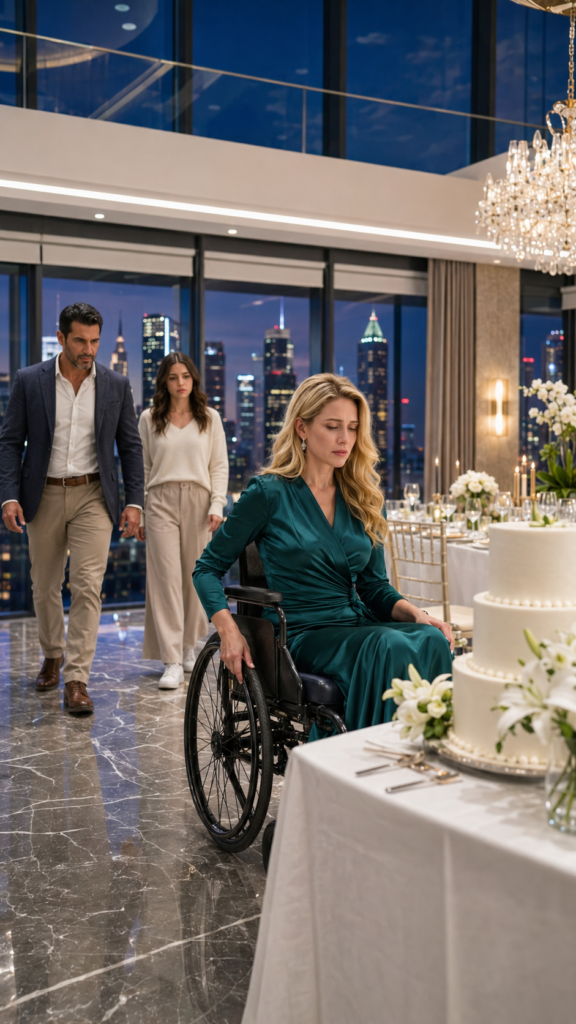
The Crystal Hall of the Hotel Reforma in Mexico City seemed prepared for a glamorous night.
There were white flowers, glasses gleaming under the lights, soft music, and a three-tier cake with a golden candle marking the number 40.
Everything was ready to celebrate Mariana Luján, CEO of IntegraSol, one of the most important medical technology companies in the country.
Everything, except the people.
At 7 PM, Mariana sat in her wheelchair in front of 120 empty seats.
She wore an ivory suit, her hair elegantly styled, and a smile she struggled to hold on to, even as something inside her shattered.
Her assistant, Darío, had confirmed attendance from businessmen, partners, politicians, former classmates from Ibero, distant relatives, and friends who swore they loved her like a sister.
Everyone had said yes.
At 6:15, the first message arrived.
"Sorry, a meeting came up."
Then another.
"I had a family emergency."
Then another.
"I feel terrible, let's just meet soon."
In less than an hour, everyone canceled.
Some didn’t even pretend to feel sorry.
Mariana stared at the untouched cake. She wasn’t a child waiting for balloons, but that night she felt just as abandoned as someone forgotten at school.
Eighteen months ago, a truck had run a red light on the Periferico during a heavy rain. Her SUV was wrecked. She survived, but lost the use of her legs.
Before the accident, everyone called her “the unstoppable boss.”
After, many began to speak to her slowly, as if her mind had also broken.
"We can discreetly cancel everything," Darío said, approaching cautiously. "I’ll tell the waiters to take away the dinner."
Mariana took a deep breath.
"No. It’s already paid for. Let the staff eat something. I don’t want it wasted."
"Mariana…"
"I’m fine."
But she wasn’t fine.
On the other side of the hotel, Tomás Salcedo had just finished a delivery. He was 37, wearing a messenger uniform, worn-out sneakers, and an old backpack slung over his shoulder.
In his truck, his daughter, Lucía, aged 10, waited, doing her homework by the light of her cellphone.
Tomás had been a single father since his wife died of leukemia three years earlier. He worked during the day delivering packages and at night repaired cell phones on a small table in his kitchen.
As he passed through the service hallway, he saw two waiters carrying full trays.
"What’s that for, guys?" he asked.
One sighed.
"Birthday party for an important lady. No one showed up."
Tomás stopped.
"Really? No one?"
The waiter pointed to the hall.
Tomás peeked through the half-open door and saw Mariana alone in front of her cake.
She didn’t look angry.
She looked used to enduring.
That face reminded him of Lucía when she tried not to cry for her mom.
Tomás went out to the parking lot and opened the truck door.
"Lucía, come with me."
"What happened, Dad?"
"There’s a lady who’s going to blow out candles alone."
The girl’s eyes widened.
"That’s not fair."
Lucía pulled a sheet of paper from her backpack, grabbed three markers, and quickly drew a cake with flowers.
When Tomás asked to enter, the manager looked him up and down.
"Sir, this is a private event."
"I know. We’re not here to ask for anything. Just to sing."
The manager looked at the girl holding the card with both hands.
Then he looked at Mariana.
And opened the door.
PART 2
Mariana looked up when she heard footsteps.
First, she saw Tomás, in his simple uniform, the cap twisted in his hands.
Then she saw Lucía, hiding behind her dad, clutching a card made with cheap markers.
"Good evening," Tomás said respectfully. "Sorry for barging in like this. I came to deliver a package to the hotel and heard that your party was empty."
Mariana stiffened her face out of habit.
"You don’t have to feel sorry."
Tomás shook his head slowly.
"It’s not pity. My daughter said no one should blow out a candle without someone singing Las Mañanitas."
Lucía took a step forward and handed her the card.
"Happy birthday, ma’am."
Mariana took it.
On the paper were three people around a cake. Inside, it read in crooked handwriting:
"Just because no one came doesn’t mean you don’t matter."
Mariana read the phrase twice.
On the third, her eyes filled with tears.
She hadn’t cried when she learned to use the wheelchair. She didn’t cry when an investor suggested she step down from her position "for image." She hadn’t cried when a cousin stopped inviting her to gatherings because, as she said, "it was complicated to move her."
But that card broke her.
"Thank you, my girl," she whispered.
Lucía smiled.
"My mom used to say birthdays are to remind us that a person exists, and that already means a lot."
Tomás looked down.
Mariana noticed.
"Your mom?"
"She died," Lucía replied, without drama, as someone who has learned to live with absence—"But my dad still sings to me even when we're really tired."
The pianist, who had already put away his sheet music, heard that.
Without saying anything, he returned to the piano.
The first notes of Las Mañanitas filled the hall.
A waiter stopped clearing plates. A housekeeper paused at the entrance. The chef emerged from the kitchen, apron stained. The guards approached discreetly.
Tomás began to sing, unsure at first.
Lucía followed.
Then the hotel staff joined in.
Mariana looked around.
The businessmen weren’t there. The partners were absent. The friends who toasted with expensive drinks were gone.
But the hall was no longer empty.
It was filled with people who had worked all afternoon to serve guests who never arrived, yet chose to stay.
When the song ended, Mariana blew out the candle.
She didn’t ask to walk again.
She didn’t seek revenge.
She asked for something harder: to stop begging for love where there was only convenience.
The manager ordered dinner to be served. The waiters, initially timid, ended up sitting at the tables. The chef brewed coffee. Lucía cut the cake with such seriousness that everyone burst into laughter.
Mariana invited Tomás and his daughter to sit with her.
"Do you always crash other people's parties?" she asked.
Tomás smiled.
"No, ma’am. But my wife used to say that if you see someone sinking, you don’t need to know them to throw them a hand."
Mariana watched him in silence.
"How do you learn to move on after losing so much?"
Tomás twisted the glass between his fingers.
"You don’t learn all at once. One day you just get up because you have to make breakfast. Another day because you have to pay the electricity. Another because a girl needs a uniform. And sometimes you cry in the bathroom so no one sees you. But when someone sits with you in your worst moment, even if they don’t fix anything, it doesn’t weigh the same."
Mariana looked down at her immobile legs.
"I thought today I would know who loved me."
"Well, you did know," Tomás said. "Just not the ones you expected."
Mariana let out a small, genuine laugh.
Around 10 PM, Darío entered the hall with a pale face. He leaned close to Mariana and showed her his phone.
It was a screenshot from a private group of executives.
The message read:
"Let Mariana see her reality. If the hall is empty, she will understand she no longer has strength. On Monday, we propose the transition. No drama."
The message had been written by Esteban Márquez, the CFO of IntegraSol and supposedly Mariana's friend for 11 years.
Mariana felt her blood freeze.
The party hadn’t emptied by chance.
It had been sabotaged.
Esteban had called the guests, sowed doubts about her health, told them that attending would be "taking sides" in an internal crisis.
He had even convinced several partners to leave her alone to humiliate her.
Darío spoke almost inaudibly.
"I didn’t want to ruin your night."
Mariana looked again at the 120 chairs.
Then she looked at Tomás, Lucía, and the hotel staff.
"You didn’t ruin it," she said. "You just opened my eyes."
Tomás approached with concern.
"Is everything okay?"
Mariana turned off her phone.
"No. But I understood something now."
"What thing?"
She looked at Lucía’s card on the table.
"That sometimes life leaves empty chairs so you can see who dares to stand up."
On Monday morning, the auditorium of IntegraSol was full.
Esteban Márquez arrived impeccably dressed in a black suit, expensive watch, and a politician's smile. He believed Mariana would come in shattered, ready to accept a "dignified" exit.
But Mariana entered in her wheelchair, dressed in red, Darío by her side, and a folder on her lap.
She didn’t ask for permission.
She didn’t greet with fear.
She stood before employees, executives, and shareholders.
"Before we talk numbers," she said, "let’s talk character."
The screen behind her displayed the screenshots.
The murmurs exploded.
Esteban lost his smile.
Mariana let everyone read.
Each message.
Every pressure.
Every mockery disguised as strategy.
"This was not a business decision," Mariana continued. "It was a cowardly betrayal. And it was also a demonstration of something I will not allow in this company: believing that a person is worth less because they can no longer walk."
Esteban stood up.
"Mariana, this can be clarified privately."
She looked at him unblinking.
"No. You planned this privately. I will resolve it publicly."
The board called for a 20-minute recess.
No more time was needed.
Esteban was dismissed that very day.
But the hardest blow came afterward.
Mariana announced an internal audit on contracts signed by Esteban over the past two years. What they found left everyone stunned: inflated payments, ghost suppliers, and disguised transfers as consultancies.
The man who wanted to oust her for "lack of leadership" had been stealing while she learned to live again.
The complaint reached the Public Ministry.
Several partners who hadn’t attended the party began sending messages.
"Mariana, I didn’t know."
"I was manipulated."
"Count on me."
She read some, but didn’t respond immediately.
She no longer rushed to reclaim those who had abandoned her so easily.
That same day, in front of the entire company, Mariana announced the creation of a social program called "Full Table."
The project would support people with acquired disabilities, caregivers, single mothers, widowed fathers, and families going through serious illnesses without a support network.
"For months, I thought I had to prove I was still the same woman I used to be," she said. "Today I understand that I am not the same. I am stronger, more aware, and less willing to tolerate cruelties disguised as business."
Then she asked Tomás Salcedo to come up on stage.
He appeared nervous, wearing an ironed but old shirt. Lucía was in the front row, hugging her backpack.
"Tomás doesn’t have any master’s degrees abroad," Mariana said. "He doesn’t appear in magazines or sit with investors. But he did something many in power forgot: he saw a person where others only saw an opportunity to humiliate."
Tomás swallowed hard.
"Ma’am, I just did what anyone should have done."
"No," Mariana replied. "That’s exactly why it matters. Because anyone could have done it, and hardly anyone did."
Mariana offered him the position to lead the community area of "Full Table."
Tomás's eyes widened.
"I don’t know how to lead something like that."
"You know how to reach where others don’t. The rest can be learned."
He accepted with one condition.
"That it’s not a pretty campaign for photo ops. If we’re going to help, let it be real help. With visits, follow-ups, and full names. No show."
Mariana smiled.
"Deal."
Months later, "Full Table" began to change lives.
It paid for rehabilitation therapies. It provided scholarships to children of caregivers. It accompanied patients leaving the hospital without family nearby. It delivered dinners to parents sleeping in waiting rooms of IMSS and General hospitals.
Tomás traveled through neighborhoods, clinics, and schools.
Lucía made cards for children spending birthdays in hospitals.
The card she had given that night was framed on Mariana’s desk.
"Just because no one came doesn’t mean you don’t matter."
A year later, Mariana returned to the same hall of the Hotel Reforma.
This time she didn’t invite politicians or partners with fake smiles.
She invited nurses, therapists, delivery people, teachers, hotel employees, widowed fathers, single mothers, and families supported by "Full Table."
The cake was back in the center.
The candle shone again.
But this time, not a single chair was empty.
When Las Mañanitas began, Lucía stood next to Mariana. Tomás stayed behind his daughter, eyes moist.
The hotel staff was no longer serving from afar.
Now, they were honored guests.
Mariana took the microphone after blowing out the candle.
"A year ago, I thought no one had come to my birthday," she said, voice breaking. "Today I understand that the right people arrived through a different door."
The hall fell silent.
Lucía raised her hand.
"Can I say something?"
Everyone chuckled warmly.
Mariana handed her the microphone.
The girl looked at the crowd and said:
"My mom used to say that good people don’t always take away the pain, but they sit with you so it doesn’t crush you."
No one applauded at first.
Because many were crying.
Then the entire hall stood up.
Mariana also cried, without shame, without hiding, without pretending to be strong.
And that night she understood that she hadn’t lost her people in front of 120 empty chairs.
She had only discovered who never deserved to occupy them.