PART 1
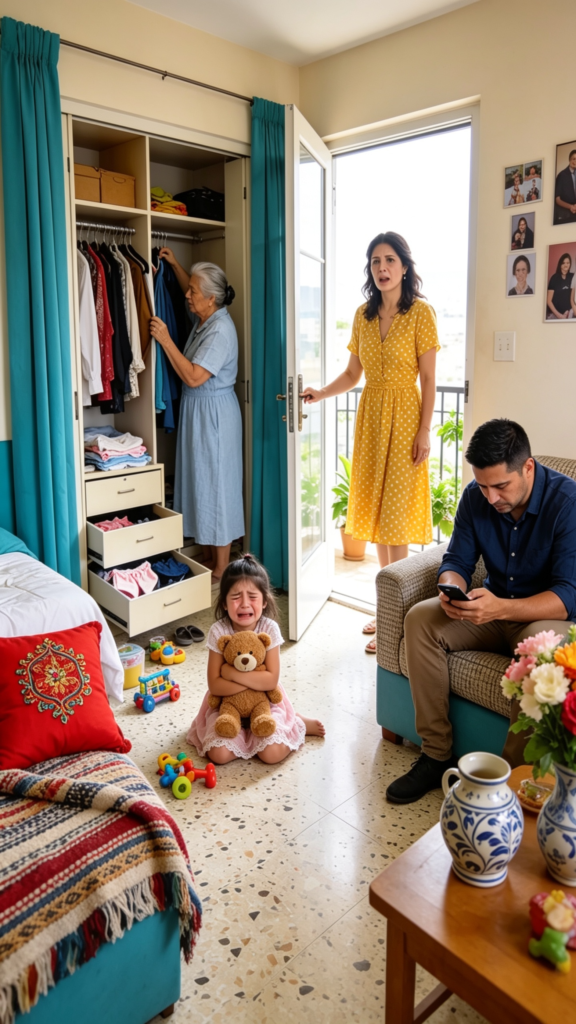
When Laura arrived at her apartment in Portales at 6:12 PM, the first thing she heard was Sofía's crying.
This wasn't a normal three-year-old tantrum. It was a choked cry, filled with fear, the kind that makes a mother drop her bag without thinking.
She found her sitting on the living room rug, clutching her doll, with swollen eyes.
Andrés, her husband, sat on the couch, phone in hand, the expression of someone who already knew everything was about to explode.
—What happened? —Laura asked.
Andrés didn’t answer.
Out of the kitchen came Doña Refugio, her mother-in-law, wearing an apron Laura had never seen and a smile that felt like a slap.
—Sweetheart, don’t be alarmed. I just tidied up a bit because the house was a mess.
Laura froze.
That apartment wasn’t big. It had two bedrooms, a tiny kitchen, and a living room where the couch, a small table, and Sofía’s toys barely fit.
But it was theirs.
They had paid for it with years of work, double shifts, saved bonuses, loans, and many tight paychecks. Every glass, every drawer, every corner had a reason.
That morning, Andrés had called her at work at 10:03.
He told her his mom had arrived “as a surprise” from Toluca. That she had fought with his brother's wife. That she needed to stay a few days to calm down.
He also mentioned that she had entered with the emergency key.
—Don’t make this a hassle, Lau. It’s my mom. Just a few days.
Laura swallowed hard and continued working. She thought that, out of respect, she would endure.
But when she walked into the kitchen, she understood it wasn’t a visit.
The pots were in a different drawer. The plates were rearranged. The coffee was on a high shelf. The glasses had replaced Sofía’s medicine bottles.
She opened a drawer and found her Tupperware stacked with rubber bands, as if someone had decided that her entire way of living was wrong.
Then she went to her bedroom.
Her underwear was on the bed.
All of it.
Bras, panties, pajamas—all pulled from the drawer and folded with a delicacy that didn’t make it any less humiliating.
In the closet, Doña Refugio's clothes were already hanging.
Not just two blouses for a few days.
All her clothes.
Dresses, sweaters, skirts, a brown coat, plastic bags with shoes, a bag of medicine, and a little box with religious trinkets.
Laura felt heat rising to her face.
She went to Sofía’s room.
The crib had an old, thick, cream-colored blanket that smelled of mothballs. On the little girl’s pillow lay a rosary.
Sofía clung to Laura's leg and said softly:
—The lady moved my things.
The lady.
She didn’t even say “grandma.”
Doña Refugio appeared in the doorway.
—I also changed the laundry soap, sweetheart. The one you use gives the girl rashes. With the years, you learn.
Laura looked at Andrés.
He lowered his gaze to his phone.
That hurt her the most.
She didn’t shout. She didn’t make a scene. She didn’t throw anything.
She picked up Sofía, took her to the bathroom, washed her face, and told her everything was okay.
Then she went back to her room, took Doña Refugio's medium suitcase, and started packing her clothes.
One blouse. Then another. Then the shoes.
Doña Refugio followed her with trembling eyes.
—Sweetheart, don’t exaggerate.
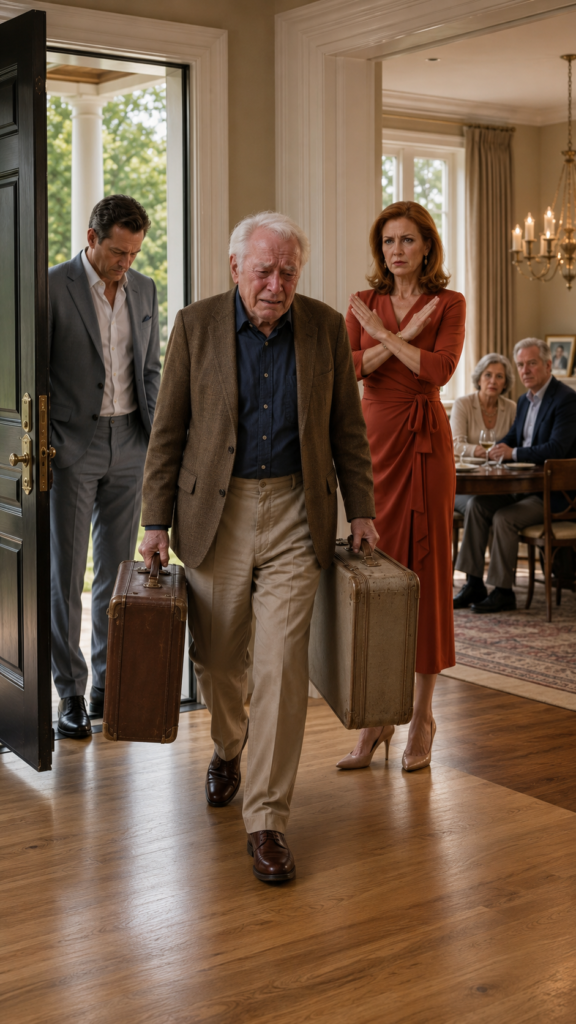
Laura closed the suitcase and left it by the door.
She pulled out her phone and requested a taxi through an app.
—It’ll arrive in eight minutes —she said.
The living room fell silent.
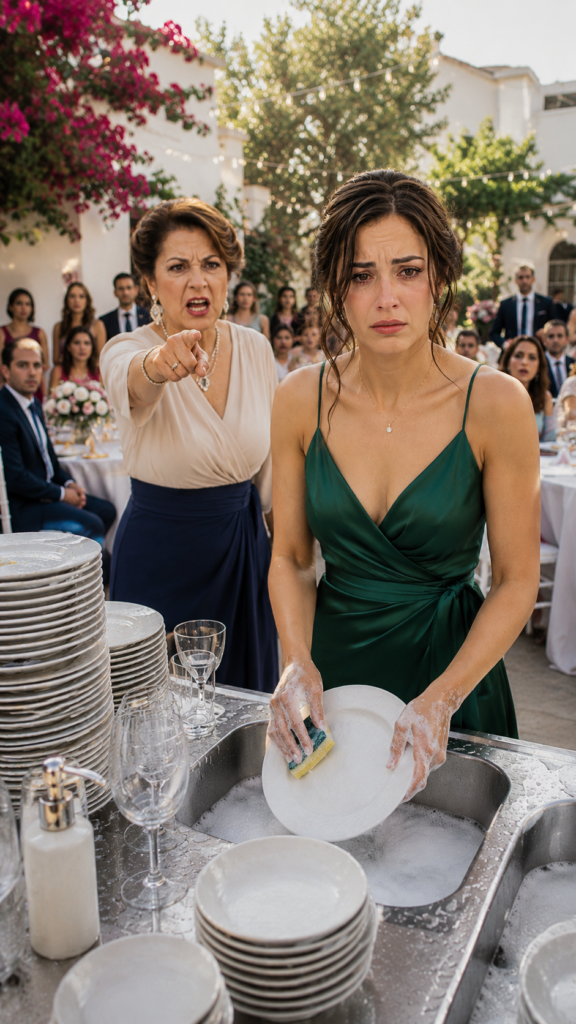
—Doña Refugio, you entered my house without permission. You touched my things. You went into my daughter’s room. You took my intimate clothing. That’s not okay.
—But I’m your mother-in-law.
—And I’m Sofía’s mother. This is our home.
Andrés stood up.
—Laura, don’t be ridiculous...
She looked at him without blinking.
—If you want to go with your mom to find a place for her to stay, go ahead. But no one enters here with a key I didn’t authorize.
Doña Refugio grabbed the suitcase with shaking hands. Before leaving, she glanced at Sofía’s crib.
Then she murmured something Laura heard as a threat:
—I thought I would fit in here.
The elevator doors closed.
Laura felt relief.
But three days later, when she called the supposed cousin where Andrés said he had left her, a strange woman answered:
—No one named Refugio lives here, ma’am. We don’t even know her.
Then Laura understood that her mother-in-law hadn’t come to visit.
And that night, Andrés confessed, crying, that his mom had slept three nights on a bench at Central del Norte.
PART 2
Laura stood frozen in the middle of the living room with the phone still pressed to her ear, even though the call had ended.
Sofía was sleeping in her room.
The television was on without sound.
Andrés had his elbows on his knees, face buried in his hands, as if he had suddenly turned into a much older man.
—Repeat that —Laura said.
Andrés couldn’t.
He just shook his head.
—Repeat where your mom slept, Andrés.
He took a deep breath, but his voice came out broken.
—At Central del Norte. On a bench. Holding her suitcase tight.
Laura felt a blow to her stomach.
She saw it, as if it were right in front of her, Doña Refugio sitting among strangers, guarding her suitcase with her feet, trying not to fall asleep for fear that someone would steal the little she had.
She saw her brown coat. Her low shoes. Her thin hands.
And she also saw the scene she had provoked: the suitcase by the door, the taxi waiting, her mother-in-law stepping into the elevator with a red face.
—You said she was with a cousin —Laura whispered.
—There was no cousin.
—You said she fought with Brenda.
—That too.
Laura gripped the phone so tightly it hurt her fingers.
—Then why did she come here with all her clothes?
Andrés lifted his face.
His eyes were swollen.
—Because she doesn’t have a home to go back to.
Laura sat down slowly, not because she wanted to, but because her legs had stopped holding her up.
Andrés swallowed hard.
—My brother sold Dad's house two months ago. Mom signed because they told her it was to pay debts. According to him, they were going to give her a room in his house. But Brenda didn't want her there. Not because she was bad, Lau, but because Mom started getting sick. A lot.
Laura looked at him, not understanding.
—Sick with what?
Andrés closed his eyes.
—Cancer.
The word fell like a broken plate.
—What?
—Pancreatic. It’s advanced. The doctor said it could be months. Maybe less.
Laura brought her hand to her mouth.
Pieces of that afternoon began to return to her mind, but they didn’t sound the same anymore.
The bag of medicine in the closet.
The box with trinkets.
The clothes hung like someone who didn’t plan to return for anything.
The phrase: “I thought I would fit in here.”
It wasn’t a threat.
It was a farewell disguised as embarrassment.
—How long have you known? —Laura asked.
Andrés lowered his gaze.
—For three weeks.
She felt rage, but she didn’t know against whom.
Against him for lying.
Against Doña Refugio for invading her home.
Against herself for feeling relief when she saw her leave.
—And why didn’t you tell me? —she asked.
—Because she asked me not to. She swore she didn’t want to come across as pitiful. She said if you knew, you would feel obligated. That she didn’t want to be a burden to anyone.
Laura let out a dry laugh, void of joy.
—And your brilliant idea was to let her in secretly with a key?
Andrés didn’t defend himself.
—I didn’t think. I really didn’t think. She told me she just wanted to spend a few days with Sofía. That she wanted to get to know her well before leaving. And when you got home… I froze.
—You sat there.
—Yeah.
—You let me kick her out.
—Yeah.
That answer, so simple, hurt her more than any excuse.
Laura stood up.
—Where is she now?
Andrés took a long time to answer.
And that silence froze her blood.
—Where is she, Andrés?
—In the hospital.
Laura felt the room spinning.
—Since when?
—Since this afternoon. She fainted at the central. A cleaning lady called an ambulance.
Laura walked into her room, put on a sweater over her pajamas, and took the keys.
—Let’s go.
—Lau...
—Let’s go right now.
They didn’t argue.
They drove through the city at night, through empty avenues, closed stalls, and traffic lights that seemed to take forever.
Laura didn’t cry on the way.
She couldn’t.
She just stared out the window, thinking about the cream-colored blanket she had folded with anger and stuffed into the suitcase as if it were an old rag.
They arrived at the general hospital a little after 2 AM.
The hallway smelled of bleach, burnt coffee, and exhaustion.
Doña Refugio lay in a bed at the end, next to a green curtain. She looked small. Much smaller than in the apartment, where her presence seemed to occupy everything.
The suitcase was under the bed.
Laura saw it and felt an urge to kneel.
Doña Refugio opened her eyes.
Upon seeing Laura, she tried to fix her hair with a weak hand, as if it still mattered to her to appear presentable in front of her daughter-in-law.
—Sweetheart… —she murmured—. I’m sorry.
Laura approached, but words wouldn’t come out.
—I shouldn’t have touched your things —Doña Refugio continued—. Your house is your house. You were right.
Laura shook her head.
—Don’t talk, Doña Refugio.
—I have to talk. Later, it won’t be possible.
That phrase split the air.
Andrés stood in the corner, crying silently.
Doña Refugio reached for Laura’s hand.
—The soap wasn’t to call you a bad mother. Camilo, as a child, would get the same rashes from some detergents. I saw the girl’s rashes and thought… I thought I could help.
Laura remembered her anger.
Remembered how she had felt that phrase as an offense.
Now it burned her with shame.
—I moved the kitchen because that’s how my mother had it —Doña Refugio said—. Glasses near the pot, salt nearby. For when you came home tired. One gets old and thinks she still serves to organize something.
Laura squeezed her hand.
—You did serve.
Doña Refugio smiled a little.
—The blanket...
Laura closed her eyes.
—I knitted that blanket when I knew Sofía was coming. It took me months because my fingers hurt a lot. I stored it with mothballs so it wouldn’t spoil. I wanted to give it nicely, with a ribbon. But I didn’t have the courage.
She breathed with difficulty.
—That’s why I put it in your crib. So that, even if you didn’t remember me, you could sleep with something of mine.
Laura couldn’t hold back anymore.
She leaned down and rested her forehead on her mother-in-law’s hand.
—Forgive me —she said, though her voice came out broken—. I didn’t know.
Doña Refugio caressed her hair with a tenderness Laura felt she didn’t deserve to feel so clean.
—You didn’t have to know, sweetheart. One also makes mistakes hiding what’s important.
Andrés then approached, like a reprimanded child.
—Mom...
Doña Refugio looked at him.
—You also made a mistake, son. A wife shouldn’t be left alone with lies. Not to obey the mother.
Andrés broke down in tears.
Laura had never seen him like that. Not when he lost his job. Not when his father died. It was a weeping without pride, without defense.
—I’m sorry —he repeated—. I’m sorry, Mom. I’m sorry, Lau.
Doña Refugio closed her eyes for a moment.
—I didn’t want to be cared for out of pity. I wanted to still serve some purpose.
That was the phrase that stuck with Laura.
Serve some purpose.
Move glasses. Change soap. Lay out a blanket. Leave a kitchen ready.
What Laura had seen as invasion had also been the last attempt of a woman to leave a mark before disappearing.
That dawn, she didn’t return to the apartment empty-handed.
She spoke with the doctor, signed papers, asked what was necessary. Andrés tried to say they could look for a place, a nurse, an option.
Laura looked at him with a different firmness.
—She’s coming home.
—Are you sure?
—Don’t ever decide for me again, Andrés.
He nodded.
Before dawn, Doña Refugio entered the apartment again.
But this time, she didn’t come in with a hidden key or shame.
She entered in a wheelchair, wrapped in a hospital sheet, with Sofía sleeping in Laura’s arms waiting at the door.
When the little girl woke up, she saw her grandmother and hid behind her mother’s legs.
Doña Refugio didn’t push her.
She just pulled out the cream-colored blanket from the suitcase.
—This is for you, sweetie.
Sofía touched it carefully.
—It smells funny.
Doña Refugio let out a giggle.
—It smells like grandma stored away.
Sofía laughed too.
And that’s how it all began.
Doña Refugio lived five more weeks in Sofía’s room.
Laura set up a single bed next to the wall, changed curtains, organized medicines, and left the glasses just where her mother-in-law had placed them that first afternoon.
She never moved the kitchen again.
At first, Sofía entered with distrust.
Then she started bringing her dolls.
Eventually, she told her stories without logic about school, cartoons, and an ant that, according to her, lived in the bathroom.
Doña Refugio listened to her as if every word were national news.
—And does the ant pay rent? —she asked.
Sofía burst out laughing.
Laura listened from the kitchen and wiped her tears with the back of her hand.
There were good days.
Days when Doña Refugio sat in the living room, folding clothes slowly and scolding Andrés for still leaving his shoes in the middle of the hallway.
There were bad days.
Days of pain, vomiting, fever, and long silences.
Laura learned to give her water with a spoon. Learned to change sheets without moving her too much. Learned that caring isn’t always pretty love; sometimes it’s exhaustion, fear, and mixed guilt.
But she also learned something that hurt to accept.
She had loved her mother-in-law late.
Late, but truly.
One night, Doña Refugio asked her to sit next to her.
Sofía was sleeping, hugging the blanket.
—You care hard, sweetheart —she said.
Laura smiled sadly.
—Sometimes too hard.
—No. That’s how a mother should care.
Laura didn’t understand.
Doña Refugio looked at the girl.
—When you kicked me out that afternoon, it hurt. Of course, it hurt. But I also thought: this woman doesn’t let anyone move her daughter’s life. Not me. Not anyone.
Laura swallowed hard.
—I was cruel.
—You were a lioness.
—I left her without a place to sleep.
Doña Refugio closed her eyes.
—No, sweetheart. Life left me without a place to sleep. You just defended your home without knowing the whole story.
Laura cried in silence.
—I wished I hated you less from before —she confessed—. But I always felt you were judging me.
Doña Refugio opened her eyes.
—And I always felt you tolerated me.
The two looked at each other.
For the first time, without masks.
—How foolish we were —said Doña Refugio.
Laura let out a laugh through tears.
—A lot.
The following Tuesday, Doña Refugio died at dawn.
Sofía was sleeping next to her, with one hand on the blanket. Laura woke up to silence, that heavy silence that comes before someone gives the news.
Andrés broke down in the doorway.
Laura didn’t scream.
She just arranged her mother-in-law’s hair, wiped her face with a warm washcloth, and pulled the blanket up to her chest, just like the first night she brought her home from the hospital.
At the wake, relatives Laura barely knew arrived.
Some were genuinely crying. Others asked about papers, expenses, and pending matters with a hurry that was infuriating.
Andrés's brother appeared with Brenda.
Laura felt embarrassed to see her. For three days she had believed that this woman had chased Doña Refugio from her house.
But Brenda approached and hugged her.
—She talked a lot about you —she said.
Laura was surprised.
—About me?
Brenda nodded.
—In the hospital, before leaving with you, she told me something. She asked me to tell you if I could someday.
Laura felt her chest tightening.
Brenda lowered her voice.
—She said: “That girl cares for hers like a lion. She kicked me out of her house, yes, but because her daughter was scared. My granddaughter will be fine with a mom like that. I can leave in peace now.”
Laura covered her mouth.
No way.
The action that weighed the most on her soul, the one that gave her the most guilt, Doña Refugio had turned into comfort.
She hadn’t cursed her.
She hadn’t hated her.
She had understood her better than Laura understood herself.
After the burial, Laura returned to the apartment and found Sofía asleep in her bed, hugging the cream-colored blanket.
It still smelled a bit like mothballs.
That smell Laura had wanted to force out with open windows, new soap, and anger.
Now it was the only thing she had left of the woman who had entered without permission to rearrange her house, not to take it away, but to leave something of hers before leaving.
Andrés changed after that.
Not all at once, nor like in the movies. He changed with shame, with therapy, with awkward conversations, repeated apologies, and with a rule Laura set for good:
In that house, there would be no more lying “to protect.”
Because lies don’t protect.
Lies leave a sick mother sleeping on a bench and a daughter-in-law carrying guilt that could have been avoided with the truth.
The blanket was never stored away again.
Sofía dragged it down the hall, lifted it onto the couch, took it to kindergarten on tough days, and said:
—It's from my grandma Refu.
Laura never washed it.
Andrés said that one day they would have to do so.
Laura always replied the same:
—Not yet.
Because even though the smell was almost gone, even though they had to press their noses against the fabric to find it, Laura needed to keep that last trace.
Not of mothballs.
Of forgiveness.
And every time she opened the drawer where Doña Refugio had placed the glasses, Laura left everything exactly the same.
Because sometimes a house doesn't become a home when everything's in its place.
Sometimes it becomes a home when someone arrives, moves everything, breaks your pride, and teaches you too late that not all invasions come to take something away.
Some come, clumsy and painful, to say goodbye.