PART 1
When Mariana opened the door to her apartment in the Narvarte neighborhood at 7:18 PM, she heard Valentina crying from the living room.
This wasn’t a tantrum.
It was a small, tight cry, like a little girl who doesn’t understand why someone has just invaded her world without permission.
Mariana dropped her keys on the table and ran.
Valentina, just 3 years old, sat next to the couch, hugging her stuffed rabbit, her face red and her eyes swollen.
On the TV, a cartoon played silently.
On the couch sat Julián, her husband, holding his phone with a vacant stare.
“What happened?” Mariana asked.
Julián didn’t respond.
From the kitchen emerged Doña Elvira, her mother-in-law, wearing a flowery apron and a calm expression, too calm for the chaos that Mariana felt in her chest.
“Don’t get upset, dear. I just tidied up. This house was a mess.”
Mariana felt something freeze inside her.
The apartment wasn’t luxurious. It had 2 bedrooms, a narrow kitchen, a small living room, and a balcony barely big enough for 2 flowerpots.
But it was her refuge.
Every piece of furniture had been bought with months of skipping dinners out. Every plate, every photo, every toy of Valentina’s had a place chosen by her.
That morning, Julián had called the dental office where Mariana worked.
He told her that his mother had arrived unexpectedly from Toluca. That she had a big fight with his brother. That she needed to stay “for a few days.”
He also confessed that she had entered with the emergency key.
“Don’t freak out, Mari. It’s my mom. Just until everything calms down.”
Mariana took a deep breath and continued working, though something kept swirling in her head.
But when she entered the kitchen, she understood that this was no visit.
The mugs were on a different shelf.
Valentina’s dishes were mixed with glass plates.
The coffee was hidden on top of the refrigerator.
The drawer where Mariana kept the girl’s medicine was stuffed with folded napkins.
She opened another drawer and found her containers arranged with handwritten labels, as if someone had decided to fix her life.
Then she went to her bedroom.
The door was ajar.
On the bed lay her intimate clothing.
All of it.
Bras, pajamas, socks, panties, shapewear, all folded into perfect little piles.
Mariana’s face burned with shame.
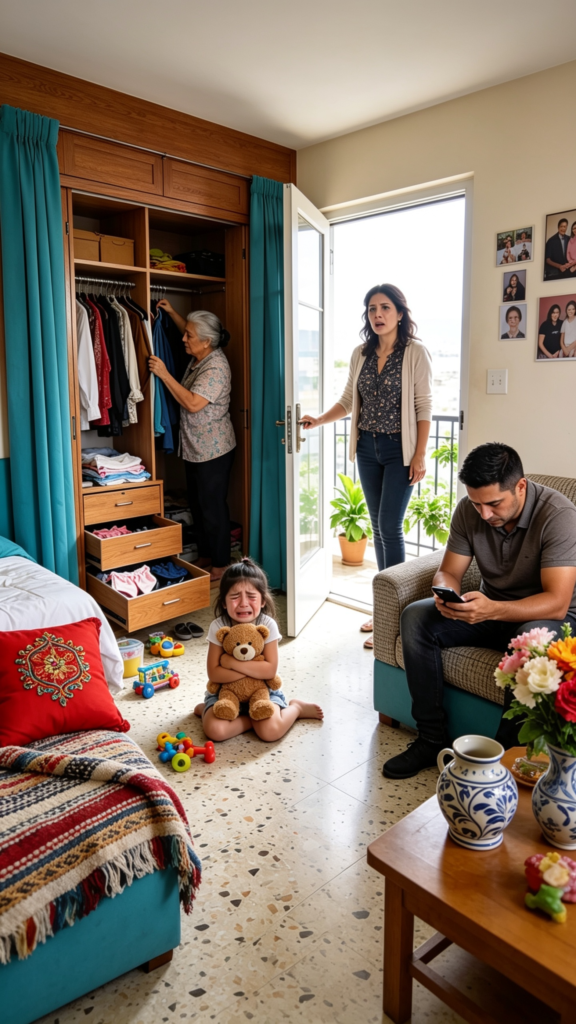
She opened the closet.
Half of her clothes were crammed against one side, while the other side held dresses, sweaters, a gray coat, bags with shoes, medications, holy cards, and a plastic box filled with old papers.
It wasn’t a suitcase for 3 days.
It was a whole life forcing itself to fit.
Mariana went to Valentina’s room.
The little girl’s bed had a thick, old, sky-blue blanket that smelled of storage. On the pillow lay a medallion of the Virgin of Guadalupe.
Valentina clung to her mother’s leg.
“Ms. Elvira moved my bed,” she whispered.
Ms. Elvira.
Not even “grandma.”
Doña Elvira appeared behind her.
“I also changed the fabric softener, dear. The one you use is too strong. We have to take care of the kids’ skin.”
Mariana turned to look at Julián.
He lowered his gaze.
And that silence hurt more than any shout.
Mariana didn’t throw anything.
She didn’t insult.
She picked up Valentina, wiped her face, and sat her on her bed.
Then she went into the master bedroom, grabbed Doña Elvira’s large suitcase, and began to pack her clothes.
A blouse.
Then another.
The shoes.
The medications.
Doña Elvira watched her as if she couldn’t believe it.
“Dear, don’t be like this. I just wanted to help.”
Mariana closed the suitcase.
She ordered a taxi through an app.
“It’ll be here in 6 minutes,” she said.
Julián stood up.
“Mari, seriously, chill.”
She looked at him firmly.
“Your mom entered my house without permission. She touched my intimate clothes. She rearranged my daughter’s room. That’s not helping.”
Doña Elvira pressed her lips together.
“But I’m family.”
“Family also asks for permission.”
The taxi arrived.
Doña Elvira took the suitcase with trembling hands. Before leaving, she glanced towards Valentina’s room.
“I thought I could still be of some use here,” she murmured.
The door closed.
Mariana felt relief.
But 2 days later, when she called the so-called aunt where Julián said he had left her, a strange voice answered:
“There’s no Elvira living here, ma’am.”
That night, Julián broke down in front of her and confessed that his mother had slept 2 nights on a bench at the Terminal de Observatorio.
PART 2
Mariana stood frozen, phone in hand, as if the entire apartment had run out of air.
Valentina was sleeping, hugging her rabbit.
The washing machine spun silently behind the patio door.
Julián sat on the edge of the couch, red-eyed, fingers intertwined, wearing the face of a man who could no longer uphold his own lie.
“Say it again,” Mariana asked.
Julián swallowed hard.
“My mom slept at the terminal.”
“Which terminal?”
“At Observatorio.”
Mariana felt a sharp blow to her chest.
She imagined Doña Elvira sitting on a cold bench, clutching her suitcase, guarding her shoes, trying not to close her eyes among vendors, guards, passengers, and people who don’t ask anything because everyone is just passing through.
She saw her in that gray coat.
With her medications.
With that sky-blue blanket Mariana had shoved into the suitcase out of anger, as if it were any old rag.
“You told me she was with your aunt Chayo,” Mariana said.
“There’s no aunt Chayo.”
“You said she fought with your brother.”
Julián covered his face.
“That did happen, but not like I told you.”
Mariana clenched her jaw.
“Then explain to me why she came here with all her clothes.”
Julián lifted his head.
His voice was shattered.
“Because she no longer has a home.”
Mariana sat down slowly.
Not out of calm.
But out of fear.
“How can she not have a home?”
“My brother convinced her to sell my dad’s house. He told her it was to pay debts and fix papers. He promised her a room in his apartment in Toluca. But when he took her there, his wife said she couldn’t stay.”
“Why?”
Julián took too long to answer.
That silence scared Mariana more than the answer.
“Because she’s sick.”
Mariana felt her hands go cold.
“Sick with what?”
Julián cried silently.
“Cancer. In the pancreas. Advanced.”
The word fell in the living room like broken glass.
Mariana brought a hand to her mouth.
Suddenly, all the images from that afternoon returned, but with a different meaning.
The bag of medications.
The holy cards.
The closet full, not as an invasion, but as a final move.
Doña Elvira’s phrase at the door.
“I thought I could still be of some use here.”
It wasn’t manipulation.
It was shame.
It was fear.
It was a woman trying to enter a family before leaving this world.
“Since when do you know?” Mariana asked.
Julián looked down.
“A month ago.”
Mariana let out a dry laugh, devoid of joy.
“And in a month, you couldn’t find a moment to tell me your mom was dying?”
“She asked me not to tell you.”
“Oh, of course. And you, being so obedient, preferred to sneak her in with a key.”
Julián didn’t defend himself.
“She told me she didn’t want to come across as pitiful. If you knew, you would feel obligated. She wanted to spend time with Vale without everyone seeing her as sick.”
“And so she rummaged through my drawers?”
“I don’t know. I didn’t think. I was scared. I was scared to see her like that.”
Mariana stood up.
The rage was still there, but it no longer had a single direction.
She hurt for Julián for being a coward.
She hurt for Doña Elvira for being imprudent.
And she hurt for herself for having felt relief when the door closed.
“Where is she now?”
Julián didn’t answer.
Mariana felt a knot in her throat.
“Julián, where’s your mom?”
“At the hospital.”
“Since when?”
“This afternoon. She fainted at the terminal. A cop called an ambulance.”
Mariana walked to the room, put on sneakers without socks, grabbed a sweater, and took the keys.
“Let’s go.”
“Mari…”
“Let’s go right now.”
They didn’t speak during the drive.
The city looked different at dawn. Closed stalls, halted taxis, empty streets, and traffic lights that seemed to mock time.
Mariana stared out the window without crying.
She couldn’t.
She just thought about the sky-blue blanket, the medallion on Valentina’s pillow, and Doña Elvira’s hands folding her underwear with a delicacy that didn’t erase the humiliation but perhaps revealed something else.
They arrived at the general hospital after 2 AM.
The hallway smelled of bleach, old coffee, and exhaustion.
Doña Elvira lay on a bed next to a green curtain. She looked smaller, more fragile, as if the woman who had filled the apartment with her presence could now fit under a sheet.
The suitcase was under the bed.
Mariana saw it and felt shame down to her bones.
Doña Elvira opened her eyes.
Upon recognizing Mariana, she tried to fix her hair.
“Dear… I’m sorry.”
Mariana approached, but her voice wouldn’t come out.
“I shouldn’t have touched your things,” Doña Elvira murmured. “Your home is your home. You were right.”
“Don’t speak, Doña Elvira.”
“Yes, I have to. Later, one leaves things unfinished, and unfinished things weigh heavy.”
Julián stood in the corner, crying like a child.
Doña Elvira reached for Mariana’s hand.
“The fabric softener wasn’t to criticize you. Julián used to break out in rashes. I saw the girl scratching her neck and thought I could help.”
Mariana remembered her anger.
She recalled feeling that phrase as an attack on her motherhood.
Now it burned her with guilt.
“I arranged the kitchen like my mom had it,” Doña Elvira continued. “Mugs down, pots close, salt at hand. An old lady thinks she can still leave something ready for when others come home tired.”
Mariana squeezed her hand.
“You didn’t have to do everything alone.”
Doña Elvira smiled faintly.
“I never knew how to ask for permission, dear. In my house, if something was needed, one just did it.”
She struggled to breathe.
“I knitted the blue blanket when I knew Valentina was coming. It took me months. My fingers were already hurting. I saved it to give it to you on a pretty day, with a bow and everything. But then I got sick, and then I felt ashamed.”
Mariana closed her eyes.
“I stuffed it into the suitcase as if it were worthless.”
“You didn’t know.”
“I kicked you out.”
“You protected your daughter.”
Mariana broke into tears.
This wasn’t an elegant cry. It was one of those cries that bend the body, that come out with shame, with rage, and with love too late.
“I’m sorry,” she said.
Doña Elvira caressed her hand.
“Don’t carry what wasn’t yours. My son lied. I hid. You reacted to what you saw.”
Julián stepped closer.
“Mom, I’m sorry. Sorry for leaving you there. Sorry for not telling the truth.”
Doña Elvira looked at him with tenderness but also with firmness.
“A wife is not protected with lies, son. And a mother is not obeyed when she’s hiding what everyone needs to know.”
Julián broke down.
Mariana had never seen him so stripped bare.
“I didn’t want to be a burden,” Doña Elvira whispered. “I wanted Valentina to remember me, even if just a little.”
That phrase pierced Mariana.
She hadn’t wanted to enter to take charge.
She hadn’t wanted to enter to steal her place.
She wanted to leave a mark.
Clumsy.
Invasive.
Painful.
But a mark.
That dawn, Mariana spoke with the doctor, requested information, signed papers, and asked everything she needed to ask.
Julián mentioned looking for a boarding house, a caregiver, a temporary option.
Mariana looked at him with a different, harsher calm.
“She’s coming home.”
“Are you sure?”
“What’s not going to happen again is you deciding for me.”
Julián nodded.
Before dawn, Doña Elvira returned to the apartment.
But this time she didn’t enter with a hidden key.
She entered in a wheelchair, wrapped in a hospital blanket, with Mariana opening the door and Valentina half-asleep behind her legs.
The little girl looked at her grandmother with distrust.
Doña Elvira didn’t try to hug her.
She simply pulled the blue blanket out of the suitcase.
“This is for you, little one.”
Valentina touched the fabric.
“It smells weird.”
Doña Elvira let out a weak giggle.
“It smells like grandma stored away.”
Valentina laughed.
And with that laughter began a second chance that no one knew how long it would last.
Doña Elvira lived for 6 more weeks in Valentina’s room.
Mariana placed a single bed against the wall. She organized the medications on a tray. She bought a small bell so Doña Elvira could call her if she needed anything.
The kitchen remained as her mother-in-law had arranged it.
Mugs down.
Pots close.
Salt at hand.
At first, Valentina would only enter if Mariana went with her.
Then she began to bring her toys.
Soon she would lie beside her bed to tell her long stories about kindergarten, a girl who bit crayons, and an imaginary dog that, according to her, lived in the elevator.
Doña Elvira listened as if every word were a miracle.
“And does that dog pay maintenance?” she would ask.
Valentina would burst out laughing.
Mariana listened from the kitchen, wiping her tears with her shoulder because her hands were always full.
There were calm days.
Days when Doña Elvira would slowly fold clothes and scold Julián for leaving glasses everywhere.
“You’re still as messy as ever, kid.”
Julián would hang his head.
“Yes, mom.”
There were terrible days.
Days of pain, fever, vomiting, fear, and silences so long that Mariana learned to measure Doña Elvira’s breathing from the door.
Caregiving wasn’t pretty all the time.
It was exhaustion.
It was the smell of medicine.
It was waking up every 2 hours.
It was crying in the bathroom so Valentina wouldn’t see her.
But it was also getting to know a woman Mariana had judged only by her flaws.
One afternoon, while Valentina slept hugging the sky-blue blanket, Doña Elvira asked to speak with Mariana.
“You care like a lioness, dear.”
Mariana smiled sadly.
“Sometimes I bite too much.”
“No. That’s how a daughter is cared for.”
“I was cruel to you.”
Doña Elvira shook her head.
“You were firm. It hurts, yes. But that afternoon I understood that Valentina was safe. If you kicked me out for scaring the girl, then no one is going to walk all over her.”
Mariana cried in silence.
“I wanted to love you before, but I always felt you were judging me.”
Doña Elvira looked at her.
“And I always felt you tolerated me out of courtesy.”
The two fell silent.
Then Doña Elvira smiled.
“How foolish we were.”
Mariana let out a broken laugh.
“Pretty foolish, to be honest.”
Doña Elvira died on a Friday at 5:40 AM.
Valentina was sleeping in her bed, hugging the sky-blue blanket. Mariana woke up to a different silence, one heavy, definitive.
Julián stood frozen in the doorway, unable to move.
Mariana was the one who approached.
She fixed Doña Elvira’s hair, wiped her face with a warm cloth, and tucked the blanket up to her chest.
She didn’t scream.
She didn’t make a fuss.
She simply held her hand until help arrived.
At the wake, relatives appeared whom Mariana barely knew.
Some cried for real.
Others asked about papers, debts, and expenses with an urgency that was infuriating.
Julián’s brother arrived with his wife.
Mariana felt a knot. For days she had believed that this woman had been the villain of it all.
But the woman approached and hugged her.
“Doña Elvira talked a lot about you,” she said.
Mariana was surprised.
“About me?”
“Yes. In the hospital, she asked me that if I could, to tell you something.”
Mariana felt her chest close up.
“What?”
The woman lowered her voice.
“She said: ‘Mariana kicked me out of her house because her daughter was scared. It hurt me, but it also gave me peace. That girl has a mother who stands her ground. I can go peacefully now.’”
Mariana covered her mouth.
The scene that brought her the most guilt, Doña Elvira had transformed into comfort.
She hadn’t hated her.
She hadn’t cursed her.
She had understood her.
Perhaps too late, but she had understood.
After the burial, Mariana returned to the apartment.
Valentina was asleep on the couch, hugging the sky-blue blanket.
It still smelled a bit of storage.
That smell that Mariana had wanted to erase with soap, open windows, and anger.
Now it was all she had left of a woman who had entered without permission to rearrange her home, not to steal her place, but to leave something of hers before saying goodbye.
Julián changed after that.
Not like in a novel.
He changed with therapy, with apologies, with awkward conversations, and with a rule that Mariana set for good:
In that house, no one would ever lie again “to protect.”
Because lies don’t protect.
Lies leave a sick mother sleeping on a bench and a daughter-in-law carrying a guilt that could have been avoided with one truth told in time.
The sky-blue blanket was never put away again.
Valentina carried it from the room to the living room, from the living room to the couch, from the couch to the car.
When someone asked, she proudly replied:
“It’s from my grandma Elvi.”
Mariana never washed it.
Julián said that someday they would have to.
Mariana always answered the same:
“Not yet.”
Because even though the smell had almost gone, she needed to preserve that last trace.
Not of dust.
Not of mothballs.
Of forgiveness.
And every time she opened the drawer where Doña Elvira had placed Valentina’s small cups, Mariana left everything exactly as it was.
Because sometimes a house doesn’t become a home when no one touches your things.
Sometimes it becomes a home when someone arrives, moves everything, breaks your pride, and teaches you too late that not all invasions come to take something from you.
Some arrive clumsily, awkwardly, and painfully.
But they only came to say goodbye.