PART 1
For years, Don Ernesto Villaseñor let everyone believe he was just another old man, living off a meager pension and a warm bowl of soup.
He never spoke of his savings.
He never boasted that, after 35 years as an accountant in Guadalajara, he had amassed nearly $800,000 in investments, funds, and accounts he managed with almost obsessive discretion.
To his son Leonardo and daughter-in-law Mariela, Don Ernesto was simply “the grandpa of the house.”
The one who fixed the sink leak.
The one who collected the gas bills.
The one who prepared beans, red rice, and chicken broth when no one felt like cooking.
The one who barely got in the way, according to Mariela.
Six years earlier, when his wife Teresa passed away, Leonardo asked him to move in with them to a house in Zapopan.
“I don’t want you to be alone, Dad,” he said, hugging him with genuine tears.
Don Ernesto agreed.
Not for comfort, but because the silence of his apartment had become unbearable.
At first, Mariela treated him with respect.
She served him coffee.
She called him “Don Ernes.”
She even asked if he needed anything from the store.
But as months passed, affection turned into tolerance.
And tolerance morphed into annoyance.
“Don Ernesto, could you have dinner in the kitchen tonight? Some friends of Leo are coming over, and we want to use the dining room.”
He smiled.
“Of course, daughter. It’s no problem.”
Then came more phrases.
“Could you stay in your room for a bit? The gathering is more intimate.”
“Could you enter through the garage? My friends don’t know you live here.”
“Could you not talk about old things? It makes the atmosphere heavy.”
Don Ernesto obeyed without arguing.
He wasn’t weak.
He had just learned that not every battle was worth the toll on his heart.
Besides, he still loved Leonardo.
And as long as his son seemed calm, he was willing to take up the smallest space possible.
But his auditor's eyes never stopped watching.
On the kitchen counter, he saw car contracts, bank statements, maxed-out credit cards, personal loans, expensive renovations, and purchases that made no sense.
Leonardo and Mariela lived like the rich.
Trips to Cancun.
Brand-name watches.
Dinners in Andares.
Parties with music, expensive wine, and perfect Facebook photos.
What no one knew was that many of those doors remained open because Don Ernesto had signed as a guarantor.
An auto loan.
A business line of credit.
A loan for home renovations.
And two bank guarantees that Leonardo had asked for “just while they got settled.”
Don Ernesto never demanded anything in return.
He never threw it in their faces.
He thought helping a son was sowing peace.
Until that night.
Mariela organized a dinner with Leonardo’s coworkers. Laughter, expensive bottles, and soft music filled the air. Don Ernesto spent three hours preparing stuffed mushrooms and a morita chili sauce that had fascinated Leonardo since childhood.
When he stepped into the dining room with the tray, Mariela approached with a cold smile.
“Don Ernesto, I think it’s time you stopped living with us.”
Silence fell like a stone.
Leonardo was there.
His son.
His only son.
Don Ernesto looked at him, hoping for a word, a defense, even a “Mariela, not now.”
But Leonardo looked down.
Then Mariela, with a calmness that hurt more than a scream, added:
“Leo needs space. We need our life.”
Don Ernesto set the tray down on the table.
“Do you think the same, son?”
Leonardo swallowed hard.
“Dad… I really think it would be better for you to find another place.”
Don Ernesto didn’t argue.
He didn’t raise his voice.
He didn’t cry in front of them.
He only nodded.
“Alright.”
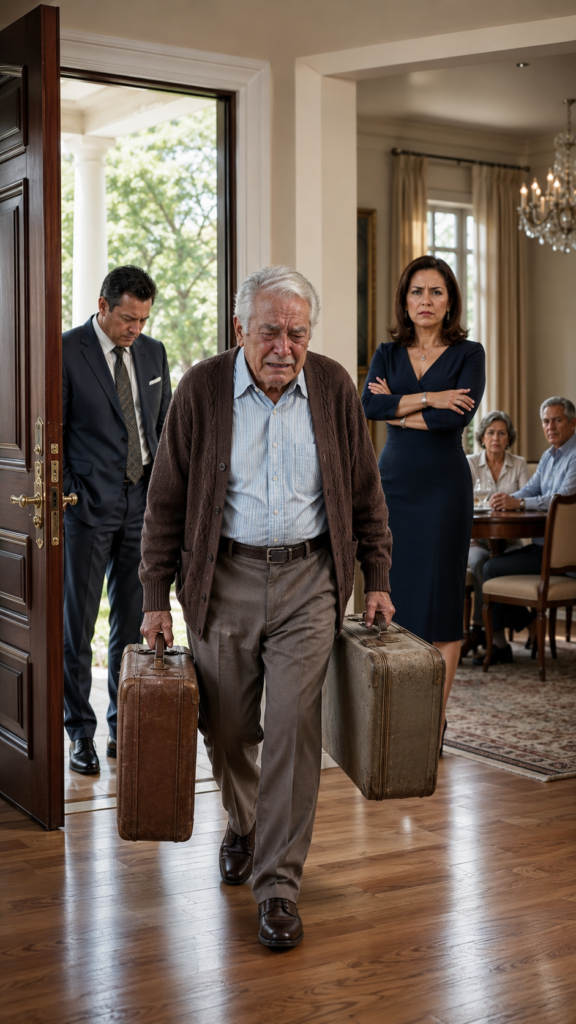
That early morning, while the party continued downstairs, he packed two suitcases.
He tucked away photos of Teresa, documents, his laptop, a black folder, and the gray sweater his wife had knitted for him before she got sick.
Before leaving, he left the keys on the counter.
But he also took something Mariela never imagined.
All the papers that could sink them.
PART 2
At 6:20 in the morning, Don Ernesto left that house without making a sound.
He didn’t leave a note.
He didn’t block anyone.
He didn’t create a scene.
He took a taxi to a small hotel near downtown Guadalajara and requested a simple room for three nights.
The receptionist, a young girl, asked if he needed help with his luggage.
“No, thank you, dear. I can still carry this.”
But what he truly carried was much heavier.
It wasn’t clothes.
It was the humiliation of being treated like an old piece of furniture in the house he had helped sustain.
That same day, he called attorney Sofía Cárdenas, a lawyer specializing in financial contracts.
He had known her for years, as Don Ernesto had audited companies where she provided counsel.
When he sat across from her and opened the black folder, Sofía frowned.
There were copies of guarantees, promissory notes, securities, account statements, notarized contracts, and transfer receipts.
All organized by date.
All impeccable.
“Don Ernesto… do you know how much risk you’re carrying with these?”
He sighed.
“Yes. That’s why I came.”
Sofía spent 40 minutes reviewing the documents.
Then she took off her glasses and asked:
“What do you want to do exactly?”
Don Ernesto looked at the photo of Teresa he carried in his wallet.
“I want to get out of all of it. No revenge. No shouting. Just according to the law.”
“That means several institutions will require new guarantees immediately.”
“I know.”
“And if they can’t respond, their credits can be frozen.”
“I also know.”
“Are you sure?”
Don Ernesto pressed his lips together.
“My son allowed me to be thrown out of his house like garbage. I can’t keep financing a life where I’m the burden.”
For the next three weeks, everything moved in silence.
Don Ernesto rented a small apartment in the Americana neighborhood.
He bought a wooden table, two chairs, a coffee maker, and some basil pots for the window.
He updated his tax address.
He closed a joint account where Leonardo was listed as the operational beneficiary.
He withdrew his signature as a guarantor on the renovation loan.
He canceled a bank guarantee that backed Mariela’s business.
And he formally notified the bank that he would no longer be responsible for the credit on the SUV that Leonardo flaunted as if he had paid for it entirely through hard work.
Meanwhile, Leonardo didn’t call.
Mariela didn’t either.
They only sent a dry message on the fifth day.
“We hope you’re well. When you have a permanent place, let us know so we can send your medicines.”
Don Ernesto read the message twice.
He didn’t reply.
In his new apartment, sitting in front of a cup of coffee, he opened his investment account and looked at the figure he had saved over decades.
Almost $800,000.
Money born from early mornings, discipline, simple meals, reinvested bonuses, and years of not spending to appear wealthy.
His original plan was to leave it all to Leonardo.
Now he wasn’t so sure.
On the 21st day, at 8:30 in the morning, a messenger arrived at the house in Zapopan.
Mariela opened the door in a silk robe, coffee in hand, and a look of annoyance.
She received three envelopes.
The first was from the bank.
They informed her that the credit line for her business was suspended until a new guarantee was presented.
Mariela felt a punch in the stomach.
She opened the second.
It was from the legal office of Sofía Cárdenas.
It notified her that Don Ernesto was withdrawing his signature as a guarantor for the renovation loan of 1,250,000 pesos.
She opened the third with trembling hands.
The credit for the SUV would be reviewed immediately due to lack of collateral support.
“Leonardo!” she screamed.
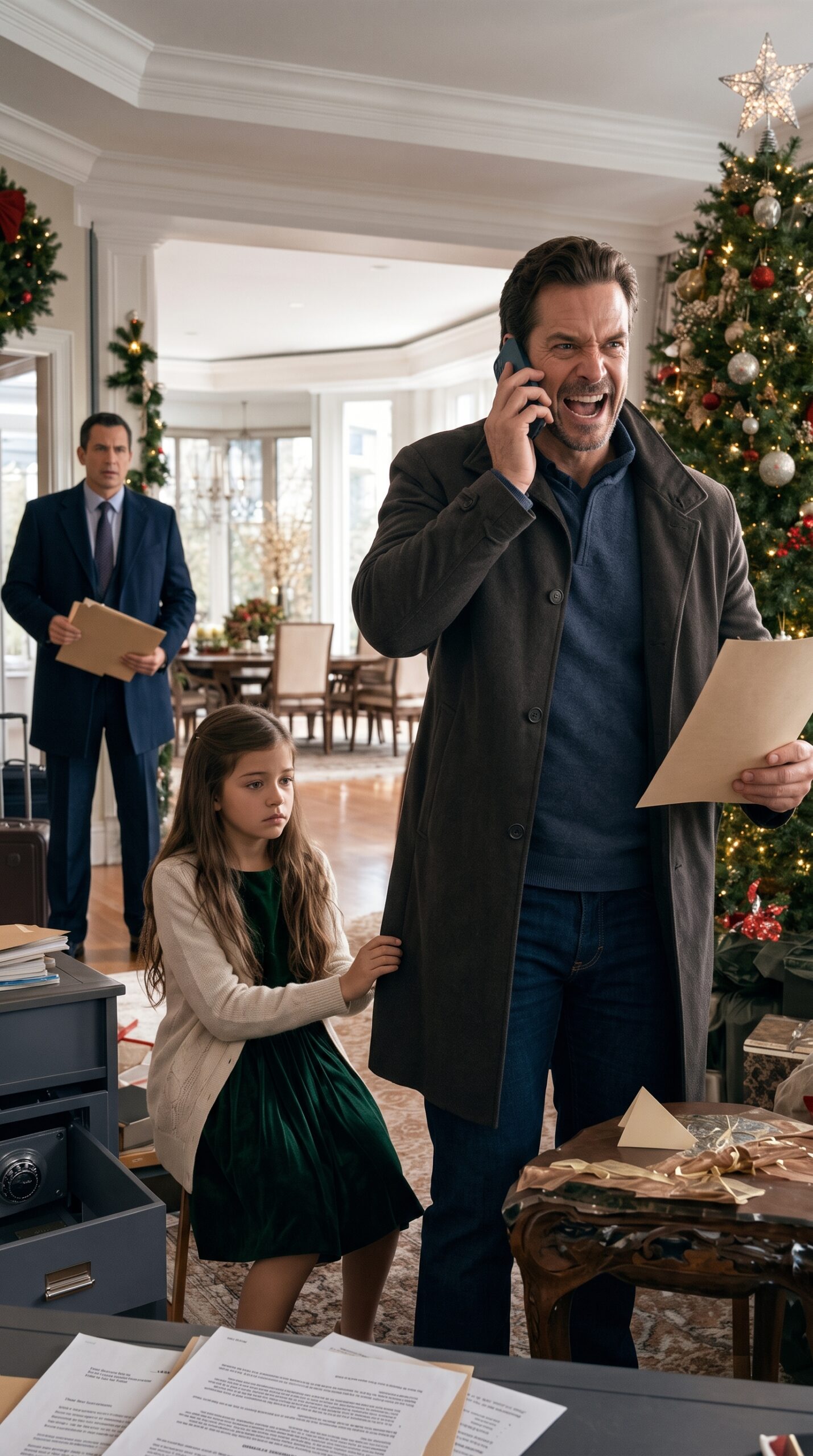
Leonardo rushed down the stairs.
He read the papers with a pale face.
“He can’t do this.”
“How can he not?” Mariela began to cry with anger. “You said your dad had nothing!”
Leonardo didn’t respond.
Because there lay the first truth Mariela didn’t know.
He suspected his father had money.
He didn’t know the exact amount, but for years he had seen bank statements, envelopes from the bank, and transactions that didn’t match a simple pension.
And yet, he allowed Mariela to treat him like a burden.
Not out of ignorance.
Out of cowardice.
That afternoon, the calls began.
First Leonardo.
Then Mariela.
Then messages.
“Dad, we need to talk.”
“Don Ernesto, I think there was a misunderstanding.”
“It wasn’t our intention to make you feel bad.”
“Please, this could ruin us.”
Don Ernesto didn’t reply until nightfall.
When Leonardo finally heard his voice, he let out a desperate sigh.
“Dad, please. Mariela was stressed. You know how she is.”
Don Ernesto closed his eyes.
“Yes, son. I know exactly how she is. What I didn’t know was how you were.”
There was silence.
“I didn’t want to hurt you.”
“But you did.”
“We can fix this. Come back home.”
Don Ernesto let out a sad laugh.
“To which home? The one I was asked to leave in front of strangers?”
Leonardo began to cry.
“Dad, we’re really struggling. The bank is on us. Mariela has overdue payments. If you don’t sign again, we could lose everything.”
Then Don Ernesto said the phrase that shattered his son’s chest:
“Sometimes you lose things to understand whom you had lost long before.”
Leonardo went to his father’s apartment the next day.
He arrived with dark circles under his eyes, a wrinkled shirt, and a bag of sweet bread, just like when he was a child visiting Teresa on Sundays.
Don Ernesto opened the door but didn’t hug him.
Leonardo entered and looked around the simple place.
“You live here?”
“Yes.”
“But you could be in something better.”
“Of course, I could.”
Leonardo lifted his gaze.
“So it’s true.”
“What thing?”
“That you have money.”
Don Ernesto walked over to a filing cabinet, took out a blue folder, and placed it on the table.
“I have enough to live in peace. And I used to think of leaving it all to you.”
Leonardo stood frozen.
“How much?”
“Enough for that question to hurt.”
The son covered his face with his hands.
“Dad…”
“Don’t cry over money, Leonardo. Cry for the night your wife humiliated me and you chose to look at the floor.”
The real twist came four days later.
Desperate, Mariela went to the apartment unannounced.
She didn’t come to apologize.
She came to negotiate.
“Don Ernesto, let’s be clear. You also benefited from living with us.”
He let her speak.
“You can’t leave us like this. My business depends on that credit line. Leo needs the car to work. And the house… the house also has your name in several proceedings.”
Don Ernesto looked at her calmly.
“No, Mariela. The house is in your names. I only signed so you could keep it when you were already drowning.”
She gritted her teeth.
“Then help us one last time.”
“No.”
Mariela changed her tone.
“If you don’t help, Leo will have to choose between his family and you.”
Don Ernesto smiled faintly.
“He already chose that night.”
Mariela stormed out in fury.
But she didn’t know that Sofía Cárdenas had already prepared the final document.
Don Ernesto modified his will.
He didn’t leave Leonardo completely out.
He left him a letter, his grandfather’s watch collection, and a small account with 50,000 pesos.
The rest of his estate would go to a trust for scholarships for young people who cared for abandoned elderly people.
When Leonardo found out, he arrived devastated.
“Are you punishing me?”
Don Ernesto looked at him with pain, not hatred.
“No, son. I’m putting my money where it can still teach something.”
Leonardo fell to his knees.
“Forgive me.”
For the first time, Don Ernesto cried.
Not for the estate.
Not for the house.
He cried because for six years he had confused silence with love, utility with belonging, and obedience with family.
He placed a hand on his son’s shoulder.
“I forgive you, Leonardo. But forgiving doesn’t mean I’ll finance your life again.”
Months later, the house in Zapopan was sold.
The SUV was returned.
Mariela’s business closed.
She blamed everyone but herself.
Leonardo, on the other hand, started anew in a small apartment, without luxuries, without credit cards, and with a shame that wouldn’t fit in any suitcase.
He visited his father every Sunday.
At first, Don Ernesto only offered him coffee.
Then, a bowl of broth.
Later, conversation.
But he never handed back control of his life.
The last time someone asked Don Ernesto if he regretted being so harsh, he replied:
“I wasn’t harsh. It was harsh to discover that my presence was worth less than my signature.”
And that phrase was shared thousands of times, because in many families, there’s someone who doesn’t get in the way, someone who holds everything in silence… until one day they tire of being invisible.