PART 1
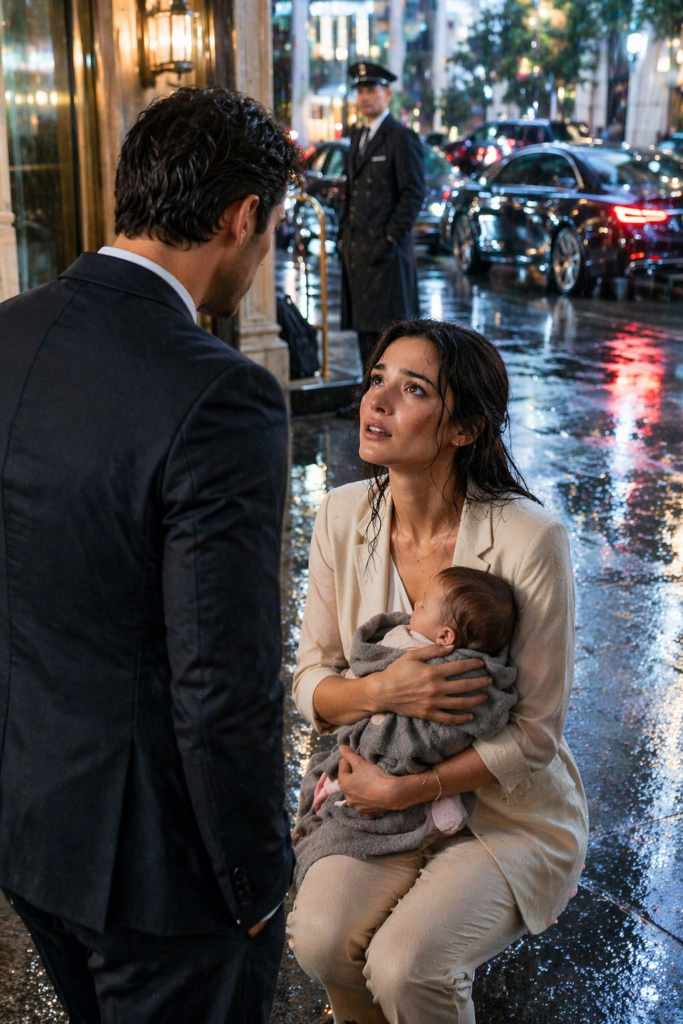
"Sir, please… don’t you need someone to wash dishes, sweep, or clean bathrooms? My little girl hasn’t had a bite to eat in two days."
Her voice trembled under the rain in front of the Hotel Alameda Real, right on Paseo de la Reforma, where luxury cars splashed puddles as if misery didn’t exist.
Bruno Arriaga stepped down from his black SUV, his coat soaked, his phone buzzing with messages, and his patience shattered.
Upstairs, in the hotel’s private restaurant, his mother, Doña Regina Arriaga, awaited him alongside twelve partners of the family consortium.
It was a business dinner.
Or so they had told him.
Bruno barely glanced at the woman speaking from the entrance. She was drenched, emaciated, wearing shoes that were falling apart and an old jacket clinging to her body.
Cradled in her arms was a sleeping child, wrapped in a pink blanket now gray from use.
A guard tried to push her away.
“Ma’am, you can’t be here.”
She lowered her gaze, humiliated.
Bruno was about to keep walking, but then the woman lifted her face.
And the noise of Reforma vanished.
The honks, the rain, the footsteps, everything faded to silence.
“Renata…,” he whispered.
The woman turned pale.
Her eyes didn’t show joy.
They showed fear.
“Don’t say my name,” she murmured, barely moving her lips. “Your mom is watching.”
Bruno felt the air cut off.
Renata, his wife, had died two years earlier in an alleged accident on the way to Puebla. They had found a burned car, charred documents, and remains a private forensic doctor identified as hers.
Doña Regina had wept on television.
She organized a closed mass.
She told Bruno he had to be strong, forget, obey.
Bruno had buried a sealed coffin.
He had cried in front of a grave marked with his wife’s name.
And now Renata stood there, alive, broken, with a child in her arms.
Bruno looked at the little girl.
“Is she…?”
Renata tightened the blanket.
“She’s your daughter. Her name is Lucía.”
Bruno stepped back, as if he had been struck in the chest.
The girl was just over a year old. That meant Renata had been pregnant when she disappeared.
From the restaurant’s window, an elegant figure observed with a glass in hand.
Doña Regina.
Bruno understood that any reaction could cost them their lives.
He straightened up, feigned indifference, and said loudly:
“There’s always a shortage of people in the kitchen. Come in, ma’am. Ask for the manager.”
Renata didn’t respond.
She merely walked behind him, head down, like someone who already learned that even breathing heavily could cost her dearly.
In the elevator, Bruno didn’t touch her.
He punched a code into his phone, turned off the interior camera, and ascended directly to a private suite.
When he closed the door, the world came crashing down around him.
He fell to his knees in front of her.
Renata placed the child in his arms.
Bruno held her with clumsy, desperate tenderness, as if cradling a miracle that could vanish if he breathed too hard.
“I was told you were dead,” he said, his voice broken.
Renata swallowed hard.
“Your mother wanted that.”
Bruno lifted his gaze.
“What did she do to you?”
Renata slowly rolled up her wet sleeve. Old marks were etched on her wrists.
“She had me picked up after I left an appointment. She paid Dr. Leal to sign off on the identification of the remains. I was locked up in a house near Valle de Bravo. When she found out I was pregnant, she said that girl would ruin everything.”
Bruno shook his head.
“It can’t be. My mom is cold, yes, but…”
“Your dad left a clause,” Renata interrupted. “If you couldn’t lead the group, your wife would take control temporarily. Not her.”
Bruno’s phone vibrated.
Mom.
Renata recoiled in terror.
“Don’t answer. If she suspects I’m here, she’ll make us disappear again.”
Bruno glanced at Lucía, sleeping.
Then he answered.
“Bruno,” Doña Regina said. “The meeting starts in 15 minutes. And stop wasting time with beggars. They’re not your problem.”
Bruno hung up slowly.
He pulled a black phone from his briefcase.
“For two years, I pretended to be destroyed,” he said. “But I never fully believed that story.”
He typed a message.
She’s alive. The girl too. Activate the operation.
Renata let out a sob.
Bruno walked toward the door.
“Tonight my mother will understand something.”
“What?”
He looked toward the restaurant, where Doña Regina continued to wait.
“That burying a woman alive has a price.”
But when Bruno stepped out, Renata saw two men standing in front of the suite through the peephole.
One spoke on the phone:
“The wife is inside. The girl too.”
PART 2
Renata felt her legs go weak.
For a second, she thought Bruno had turned her in.
She held Lucía tight against her chest and searched for something to defend herself with: a lamp, a chair, anything.
Then one of the men slid a badge under the door.
Private investigation. Family protection.
Renata covered her mouth to keep from crying.
They weren’t Regina’s men.
They were the first barrier between her daughter and the hell they had just escaped.
Meanwhile, on the 18th floor of the hotel, Doña Regina Arriaga smiled as if the world still belonged to her.
The private room was filled with candles, expensive glasses, and lawyers in dark suits. There were twelve advisors, two notaries, and Esteban Cárdenas, the consortium’s financial director.
Everyone pretended it was an elegant dinner.
Bruno knew it was an ambush.
His mother had prepared documents to declare him incapable of leading Grupo Arriaga. They would allege chronic depression, emotional instability, and business negligence since Renata’s supposed death.
Then, Esteban would take over the operation.
And Doña Regina would continue to pull the strings from behind, as always.
"My widowed son finally arrives," she said when Bruno entered. "Always late, even to save your own surname."
Some chuckled softly.
Others looked down.
Bruno sat without responding.
Esteban pushed a folder toward him.
"It’s a temporary restructuring, Bruno. No one wants to take anything from you. We want to help you, man. You’ve been through a lot."
Bruno glanced at the folder.
"How noble."
Doña Regina set her glass down on the table.
"Don’t make a scene. Since Renata died, you’ve become useless."
The word ‘died’ fell heavy, false, repugnant.
Bruno picked up the pen.
His hidden phone vibrated inside his coat.
It was a message from Jimena Larios, the private investigator he had hired 18 months ago.
We found the house. There are cameras, medications, handcuffs, fake documents, and baby clothes. The caretaker is testifying.
Bruno didn’t move a muscle.
He just lifted the pen and asked:
"Before I sign, I want to know something."
Regina sighed.
"You always need to turn everything into a novel."
"Where’s Renata’s ring?"
Esteban answered too quickly.
"It was lost in the fire."
Bruno fixed his gaze on him.
"How strange. The report said no jewelry was found."
Silence shifted.
A lawyer stopped reviewing his papers.
Doña Regina barely smiled.
"Are you going to talk about a ring at a corporate meeting?"
"No," said Bruno. "I’m going to talk about an empty grave."
A waiter approached and placed a white envelope in front of Bruno.
He opened it calmly.
He pulled out photographs of bank transfers made to Dr. Hugo Leal, four days before Renata disappeared.
There were also email captures, invoices from a private clinic, and payments to a ghost company that rented a house in Valle de Bravo.
Esteban lost color.
Regina did not.
"Fabricated trash," she said.
The room’s doors opened.
Dr. Leal walked in, escorted by two police agents. He looked disheveled, with sunken eyes and his hands cuffed.
Regina stood up.
"I don’t know that man."
Leal let out a bitter laugh.
"You don’t know me now, ma’am? You paid me six million to sign that the remains were your daughter-in-law’s."
Advisors began to murmur.
One of the notaries closed his notebook.
Esteban pushed his chair back, searching for the side exit.
Bruno didn’t even turn.
He was waiting for another piece.
His phone vibrated again.
Jimena: Esteban authorized payments for the property. There are also recordings of Regina talking about the baby.
Bruno lifted his gaze to his mother.
"Are you also going to say you don't know your granddaughter?"
For the first time, Regina lost her smile.
"Shut up."
"For two years you watched me cry in front of a fake tomb," Bruno said. "You hugged me knowing my wife was locked up."
Regina gritted her teeth.
"That woman was going to take everything from you."
"No. You took everything from me."
"Sign the papers," she ordered.
Bruno smiled without joy.
"I already signed them."
Regina looked at the folder and a shadow of triumph crossed her face.
But the oldest lawyer on the board examined the sheet and frowned.
"Madam Arriaga… this is not a valid signature. It’s a mark of coercion contemplated in the family trust."
Esteban muttered a curse.
Bruno stood up.
"Everything signed tonight is null and void. And everything said here is being recorded."
Regina glanced at the corners of the room.
The small lights of hidden cameras flickered.
Then the doors opened again.
Renata entered, holding Lucía in her arms.
The entire room froze.
Some advisors stood up.
Others crossed themselves.
The woman everyone had presumed dead walked among them, her face pale, clothes still damp, and a dignity no two years of captivity could strip away.
Bruno moved toward her, but Renata raised a hand.
She wanted to walk alone.
She wanted everyone to see her.
Doña Regina pointed at the child.
"That creature doesn’t have Arriaga blood."
Lucía woke up and began to cry.
Renata walked to the table, pulled out a small recorder from her jacket pocket, and placed it in front of everyone.
"Then listen to what you said when she was born."
Regina’s voice filled the room.
"That girl must not leave here. If Bruno knows he has a daughter, I lose him. And I didn’t raise a son for some little girl from the barrio to come and rule him."
No one breathed.
The recording continued.
"Renata can live as long as she obeys. But the baby cannot appear in any record. If necessary, her name is changed or she disappears too."
An advisor stood up abruptly.
"This is monstrous."
Regina shouted:
"It's edited!"
Renata looked at her without blinking.
"I also have the hospital bracelet."
She pulled out a plastic bag. Inside was a yellowed bracelet, folded into quarters.
"A nurse hid it from me when she saw they were watching me. There’s the fake name they used, the clinic, and my daughter’s date of birth."
Jimena Larios entered the room holding a court order.
Behind her came more agents.
"Regina Arriaga Montes, you are under arrest for kidnapping, unlawful deprivation of liberty, forgery, procedural fraud, criminal conspiracy, and attempted murder."
Regina let out a laugh.
"Do you know who I am?"
Jimena didn’t blink.
"Yes. That’s why I came with eight patrols."
Esteban tried to run toward the side door.
An agent blocked his path.
"Not so fast, accountant."
Esteban raised his hands immediately.
"I cooperate. I have emails, codes, accounts, contracts. She ordered everything."
Regina glared at him with hatred.
"Rat."
Bruno stepped toward his mother.
"No. The rat was locking up a pregnant woman because you couldn’t control your son."
Regina turned to him.
"I did it for you."
Bruno slowly shook his head.
"No. You did it for power."
For years, Bruno believed his mother’s hardness was strength. He thought her orders were care. He thought her coldness was discipline from a wealthy family.
That night he understood the truth.
Some mothers do not love.
They possess.
And when they feel they are losing control, they can call any cruelty love.
Regina looked at Lucía.
Her face barely changed.
"Let me see her."
Renata stepped back.
"No."
"She’s my granddaughter."
Bruno stood in the way.
"You have no granddaughter."
That sentence struck her harder than the handcuffs.
For the first time, Doña Regina seemed old.
The agents took her by the arms. She struggled, screamed political names, threatened to destroy careers, and promised to drown everyone.
But no one moved to help her.
Not a partner.
Not a lawyer.
Not her own son.
As they dragged her out of the room, Renata didn’t smile.
Nor did Bruno.
Justice doesn’t always arrive as a celebration.
Sometimes it arrives as a door that finally closes.
The following months were heavy.
The press dubbed the case "the living widow of Reforma." Reports, interviews, theories, and viral videos poured out where half of Mexico wondered how such a powerful woman could hide a crime for two years.
The house in Valle de Bravo revealed more horror than Renata had been able to recount.
There were cameras in the bedroom, locks on the windows, sedatives, fake documents, and baby clothes stored in boxes labeled as inventory.
A truth also emerged that shattered everyone.
The remains used to fake Renata’s death belonged to a young woman named Marisol Rojas, a 23-year-old maid whose family had been knocking on doors for years without anyone listening.
Renata attended Marisol’s real funeral.
She brought white flowers and hugged that girl’s mother.
She didn’t know her, but she understood too well what it meant for the powerful to believe a poor woman could vanish without consequences.
Dr. Leal lost his license and was convicted.
Esteban pleaded guilty and provided evidence of secret accounts, bribes, and hidden properties.
Regina received a long sentence after a trial that filled the news, dinner tables, and comments on Facebook.
Some said it was impossible for a mother to do that.
Others responded that precisely by thinking this way, many monstrosities hide behind the word family.
Bruno regained control of the consortium, but he didn’t celebrate.
The first thing he did was change the statutes.
No family member could control the company without independent oversight. Half of his shares legally passed to Renata. Together they created a foundation to support missing mothers, women locked up by powerful partners or families, and children registered under false names.
Renata didn’t heal overnight.
For weeks, she slept with the light on.
She couldn’t hear keys without trembling.
She wouldn’t let anyone hold Lucía for too long.
Bruno learned not to ask her to forget.
He learned that loving after horror doesn’t mean demanding quick smiles.
It means staying close.
It means not invading.
It means showing, every day, that the door no longer has a lock.
Lucía’s second birthday was in a small garden in Coyoacán.
There were no press.
No businessmen.
No powerful surnames or expensive glasses.
Just vanilla cake, crooked balloons, soft music, and a little girl laughing with her hands covered in frosting.
Renata watched Bruno lift their daughter in his arms.
Lucía touched his face and said:
"Daddy."
Bruno closed his eyes.
The word hurt him with happiness.
That same afternoon, a letter arrived from prison.
The envelope bore the name Regina Arriaga.
Renata left it on the table.
"Do you want to read it?"
Bruno stared at the paper for several seconds.
Maybe before, he would have opened it.
Maybe he would have sought an apology, an explanation, a human crack in that woman who had birthed and destroyed him at the same time.
But then he heard Lucía’s laughter.
He saw Renata in the sun, alive, breathing without asking permission.
He took the letter, walked to the grill, and burned it without opening it.
"No," he said. "The dead aren’t always in a grave. Sometimes they’re in the power they no longer have over us."
Renata approached and rested her head on his shoulder.
Lucía ran toward them with a piece of cake in her hand, leaving sweet footprints on the floor.
For two years, Regina turned them into ghosts.
But that afternoon, under the city’s warm light, Bruno understood that life knows how to take revenge too.
Not always with shouts.
Not always with blood.
Sometimes it takes revenge with a laughing girl in the arms of the mother no one could erase.