PART 1
—How can it be that my daughter is taking food from the trash when I send 100,000 pesos every month for her?
Alejandro Robles's voice thundered behind the private room of the Hotel Imperial Reforma, just as everyone inside was singing "Las Mañanitas" for Doña Teresa, his mother.
The party for her 70th birthday looked like a magazine spread: white orchids, candelabras, waiters in black gloves, smiling politicians posing for photos, and an enormous dessert table that hardly anyone touched.
Alejandro, owner of a powerful construction company in Mexico City, arrived late due to a business call. To avoid reporters, he entered through the service hallway.
And there he saw her.
A skinny little girl, her dress dirty, her sneakers torn, and her hair tied up haphazardly, was crouched next to a black trash bag.
With trembling hands, she pulled out hard bread rolls, cold empanadas, and half-eaten pastries from a discarded tray.
Alejandro froze.
—Sofía?
The girl lifted her face, pale, with crumbs stuck to her fingers.
—Dad?
Alejandro felt the air rush out of him.
It was his daughter.
He hadn't seen her in 3 years, since his wife, Lucía, had supposedly run off with another man, leaving him a cold letter, divorce papers, and a wound he never wanted to confront.
His mother swore that Lucía wanted nothing to do with him. That she had taken the girl out of spite. That if he searched for them, he would only humiliate himself.
Proud and pained, Alejandro believed that version.
But he never stopped sending money.
Every month, he deposited 100,000 pesos into an account that Doña Teresa claimed Lucía used to keep Sofía "like a princess."
And now his daughter was scavenging for bread in the trash at her own grandmother's party.
—My love… why are you doing this? —he asked, his voice breaking.
Sofía hid the tray against her chest.
—For my mom. She says she isn't hungry, but I know she is. Yesterday she only had coffee with water.
Alejandro felt a blow to the chest.
—No, Sofía. That can't be. I send money.
The girl looked at him, confused.
—Money? Mom never receives anything. We live in a tiny room in La Merced. When it rains, the water comes in. Sometimes we sleep sitting up because the floor gets wet.
Alejandro took a step back.
—Who did this to you?
Sofía lowered her voice.
—Grandma. She kicked us out when you traveled to Monterrey. She told Mom that you no longer loved us. That if we tried to find you, she would destroy your company and have her arrested.
The noise of the party faded into the background.
—My mother kicked you out?
Sofía nodded, tears streaming down her face.
—She also said I wasn’t really your daughter.
Something broke inside Alejandro.
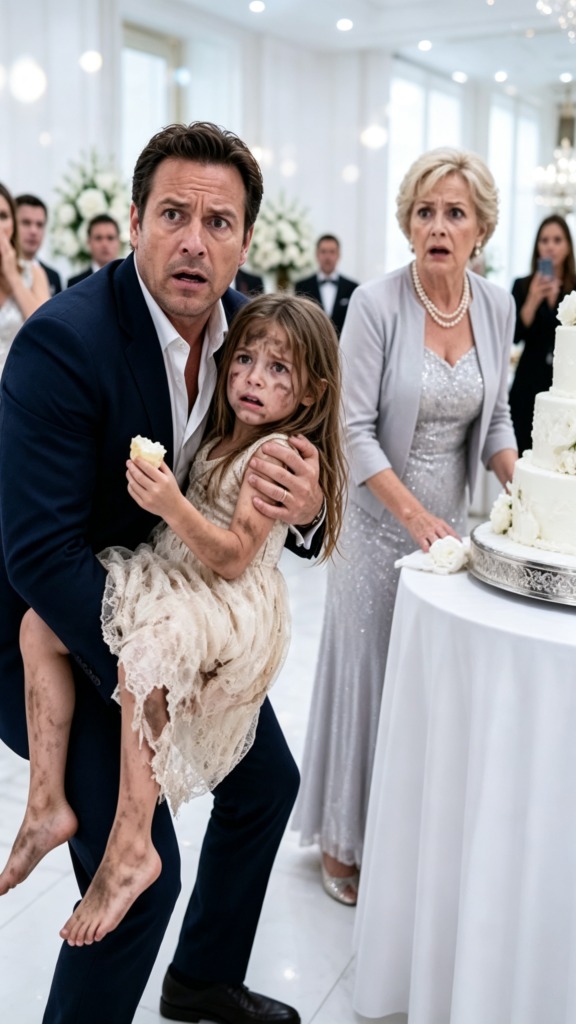
He gently took away the rotten bread, lifted Sofía into his arms, and walked toward the main room.
The musicians stopped playing when he entered with the dirty girl in his arms.
Doña Teresa, dressed in gold and pearls, was about to cut the cake. Her smile froze.
—Alejandro… what are you doing with that girl here?
He stopped in front of everyone.
—This girl is my daughter. And now you’re going to tell me, in front of your guests, where the 100,000 pesos I’ve sent you every month for the past 3 years are.
The room went dead silent.
Doña Teresa tightened her grip on her glass.
—Don’t make a scene, son. The girl is being manipulated by her mother.
Sofía clung to Alejandro’s neck.
—My mom never spoke badly of you, Dad.
A murmur swept through the tables.
Then Don Eusebio, the family’s former driver, stepped forward from the back. His eyes were filled with fear.
—Boss… I can’t stay silent anymore.
Doña Teresa turned furiously.
—Eusebio, not a word.
But the man took a deep breath.
—Mrs. Lucía never left you. Your mother kicked her out with the girl. And the letter you received… your wife didn’t write it.
Alejandro looked at his mother as if seeing a stranger.
—Who wrote it?
Don Eusebio lowered his gaze.
—Doña Teresa.
And in that moment, Alejandro understood that the bread in the trash was not the worst thing he was going to discover that night.
PART 2
Alejandro left the hotel with Sofía in his arms as Doña Teresa's party turned into a hell of whispers, screams, and recording phones.
The guests who moments ago had been toasting with champagne now stepped away as if embarrassment were contagious.
Doña Teresa followed him to the lobby.
—Alejandro, listen to me. I did everything for you.
He didn’t stop.
—For me? My daughter was eating scraps from the garbage.
—You don’t know the whole story.
Alejandro turned with eyes filled with rage.
—Then start praying that the story isn’t worse.
In the truck, Sofía didn’t let go of his hand. She told him that Lucía was working washing dishes in a local eatery, sewing clothes at night, and had sold her wedding ring to pay rent.
She told him that sometimes they ate instant soup between the two of them. That her mom pretended to sleep early so she wouldn’t notice that she was hungry.
—She said you were working a lot —Sofía whispered—. That one day you would find us.
Alejandro closed his eyes.
The guilt tasted like blood.
For 3 years, he preferred to believe in a letter rather than search for the woman he swore to love. He preferred pride over truth.
When they arrived at the building where they lived, a neighbor stepped out into the hallway.
—Are you the dad? How nice, you show up when the lady is almost dying on us.
Alejandro felt the world collapse.
—Where’s Lucía?
—She collapsed at the eatery. They took her to the General Hospital.
Sofía started screaming for her mom.
Alejandro drove like a madman down Eje Central. When he arrived at the hospital, he found Lucía in a bed, emaciated, with dry lips and arms marked by needles.
When she saw Sofía, she barely smiled.
When she saw Alejandro, the smile disappeared.
—What are you doing here?
He stepped closer, broken.
—I know everything. My mother kicked you out. She stole the money. She lied to me.
Lucía let out a dry laugh.
—And does that erase 3 years, Alejandro?
He couldn't answer.
Dr. Mauricio Salinas entered with a file in hand.
—Mr. Robles, your wife has advanced renal failure. She needs a transplant urgently.
Alejandro went cold.
—Why didn’t anyone tell me?
Lucía looked at him wearily.
—Where would I send it? To the number you changed? To the office where your guards dragged me out? To the house where your mother threatened to report me for theft?
Each word shattered him.
—I’ll get compatibility tests done today.
—Don’t come playing the hero.
—It’s not heroism, Lucía. It’s the least I should have done from day one.
That dawn, Alejandro’s lawyer arrived at the hospital with bank statements.
The transfers of 100,000 pesos never reached Lucía.
Everything was diverted to Doña Teresa’s personal accounts and a ghost company run by Ramón Robles, Alejandro’s younger brother.
But there was something darker.
Several medications Lucía had bought with the help of a supposed "anonymous benefactor" contained components that worsened her condition. The invoices came from an office linked to Ramón.
Lucía covered her mouth.
—No… that can’t be.
Before dawn, Doña Teresa appeared in the hospital hallway, without jewelry, without makeup, with her hair disheveled.
—I just wanted to protect my son —she said, crying.
Alejandro stood up slowly.
—Protect me from my sick wife and my hungry daughter?
Doña Teresa took out an old envelope.
—Ramón gave me a test. It said that Sofía wasn’t yours.
Lucía tried to sit up.
—That’s a lie.
The doctor examined the paper and frowned.
—This doesn’t have an official seal or valid signature. It’s false.
Doña Teresa trembled.
—Ramón told me that Lucía wanted to take everything. That her family had caused the accident where your father died.
Lucía paled.
—My dad died of a heart attack. He never met Mr. Robles.
In that moment, Alejandro's phone rang. It was his lawyer.
—Sir, we found a safe belonging to Ramón. There are documents, audio recordings, and a signed confession.
The safe arrived at the hospital escorted by two detectives.
Alejandro opened it in front of everyone.
Inside were photos, receipts, medical papers, copies of transfers, and a handwritten letter.
He began to read with a trembling voice.
“If this comes to light, let it be known: I forged the DNA test. Sofía has always been Alejandro’s daughter.”
Lucía closed her eyes and cried in silence.
Doña Teresa clutched her chest.
The letter continued.
Ramón confessed that he had invented the story of Alejandro's father's accident to sow hatred against Lucía. He also admitted to drafting the false abandonment letter, bribing a bank employee, and using the transfers to pay off gambling debts.
But the cruelest twist was at the end.
Ramón had intentionally made Lucía sick.
He wanted her to die before Alejandro discovered the truth, so he could blame her for disappearing with the money.
Alejandro dropped the letter.
—My God…
Doña Teresa dropped to her knees.
—I didn’t know about the medications. I swear I didn’t know.
Lucía looked at her with a sadness that hurt more than a scream.
—But you did know that my daughter was hungry.
No one said anything.
Sofía climbed down from the chair and walked toward her grandmother. Everyone thought she was going to confront her.
But the girl pulled a handkerchief from her pocket and handed it to her.
—Don’t cry, Grandma.
That gesture broke everyone.
Lucía cried because her daughter, after sleeping cold and scavenging for bread, still had the heart to show compassion.
Alejandro embraced Sofía.
—I’m sorry, my love. I’m sorry for not finding you.
The girl touched his face.
—I knew you would come, Dad.
The compatibility tests arrived that same afternoon.
Alejandro was compatible with Lucía.
She refused at first.
—I won’t accept you risking your life out of guilt.
He took her hand.
—It’s not guilt. It’s love. And also justice. For 3 years, I didn’t defend you. Now I’ll fight for you, even if it’s against my own blood.
The surgery was scheduled urgently.
Doña Teresa waited outside the operating room without pearls, without bodyguards, without that air of a queen she always used to command. For the first time, she looked like just an old woman crushed by her decisions.
Hours later, the doctor came out.
—The operation was a success.
Sofía shouted with joy.
Alejandro handed all the documents to the authorities. The bank employee was arrested. The ghost accounts were frozen. Ramón, who was already a fugitive, was found days later in Veracruz and arrested for fraud, forgery, attempted homicide, and theft.
Doña Teresa resigned from the family council and agreed to testify before the Public Ministry.
The news went viral throughout Mexico.
Many expected Alejandro to defend the Robles name. But he did the opposite.
In a press conference, before cameras, he said:
—A last name is worth nothing if it’s built on the hunger of a girl. I failed as a husband and as a father because I preferred to believe a comfortable lie rather than seek the truth.
Lucía watched the statement from the hospital.
She didn’t smile.
It still hurt too much.
But for the first time in 3 years, she felt the weight shifting onto those who should carry it.
Recovery was slow. There were days when Lucía didn’t want to talk to Alejandro. There were nights when she woke up crying in the damp room, for Sofía's hunger, for the mansion's door closing in her face.
Alejandro didn’t demand forgiveness.
He woke up early, took Sofía to school, learned to braid her hair, went to therapy with them, and stayed silent when Lucía needed to cry.
Months later, Lucía returned to the house in Las Lomas.
Not as an expelled woman.
Not as a humiliated wife.
She returned as the owner of her life.
Sofía ran through the bougainvilleas in the garden with a clean dress and new shoes. She no longer hid food in her pockets. She no longer asked if her dad loved her.
Doña Teresa asked to see her one Sunday. She arrived with soup made by her, without a driver, without jewelry.
Lucía welcomed her at the door.
—I don’t know if I’ll ever be able to forgive you —she said.
Doña Teresa lowered her gaze.
—I understand.
Sofía ran out and hugged her grandmother. Lucía didn’t stop her. She didn’t smile either.
She just said:
—Thank you for the soup, Teresa.
For Doña Teresa, that was more than she deserved.
A year later, Alejandro created a foundation for single mothers without legal support, food, or shelter. The first rule was simple: no woman would be ignored for lacking a last name, money, or connections.
Lucía went up on stage with Sofía's hand in hers. She was still thin, but she was standing. Strong. With dignity intact.
Alejandro watched her from below, knowing that he might never regain everything he lost.
Because some mistakes can't be fixed with money.
Some hungers aren’t forgotten.
And some families only begin to heal when someone dares to look at the garbage head-on and ask, without fear, who was capable of throwing away the love they swore to protect.